Provedor profesional de péptidos cosméticos | GENOPEP



From Sample to Bulk Order: A Copper Tripeptide-1 Procurement Checklist
A Copper Tripeptide-1 procurement checklist should connect five decisions: define the intended commercial item before requesting a sample; validate that sample in the actual formula and package; qualify the supplier and documents; approve the specification and first bulk-order scope; then receive, release and monitor each commercial lot. A successful sample does not automatically approve an undefined bulk item.
introdución
Moving from a Copper Tripeptide-1 sample to a GHK-Cu bulk order is not simply a change in quantity. The project moves from exploration to controlled supply. Decisions that were tolerable during screening—such as incomplete composition detail, a provisional package, or a sample from available stock—can become expensive when the formula, packaging study, launch schedule and commercial inventory depend on them.
The current Skinkind Cosmetics product page lists Copper Tripeptide-1 in powder and solution formats. It describes powder by form, appearance, HPLC purity options, packaging and storage, while the solution is described by liquid appearance, customizable peptide content, packaging and storage.[1] These distinctions matter at the first inquiry: the sample, approved specification and commercial item must refer to the same defined supply route, or the differences must be evaluated and documented.
This guide addresses cosmetic raw-material procurement. It does not cover injections, medical reconstitution, self-administration or finished consumer serum dosing.
The Five-Gate Procurement Path
| porta | Decision to Make | Minimum Evidence Before Moving Forward |
| 1. Sample definition | Is the sample representative of the intended commercial item? | Product name, form, concentration or purity basis, lot identity, package, storage and available documents |
| 2. Formula validation | Does the defined material fit the actual formula, process and package? | Formula records, use level, addition method, pH, compatibility, stability and packaging observations |
| 3. Cualificación do provedor | Can the supplier support controlled and traceable commercial supply? | Supplier identity, quality information, specification, TDS, SDS, COA format, traceability and change communication |
| 4. First-order release | Is the exact order technically and commercially approved? | Approved specification, quantity, package, batch or stock status, lead time, shipment plan and receipt readiness |
| 5. Ongoing control | Does each delivered lot remain suitable and consistent? | Incoming checks, release status, deviations, supplier performance, lot history and forecast updates |
The gates are sequential, but they are not isolated. A formula result can reveal that the requested concentration is impractical. A document review can show that the sample and commercial item use different specifications. A shipping plan can expose a storage limitation at the receiving site. Each finding should update the project record before the next commitment.
Gate 1: Define the Commercial Item Before Requesting a Sample
A useful sample request begins with the item the team hopes to buy later. Confirm whether the project needs powder or solution, the target purity or peptide-content basis, carrier or preservative system, intended application, target market, preliminary quantity and document requirements. If the final format is not yet known, request clearly identified alternatives rather than treating them as equivalent.
For the sample itself, record product name, supplier item or grade, batch or lot number, net quantity, package, date received, storage condition, expiry or retest information where applicable, and the documents supplied. A sample without lot identity may support early visual exploration, but it is weak evidence for raw material approval because it cannot be reliably linked to batch data.
Ask one direct question: “If this sample passes, what exact commercial item will you quote and supply?” The answer should identify whether the later material uses the same form, composition, specification, manufacturing route and packaging concept. If not, define what must be bridged before purchase.
Gate 2: Validate the Material in the Real Product Context
Sample evaluation should answer the project’s actual development questions. Typical observations include identity against the supplier information, handling, solubility or dispersion, color contribution, pH impact, addition sequence, process-temperature exposure, compatibility with the formula, preservation considerations and interaction with the intended finished-product package.
Keep the sample code, supplier lot, formula version, batch size, use level, process, packaging and observation dates connected in one record. “The copper peptide worked” is not a transferable result. “Supplier item X, lot Y, at the defined commercial-solution percentage in formula version Z under the recorded process” is a result that another team can review.
Formula stability and finished-product performance remain formula-validation-dependent. A supplier TDS can establish a starting point, but it cannot replace the brand’s stability, compatibility, microbiological, packaging and market-specific assessments.
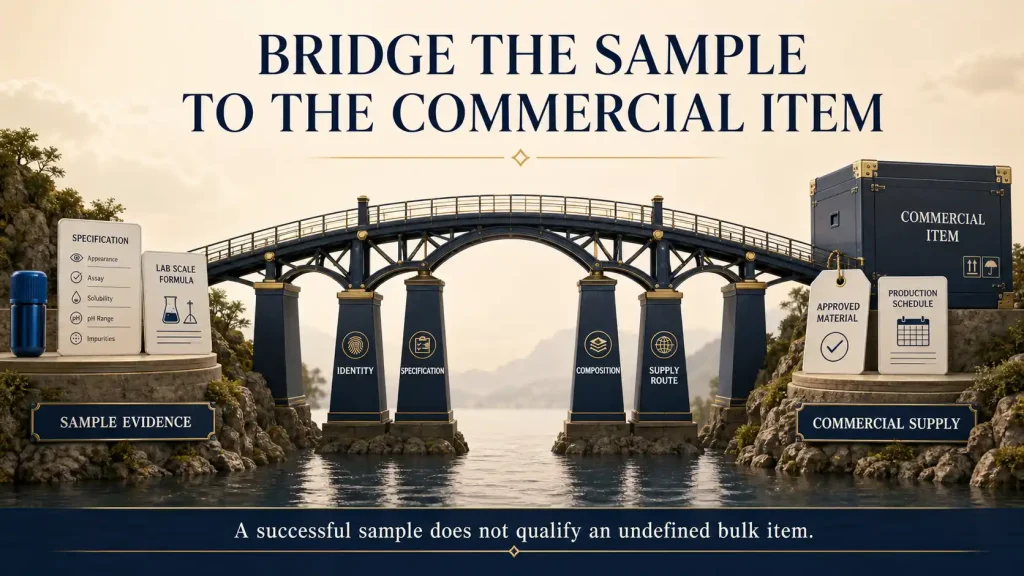
Bridge the Sample to the Commercial Item
The cleanest sample-to-bulk transfer uses the same item and specification. When that is impossible, document each difference and decide whether it can affect formula fit or quality control. Common differences include:
- A different lot from the same approved specification.
- A sample filled into a small vial while commercial material uses a larger product-contact package.
- A stock solution sample followed by a customized concentration.
- A provisional carrier or preservative system followed by a commercial version.
- A distributor sample followed by direct manufacturer supply.
- A sample tested under an earlier analytical method or specification revision.
Not every difference requires a full development restart. The required bridge should be proportional to risk. A documented packaging-size change may need receipt and handling confirmation; a composition or concentration change may require new formula work; a supplier or manufacturing-route change may require quality review and targeted revalidation.
Gate 3: Qualify the Supplier and Document Package
Supplier qualification should be appropriate to the ingredient, project stage, purchasing volume and target market. It can include a supplier questionnaire, business and manufacturing identity, quality-system information, specification review, document review, sample history, communication performance, audit evidence where justified, and agreement on change notification.
ISO 22716 provides cosmetic GMP guidance for production, control, storage and shipment, and its current edition was confirmed in 2022.[2] Health Canada likewise highlights controlled raw-material storage and handling, testing or examination against defined standards, written procedures and records for raw materials, manufacturing, finished products and distribution.[3] These sources describe quality-system outcomes; they do not certify a supplier merely because a logo or standard number appears in a sales file.
Request documents that support decisions, not a generic folder. A practical starting set includes TDS, SDS, specification, representative or batch-specific COA, complete INCI or composition statement, storage and shelf-life statement, traceability information and project-specific regulatory declarations. Confirm revision dates and whether the document applies to the sampled and quoted item.
Gate 4: Freeze the Approved Specification and Change Rules
Before the first commercial order, approve the material specification and define which changes require notification or reapproval. Relevant change categories may include identity, purity or peptide-content limits, analytical methods, carrier or preservative composition, pH range, package material, manufacturing site, production route, shelf life, storage or labeling.
The European Union Cosmetics Regulation requires cosmetic-product manufacture to comply with GMP and requires the product information file to include a description of the manufacturing method and a statement of GMP compliance.[4] Ingredient approval remains part of the responsible person’s and manufacturer’s broader finished-product control. It should not be reduced to collecting a COA after purchase.
Define who owns technical approval, quality approval and commercial approval. Purchasing may coordinate the order, but it should not be expected to decide formula compatibility or analytical acceptability alone. A simple approval record should identify the approved item, supplier, specification revision, intended application, required documents and authorized approvers.
Gate 5: Release the First Bulk Order
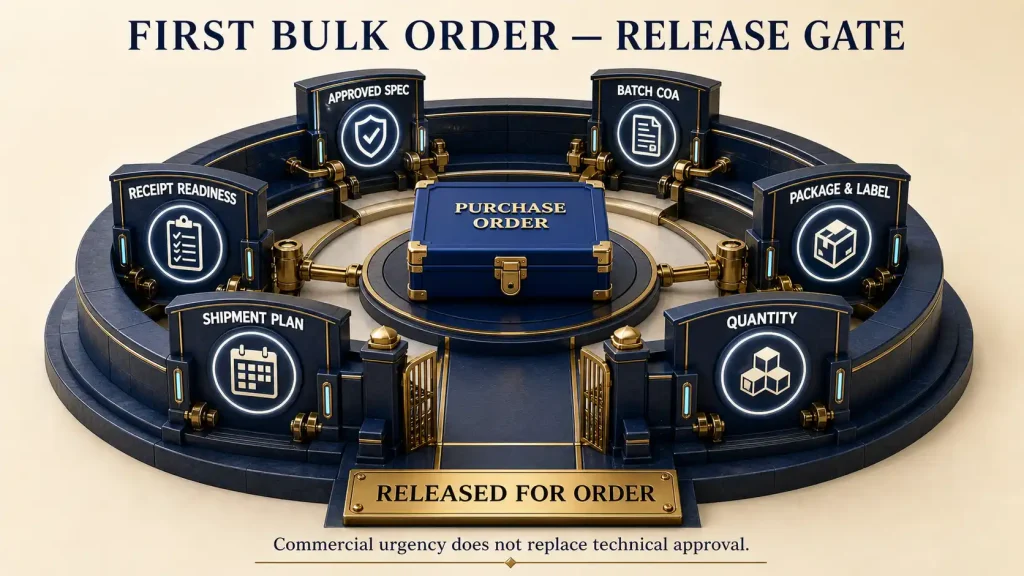
The first bulk order should not be released until six elements agree: the approved specification, expected batch COA, packaging and label, quantity, shipment plan and receipt readiness. Commercial urgency can change timing or escalation, but it should not silently remove a technical approval.
Approved Specification
Attach or reference the exact revision in the purchase order or purchasing system. If the supplier quote uses a different product name, code, concentration or grade, reconcile it before ordering.
Batch COA and Release Basis
Confirm which tests will appear on the peptide batch COA, the specification limits, test-method references where available, and whether pre-shipment review is required. A COA is batch evidence against a specification; it is not a substitute for approving the specification itself.
Packaging and Label
Confirm product-contact material, package size, closure, tamper evidence, light or moisture protection, secondary containment, label content and lot traceability. Make sure the package can be stored and dispensed safely at the receiving site.
Quantity and Timing
Link quantity to the approved production and validation plan, including realistic loss, retain samples and any justified safety stock. Confirm stock or made-to-order status, quality-release time, export preparation and delivery schedule.
Shipment and Receipt Readiness
Agree on transport condition, trade term, required indicators or protective packaging, shipping documents, contact points and excursion handling. Before dispatch, confirm that the receiving site has the required space, controlled storage, quarantine status, sampling plan and trained personnel.
Receive, Quarantine and Release the Commercial Lot
At receipt, compare the shipment with the purchase order, packing list, label and approved item. Record arrival time and condition, package count, seal integrity, external damage, transport evidence where required, lot number, net quantity and transfer to the specified storage condition. Place the material under an appropriate hold or quarantine status until the site’s release procedure is complete.
FDA’s cosmetic GMP inspection checklist asks whether raw materials and primary packaging are stored and handled to prevent mix-up, contamination or alteration; whether containers carry identity, lot and control status; whether materials are examined or tested against procedures; and whether records document raw materials and rejected disposition.[5] The checklist is guidance, not proof that one universal incoming test plan fits every cosmetic ingredient.
Incoming controls should be defined by the approved specification, supplier qualification, material risk and site procedure. Appearance can support inspection, but the characteristic blue color alone cannot establish identity, content, purity or microbiological quality. Release should be documented by an authorized function.
Procurement Continues After the First Delivery
The first accepted lot becomes the start of a supply history. Track delivery performance, documentation accuracy, COA trends within specification, packaging condition, deviations, investigation response, change notifications and complaint handling. Review these records before changing order size, reducing incoming controls or renewing a supply agreement.
Forecasting should connect inventory, supported shelf life or retest window, lead time, production plan and storage capacity. Large safety stock is not automatically reliable supply; it can create aging inventory and reduce flexibility when a formula, specification or market requirement changes.

Final Copper Tripeptide-1 Procurement Checklist
| Punto de control | Confirm Before Approval |
| Identidade da mostra | Product, form, supplier item, lot, package, storage and sample documents are recorded |
| Commercial match | Sample and quoted bulk item match, or every difference has a documented bridge decision |
| Formula evidence | Use level, process, pH, compatibility, stability and packaging work use traceable formula records |
| Supplier status | Supplier qualification is complete for the project’s risk, market and commercial stage |
| especificación | Exact approved revision defines identity, content or purity, tests, limits and applicable methods |
| Documentos | TDS, SDS, specification, COA format, composition, storage, traceability and required declarations agree |
| Cambiar o control | Notification and reapproval triggers are defined for composition, method, site, route, package and storage changes |
| Orde de compra | Product code, quantity, package, price basis, lead time, delivery term and required documents are unambiguous |
| Suba | Transport condition, protection, contacts, documentation and excursion process are agreed |
| Receipt and release | Quarantine, inspection, sampling, testing, storage transfer and authorized release are ready |
| subministración continua | Lot history, deviations, performance, inventory, forecast and change notifications are reviewed |
Preguntas máis frecuentes
1. Does a passed Copper Tripeptide-1 sample approve the bulk order automatically?
No. The sample result applies to a defined sample lot, formula and test context. Before a bulk order, confirm that the commercial item matches the sample in identity, specification, composition and supply route, or complete a risk-based bridge for any differences.
2. What documents should accompany a Copper Tripeptide-1 sample?
At minimum, request enough information to identify and handle the sample: product name, form, supplier item, lot number, specification or key acceptance basis, storage, expiry or retest information where applicable, and relevant TDS, SDS or COA. The exact package depends on the project and market.
3. Can the commercial lot be different from the sample lot?
Yes. Samples and commercial orders often come from different lots. The key is that both lots belong to the same approved item and specification, with traceable batch documentation. If composition, concentration, site, route or specification changes, perform an appropriate review before use.
4. Who should approve a GHK-Cu bulk order?
Roles vary by organization, but technical or formulation staff should approve formula fit, quality staff should approve the supplier, specification and release basis, and purchasing should approve commercial terms and execute the order. Responsibilities and escalation should be documented.
5. What should trigger requalification or revalidation?
Triggers can include a new supplier or manufacturing site, material form or composition change, concentration or specification revision, analytical-method change, package change, repeated deviation, adverse trend, long supply interruption, or a significant finished-formula change. Define triggers in advance and scale the response to risk.
CTA
To move from a Copper Tripeptide-1 sample to a controlled commercial order, send Skinkind Cosmetics the required form, purity or concentration basis, application, target market, formula stage, sample quantity, expected bulk quantity, packaging preference, document list, destination and desired timeline. Genopep can then align sample options, specification, documentation, packaging and commercial supply scope before your team commits to a bulk order.
Review Copper Tripeptide-1 formats and request a sample-to-bulk procurement scope
References
1. Skinkind Cosmetics / GENOPEP. Copper Tripeptide-1 product information: powder and solution formats, specifications, packaging, shipping and storage. Páxina do produto
2. International Organization for Standardization. ISO 22716:2007 Cosmetics—Good Manufacturing Practices (GMP)—Guidelines on Good Manufacturing Practices. Current edition confirmed in 2022. Rexistro ISO
3. Health Canada. Good Manufacturing Practices (GMPs) for Cosmetic Products: raw-material control, testing, written procedures, storage and records. Orientación gobernamental
4. European Parliament and Council. Regulation (EC) No 1223/2009 on Cosmetic Products, including Article 8 on GMP and Article 11 on the product information file. EUR-Lex consolidated text5. U.S. Food and Drug Administration. Good Manufacturing Practice (GMP) Guidelines/Inspection Checklist for Cosmetics: raw-material storage, examination, control status, records and laboratory controls. Guía da FDA