Professionelle Kosmetik-Peptid-Liwwerant | GENOPEP



How to Choose a Multi-Peptide Solution for Skincare Development
Choose a multi-peptide solution for skincare by matching its composition and supporting evidence to a defined product brief. Compare peptide content, carrier ingredients, processing requirements, finished-formula compatibility, and supply documentation. Shortlist candidates for controlled formulation trials before committing to the solution with the longest ingredient list or the lowest price per kilogram.
Start with the product you need to develop
A supplier presents a blend of several peptides. The product team sees an anti-aging story, the formulator asks how it behaves in an emulsion, and purchasing asks for a price. All three questions are reasonable, but they describe different parts of the decision. A useful selection process puts them in an order that prevents an attractive ingredient presentation from becoming an expensive reformulation exercise.
Write a brief that identifies the intended user, application area, product format, primary cosmetic benefit, target market, and cost allowance. Add practical constraints: a transparent appearance, a fragrance-free concept, a particular packaging system, or an existing base that must be retained. These details can eliminate unsuitable candidates before samples arrive. A rich night cream and a clear eye serum may share a wrinkle-care concept while requiring different ingredient systems.
Define success before discussing individual peptide names. If the brief targets visible fine lines, identify the type of assessment that could support that claim. If it targets comfort in dry-feeling skin, decide which tolerability and user-experience questions matter. Keep one primary objective and a manageable number of supporting benefits. Otherwise, every additional ingredient can seem essential and the shortlist becomes impossible to compare.
Understand exactly what the supplier is selling
Here, a multi-peptide solution means a cosmetic raw-material preparation containing more than one peptide in a specified carrier system. It is normally incorporated into a finished formula. The commercial name alone does not tell you whether the material is a dilute aqueous solution, a solubilized preparation, a dispersion, or a more complex delivery system. Ask the supplier to identify the physical form and provide the complete INCI composition.
The carrier deserves the same attention as the headline peptides. Water, glycols, solubilizers, buffers, and preservatives may contribute to the formula at the proposed use level. Ask what each supporting ingredient does and whether its contribution fits your base and label requirements. “Ready to integrate” can describe an easier handling format; it does not establish that the material can be added unchanged to every serum or cream.
For each peptide, request a clear role in the proposed product concept and the evidence supporting that role. A long list may contain overlapping functions. Conversely, a shorter blend may address a focused brief well. Complementary mechanisms provide a rationale for testing a combination. A claim of synergy requires an appropriate comparison showing what the combination contributes beyond its components under the test conditions.
Compare peptide content on the same basis
Peptide solution concentration and the percentage of solution added to a formula are different values. Before comparing quotations, establish whether a specification describes one peptide, the combined peptide content, or the amount of a commercial ingredient preparation. An HPLC purity figure for a peptide powder is also a different measurement from the mass concentration of peptides in a supplied liquid. Ask for the definition and analytical basis behind each number.
Consider an illustrative mass-based calculation. A concentrate containing 500 ppm total peptide, used at 2% by weight, contributes 10 ppm total peptide to the finished formula: 500 × 0.02 = 10. This assumes the specified content is correct, the formula mass includes the concentrate, and no peptide is lost during processing. It is a calculation example, not a Genopep specification or an effective-dose recommendation.
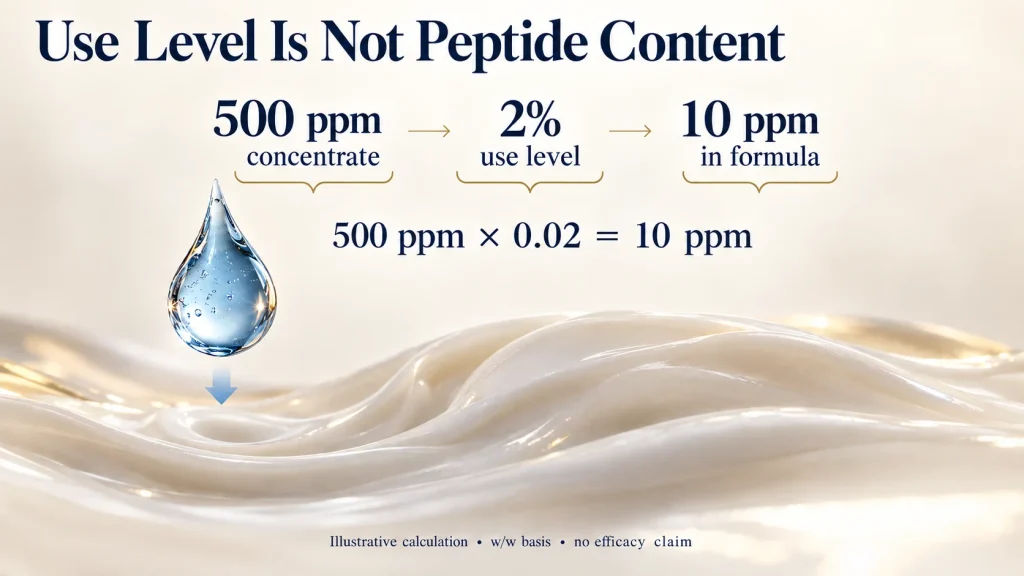
If that 500 ppm represents several peptides together, the calculation does not reveal the concentration of each one. Nor does the same total ppm make two different blends equivalent. Their composition, carrier, evidence, and intended use may differ. Use the calculation to clarify what is being compared, then assess whether the supporting studies concern the actual material and proposed use level.
Check whether the solution fits the formulation
Build a compatibility discussion around your proposed base, rather than asking whether the peptide blend is “stable” in general. Share the intended pH range, manufacturing sequence, expected heat exposure, other active ingredients, preservative system, and packaging. Request a current technical data sheet and distinguish demonstrated limits from suggested starting conditions. A broad claim of compatibility is less useful than a documented processing recommendation relevant to your formula.
Plan the first trial so that you can interpret the result. Keep a base control and prepare candidate versions with recorded use levels and processing conditions. Examine appearance, odor, pH, viscosity, and any precipitation or separation. Agree in advance which changes require reformulation or further analysis. These early observations help screen candidates; a clear-looking sample alone does not establish peptide retention or long-term product stability.
Stability work should follow the actual product and package. Cosmetics Europe and CTFA guidance describes physical, chemical, and microbiological quality as relevant considerations and allows testing programs to be adapted to the formulation. Separately, ISO 11930 provides a framework for evaluating antimicrobial protection. A preserved ingredient concentrate does not establish the protection of a finished product after dilution and combination with other materials. [5,6]
Match the evidence to the decision
A useful supplier dossier should help answer a specific question. Identity and content data establish what the supplied material is. Compatibility work addresses how it behaves in a formulation. Performance studies address an endpoint under a defined protocol. Filing these documents together is helpful, but their conclusions are not interchangeable. Read the tested material, concentration, vehicle, control, endpoint, and study duration before interpreting a headline result.
Skin-delivery evidence is one example of why context matters. Kraeling and colleagues investigated acetyl hexapeptide-8 in a particular oil-in-water formulation using an in vitro skin model. Most applied peptide was recovered from the surface, and none was detected in the dermis or receptor fluid under that protocol. The study does not determine the behavior of every peptide system; it shows why a proposed deeper-skin mechanism cannot substitute for formulation-relevant delivery evidence. [4]
For human studies, check whether the tested product is the supplier’s ingredient in a reference base or the final product you intend to sell. Look for a suitable comparator and whether the reported change is relative to baseline or to the control. A multi-active cream can produce a useful product result without isolating the contribution of its peptide blend. Record what the study supports and what your own development program still needs to establish.

Build a shortlist around the brief
Use the same questions for every candidate. The following worksheet is an editorial selection tool, not a universal pass score. Enter document references and unresolved questions rather than awarding points for persuasive wording. Treat any missing information that could alter safety assessment, processing, or the intended claim as an open issue requiring resolution before the relevant development decision.
| Auswiel Fro | Beweiser fir ze froen | Decisioun |
| Does it fit the primary benefit? | Relevant study and defined endpoint | Keep the concept focused |
| What is in the preparation? | Complete INCI and composition details | Check carrier and labeling fit |
| How much peptide enters the formula? | Content specification and use level | Compare on a consistent basis |
| Can the base accommodate it? | TDS and controlled prototype trials | Identify necessary formula changes |
| What is still unproven? | Study limitations and test plan | Budget time and validation |
| Can supply remain consistent? | Batch specifications and change control | Assess scale-up readiness |
The Genopep portfolio illustrates how different briefs can lead to different starting points. The Skinkind Cosmetics category page presents PxGHK-7® as a repair-focused multi-peptide solution for anti-aging development and Geno-Wrinkle Pro™ as an anti-wrinkle solution. These are supplier-defined application directions, not a head-to-head ranking or proof that one fits every formula. [1–3]
Once the brief is clear, review the Pro Peptide Solutions available from Genopep and request the current composition, technical instructions, and evidence for the relevant option. Use the category page to identify candidates, then use product-specific documentation and your own formulation trials to make the selection.
Apply the process to a real development decision
Imagine a brand developing a lightweight, fragrance-free facial serum for visible fine lines. The existing base is clear, the airless pack is already selected, and the launch budget allows evaluation of two candidate solutions. This is an illustrative brief, not a customer case study. The team first asks both suppliers for composition details and processing instructions. A candidate that cannot meet the required appearance without a major base change should have that development cost recorded immediately.
Next, R&D prepares the two prototypes at their respective documented starting levels and retains a suitable control. Record the actual peptide contribution instead of forcing both preparations to the same percentage. If their carriers differ materially, discuss whether an additional carrier-matched control is needed for the question being tested. The initial comparison can establish handling and physical compatibility. It should not be presented as a consumer efficacy comparison based on texture, appearance, or a few days of internal use.
Before advancing a candidate, hold a short review with product, R&D, quality, and purchasing. Confirm which requirements it meets, which remain open, and who will resolve them. For example, an acceptable prototype might advance to packaged stability testing while the supplier provides a missing content method. That status should remain conditional until the required evidence is available. Keep the rejected candidate’s documented reason too; it may become relevant if the package, base, or market brief changes later.
Include development cost and supply continuity
Compare cost at the proposed use level. For a mass-based formula, ingredient cost per kilogram of finished product equals the solution price per kilogram multiplied by its formula weight fraction. A higher-priced concentrate may contribute less cost if its appropriate use level is lower, but that conclusion requires comparable performance requirements and evidence. Price per ppm alone cannot decide between blends with different compositions.
Include the work needed to integrate the solution: base adjustments, analytical testing, stability studies, packaging evaluation, and any changes to preservation. A convenient preparation may reduce some handling work while creating other requirements. Ask purchasing and R&D to compare the same development scenario rather than evaluating the quoted material and the finished formula as separate projects.
Before moving beyond a successful prototype, confirm the available pack sizes, lead time, transport conditions, unopened and in-use storage guidance, and batch documentation. Ask how changes in peptide content, carrier composition, preservation, or analytical method are communicated. The preferred candidate should have a credible path from the sample tested in your laboratory to the material delivered for production.
Oft gestallten Froen
1. Is a multi-peptide solution better than a single peptide?
It depends on the brief. A combination may suit a product targeting several defined concerns, while one well-characterized peptide may be easier to assess for a focused objective. Compare relevant evidence, concentration, compatibility, and development requirements. The number of peptides is not a performance test.
2. What percentage of a multi-peptide solution should be used?
Use the current guidance for the exact supplied preparation as a development starting point, then check the evidence and validate the finished formula. Different concentrations and carrier systems cannot share a universal use level. Also calculate the peptide content contributed by the solution at that percentage.
3. Can a peptide solution be added to an existing serum base?
Possibly, but it changes the formula. Review the incoming water, solvents, preservatives, pH contribution, and other constituents. Prepare a controlled trial and re-evaluate the properties affected by the change. A successful incorporation step is the beginning of compatibility assessment, not its conclusion.
4. Does a COA prove that the solution will reduce wrinkles?
A certificate of analysis reports results against specified batch tests. It can support material acceptance, but it does not replace a performance study. Assess wrinkle-related evidence separately, including the tested formula, use level, comparator, measurement method, and population.
5. When should a brand request a custom peptide solution?
Consider customization when available preparations cannot meet a defined composition, carrier, processing, or product-positioning requirement. First identify the limitation in writing. Then establish what development, testing, minimum order, and documentation commitments would change. Customization is most useful when it solves a specific project constraint.
Discuss your skincare development brief
To discuss a multi-peptide solution for skincare with Genopep / Skinkind Cosmetics, share your target benefit, product format, market, planned base, relevant processing conditions, and project scale. Include any ingredients or packaging already fixed. This gives the technical team a basis for identifying relevant candidates and discussing the documents and samples needed for evaluation.
Contact Genopep / Skinkind Cosmetics
Referenze
1. Skinkind Cosmetics / Genopep. Peptides Solution. Current portfolio and supplier application positioning; accessed 23 September 2026.
2. Skinkind Cosmetics / Genopep. PxGHK-7® Multi-Peptide Repair Solution for Advanced Anti-Aging. Supplier product information; accessed 23 September 2026.
3. Skinkind Cosmetics / Genopep. Geno-Wrinkle Pro™ Multi-Peptide Anti-Wrinkle Serum Solution. Supplier product information; accessed 23 September 2026.
4. Kraeling MEK, Zhou W, Wang P, Ogunsola OA. In vitro skin penetration of acetyl hexapeptide-8 from a cosmetic formulation. Cutaneous and Ocular Toxicology. 2015;34(1):46–52. doi:10.3109/15569527.2014.894521. Primary in vitro study; formulation-specific delivery context.
5. Cosmetics Europe / CTFA. Guidelines on Stability Testing of Cosmetic Products. March 2004. General industry testing guidance; not a peptide-specific stability specification.
6. ISO 11930:2019. Cosmetics — Microbiology — Evaluation of the antimicrobial protection of a cosmetic product. Official scope and standard listing, with Amendment 1:2022 shown; accessed 23 September 2026. Cited for scope, not for reproduction of the full test procedure.