Professional Cosmetics Peptide Supplier | GENOPEP



Peptide Powders vs Pre-Blended Peptide Solutions: A Formulator’s Guide
Peptide powders offer more control over carrier choice and, when sourced individually, peptide ratios. Pre-blended peptide solutions can reduce in-house weighing and premixing, but introduce a defined carrier and composition. Neither format is automatically more effective, stable, or economical. Compare the specified peptide content, final formula constraints, preparation workload, and cost at the intended use level before selecting a route.
The quote is only the beginning
A purchasing team receives two offers: a small pack of cosmetic peptide powder and a much larger container of a dilute peptide solution. The powder looks expensive per gram; the solution looks expensive for something that is mostly carrier. Neither observation settles the decision. The two materials may supply different peptide amounts, require different preparation steps, or contain entirely different peptide combinations.
For a useful peptide powder vs peptide solution comparison, put both candidates into the same development brief. Define the cosmetic objective, base formula, manufacturing constraints, and evidence needed for the intended claim. Then ask which format your team can incorporate reproducibly. This guide concerns raw materials for topical cosmetics, not injectable preparation or consumer DIY mixing.
Separate supply format from peptide composition
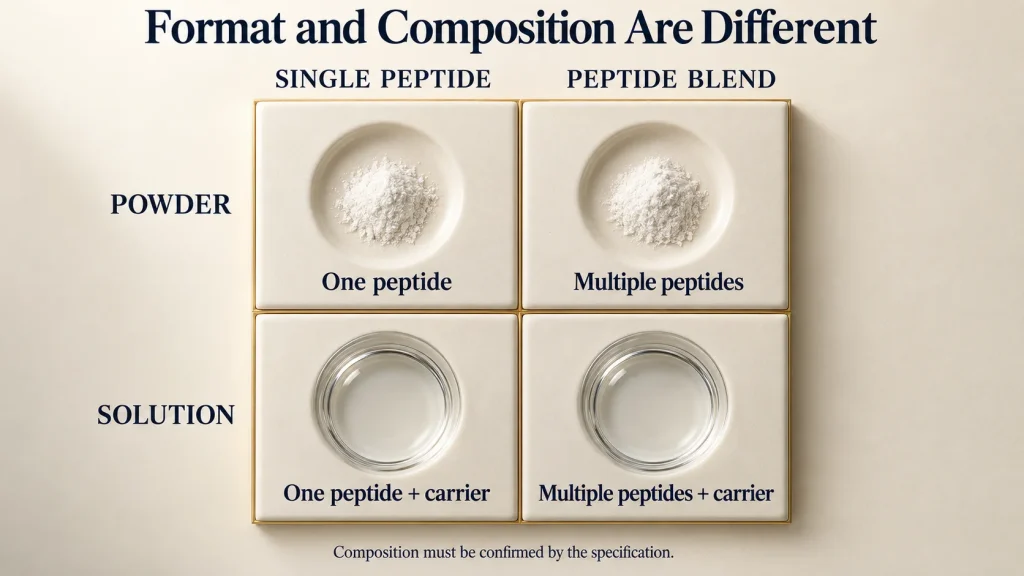
A powder can contain one peptide or a blend. A solution can also contain one peptide or several. “Pre-blended” describes ingredients combined before supply; it does not, by itself, identify those ingredients or prove that their combination performs better. A solution may include water, humectants, buffers, preservatives, or other components, depending on its specification.
Read the complete composition before comparing formats. If you buy individual powders, you may adjust each peptide separately. If you buy a fixed blend, whether dry or liquid, changing its addition level changes the whole blend together. A project that needs to vary one peptide independently therefore has a different sourcing requirement from a project that already accepts the supplier’s ratio.
What the concentration number actually describes
Before calculating an addition, establish what is being measured. HPLC area purity is different from peptide content by weight. A powder can contain counterions and moisture that contribute to weighed mass. Bachem’s quality-control guide distinguishes identity, purity, and content; these analytical questions should not be collapsed into one percentage. [1]
For a liquid ingredient, ask whether its stated concentration refers to an individual peptide, total peptides, or the whole commercial complex. Confirm the unit and basis: a mass-based concentration and a mass-per-volume value are not interchangeable without the information needed for conversion. For a multi-peptide blend, a total figure does not reveal each peptide’s amount.
Do not multiply a powder’s weight by its HPLC purity and assume you have established an accurate active dose. Ask how the assay is defined, whether the reported content includes peptide-related impurities, and which correction the supplier recommends. A precise spreadsheet cannot resolve an ambiguous specification. Keep detailed dose calculations separate from claims about skin performance.
Powders move more preparation work into your process
At a small pilot scale, the required powder mass may be inconveniently low. Check it against the balance’s qualified weighing range rather than its displayed number of decimal places. An internally prepared stock can make dosing more manageable, but that stock becomes another controlled material: it needs a defined preparation method, concentration basis, container, identification, and permitted holding time.
Use the selected ingredient’s instructions to establish a cosmetic-compatible premix. Do not assume every peptide dissolves in water or transfer a research-laboratory solvent recipe directly into a skincare formula. Bachem’s handling guidance highlights moisture uptake and sequence-dependent handling concerns, but its research storage conditions are not universal specifications for commercial cosmetic ingredients. [2]
Record the mixing order and how complete incorporation will be assessed. A clear-looking premix alone does not quantify peptide recovery or demonstrate chemical stability. When the process includes a transfer, rinse, or filtration step, establish whether that step changes the delivered amount. These are development questions to investigate, not losses to assume for every peptide.
A supplied solution brings its carrier into the formula
The practical attraction of pre-blended peptide solutions is that some preparation has already been done by the supplier. Your team may receive a single liquid material to weigh instead of preparing several separate stocks. That can simplify a production instruction, particularly when the accepted blend ratio will remain unchanged. It does not remove incoming checks or establish compatibility with your base.
The carrier is part of the formula budget. Consider its contribution to water, humectants, electrolytes, solvents, and preservation, as applicable. A carrier that fits a watery serum may require adjustment in a low-water system or a texture-sensitive emulsion. Review the complete supplied composition with the formulator; simply deducting the solution’s whole addition from water can misstate the finished formula.
A fixed blend also creates a change-control question. Ask how changes to peptide ratio, carrier, preservative system, or manufacturing site will be communicated. For an established product, a seemingly small raw-material revision may justify targeted reassessment. Get that notification arrangement into the sourcing discussion before the first production order, rather than discovering it during a formula investigation.
Compare the work that remains
The following comparison assumes individual peptide powders on one side and a fixed pre-blended liquid on the other. A pre-blended powder or single-peptide solution will combine features from both columns. Use the table to allocate responsibilities, not to score one format as universally superior.
| Decision point | Individual powders | Fixed pre-blended solution |
| Peptide ratio | Set and control each addition | Accept or negotiate the supplied ratio |
| Carrier | Develop a suitable premix | Account for the supplied carrier |
| Preparation | Qualify weighing, dissolution and holding | Verify composition and incorporation method |
| Finished formula | Validate the chosen formula and pack | Validate the chosen formula and pack |
For example, a team exploring several peptide ratios may find individual materials more useful during screening. A contract manufacturer working from an agreed formula may prefer a documented blend with fewer separate additions. These are different operating needs. Neither choice establishes better penetration or a stronger visible result; those claims require evidence relevant to the finished product and intended use.
Stability belongs to the actual system
Avoid assigning a shelf-life advantage from format alone. A powder and a formulated solution have different exposure and handling conditions, and the relevant evidence is product-specific. Ask for the supplied material’s storage instructions, supported shelf life, packaging, and opened-container guidance. Do not assume freezing is appropriate for a commercial blend because a research peptide protocol recommends it.
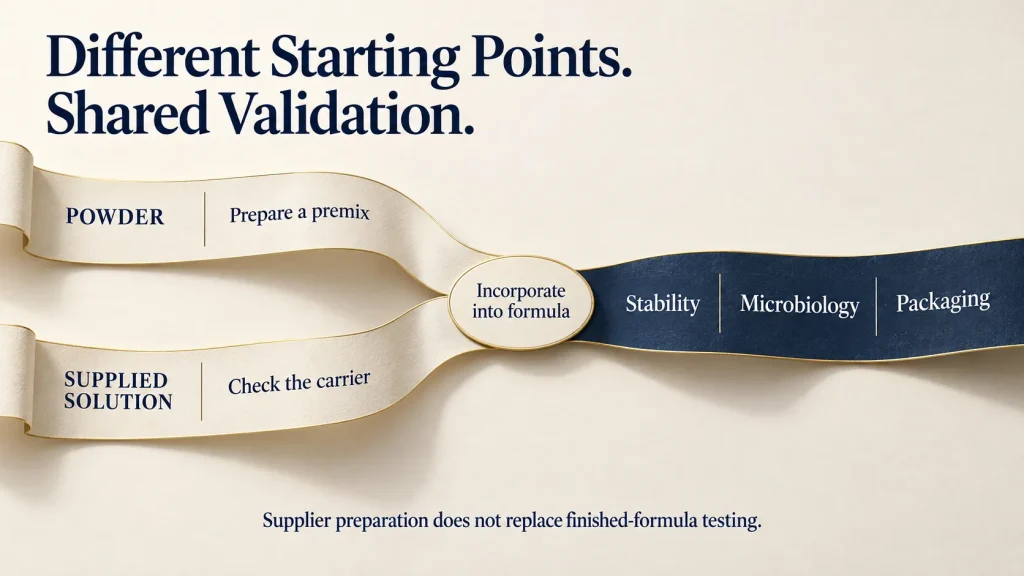
After incorporation, assess the finished formula in its intended packaging. Cosmetics Europe’s stability guidance treats physical, chemical, microbiological, and packaging-related considerations as part of a product-specific program. A stable supplied concentrate does not establish the stability of every cream made with it. Likewise, a powder that stores well can still require substantial work once introduced into a liquid base. [3]
A preservative in the concentrate is not evidence that the finished product is adequately protected. ISO 11930 addresses evaluation of a cosmetic product’s antimicrobial protection, including preservation-efficacy testing and risk-assessment considerations. Agree the appropriate finished-product assessment with the responsible technical team. The raw material’s microbiological specification and the formula’s preservation performance answer different questions. [4]
Price the formula, then price the workload
Begin with the ingredient cost per kilogram of finished product: the supplied material’s price per kilogram multiplied by its mass fraction in the formula. Use quotations on the same currency and delivery basis. Compare equivalent peptide doses only when identity and content data genuinely support that comparison; equal total peptide ppm in different blends does not establish equivalent performance.
Then add the costs your own process incurs: stock preparation, quality checks, transfer losses where measured, unused material, packaging size, and any storage requirements. Development effort matters too. If one route needs several rounds of carrier work, include that workload in the project estimate. Do not insert a generic percentage saving for solutions; the result depends on the plant, batch size, and specification.
Pack size can reverse a seemingly attractive comparison. Ask whether the minimum order matches the forecast and whether the remaining stock can be used within its supported life. A low unit price offers little benefit when much of the purchased material expires unused. Conversely, an established internal premix process may make powders economical without adding substantial new work.
Plan the handover from bench to production
A successful beaker trial is a useful starting point, but the production instruction must describe what operators will actually do. For the powder route, identify who prepares the premix, which equipment is qualified for the required quantity, and how the premix is transferred and reconciled. For the supplied-solution route, confirm the sampling and handling instructions, the amount to add, and whether any conditioning or mixing is required before use. Do not improvise that last step from appearance alone.
Review the time between preparation and incorporation. A stock made immediately before a trial is a different handling situation from a stock held across shifts. If the manufacturing plan requires a hold, establish the container, conditions, identification, and acceptance checks for that interval. The supplier’s shelf life for an unopened raw material should not be reassigned to a diluted internal premix. Keep the raw material, the intermediate, and the finished bulk clearly distinguished in the records.
Finally, agree what happens when a deviation occurs. If a premix remains hazy, an addition is delayed, or a delivered liquid differs from its appearance specification, operators need an escalation route and disposition decision rather than an unofficial adjustment. This practical handover can be more important to consistency than the original format choice. Record any required reassessment before approving the first full-scale batch.
Run a comparison that can support a decision
Write a short trial brief before requesting samples. Specify the base type, intended use level, processing limits, excluded carriers, target market, and forecast batch size. Obtain the TDS, SDS, representative COA, and composition information for each candidate. Resolve unclear assay language before mixing. If confidential blend details are needed for assessment, discuss how they can be reviewed under an appropriate confidentiality arrangement.
Where feasible, compare candidates in a common base and account for carrier differences, including a suitable carrier control when interpreting results. Record the actual preparation time and problems rather than relying on a supplier’s general description of convenience. Establish acceptance criteria before reviewing samples: for example, acceptable appearance, formula properties, assay behavior where relevant, and the tests needed before scale-up.
Frequently Asked Questions
1. Is peptide powder stronger than a peptide solution?
Powder may be more concentrated as supplied, but concentration in the pack is not the same as performance on skin. Compare identified peptide amounts in the finished formula, the vehicle, and relevant evidence. A higher raw-material concentration does not by itself justify a stronger cosmetic claim.
2. Can peptide powder be added directly to a cream?
Only follow a direct-addition route when it is supported for that material and process. Otherwise, develop an appropriate premix and incorporation method. Do not assume visible disappearance in a cream confirms uniform distribution, complete dissolution, or retention of the intended peptide content.
3. Does a peptide solution need additional preservation?
The finished product needs an appropriate microbiological assessment. Existing preservatives in the supplied solution may contribute to the formula, but their presence does not establish adequate protection after dilution and mixing. Have the responsible formulator evaluate the full system rather than adding or omitting preservatives by assumption.
4. Are pre-blended peptide solutions always cheaper?
No. They may reduce preparation work, while individual powders may suit an established process or a project needing adjustable ratios. Compare cost at the intended use level, supported content, usable pack quantity, and actual development workload. There is no universal break-even batch size.
5. Can the two formats be substituted during production?
Treat substitution as a controlled formulation change. Reconcile peptide identity, content basis, counterion or salt form where relevant, and all carrier components. Reassess the manufacturing instruction and the testing affected by the change. Replacing equal weights of powder and solution will generally not preserve the same formula.
Discuss the format against your formulation brief
If a documented liquid blend fits the project, explore Pro Peptide Solutions from Genopep on Skinkind Cosmetics. The category includes repair-oriented and anti-wrinkle peptide solution concepts; the current TDS and project review should determine which candidate merits testing. The category page is a starting point for selection, not evidence of compatibility with every base. [5]
Send your formula type, target pH, processing conditions, carrier restrictions, intended market, and estimated trial quantity when you contact the technical team. Ask for the composition and assay basis alongside the sample. Those details allow a useful discussion of format, preparation work, and what your team still needs to validate.
References
1. Bachem — Quality Control of Amino Acids & Peptides: A Guide. Analytical distinctions among identity, purity, and content; not proof of finished-cosmetic efficacy.
2. Bachem — Care and Handling of Peptides. Research-peptide handling context; do not transfer its storage conditions to every cosmetic ingredient.
3. Cosmetics Europe / CTFA — Guidelines on Stability Testing of Cosmetics, 2004. General product-specific stability and packaging guidance, not peptide-specific limits.
4. ISO 11930:2019 — Cosmetics: Evaluation of the Antimicrobial Protection of a Cosmetic Product. Public scope of the standard; laboratory procedures require the applicable full text.
5. Genopep / Skinkind Cosmetics — Peptides Solution. Supplier category and development positioning; confirm current specifications separately.