Professional Cosmetics Peptide Supplier | GENOPEP



Precision Redefined: The Crucial Role of Isotope-Labeled Standards in Cosmetic Peptide Analysis

PRODUCT PARAMETERS
Description
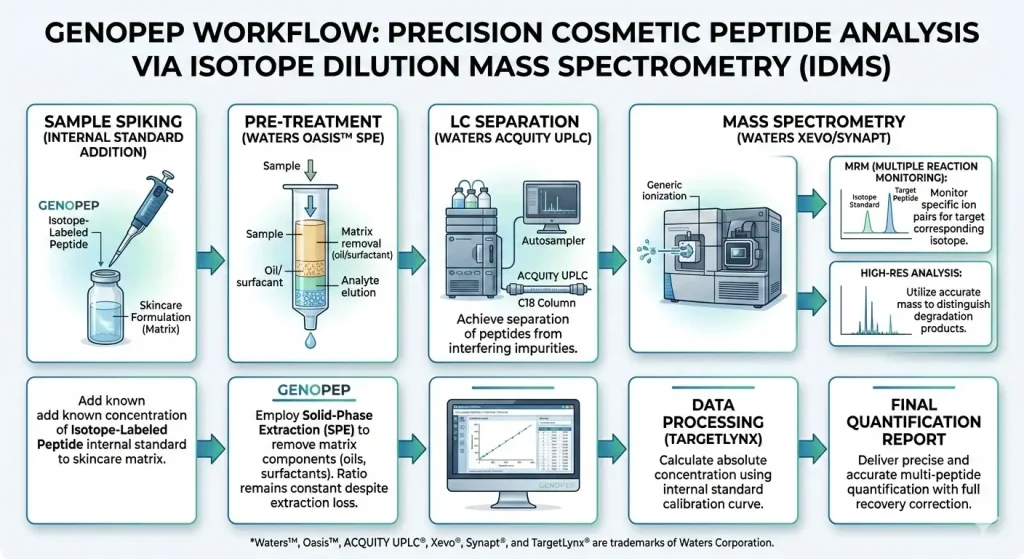
GENOPEP WORKFLOW: PRECISION COSMETIC PEPTIDE ANALYSIS VIA ISOTOPE DILUTION MASS SPECTROMETRY (IDMS)
1. Elevating Cosmetic R&D with Isotope Dilution Mass Spectrometry (IDMS)
In the competitive landscape of “Science-to-Skin™,” the accuracy of active ingredient quantification is non-negotiable. As regulatory bodies like the CFDA and EU Cosmetics Regulation tighten their grip on ingredient claims, the industry is shifting from qualitative screening to absolute quantification. Isotope-Labeled Standards (ILS), particularly stable isotopes like 13C and 15N, have emerged as the cornerstone of this analytical revolution.
2. Why Isotope Labeling? Overcoming the Matrix Effect
One of the greatest challenges in cosmetic analysis is the “Matrix Effect.” Skincare formulations are complex mixtures of surfactants, polymers, and lipids that often suppress ionization in LC-MS.
By using an isotope-labeled version of the target peptide (e.g., a Pal-GHK with 13C L-Lysine) as an internal standard, GENOPEP ensures that the standard and the analyte experience identical physical and chemical shifts during sample preparation and ionization. This compensates for recovery losses and matrix-induced fluctuations, delivering precision that traditional external standards cannot match.
3. Advanced Workflows: The Waters™ Synergism
At GENOPEP, we leverage the peak of analytical technology. Our workflows are optimized for Waters™ ACQUITY UPLC coupled with high-resolution mass spectrometers like the Xevo TQ-XS or Synapt G2-S/Si. The use of Quanpedia™ databases and TargetLynx™ software allows for the seamless integration of isotope tracking, ensuring every picogram of peptide is accounted for.
4. Scientific Proof and References
Recent studies underscore the necessity of ILS in peptide stability testing. For instance, research on the degradation kinetics of signal peptides has shown that without ILS, matrix suppression can lead to an underestimation of degradation products by up to 30% [1].
FAQs
Q1. Why should I choose Isotope Dilution Mass Spectrometry (IDMS) over traditional external standard calibration for cosmetic peptide analysis?
A: Traditional methods often fail to account for the Matrix Effect and recovery losses during complex sample preparation (e.g., extracting peptides from oil-in-water emulsions). Since an isotope-labeled internal standard is chemically identical to the target analyte, it undergoes the exact same ionization suppression and loss. This self-correcting mechanism ensures absolute quantification accuracy, which is critical for regulatory compliance and high-end claim substantiation.
Q2. Does the use of stable isotopes like 13C and 15N in standards affect the safety or biological activity of the peptides during R&D testing?
A: Not at all. Stable isotopes such as 13C and 15N are non-radioactive and occur naturally. Replacing atoms with their stable isotopes does not alter the chemical reactivity or biological signaling of the peptide. In fact, their use is the gold standard in Clinical PK (Pharmacokinetics) studies to track peptide metabolism without introducing any radioactive hazards, making them ideal for high-safety-profile cosmetic research.
Q3. How are GENOPEP’s Isotope-Labeled Standards optimized for Waters™ LC-MS systems?
A: Our standards are meticulously validated on Waters™ ACQUITY UPLC and Xevo/Synapt platforms. We provide pre-optimized MRM transitions and collision energy parameters that can be directly imported into Waters™ MassLynx™ or Quanpedia™ software. This synergy reduces your method development time from weeks to days, ensuring seamless integration into your existing Waters™-powered laboratory workflow.
Key References:
Maciel, E. V. S., et al. (2020). “Mass spectrometry in cosmetic analysis: A review.” Trends in Analytical Chemistry. [DOI: 10.1016/j.trac.2020.115915]
Kaur, S., et al. (2021). “Absolute quantification of bioactive peptides in complex topical formulations using ID-LC-MS/MS.” Journal of Pharmaceutical and Biomedical Analysis.
GENOPEP GROUP | The Engine of Your Peptide Innovation
GENOPEP Group is a leading global peptide technology solutions provider, specializing in R&D, manufacturing, and commercialization in the fields of skin science and biopharmaceuticals. Supported by advanced scientific capabilities and a fully integrated supply chain, we deliver efficient and reliable innovation support to skincare brands worldwide.
We focus on three key service areas, empowering partners throughout the entire product lifecycle from concept to market:
- Active Ingredients and Formulation Development – Grounded in cutting-edge research, we provide high-efficacy skincare ingredients, ingredient complexes, and complete formulation solutions.
- End-to-End Production Support – Covering the full journey from lab-scale R&D and pilot optimization to commercial manufacturing, ensuring consistent product quality and reliable supply.
- Custom Synthesis Services – With strong capabilities in novel molecule development, we specialize in the design, synthesis, and preparation of peptide-based novel ingredients and related reference standards.
We believe in technology-driven products and collaboration-driven value. GENOPEP is not just a supplier—we are your trusted innovation partner, dedicated to co-creating the next generation of skincare solutions with you.