Professional Cosmetics Peptide Supplier | GENOPEP



Geno-Soothe Pro™ 8-Peptide Soothing Complex
PRODUCT PARAMETERS
Description
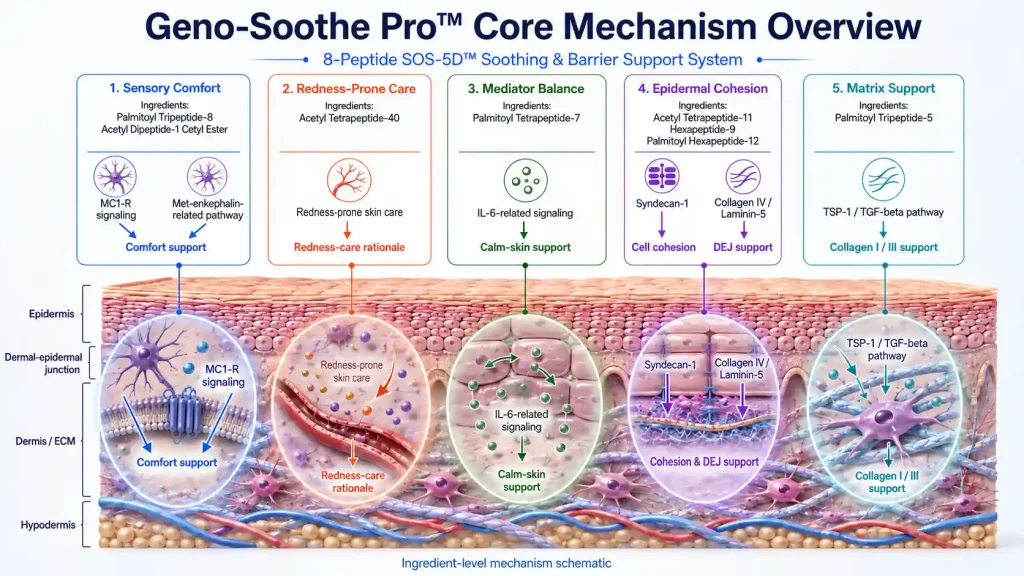
Geno-Soothe Pro™ is an aqueous eight-peptide complex developed for skincare brands formulating soothing, redness-prone skin care, barrier-support and age-defense products. Its SOS-5D™ design organizes eight peptides across sensory comfort, visible redness care, mediator balance, epidermal cohesion and matrix support.
1. Composition & Technical Specifications
1.1 Eight-Peptide Composition
| Peptide INCI | Ingredient-level Role |
| Acetyl Tetrapeptide-40 | Included for visible-redness care positioning, with an ingredient-level rationale involving effects on collagenase and vascular-growth-factor expression; finished-product claims require substantiation. |
| Palmitoyl Tripeptide-8 | An alpha-MSH-inspired peptide positioned for neurogenic discomfort and redness-prone appearance care through an MC1-R-related mechanism. |
| Acetyl Dipeptide-1 Cetyl Ester | Selected for sensory-comfort positioning around stinging, burning and tight-feeling skin. This rationale is associated with a Met-enkephalin-related pathway. |
| Palmitoyl Tetrapeptide-7 | Supports a calm-skin and age-defense formulation concept associated with IL-6-related signaling and extracellular-matrix protection. |
| Acetyl Tetrapeptide-11 | Positioned to support epidermal cohesion, with stimulation of Syndecan-1 synthesis as the relevant ingredient-level mechanism. |
| Hexapeptide-9 | Included for recovery and dermal-epidermal-junction support, associated with Collagen IV and Laminin-5 production. |
| Palmitoyl Hexapeptide-12 | Included for barrier, mechanical and matrix-support positioning within the DEJ-support architecture; blend-level performance should be validated in the final formula. |
| Palmitoyl Tripeptide-5 | A matrix-support peptide associated with a TSP-1/TGF-beta pathway and Collagen I/III synthesis. Finished-product performance requires formula-specific testing. |
1.2 Physical & Formulation Specifications
| Field | Content |
| Product name | Geno-Soothe Pro™ |
| Technical system | SOS-5D™ |
| Active composition | Eight-peptide complex |
| Recommended pH range | pH 5.0-7.0 |
| Recommended use level | 2%-5%, subject to formula validation |
| Process guidance | Add during the cool-down phase below 40°C |
2. SOS-5D™ Five-Phase Mechanism Rationale
2.1 Phase 1: Sensory Comfort & Neurogenic-Signal Care
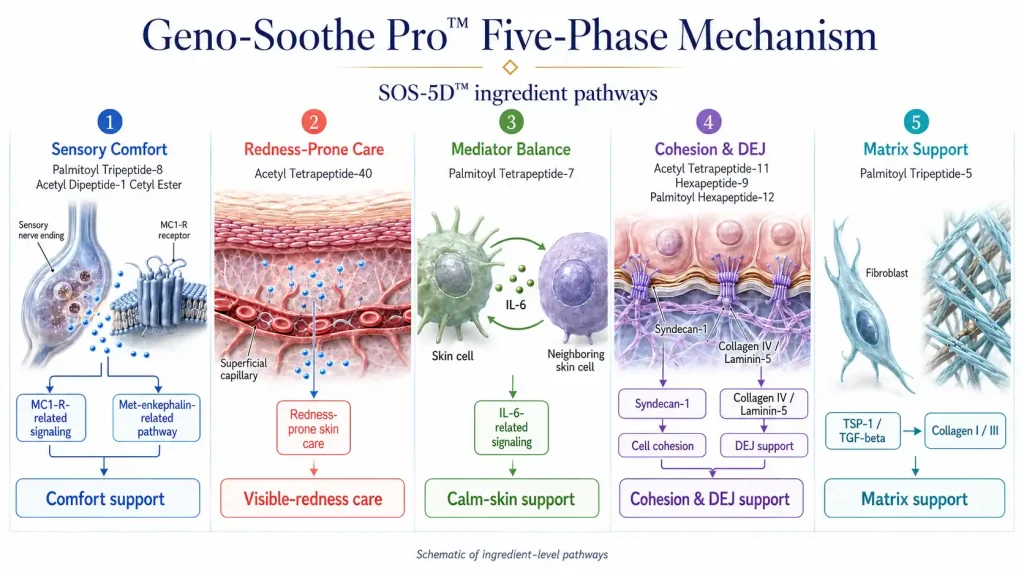
Palmitoyl Tripeptide-8 is an alpha-MSH-inspired peptide linked to MC1-R-related signaling, while Acetyl Dipeptide-1 Cetyl Ester is associated with a Met-enkephalin-related comfort pathway. Together, they provide the ingredient rationale for formulas intended to improve the perception of temporary stinging, burning and tightness.
2.2 Phase 2: Redness-Prone Appearance Care
Acetyl Tetrapeptide-40 anchors the visible-redness component of SOS-5D™. Its ingredient-level rationale includes effects on collagenase and vascular-growth-factor expression. This supports the development of redness-prone skin-care formulations.
2.3 Phase 3: Pro-Inflammatory Mediator Balance
Palmitoyl Tetrapeptide-7 is associated with IL-6-related signaling. Within Geno-Soothe Pro™, this ingredient-level rationale supports a calm-skin and age-defense concept.
2.4 Phase 4: Epidermal Cohesion & DEJ Support
Acetyl Tetrapeptide-11 is associated with support for Syndecan-1 synthesis and keratinocyte cohesion. Hexapeptide-9 and Palmitoyl Hexapeptide-12 are positioned for dermal-epidermal-junction and matrix support. This phase combines the ‘molecular scaffold’ concept with progressive barrier-cohesion support.
2.5 Phase 5: Dermal Matrix Support
Palmitoyl Tripeptide-5 completes the SOS-5D™ architecture with a matrix-support rationale. It is associated with a TSP-1/TGF-beta pathway and Collagen I/III synthesis. This ingredient-level rationale supports resilient-looking skin.
3. Geno-Soothe Pro™ Advantage Matrix
| Feature | Commercial & Formulation Value |
| Eight-Peptide Architecture | Combines eight peptides in one pre-designed complex, giving brands a coherent multi-pathway story without independently sourcing each peptide. |
| Five-Dimensional Positioning | Connects sensory comfort, visible redness care, mediator balance, epidermal cohesion and matrix support in one formulation concept. |
| Sensitive-Skin-Friendly Story | Provides a cosmetic formulation framework for soothing and barrier-support products. |
| Formulation Efficiency | A ready-to-evaluate multi-peptide solution can simplify concept development; compatibility, stability and efficacy still require finished-formula validation. |
4. Formulation Applications & Guidance
Suggested Application Concepts
- Soothing facial serums and essences
- Barrier-support gel-creams and lightweight emulsions
- Eye-care formulas for tired-looking or sensitive-feeling skin
- Sensitive-skin-friendly age-defense formulas
- Cosmetic post-stress care concepts, subject to finished-product safety and claims review
Formulation Guidance
- Use level: 2%-5%; optimize according to the target formula and evidence package.
- Recommended pH range: 5.0-7.0.
- Process: add during the cool-down phase below 40°C.
- Retinol/AHA systems: evaluate compatibility through stability, color, odor, viscosity, pH and tolerability checks in the final formula.
- Confirm preservative compatibility, packaging compatibility and the final supplier TDS/COA before scale-up.
5. Professional FAQ
Q1: What differentiates Geno-Soothe Pro™ from a single soothing peptide?
The complex combines eight peptides across five formulation dimensions. This gives brands a broader concept covering sensory comfort, redness-prone appearance, mediator balance, epidermal cohesion and matrix support. It does not by itself prove that the blend will outperform every single-peptide formula; comparative performance requires controlled testing.
Q2: Is it suitable for redness-prone or sensitive-feeling skin-care concepts?
Yes, that is its intended cosmetic positioning. The final formula should still undergo safety, tolerability and efficacy testing appropriate to the target market. Geno-Soothe Pro™ is a cosmetic ingredient, not a treatment for rosacea, allergy or another skin disease.
Q3: Can the complex be promoted for use immediately after laser or microneedling procedures?
Ingredient information alone is not sufficient for that claim. Any professional-procedure aftercare positioning requires finished-product safety evidence, microbiological and packaging controls, instructions for use, and target-market regulatory review. Suitability for use immediately after a procedure or within the following 72 hours requires this specific supporting evidence.
Q4: Why include several peptides in the DEJ and barrier-support dimension?
The ingredients have complementary roles: Acetyl Tetrapeptide-11 for epidermal cohesion and Hexapeptide-9 plus Palmitoyl Hexapeptide-12 for DEJ and matrix support. This provides a layered formulation rationale, while blend-level and finished-product outcomes still require testing.
Q5: Can it be used in high-strength retinol or AHA formulas?
It can be evaluated as a candidate soothing and barrier-support component. Compatibility depends on the complete formula. Confirm peptide stability, preservative compatibility, pH drift, color, odor, viscosity and final-formula tolerability under the actual conditions of use.
Q6: How should formulators protect stability?
Follow the recommended pH range of 5.0-7.0 and cool-down addition below 40°C, then verify the complete system through formula-specific stability testing. Storage and shelf-life specifications should follow the final supplier TDS/COA.
Q7: Does Geno-Soothe Pro™ replace antihistamines or other medicines?
No. Geno-Soothe Pro™ is a cosmetic ingredient complex for topical cosmetic formulations. It is not intended to diagnose, treat, cure or prevent allergy, rosacea, hives or any other disease, and it must not be presented as a substitute for medical care or medication.
References & Source Links
- GENOPEP Peptides Solution category
- FDA: Cosmetics Labeling Claims
- EU Commission Regulation (EU) No 655/2013 on common criteria for cosmetic claims
- Ferreira et al. Usage of Synthetic Peptides in Cosmetics for Sensitive Skin. Cosmetics. 2021;8(3):75. PMID 34451799.
- Ligorio et al. Noninvasive Monitoring of Palmitoyl Hexapeptide-12 in Human Skin Layers. ACS Appl Bio Mater. 2025. PMID 39964201.
- Luger et al. The role of alpha-MSH as a modulator of cutaneous inflammation. Ann N Y Acad Sci. 1999. PMID 11268349.
GENOPEP GROUP | The Engine of Your Peptide Innovation
GENOPEP Group is a leading global peptide technology solutions provider, specializing in R&D, manufacturing, and commercialization in the fields of skin science and biopharmaceuticals. Supported by advanced scientific capabilities and a fully integrated supply chain, we deliver efficient and reliable innovation support to skincare brands worldwide.
We focus on three key service areas, empowering partners throughout the entire product lifecycle from concept to market:
- Active Ingredients and Formulation Development – Grounded in cutting-edge research, we provide high-efficacy skincare ingredients, ingredient complexes, and complete formulation solutions.
- End-to-End Production Support – Covering the full journey from lab-scale R&D and pilot optimization to commercial manufacturing, ensuring consistent product quality and reliable supply.
- Custom Synthesis Services – With strong capabilities in novel molecule development, we specialize in the design, synthesis, and preparation of peptide-based novel ingredients and related reference standards.
We believe in technology-driven products and collaboration-driven value. GENOPEP is not just a supplier—we are your trusted innovation partner, dedicated to co-creating the next generation of skincare solutions with you.