Professional Cosmetics Peptide Supplier | GENOPEP



Formulating Advanced Anti-Aging Serums with High-Purity Pentapeptide-18 Solution
Transitioning from Lab Scales to Industrial Batching
Transitioning a peptide-containing serum from a controlled 1-liter laboratory beaker to a 50-to-100-kilogram pilot or commercial batch is one of the practical pressure points in cosmetic engineering. At bench scale, localized heat transfer, mechanical shear and mixing uniformity are easier to manage. During scale-up, however, thermal gradients near heating jackets, changes in blade tip speed and uneven turnover can create localized processing conditions that are not visible in a small development beaker.
For delicate cosmetic oligopeptides such as Pentapeptide-18, these scale-up variables should be controlled with discipline. Excessive heat exposure after active addition may accelerate degradation risk, while unnecessary high-shear processing can introduce air, disrupt viscosity and increase variability in the finished matrix. The formulation goal is not to avoid all processing energy, but to separate the hot emulsification stage from the peptide addition stage and introduce the active under cooler, lower-shear conditions.
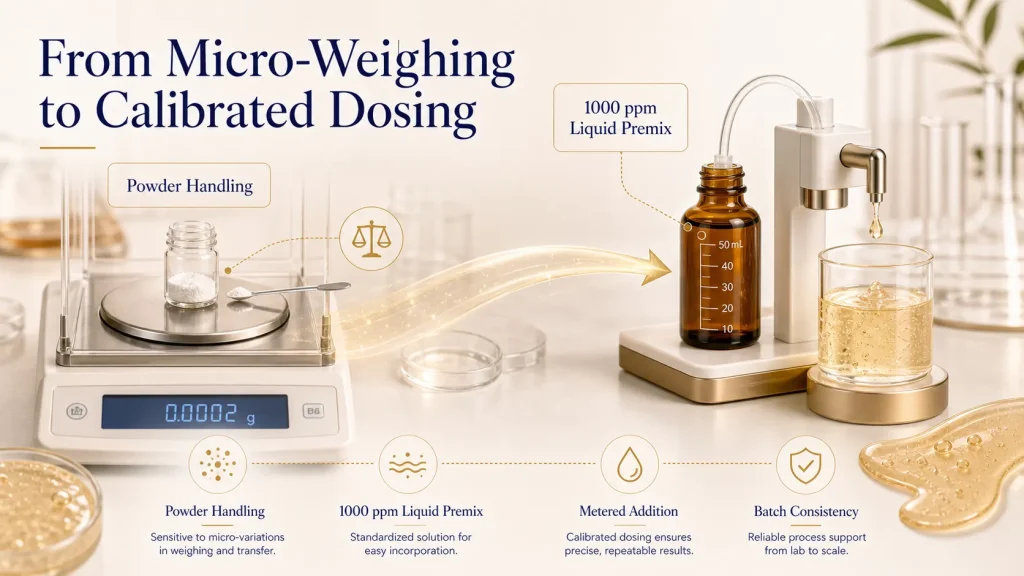
This is where a standardized Pentapeptide-18 1000 ppm liquid solution becomes useful. Compared with micro-weighing lyophilized powder for every batch, a calibrated liquid premix can simplify transfer, improve dosing practicality and reduce operator-dependent variation. For brands and formulators building premium anti-aging serums, this format provides a cleaner bridge from lab concept to repeatable production.
Step-by-Step Blueprint Using Genopep‘s 1000 ppm Liquid Form
Genopep’s Pentapeptide-18 1000 ppm liquid solution is designed as a ready-to-use active ingredient format for anti-aging serum development. The following blueprint is a practical compounding framework rather than a universal formula. Each finished product still requires formula-specific compatibility, stability and microbiological validation before launch.
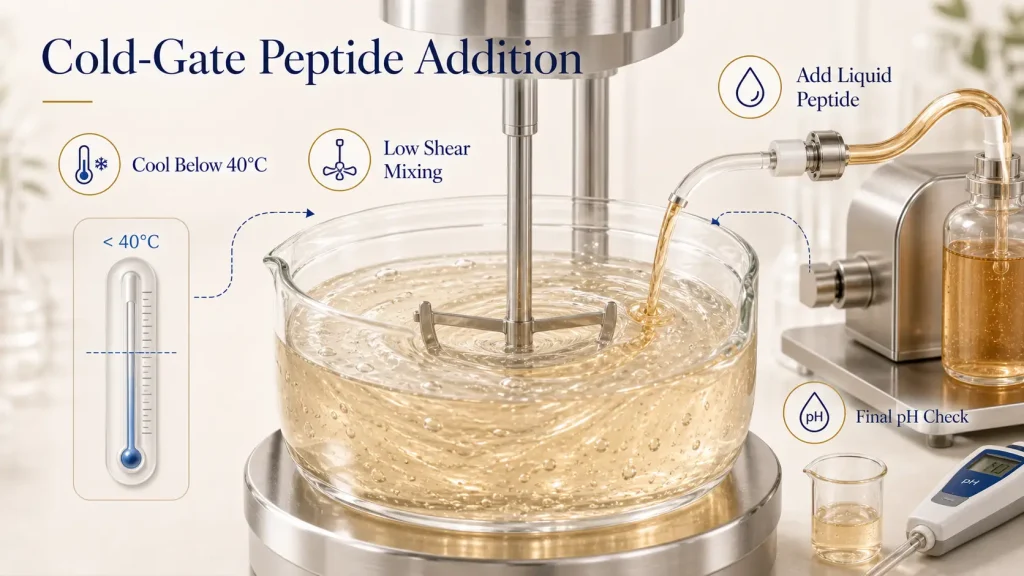
Step 1: Main Aqueous Phase Dispersion & Base Construction
Begin by preparing the core aqueous vehicle. Charge the stainless-steel vessel with deionized water and initialize anchor agitation at a stable speed suitable for the vessel geometry. Incorporate chelating agents such as Disodium EDTA where appropriate to help manage trace metal ions that can contribute to oxidation risk. Hydrophilic rheology modifiers such as xanthan gum or hydroxyethylcellulose can be pre-dispersed into a glycol carrier before hydration. If the formula is an oil-in-water emulsion serum, the main phase may be heated for emulsification before the peptide is introduced later in the cool-down stage.
Step 2: The Thermodynamic Cold-Gate Active Integration
After emulsification and homogenization of lipid components, the batch should enter a controlled cooling phase. Turn off intensive high-shear equipment before peptide addition and maintain smooth anchor mixing to support uniform cooling without drawing excessive air into the tank. Monitor the bulk temperature until it drops below 40°C. This threshold functions as a practical cold-gate for adding the Pentapeptide-18 liquid solution.
Introduce Genopep Pentapeptide-18 1000 ppm solution slowly into the matrix vortex under low-shear mixing. This timing reduces unnecessary heat and mechanical exposure after active addition and helps the liquid premix distribute evenly through the serum base.
Step 3: Electrometric pH Stabilization Protocol
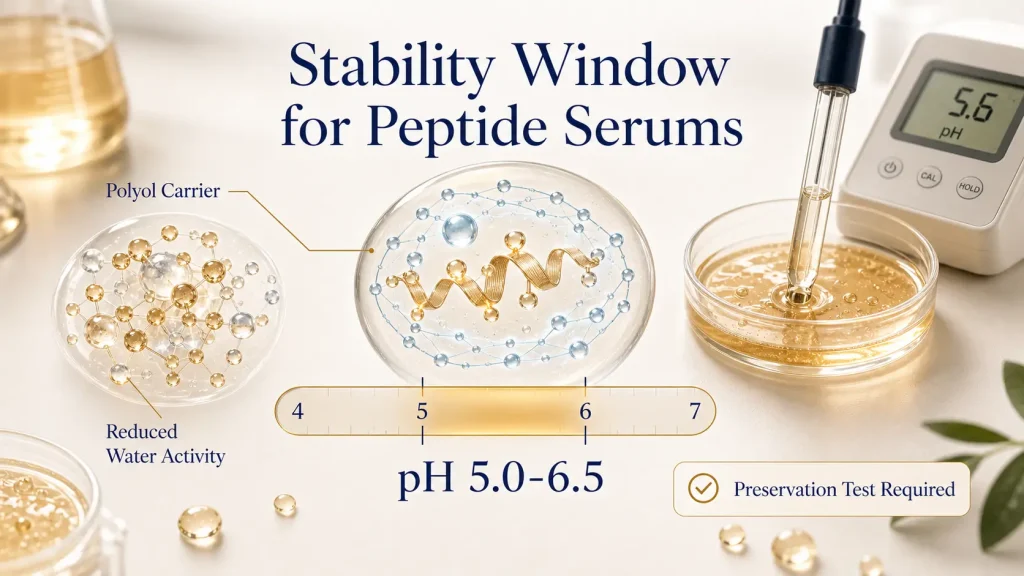
After complete active dispersion, measure the formula with a calibrated digital pH meter. A mild buffer system, such as a citric acid-sodium citrate pair, can be used to adjust the final formula to a target pH window of 5.0-6.5 where the overall base, preservative system and skin feel remain compatible. Maintaining this pH range supports peptide-friendly formulation design, but it does not replace formal stability testing.
Stability and Preservation Advantages of Genopep Carriers
Sourcing Pentapeptide-18 as a liquid solution can provide formulation chemists with practical manufacturing advantages over powder-only handling. A purpose-built polyol co-solvent carrier helps improve dispersion, reduce handling friction and support a lower water-activity environment around the peptide solution. This does not make the finished product automatically stable, but it gives the formulator a more controlled starting point.
The carrier strategy also supports a more disciplined preservation design. Polyols can contribute to lower water activity and improved formula robustness, but the final serum still requires preservative compatibility review and microbial challenge testing. For clean-positioned products, the stronger message is not automatic preservative exemption, but validated preservation with a more formulation-friendly active format.
Sourcing Specification Comparison
The matrix below summarizes practical sourcing considerations for teams evaluating Pentapeptide-18 formats for premium anti-aging serum development.
| Technical Parameter | Genopep 1000 ppm Pentapeptide-18 Liquid Solution | Generic Powder or Simple Aqueous Material |
| Peptide assay and purity | COA-backed HPLC specification; high-purity batches can be selected against defined release criteria. | Purity, byproducts and assay may vary by supplier; each lot requires incoming verification. |
| Dosing accuracy | Pre-diluted liquid form simplifies addition and reduces micro-weighing variability during scale-up. | Milligram-level powder weighing can increase handling error, transfer loss and operator dependency. |
| Process addition | Designed for cold-gate addition below 40°C with low-shear mixing after emulsification. | Direct addition into hot or high-shear phases can increase processing risk for peptide-containing formulas. |
| Carrier environment | Polyol co-solvent system supports handling, dispersion and lower water-activity formulation strategy. | Simple water solutions may require additional compatibility and preservation work in the finished formula. |
| pH and stability window | Target final formula pH: 5.0-6.5, confirmed through formula-specific stability testing. | No universal pH protection; stability must be confirmed in each base and packaging system. |
| Preservation strategy | Can support a milder preservation design, but final formulas still require microbial challenge testing. | Finished product preservation cannot be assumed from raw material format alone. |
By choosing a calibrated liquid peptide solution, brands and formulators can reduce processing complexity during scale-up, improve batch handling and create a clearer technical story for anti-aging serum development. Genopep can support formulation discussion, sample evaluation and documentation review for teams preparing peptide serum concepts for production.
References
Schagen, S. K. (2017). Topical peptide treatments with effective anti-aging results. Cosmetics, 4(2), 16. https://doi.org/10.3390/cosmetics4020016
Blanes-Mira, C., Clemente, J., Jodas, G., Gil, A., Fernandez-Ballester, G., Ponsati, B., Gutierrez, L., Perez-Paya, E., & Ferrer-Montiel, A. (2002). A synthetic hexapeptide with antiwrinkle activity. International Journal of Cosmetic Science, 24(5), 303-310.
ISO 11930. Cosmetics – Microbiology – Evaluation of the antimicrobial protection of a cosmetic product.
ICH Q1A(R2). Stability Testing of New Drug Substances and Products. Used here as general stability-study context; finished cosmetic validation should follow applicable cosmetic regulations and internal quality protocols.