Professional Cosmetics Peptide Supplier | GENOPEP



Are Peptides Good for Aging Skin? How to Read Anti-Aging Ingredient Claims
Are peptides good for aging skin? Some topical peptide formulas may improve defined cosmetic endpoints such as hydration, wrinkle appearance or perceived firmness, but “peptides” are not one interchangeable active. Results depend on the exact sequence, concentration, vehicle, stability, skin delivery and finished-product evidence. A credible claim should therefore name the peptide and the measured outcome.
Introduction
Peptides have become a familiar anti-aging label, yet the word covers a large and chemically diverse group. A short amino-acid chain may be designed as a signal peptide, modified with a lipid group, complexed with a metal ion or developed for another cosmetic function. Two products can both say “peptide serum” while containing different ingredients, different concentrations and very different evidence packages.
That is why the question “are peptides good for aging skin” cannot be answered with a universal yes or no. The useful answer starts with a target: dry surface texture, visible fine lines, uneven tone, reduced elasticity measurements or another defined concern. It then asks whether the selected peptide and finished formula have evidence that measures that same endpoint.
For skincare brands, formulators and product teams, this distinction prevents a common development error: selecting a fashionable category first and inventing the claim later. A stronger brief moves in the opposite direction—define the consumer-visible outcome, choose a plausible ingredient and vehicle, verify stability and delivery, then test the finished product. This article discusses topical cosmetics only; injectable and therapeutic peptide uses are outside scope.
Aging Skin Is Not a Single Endpoint
Visible skin aging reflects multiple processes. Repeated ultraviolet exposure, oxidative stress, barrier changes, slower renewal, altered pigmentation and changes in collagen and elastic-fiber organization can contribute to dryness, roughness, wrinkles, uneven tone and reduced resilience. One formula is unlikely to address every process to the same degree, and a study of one outcome should not be used as proof of another.
For example, higher corneometer hydration can support a moisturization claim, but it does not prove that dermal collagen increased. A lower expert-graded wrinkle score may support an appearance claim, but it does not establish that chronological aging was reversed. Better consumer-perceived firmness can be valuable, yet it is not the same endpoint as an instrumental elasticity measurement. Precise endpoint naming is the foundation of defensible anti-aging communication.
“Peptides” Describe a Category, Not One Mechanism
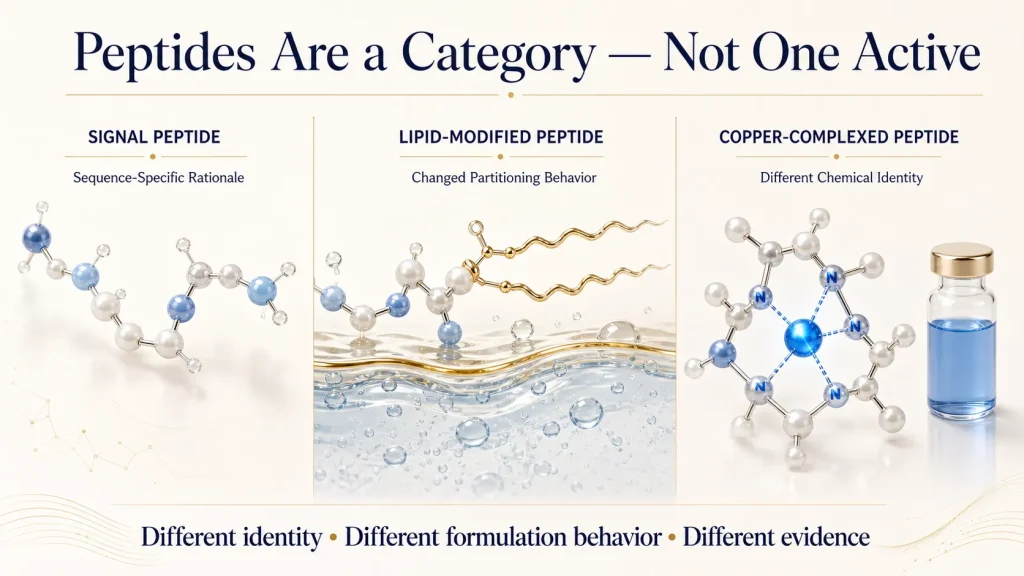
Peptides are commonly grouped by their intended cosmetic rationale. Signal or matrikine-inspired peptides are designed around cell-signaling concepts related to extracellular-matrix maintenance. Carrier peptides are discussed as complexes that bind or present trace elements; Copper Tripeptide-1 is a familiar cosmetic example. Other peptides are developed around enzyme-modulating, soothing, pigmentation or expression-line concepts. These categories are useful for formulation planning, but they do not prove that every ingredient in a category performs equally.[3]
The exact INCI name and amino-acid sequence matter because small structural changes can affect charge, solubility, stability, affinity and interaction with the formulation. Lipid modification may alter partitioning behavior; metal complexation changes the chemical identity; sequence length and composition influence both degradation and skin-delivery challenges. Calling all of these materials simply “collagen peptides” or “anti-aging peptides” removes information that R&D and claims teams actually need.
| Peptide Description | Useful Development Question | Evidence Still Needed |
| Signal-peptide concept | Which sequence and biological pathway support the rationale? | Finished-formula performance on a relevant cosmetic endpoint |
| Lipid-modified peptide | Does the modification improve formula fit or skin partitioning under the intended conditions? | Stability, delivery and controlled product testing |
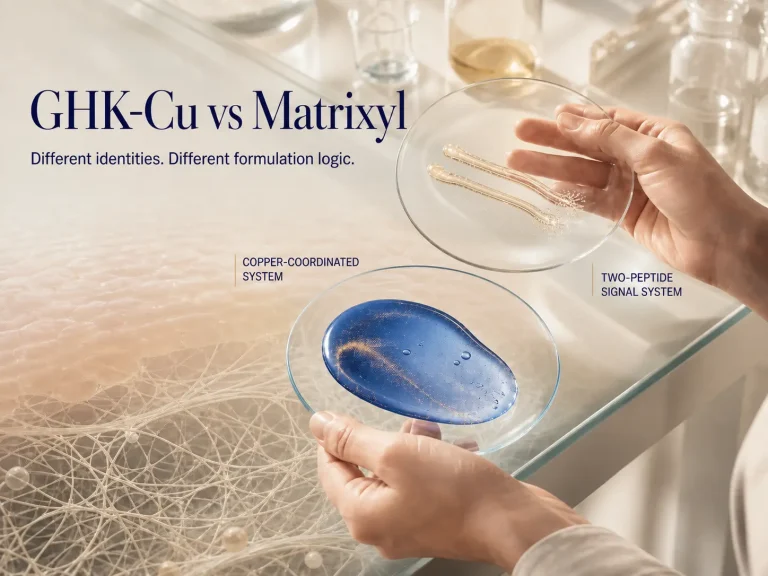
| Copper-complexed peptide | Is identity, copper complexation and peptide content verified? | Formula compatibility and outcome-specific substantiation |
| Multi-peptide blend | Does each component have a defined role at the actual use level? | Evidence for the complete blend, not only its individual ingredients |
| Generic “peptide complex” | Can the supplier disclose INCI names, sequence basis and specification? | Traceable composition and batch documentation before any claim review |
What Does the Clinical Evidence Actually Show?
A 2026 systematic review and meta-analysis included 19 randomized controlled trials with 1,341 participants and reported improvements in several skin-aging parameters across peptide interventions.[1] The important limitation is route: 17 studies evaluated oral peptides and only two evaluated topical formulations. The pooled findings were therefore driven mainly by oral products and cannot be transferred wholesale to a topical serum.
The same review found high heterogeneity in peptide type, dose and outcome methods, while elasticity and skin-density results were inconsistent.[1] Earlier reviews of extracellular-matrix-stimulating cosmetic peptides also identified methodological limitations in published clinical studies.[2] This does not mean that topical peptides cannot work. It means that a broad category-level promise is less defensible than a specific claim supported by a defined peptide, formula, population, duration and measurement method.
Evidence should also be separated by layer. A cell-culture experiment can establish a mechanistic rationale, and an ex vivo study can explore stability or skin distribution, but neither directly proves what consumers will see after using a finished formula. A controlled human study is closer to the marketing endpoint, although its value still depends on the comparator, blinding, sample size, statistics and whether the tested product matches the commercial formula.[4,5]
Why the Finished Formula Matters
Peptides can present formulation challenges involving water activity, pH, oxidation, hydrolysis, interactions with other ingredients and preservation systems. Their ability to reach a relevant skin compartment also varies with molecular properties, the condition of the skin and the vehicle. A recent cosmetic-peptide safety framework therefore treats characterization, exposure, local tolerability, delivery and formulation stability as connected questions rather than isolated boxes.[4]
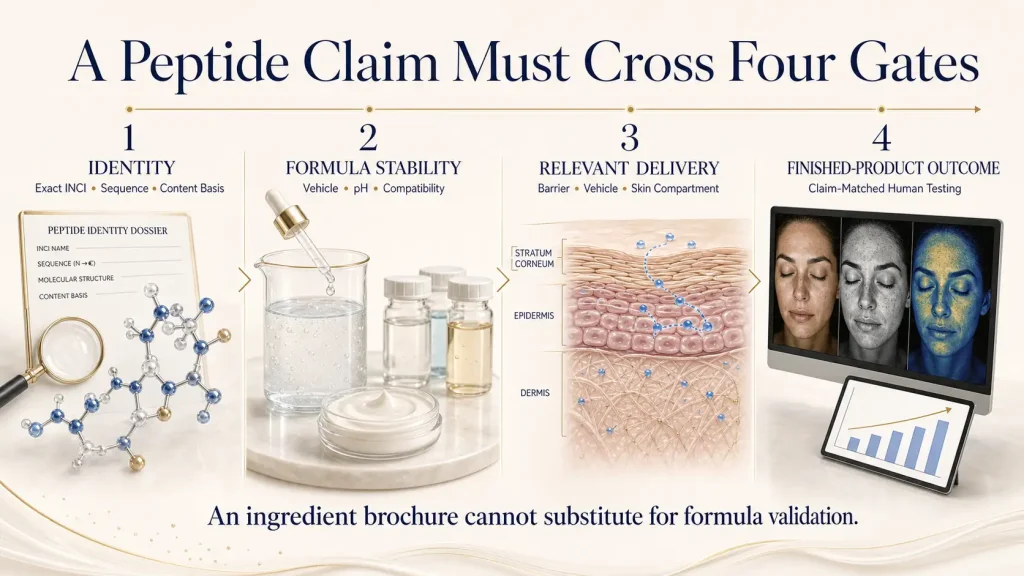
This is why an ingredient brochure cannot substitute for formula validation. An R&D team should confirm the raw-material identity, active or peptide-content basis, analytical method, recommended handling conditions and the conditions under which compatibility statements were generated. It should then test the actual formula through development stability, packaging compatibility, microbiological control where applicable and performance methods aligned with the intended claim.
How to Read an Anti-Aging Peptide Claim
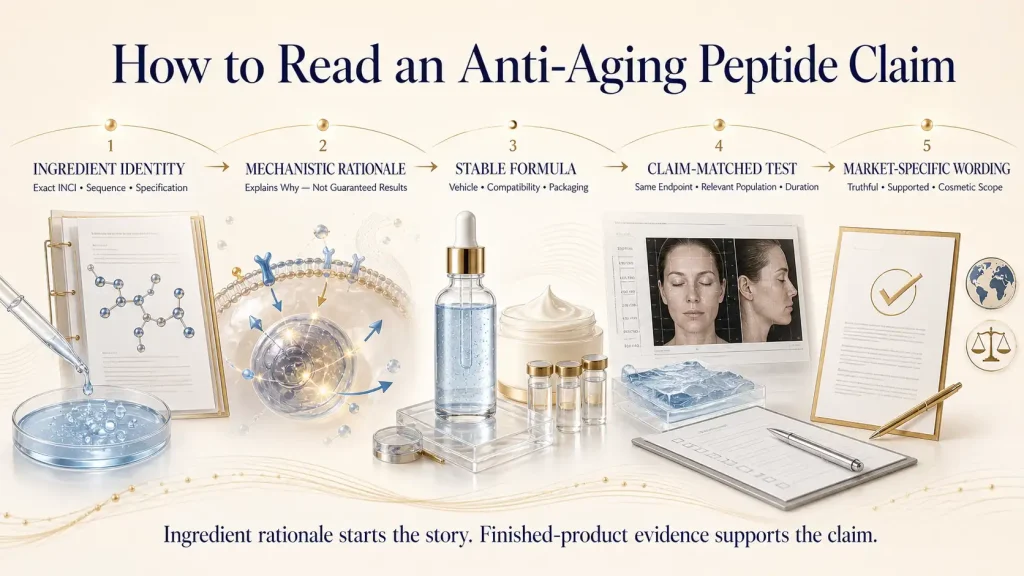
A strong claim can be traced through an evidence chain. First, the ingredient is identified correctly. Second, the proposed mechanism is described as a rationale rather than a guaranteed consumer outcome. Third, the formula remains stable and delivers the ingredient under the intended use conditions. Fourth, the study measures the same endpoint named in the claim. Fifth, the final wording stays within the cosmetic rules of the target market.
| Claim Check | More Defensible | Warning Sign |
| Ingredient identity | Exact INCI name, sequence or supplier-defined composition | “Advanced peptides” with no disclosed identity |
| Evidence level | Human finished-product data supported by relevant analytical and mechanistic work | Cell data presented as proof of visible consumer results |
| Endpoint | Hydration, wrinkle appearance or elasticity parameter named precisely | “Reverses aging” or “rebuilds youthful skin” without a defined endpoint |
| Study design | Relevant control, time point, method, population and statistical analysis | Uncontrolled photographs or percentages with no protocol |
| Formula match | Tested formula or a justified equivalent to the commercial product | Borrowed results from another vehicle, concentration or peptide blend |
| Market wording | Truthful, supportable cosmetic appearance language | Disease, healing or body structure/function language presented as a cosmetic claim |
In the United States, cosmetic labeling claims must be truthful and not misleading; claims to treat disease or affect the structure or function of the body can change the product’s regulatory status.[11] In the European Union, cosmetic claims are expected to meet common criteria including evidential support, truthfulness and informed decision-making.[12] Brands selling across markets should therefore review the exact final wording by jurisdiction rather than assuming one global phrase is automatically acceptable.
Peptides vs Retinoids: Avoid a False Either-Or Choice
Topical tretinoin has a substantially larger and more established clinical evidence base for photoaging than the topical peptide category as a whole. A systematic review of randomized trials reported consistent improvements in several clinical signs of photoaging, although prescription tretinoin, cosmetic retinol and other retinoids should not be treated as interchangeable products.[7,8] Retinoids can also present irritation and stability challenges, so formula design and user tolerance remain important.
The practical question is not whether every peptide is “better” or “weaker” than retinol. It is whether a particular formula fits the target user, endpoint, tolerance profile and product concept. A peptide product may occupy a complementary or alternative positioning space, but equivalence or superiority requires direct comparative evidence for the tested finished formulas. Mechanistic diagrams alone cannot establish that ranking.
Copper Tripeptide-1 as an Evidence-Reading Example
Copper Tripeptide-1 illustrates why identity and evidence layer matter. The Cosmetic Ingredient Review describes it as a complex formed by copper and Tripeptide-1 and lists it as a skin-conditioning agent; its panel concluded that the reviewed peptide group was safe in the reported practices of use and concentration.[6] This safety conclusion is not, by itself, proof of a particular anti-aging result.
GHK-Cu literature provides biological rationale and some human cosmetic observations, but topical studies are not uniformly large, independently replicated or based on the same vehicle and endpoints. One small randomized study after carbon-dioxide laser resurfacing did not find significant between-group improvements in objective wrinkle or overall skin-quality measures, although satisfaction differed.[9] Reviews continue to describe promise alongside delivery and study-design limitations.[10]
The current Skinkind Cosmetics product page presents Copper Tripeptide-1 in powder and customizable solution formats.[13] For a brand evaluating either format, the next questions are practical: What identity and content basis appear on the current TDS and COA? What handling and storage conditions apply to the purchased form? Is the peptide compatible and stable in the proposed vehicle? Which finished-product test will substantiate the intended cosmetic claim? The product-page format information is commercially useful, but it should not be converted into universal efficacy.
A Practical Checklist for Product Teams
Define the visible concern and the exact cosmetic endpoint before selecting a peptide.
Record the exact INCI name, sequence or complex identity, supplier format and content basis.
Separate mechanism evidence, raw-material data and finished-product performance in the claim file.
Confirm formulation stability, compatibility, packaging and use conditions before planning a performance study.
Match the test method, duration and population to the final claim, then review the wording for each target market.
Conclusion
Are peptides good for aging skin? Some topical peptide formulas may support defined cosmetic outcomes, but the answer belongs to the exact peptide and finished formula rather than to the category name alone. Ingredient identity, concentration basis, vehicle, stability, delivery, study design and measured endpoint all determine how much a claim can reasonably say.
For product teams, the category label is only a starting point. Copper Tripeptide-1 can provide a defined material identity and a plausible skin-conditioning rationale, while finished-product evidence must still support the commercial formula and final wording. This separation keeps ingredient promise, formula performance and market claims in the correct evidence layers.
Frequently Asked Questions
1. Do peptides actually work in skincare?
Some peptide-containing skincare products have shown improvements in defined outcomes, but performance cannot be assigned to the whole category. The 2026 systematic review included only two topical studies among 19 peptide RCTs, so broad conclusions about all topical peptides remain limited.[1] The most credible answer comes from evidence for the exact peptide and finished formula.
2. Are peptides good for older skin?
They can be reasonable ingredients for formulas targeting concerns common in older skin, such as dryness, rough texture or visible fine lines, provided the chosen peptide and formula support the intended endpoint. Age alone does not determine suitability. Skin condition, tolerance, the rest of the routine and the quality of the finished-product evidence are more useful decision factors.
3. How long does it take for peptides to work in skincare?
There is no universal timetable. Hydration or sensory changes may be noticed quickly when they come from the complete moisturizing vehicle, while wrinkle or elasticity studies usually require repeated use over weeks or months. Brands should use the duration tested for their finished formula and should not borrow a timeline from another peptide, concentration or product.
4. Which is better for aging skin, peptides or retinol?
They are not directly interchangeable categories. Retinoids—especially prescription tretinoin—have a more established clinical evidence base for photoaging, while peptide evidence is more ingredient- and formula-specific.[7,8] A product choice should consider the target endpoint, tolerance, regulatory category and formulation. Claims of superiority require direct comparative testing of the finished products.
5. Is there a downside to using peptides?
Potential downsides include limited evidence for some sequences, uncertain skin delivery, instability, incompatibility, formula cost and irritation from the complete product. A safety conclusion for one characterized peptide does not cover every peptide or every formula. Suppliers and brands should evaluate identity, purity or content basis, impurities, exposure, tolerability and finished-product safety for the intended use.[4,6]
CTA
For brands asking “are peptides good for aging skin,” the most useful next step is not to choose a category-level promise. Build a traceable evidence chain from the target endpoint to the peptide identity, supplier documentation, stable vehicle, finished-product test and jurisdiction-specific wording.
Genopep supplies Copper Tripeptide-1 in powder and customizable solution formats, while Skinkind Cosmetics can provide current format information and technical documents for formulation evaluation. Product teams should use the applicable TDS, COA and sample data for the purchased material, then confirm compatibility, stability and performance in their own finished formula.
Review Skinkind Cosmetics Copper Tripeptide-1 Formats and Request Technical Documents
References
1. Nukaly HY, Halawani IR, Irtaza HM, et al. Oral and Topical Peptides for Skin Aging: Systematic Review and Meta-Analysis of Randomized Controlled Trials. Frontiers in Medicine. 2026;13:1618306. PMC full text
2. Michalek IM, Lelen-Kaminska K, Caetano Dos Santos FL. Peptides Stimulating Synthesis of Extracellular Matrix Used in Anti-Ageing Cosmetics: Are They Clinically Tested? Australasian Journal of Dermatology. 2019;60(4):e267-e271. DOI record
3. Pintea A, Manea A, Pintea C, et al. Peptides: Emerging Candidates for the Prevention and Treatment of Skin Senescence: A Review. Biomolecules. 2025;15(1):88. PMC full text
4. Bjerke DL, Li J, Gao Y, Hu P, Lintner K, Hakozaki T. A Framework for the Safety Evaluation of Peptides in Cosmetics. Current Research in Toxicology. 2026;10:100291. PMC full text
5. Ash M, Zibitt M, Shauly O, Menon A, Losken A, Gould D. The Innovative and Evolving Landscape of Topical Exosome and Peptide Therapies: A Systematic Review of the Available Literature. Aesthetic Surgery Journal Open Forum. 2024;6:ojae017. PMC full text
6. Johnson W Jr, Bergfeld WF, Belsito DV, et al. Safety Assessment of Tripeptide-1, Hexapeptide-12, Their Metal Salts and Fatty Acyl Derivatives, and Palmitoyl Tetrapeptide-7 as Used in Cosmetics. International Journal of Toxicology. 2018;37(3 Suppl):15S-29S. CIR safety assessment
7. Sitohang IBS, Makes WI, Sandora N, Suryanegara J. Topical Tretinoin for Treating Photoaging: A Systematic Review of Randomized Controlled Trials. International Journal of Women’s Dermatology. 2022;8(1):e003. PMC full text
8. Milosheska D, Roškar R. Evidence for the Efficacy of Over-the-Counter Vitamin A Cosmetic Products in the Improvement of Facial Skin Aging: A Systematic Review. Cosmetics. 2022;9(1):10. PMC full text
9. Miller TA, et al. Effects of Topical Copper Tripeptide Complex on CO2 Laser-Resurfaced Skin. Archives of Facial Plastic Surgery. 2006;8(4):252-259. PubMed record
10. Mortazavi SM, Mohammadi Vadoud SA, Moghimi HR. Topically Applied GHK as an Anti-Wrinkle Peptide: Advantages, Problems and Prospective. BioImpacts. 2025;15:30071. PMC full text
11. U.S. Food and Drug Administration. Cosmetics Labeling Claims. FDA guidance
12. European Commission. Commission Regulation (EU) No 655/2013 Laying Down Common Criteria for the Justification of Claims Used in Relation to Cosmetic Products. EU regulation
13. Skinkind Cosmetics / GENOPEP. Copper Tripeptide-1 (CAS: 49557-75-7) Anti-Aging Peptides. Product page