Professional Cosmetics Peptide Supplier | GENOPEP



Can Sagging Skin Become Firmer Again? Realistic Expectations for Cosmetic Care
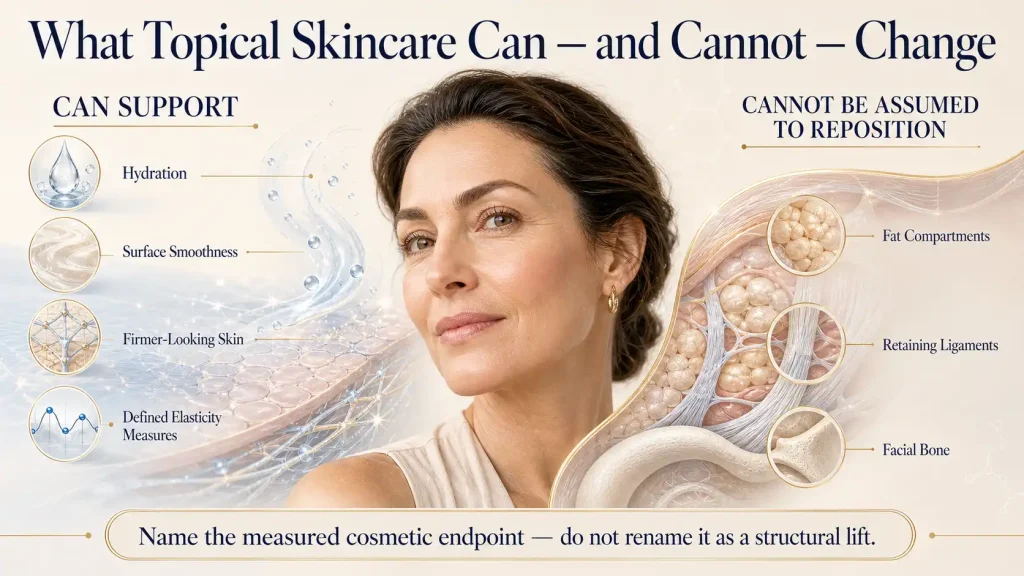
Can sagging skin become firmer again? Topical skincare can improve hydration, texture, fine lines and the appearance or feel of firmness, especially when dryness and photodamage contribute to the concern. It cannot reposition facial fat, tighten retaining ligaments or reverse bone-related changes. The most defensible cosmetic promise is therefore a measurable improvement in firmer-looking skin, not a guaranteed lift or complete reversal of laxity.
Introduction
“Firming,” “tightening” and “lifting” are often placed next to one another in skincare marketing, but they are not interchangeable outcomes. A hydrating formula can make dry surface lines look softer within hours. A well-designed long-term routine may improve visible photodamage and skin quality over months. Neither result automatically means that a cream has physically lifted deeper facial structures.
This distinction matters to consumers, and it matters even more to skincare brands, formulators and claim teams. If the target concern is described simply as “sagging,” a product can easily be positioned beyond what its ingredients, formula and study design actually support. A credible development brief starts by defining the visible feature to be improved and the depth at which it originates.
For anyone asking, “Can sagging skin become firmer again?”, the answer must be separated by anatomical layer and measurable cosmetic endpoint. This article explains why skin loses firmness, what topical care can realistically change, how to read common firming claims, and where Copper Tripeptide-1 can fit in an evidence-led cosmetic concept. It discusses topical cosmetics only; injectable, surgical and therapeutic uses are outside scope.
Why Does Skin Lose Firmness?
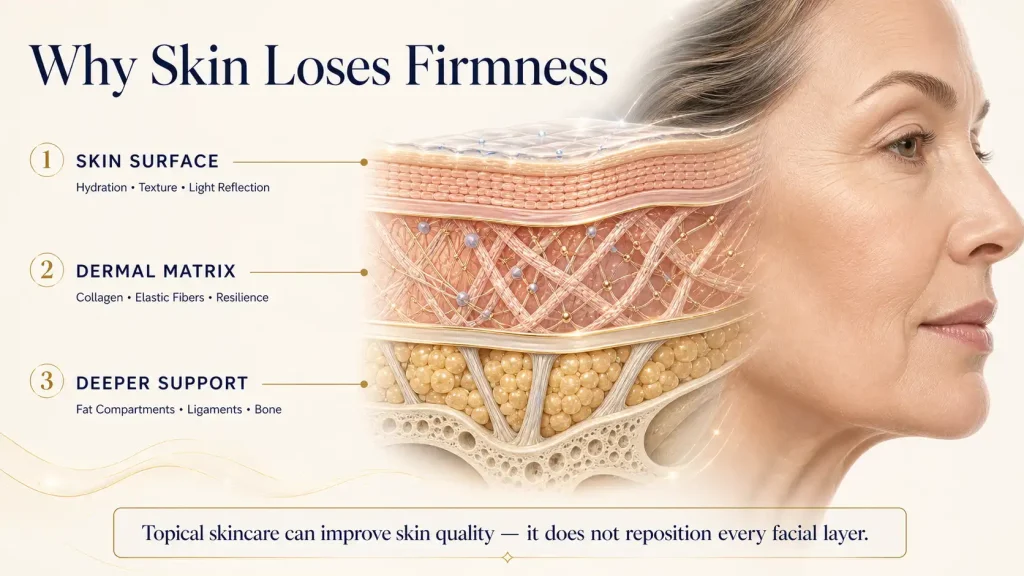
Visible facial aging is a layered process. Reviews of skin aging describe changes in the epidermis, dermis, dermal-epidermal junction and subcutaneous tissues. Collagen becomes less abundant and more fragmented, the elastic-fiber network becomes disorganized, glycosaminoglycan function changes, and barrier performance may decline.[1-4] Together, these changes can reduce resilience and contribute to wrinkles, roughness and loss of elasticity.
Chronological aging is only part of the picture. Repeated ultraviolet exposure promotes oxidative stress and matrix metalloproteinase activity, contributing to collagen fragmentation and abnormal elastic material. Smoking and other environmental exposures can add to this burden. These influences act over time, which is why prevention and consistency matter more than a short “rescue” cycle.[1-3]
Facial laxity also reflects structures below the skin. Age-related changes in fat compartments, retaining ligaments, muscle behavior and the facial skeleton alter support and volume distribution.[5] A topical product may improve the condition and appearance of the skin covering those structures, but it cannot be assumed to reposition them. This is the central limit behind any honest answer to “can sagging skin be improved?”
What Can Skincare Realistically Do?
Topical care can produce meaningful cosmetic improvements, but the outcome should be named precisely. Hydration can temporarily increase surface smoothness and reduce the visibility of dehydration lines. Barrier-supportive formulas can improve comfort and reduce the rough, crepey appearance that makes laxity seem more pronounced. Photoprotection helps limit additional UV-driven damage, while selected retinoids have the strongest clinical evidence among topical approaches for improving several signs of photoaging, including wrinkles.[6,7]
The evidence for one outcome should not be silently transferred to another. A study that records better hydration does not prove a lifting effect. A reduction in wrinkle score does not prove that jowls were repositioned. An ingredient study showing collagen-related signaling does not establish that a finished serum will visibly tighten the face. Each claim requires a method that measures the same endpoint under relevant conditions.
| Cosmetic Outcome | What a Topical Formula May Support | What It Does Not Establish |
| Immediate plumping | Better hydration, smoother surface reflection and softer-looking dehydration lines | New collagen formation or structural lifting |
| Firmer-looking skin | Improved texture, resilience measures or consumer-perceived firmness after consistent use | Repositioning of fat pads, ligaments or jowls |
| Improved elasticity | A change in a defined instrumental elasticity parameter | Permanent tightening of all facial tissues |
| Reduced visible photoaging | Improvement in validated wrinkle, roughness or pigmentation endpoints | Reversal of chronological aging |
| “Lifting” appearance | A limited, study-defined change in contour or appearance | A surgical or device-equivalent face lift |
Why Skin May Look Firmer Without Being Physically Lifted
Visible improvement can arise through several pathways that do not require deep structural repositioning. First, better water balance changes how the stratum corneum scatters light and how sharply fine surface lines are seen. Second, smoother texture and more even tone reduce the shadows and contrast that exaggerate an aged appearance. Third, a gradual improvement in photodamage-related endpoints may make the skin look more resilient even when facial volume and ligament position are unchanged.
These are not “fake” results; they are cosmetic results. The problem begins only when the measured outcome is renamed. If a study measured corneometer hydration, the report should not become evidence for collagen regeneration. If a consumer questionnaire recorded a firmer feel, the marketing copy should not silently convert it into an objective lift. Accurate naming protects both scientific credibility and consumer expectations.
For product teams, it is useful to define success as a bundle of complementary endpoints rather than one dramatic promise. Standardized photographs can document overall appearance, instrumental measurements can quantify selected mechanical properties, expert grading can evaluate wrinkles or texture, and user feedback can capture feel and satisfaction. When these methods point in the same direction, the finished-product story becomes more credible without requiring exaggerated language.
Firming, Tightening and Lifting: Read the Claim Before the Ingredient
“Firming” is usually the most defensible cosmetic territory when it refers to the look or feel of the skin and is supported by appropriate testing. “Tightening” may describe an immediate sensory or film-forming effect, or it may imply a longer-term change; the study must make clear which one is meant. “Lifting” is more demanding because readers may understand it as a change in facial position or contour.
For brands selling in multiple markets, wording should be reviewed against the intended jurisdiction. FDA guidance states that claims about treating disease or affecting the structure or function of the body can cause a product to be regulated as a drug in the United States.[10] In the European Union, cosmetic claims must meet common criteria including evidential support, honesty and informed decision-making.[11] A phrase that is visually attractive is not automatically acceptable or substantiated.
A useful claim ladder is: first define the visible concern; then specify whether the effect is immediate or cumulative; select an ingredient and vehicle that fit the mechanism; and finally test the finished formula. This order prevents the common error of starting with an impressive raw-material story and inventing a finished-product claim around it.
Where Does Copper Tripeptide-1 Fit?
Copper Tripeptide-1 is the cosmetic ingredient name for a copper complex of Tripeptide-1 and is listed by the Cosmetic Ingredient Review as a skin-conditioning agent.[8] GHK-Cu research provides a mechanistic rationale involving extracellular-matrix-related signaling, tissue-remodeling pathways and skin-conditioning concepts. This makes it relevant to formulas positioned around skin quality, smoother texture and a firmer-looking appearance.
The limitation is equally important. Much of the broad biological discussion around GHK-Cu comes from laboratory, wound, tissue or mechanistic literature rather than large, independent trials of ordinary cosmetic products on facial laxity. In a small randomized study of products used after carbon-dioxide laser resurfacing, objective assessments found no significant between-group improvement in wrinkles or overall skin quality, although patient satisfaction was higher in the GHK-Cu group.[9] That result does not prove that Copper Tripeptide-1 has no cosmetic value; it shows why ingredient promise and finished-product performance must remain separate.
For an interest-stage product concept, the appropriate translation is not “reverses sagging” or “rebuilds a youthful face.” It is a candidate skin-conditioning peptide for formulas designed to support skin quality and a firmer-looking appearance, subject to concentration, raw-material identity, vehicle, stability, packaging, use pattern and finished-product testing.
The current Skinkind Cosmetics product page presents Copper Tripeptide-1 in powder and customizable solution formats.[12] Formulators should confirm the exact purchased format, peptide or active content basis, analytical method, storage conditions and batch-specific results in the current TDS and COA rather than relying on a generic “copper peptide” label or blue color alone.
A Practical Development Plan for Firmer-Looking Skin
- Define the target precisely: Separate dehydration lines, rough crepey texture, reduced instrumental elasticity and visible lower-face laxity. They are not one endpoint.
- Choose a realistic time frame: An immediate hydration or film effect and an eight-to-twelve-week cumulative appearance study need different protocols and wording.
- Build the formula, not just an ingredient list: Consider vehicle, pH, preservative system, packaging, sensory profile and stability. Confirm compatibility with the supplier rather than applying universal internet mixing rules.
- Match the method to the claim: Use standardized photography, validated grading, suitable elasticity or deformation measurements, and consumer perception only for the questions each method can answer.
- Keep an evidence chain: Connect raw-material identity, formula stability, protocol, statistics, final wording and market-specific regulatory review in one claim file.

Conclusion
Can sagging skin become firmer again? The most accurate answer is that topical care may improve hydration, texture, fine-line appearance and defined measures or perceptions of firmness when the formula and testing support those outcomes. It should not be presented as repositioning fat compartments, retaining ligaments or facial bone.
For Copper Tripeptide-1, mechanistic and ingredient-level evidence can justify development interest, but it does not determine the performance of every finished product. Finished-product evidence is therefore required for finished-product claims. A commercially credible concept keeps the full chain intact: material identity, concentration basis, formula compatibility and stability, suitable packaging, claim-matched testing and market-specific wording.
Frequently Asked Questions
1. Can sagging skin be improved?
Yes, its appearance can sometimes be improved, especially when dehydration, rough texture and photodamage make the skin look less firm. Skincare may improve hydration, smoothness, resilience measurements and the perception of firmness. It should not be expected to reposition deeper facial structures or completely reverse established laxity.
2. What skincare helps with sagging?
A practical routine prioritizes daily photoprotection, adequate moisturization and well-tolerated evidence-based actives selected for the user’s needs. Retinoid evidence is stronger for photoaging and wrinkles than the evidence available for many fashionable firming ingredients.[6,7] Peptides such as Copper Tripeptide-1 may support a broader skin-quality concept, but finished-formula evidence should guide the claim.
3. Will sagging skin ever go away?
Not necessarily. Mild, appearance-based concerns may look better when hydration, texture and photodamage are addressed, but structural laxity generally does not disappear because of topical skincare alone. Brands should avoid promising complete or permanent reversal.
4. What do dermatologists recommend for sagging skin?
Recommendations depend on severity, skin condition, tolerance and goals. Preventing additional photodamage and using evidence-based topical care can support skin quality. When the concern comes mainly from volume loss or deeper support changes, a qualified clinician can explain which professional options, if any, match the anatomy and risk profile. This article does not provide individual medical advice.
5. Can sagging facial skin be reversed?
“Reversed” is too broad for most cosmetic claims. A formula may improve defined endpoints such as hydration, roughness, wrinkle appearance, elasticity measurements or perceived firmness. Reversal of all tissue changes involved in facial aging is not a realistic topical-cosmetic endpoint.
CTA
The practical answer to “can sagging skin become firmer again” depends on the layer and endpoint being discussed. Topical care can support better-looking skin quality and measurable cosmetic improvement, while deeper structural repositioning requires a different category of intervention and evidence.
For brands developing a firmer-looking skin or age-support formula, Genopep supplies Copper Tripeptide-1 in powder and customizable solution formats. Evaluate the selected material as one part of a complete evidence chain: verified identity, appropriate vehicle, stable finished formula, relevant testing and disciplined claims.
Review Skinkind Cosmetics Copper Tripeptide-1 Formats and Request Technical Documents
References
1. Zhang S, Duan E. Fighting against Skin Aging: The Way from Bench to Bedside. Cell Transplantation. 2018;27(5):729-738. PMC full text
2. Rittié L, Fisher GJ. Natural and Sun-Induced Aging of Human Skin. Cold Spring Harbor Perspectives in Medicine. 2015;5(1):a015370. PMC full text
3. Shin JW, Kwon SH, Choi JY, et al. Molecular Mechanisms of Dermal Aging and Antiaging Approaches. International Journal of Molecular Sciences. 2019;20(9):2126. PMC full text
4. Jin S, Li K, Zong X, Eun S, Morimoto N, Guo S. Hallmarks of Skin Aging: Update. Aging and Disease. 2023;14(6):2167-2176. PMC full text
5. Cotofana S, Fratila AA, Schenck TL, Redka-Swoboda W, Zilinsky I, Pavicic T. The Anatomy of the Aging Face: A Review. Facial Plastic Surgery. 2016;32(3):253-260. PubMed record
6. Sitohang IBS, Makes WI, Sandora N. Topical Tretinoin for Treating Photoaging: A Systematic Review of Randomized Controlled Trials. International Journal of Women’s Dermatology. 2022;8(1):e003. PMC full text
7. Zasada M, Budzisz E. Retinoids: Active Molecules Influencing Skin Structure Formation in Cosmetic and Dermatological Treatments. Postepy Dermatologii i Alergologii. 2019;36(4):392-397. PMC full text
8. Cosmetic Ingredient Review. Safety Assessment of Tripeptide-1, Hexapeptide-12, Their Metal Salts and Fatty Acyl Derivatives, and Palmitoyl Tetrapeptide-7 as Used in Cosmetics. 2014. CIR safety assessment
9. Miller TA, et al. Effects of Topical Copper Tripeptide Complex on CO2 Laser-Resurfaced Skin. Archives of Facial Plastic Surgery. 2006;8(4):252-259. PubMed record
10. U.S. Food and Drug Administration. Cosmetics Labeling Claims. FDA guidance
11. European Commission. Commission Regulation (EU) No 655/2013 Laying Down Common Criteria for the Justification of Claims Used in Relation to Cosmetic Products. EU regulation
12. Skinkind Cosmetics / GENOPEP. Copper Tripeptide-1 (CAS: 49557-75-7) Anti-Aging Peptides. Product page