Professional Cosmetics Peptide Supplier | GENOPEP



What Are Copper Peptides in Skincare? Benefits, Evidence, and Limits
Copper peptides are coordination complexes in which a short peptide binds copper. In skincare, the best-known example is GHK-Cu, commonly identified in cosmetic ingredient nomenclature as Copper Tripeptide-1. Laboratory, preformulation and limited human research support a credible skin-conditioning and extracellular-matrix-oriented rationale, but they do not prove that every copper peptide serum will deliver the same visible result.
Introduction
The phrase “copper peptides skincare” is often treated online as if it referred to one standardized active with one predictable result. It does not. Copper peptides are a category. The peptide sequence, copper complex, raw-material format, concentration basis, vehicle, packaging and evidence package can all differ.
For consumers, the question is whether a finished product suits their routine and expectations. For brands, formulators and purchasing teams, the question is more exacting: Which material is being purchased? How is it characterized? Can the formula maintain it? What evidence applies to that material, and what claim can the finished product support?
This article answers “what are copper peptides in skincare” within a topical cosmetic scope. It does not extend cosmetic ingredient research to injectable, therapeutic or wound-treatment uses.
What Exactly Are Copper Peptides?
Peptides are short chains of amino acids. Some peptide structures can coordinate metal ions through electron-donating groups in their amino-acid residues. When a suitable peptide binds copper, the resulting complex may behave differently from either the unbound peptide or free copper ion.
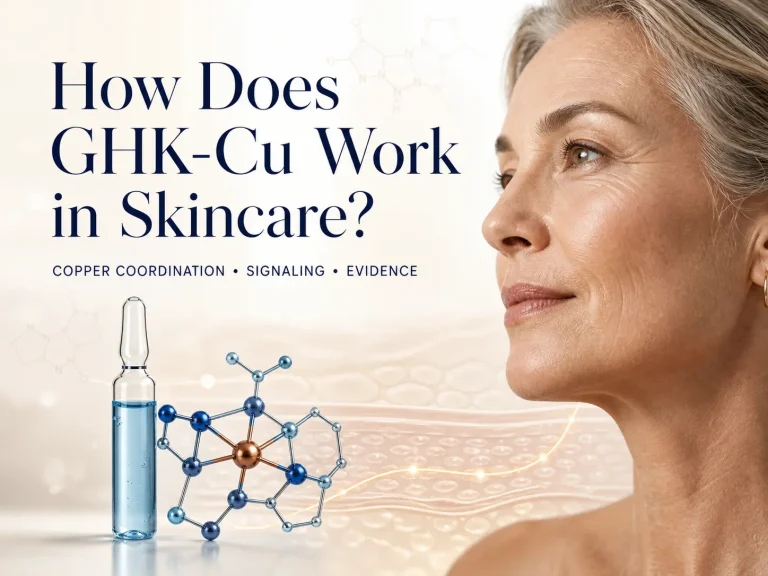
Among cosmetic peptides, the best-known copper-bound example is glycyl-L-histidyl-L-lysine copper, abbreviated GHK-Cu. GHK identifies the amino-acid sequence glycine-histidine-lysine; Cu identifies the coordinated copper ion. The Cosmetic Ingredient Review (CIR) assessment includes Copper Tripeptide-1 among the GHK-sequence ingredients and describes the reviewed group as functioning primarily as skin-conditioning agents.[1]
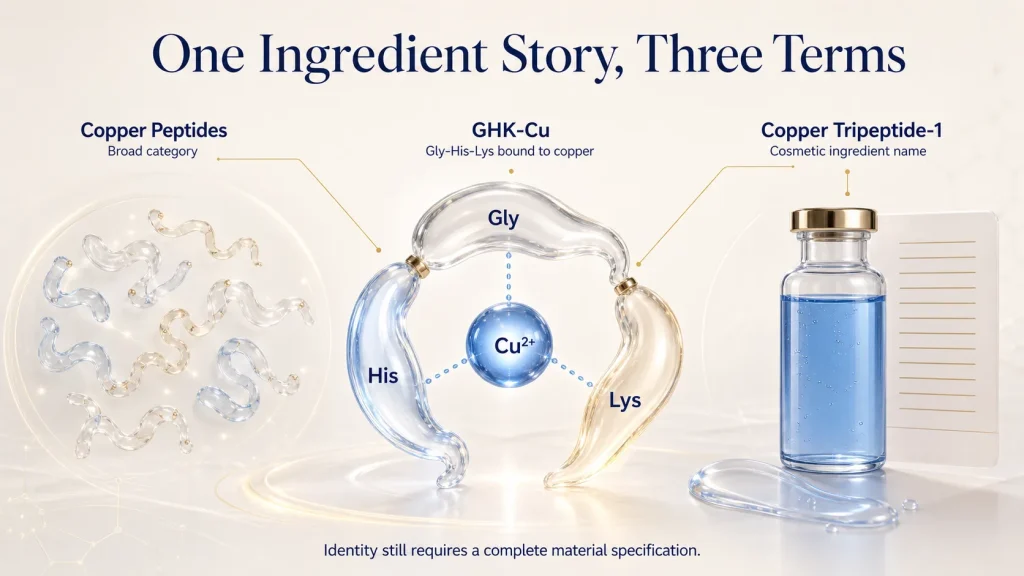
Copper Peptides, GHK-Cu, and Copper Tripeptide-1: Are They the Same?
The terms overlap, but they are not interchangeable specifications.
| Term | Practical Meaning | Important Boundary |
| Copper peptides | Broad family of peptide-copper complexes | Does not identify one peptide sequence, grade, concentration or evidence package |
| GHK | Glycine-histidine-lysine tripeptide | Does not by itself confirm that copper is coordinated |
| GHK-Cu | Copper complex of the GHK tripeptide | Scientific shorthand, not a complete raw-material specification |
| Copper Tripeptide-1 | Cosmetic ingredient name used for the GHK-copper complex | Does not establish finished-product performance |
This distinction matters commercially. A blue color or a generic “copper peptide” label cannot replace an INCI identity, sequence or complex description, assay basis, batch certificate and analytical method. Color can support an appearance check, but it cannot prove identity, purity, peptide content, copper stoichiometry, stability or efficacy.
Why Are Copper Peptides Used in Skincare?
Interest in copper peptides comes from connected lines of laboratory research involving fibroblast behavior, extracellular-matrix activity, tissue remodeling and oxidative pathways.[4,5] These findings provide a rationale for cosmetic concepts focused on firmer-looking skin, smoother-looking texture, fine-line appearance and overall skin quality. They are a starting point for product development, not a finished claim.
The most defensible copper peptide benefits can be grouped into three cosmetic directions:
1. Matrix-Oriented Appearance Concepts
Collagen, elastin, glycosaminoglycans and their organization influence how skin looks and feels. GHK-Cu is widely discussed as a signaling or carrier-type complex associated with matrix synthesis and remodeling. For cosmetics, that rationale may support “firmer-looking” or “smoother-looking” positioning when the finished formula is appropriately substantiated. It does not prove that a topical product rebuilds the dermis.
2. Skin-Conditioning and Comfort Concepts
CIR identifies the reviewed peptide ingredients primarily as skin-conditioning agents and concluded that they were safe in the practices of use and concentration described in the assessment.[1] That supports cosmetic use within the assessed boundary. It does not convert a cosmetic into a wound treatment, nor does it mean every complete formula is non-irritating for every user.
3. Antioxidant-Related Formulation Stories
Copper participates in several endogenous enzyme systems, and GHK-Cu research is frequently discussed in relation to oxidative balance.[4] In a cosmetic article, that background can explain why the ingredient attracts formulation interest. It should not be translated into absolute promises to prevent UV damage, repair DNA or reverse aging.
What Does the Evidence Actually Show?
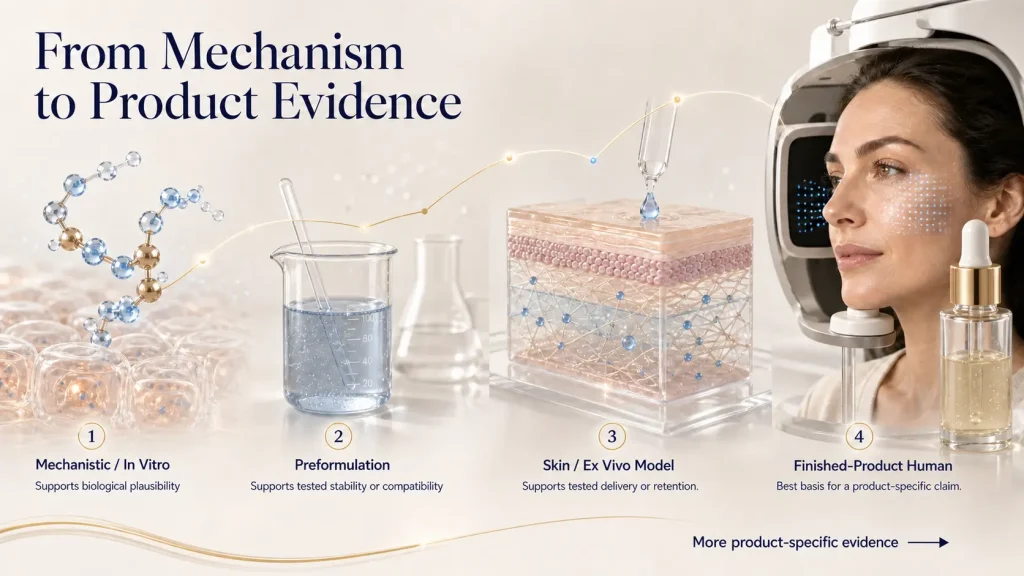
Peptide skincare evidence is not one single category. A cell experiment, a preformulation study, an ex vivo skin model and a controlled finished-product study answer different questions.
A 2016 preformulation study described GHK-Cu as highly hydrophilic and examined its stability under selected stress conditions and compatibility with selected formulation components.[2] The study reported stability in water and pH 4.5-7.4 buffers for at least two weeks at 60°C, while basic and oxidative stress promoted degradation. This is useful development information for the tested material and conditions, not a universal pH or shelf-life guarantee for every formula.
An in vitro human-skin study measured copper penetration and retention after applying a 0.68% aqueous GHK-Cu material to isolated skin layers for 48 hours.[3] It demonstrated that delivery and retention could be measured in that model. It did not establish that every commercial serum delivers the intact complex to the same location or produces the same visible outcome.
Human evidence also deserves a careful reading. In a small randomized study of skincare regimens used after CO2 laser resurfacing, 13 participants completed the study. Objective analysis found no significant between-group improvement in erythema, wrinkles or overall skin quality, although patient-reported satisfaction with overall skin quality was higher in the GHK-Cu group.[5] The result is informative precisely because it is mixed: it does not support a simple “clinically proven for every product” message. At the top of the evidence ladder, Finished-Product Human testing remains the best basis for a claim about the exact formula tested.
What Are the Main Copper Peptide Limitations?
The main copper peptide limitations are not that the ingredient has no scientific rationale. They are that the evidence, material identity and finished formula must be kept connected.
Evidence Is Material- and Formula-Specific
A result obtained with one GHK-Cu material, carrier or regimen does not automatically transfer to another. Sequence, copper coordination, concentration, solvent system, excipients, packaging and use pattern can change the relevant exposure and stability.
Topical Delivery Is Not Automatic
GHK-Cu is highly hydrophilic.[2] Skin-model research can show penetration or retention under defined conditions, but it cannot establish identical delivery from every commercial vehicle. Delivery claims should follow formula-specific evidence.
Stability Depends on the Surrounding Formula
A copper-peptide complex does not exist alone inside a serum. pH, competing chelators, reducing agents, oxidation, light, temperature, preservatives and packaging may influence appearance or chemical state. Compatibility should be tested in the intended formula rather than decided from a generic internet mixing rule.
Blue Color Is Descriptive, Not Proof
The current Skinkind Cosmetics product page describes Copper Tripeptide-1 powder as blue to deep blue and the supplied solution as a blue transparent liquid.[6] Those descriptions are useful for incoming appearance checks. They do not establish identity, HPLC purity, peptide content, copper ratio, stability or biological performance.
Tolerance Belongs to the Finished Product
CIR’s safety conclusion is bounded by the practices and concentrations assessed.[1] A finished product also contains a vehicle, preservatives, fragrance or other actives. “Generally well tolerated” should never become “cannot irritate,” and concentrated cosmetic raw materials should not be applied directly to the face.
Where Can Copper Peptides Fit in Product Development?
Copper peptides can support cosmetic concepts for mature-looking skin, texture, comfort, eye-area care and barrier-oriented positioning. A viable concept depends on the target market, regulatory wording, dosage form and evidence plan.
Raw-material format also changes the development task. Genopep presents Copper Tripeptide-1 as blue-to-deep-blue powder with HPLC purity options of at least 95% or at least 98%, and as a customizable blue transparent solution with peptide content from 1,000 ppm to 50,000 ppm.[6] These are supplier specifications and should be confirmed against the current TDS, specification and batch COA before use.
A powder can give formulators more control over stock-solution preparation, while a supplied solution can simplify handling and concentration calculations. Neither format is inherently superior. The decision should compare assay basis, preservation, transport, storage, batch documentation and the intended formula.
A Practical Evaluation Checklist for Brands
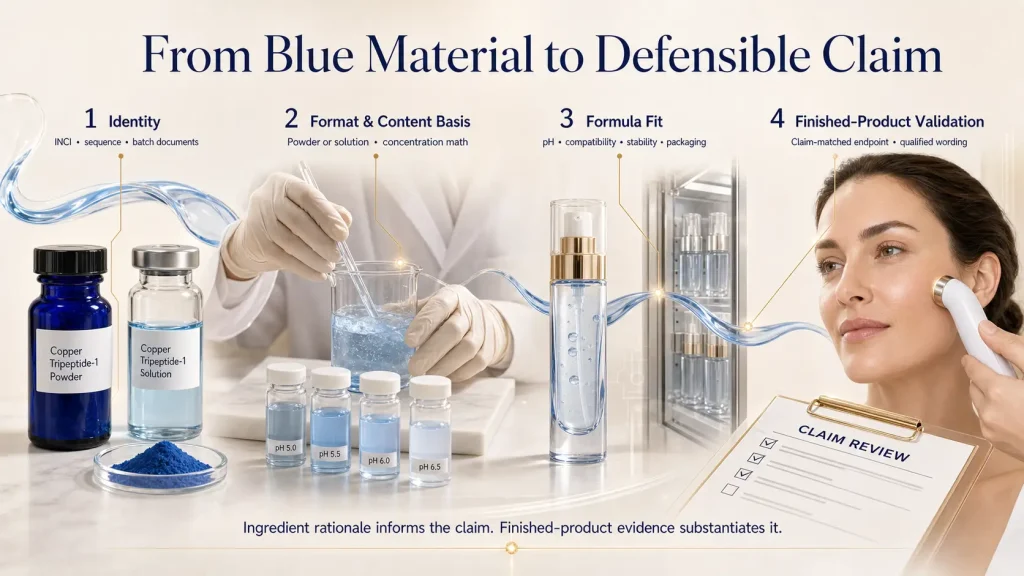
- Confirm identity: Review the INCI name, GHK sequence, copper-complex description and CAS information used by the supplier.
- Separate purity from content: HPLC purity, peptide content, active content and supplied-solution concentration answer different questions.
- Request batch documentation: Review the specification, COA, analytical method or chromatogram policy, SDS and storage requirements.
- Define the formula target: Decide whether the project is a copper peptide serum, emulsion, eye product or another format before choosing the raw-material form and input level.
- Run compatibility and stability work: Track color, odor, pH, viscosity, precipitation, packaging interaction, preservation and assay where appropriate.
- Build a claim ladder: Keep ingredient mechanism, formula rationale, instrumental endpoint and consumer-facing wording as separate layers.
- Test the finished product: Select endpoints that match the intended claim rather than using a general ingredient story as a substitute.
The most useful supplier question is therefore not simply “Do copper peptides work?” It is: “Which exact material are we buying, how is it characterized, how should it be handled, what does its evidence apply to, and what testing will our final claim require?”
Conclusion
So, what are copper peptides in skincare? They are peptide-copper complexes used in cosmetic skin-conditioning concepts, with GHK-Cu or Copper Tripeptide-1 as the best-known example. The science supports legitimate interest in matrix-oriented appearance, texture and skin-quality concepts. It also requires restraint: a plausible mechanism, blue color and raw-material specification are not substitutes for formula stability, compatibility and finished-product evidence.
For brands, the strongest story begins with exact identity, transparent specifications and realistic claims. It becomes commercially credible only when the material, formula, packaging and validation plan agree with one another.
Frequently Asked Questions
What do copper peptides do to your face?
In a finished cosmetic, copper peptides are generally used for skin-conditioning and concepts related to smoother-looking texture, firmer-looking skin and overall appearance. The outcome depends on the exact ingredient, formula, concentration, delivery, use pattern and study support. Copper peptides should not be described as rebuilding facial tissue or reversing aging.
What are the downsides of copper peptides?
The main downsides are uneven evidence quality, formula-dependent stability, uncertain transfer from ingredient studies to commercial products, possible irritation from the complete formula, and frequent confusion among purity, peptide content and concentration. Copper peptides may also increase testing and documentation requirements for a development project.
Do dermatologists recommend copper peptides?
There is no universal recommendation for every person or every copper-peptide product. A dermatologist may consider a well-formulated topical peptide product an optional cosmetic step, but the decision depends on skin condition, routine, tolerance, product quality and evidence for that specific formula.
How often should I use copper peptides on my face?
Follow the directions for the finished product. Frequency cannot be determined from the ingredient name alone because concentration, vehicle and accompanying ingredients differ. Do not apply a cosmetic raw-material powder or concentrated supplier solution directly to the face. Stop using a finished product if persistent stinging, redness or swelling occurs and seek appropriate professional advice.
How long does it take to see results from copper peptides?
There is no universal timeline. Hydration and skin feel may change sooner than fine-line or firmness measurements, but a time point reported for one study is not a promise for another formula. The most reliable timeline is the one established by a controlled study of the exact finished product.
CTA
Developing a copper peptide serum, cream or professional cosmetic concept? Genopep supplies Copper Tripeptide-1 in powder and customizable solution formats, with technical documentation and sample-evaluation support. Review the Skinkind Cosmetics Copper Tripeptide-1 product page and contact the team to discuss your target format, specification and development requirements.
References
1. Cosmetic Ingredient Review Expert Panel. Safety Assessment of Tripeptide-1, Hexapeptide-12, Their Metal Salts and Fatty Acyl Derivatives, and Palmitoyl Tetrapeptide-7 as Used in Cosmetics. Final Report. 2014.
2. Badenhorst T, Svirskis D, Wu Z. Physicochemical characterization of native glycyl-L-histidyl-L-lysine tripeptide for wound healing and anti-aging: a preformulation study for dermal delivery. Pharmaceutical Development and Technology. 2016;21(2):152-160.
3. Dymek M, et al. Human skin penetration of a copper tripeptide in vitro as a function of skin layer. Inflammation Research. 2011;60:79-86.
4. Pickart L, Margolina A. Regenerative and Protective Actions of the GHK-Cu Peptide in the Light of the New Gene Data. International Journal of Molecular Sciences. 2018;19(7):1987.
5. Miller TR, Wagner JD, Baack BR, Eisbach KJ. Effects of topical copper tripeptide complex on CO2 laser-resurfaced skin. Archives of Facial Plastic Surgery. 2006;8(4):252-259.
6. Skinkind Cosmetics / Genopep. Copper Tripeptide-1 (CAS: 49557-75-7) product page. Accessed August 2026.