Professional Cosmetics Peptide Supplier | GENOPEP



Does Acetyl Hexapeptide-8 Really Work? Clinical Evidence, Delivery Limits and Realistic Claims
Does Acetyl Hexapeptide-8 really work? Specific formulas have improved peri-orbital wrinkle measurements in controlled human studies, but the evidence does not prove that every Argireline serum, concentration or delivery system produces the same result. Low passive skin penetration, vehicle design, active-equivalent dose, test method and treatment period all affect the answer. Brands should therefore make finished-product, appearance-focused claims supported by testing of the marketed formula.
Introduction
The search question “does Acetyl Hexapeptide-8 really work” often compresses several different questions into one. A formulator may mean whether the peptide has a plausible laboratory mechanism. A brand may mean whether a finished serum can produce a measurable improvement. A consumer may mean whether visible expression lines will look smoother, how soon that might happen and whether the result will last. Those questions require different evidence.
Acetyl Hexapeptide-8, also associated with the Argireline name, is an expression line peptide used in cosmetic product concepts. Skinkind Cosmetics offers powder and solution formats within the Genopep facial-care portfolio.[8] These are formulation raw materials, not ready-to-use consumer products. The evidence for the ingredient must therefore be translated through composition, active content, vehicle, packaging, directions and finished-product testing before it becomes a defensible product claim.
What Does “Work” Mean for a Cosmetic Peptide?
A credible evaluation should define the endpoint before discussing peptide serum efficacy. “Works” may refer to lower instrument-measured roughness, a better investigator wrinkle grade, improved consumer perception, temporary hydration or a durable change after use stops. These outcomes are not interchangeable. A moisturizing base can rapidly make dry surface lines less visible, while an active-specific comparison requires an appropriate control and enough time to distinguish the complete formula from its vehicle.
For Acetyl Hexapeptide-8 results to support a marketed product, the study should match the product as closely as possible: the same formula, active-equivalent concentration, packaging, application amount, facial area, frequency and duration. An ingredient paper is valuable context, but it is not a certificate of efficacy for every product that lists the same INCI name.
What the Human Studies Actually Show
An early 2002 study described an oil-in-water emulsion containing the peptide and reported a reduction in wrinkle depth after 30 days.[1] The often-repeated “up to 30%” figure belongs to that small, defined study and should not be presented as a guaranteed result for a different formula. It is useful as proof that a topical concept was tested, not as a universal performance specification.
The most directly relevant controlled conventional-topical Acetyl Hexapeptide-8 clinical study was published in 2013. Sixty Chinese subjects were randomized in a 3:1 ratio to receive an Argireline formula or placebo on peri-orbital wrinkles twice daily for four weeks. The Argireline group showed improvement in subjective grading and silicone-replica roughness parameters, while the placebo group did not show the same objective decrease.[2] This is meaningful Argireline wrinkle evidence, but it remains limited to one population, one facial area, one formula and a four-week protocol.
A 2019 randomized, double-blind, controlled split-face study evaluated dissolving cross-linked hyaluronic-acid microstructure patches with or without Acetyl Hexapeptide-8. Fifty-two Korean women were enrolled; patches were applied to the lateral peri-orbital and nasolabial areas for four hours once weekly over 29 days. At the peri-orbital site, the peptide-containing patch showed greater improvement than the patch alone for selected wrinkle measures. In the nasolabial area, however, no significant between-product difference was found.[5] This study supports a delivery-system-specific result, not ordinary serum performance.
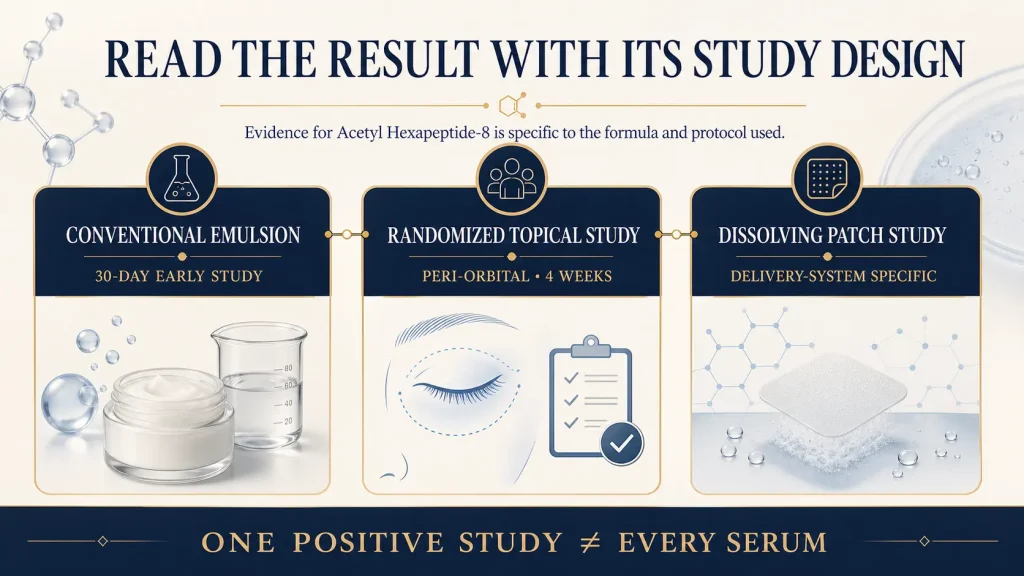
Why One Positive Study Does Not Prove Every Argireline Serum Works
The question “does Argireline reduce wrinkles” cannot be answered from the ingredient name alone. Two suppliers may sell materials with different peptide concentrations, water content, salts, solvents and preservatives. Two brands may then use different addition levels, processing temperatures, pH ranges, rheology systems and packages. Even when the declared ingredient is identical, the delivered active-equivalent dose and its condition during shelf life may not be identical.
Study design creates another layer of variation. Results can change with baseline wrinkle severity, facial expression during photography, lighting, replica preparation, device filters and statistical analysis. A percentage from one measurement variable should not be compared directly with a visual score from another study. Strong product development begins by defining the claim and endpoint, then choosing the method—not by selecting the largest percentage available for marketing.
Skin Penetration Is a Central Limitation
Argireline skin penetration is central because a proposed molecular mechanism and a topical outcome are not the same thing. In a 2015 in-vitro diffusion-cell study using an oil-in-water cosmetic formulation, most of the applied peptide was recovered in surface washes. In human cadaver skin, 0.22% of the applied dose was found in the stratum corneum, 0.01% in the viable epidermis and none in the dermis or receptor fluid under the test conditions.[3]
This does not prove that every topical product is ineffective. It shows that passive delivery cannot be assumed and that a mechanism involving deeper targets needs particularly careful substantiation. A separate porcine-skin study found that water-rich oil-in-water and water-in-oil-in-water emulsions delivered more Acetyl Hexapeptide-8 into skin than an oil-rich water-in-oil emulsion.[4] Vehicle architecture therefore changes the formulation question.
For a brand, the practical lesson is not to copy an emulsion architecture merely because it improved delivery in one laboratory model. The selected system must still meet stability, preservation, sensory, packaging, safety and claim requirements in the actual Acetyl Hexapeptide-8 formulation.
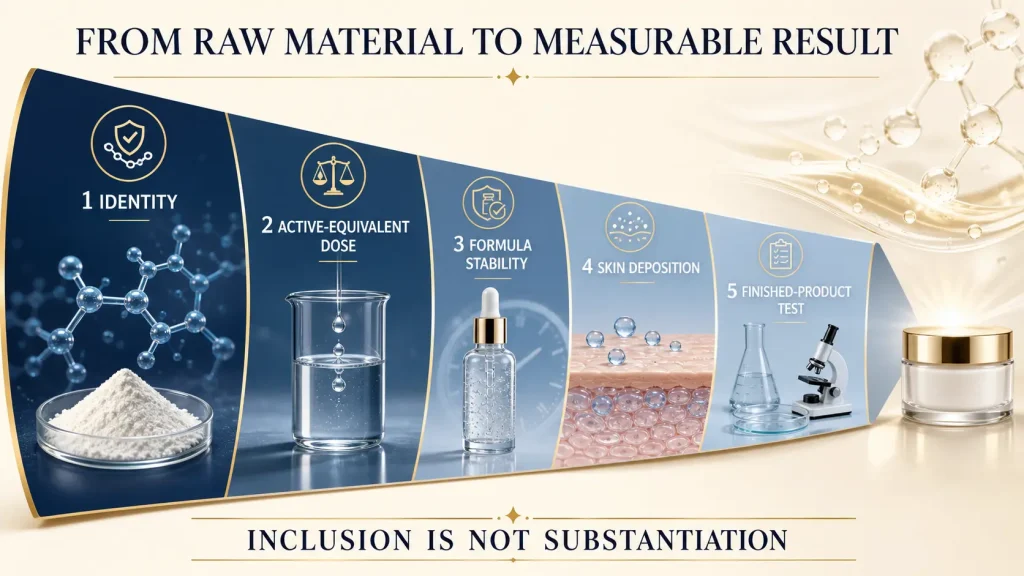
Can Argireline Reverse Existing Wrinkles?
“Reverse” implies more than a measured improvement in appearance. The published topical studies evaluated changes during defined use periods; they did not establish permanent removal of existing wrinkles or demonstrate that results persist after discontinuation. Expression lines, surface dryness, photoaging and deeper structural folds also have different contributors. A finished cosmetic may reasonably be tested for smoother-looking lines or reduced measured roughness, but permanent reversal is not supported by the available evidence.
This distinction also protects the cosmetic boundary. FDA explains that making lines less noticeable through cosmetic effects is different from claiming wrinkle removal or effects on the structure or function of the skin.[7] Public copy should describe the appearance outcome established by the finished-product study rather than repeat a laboratory mechanism as a consumer promise.
Is Argireline Stronger Than Retinol?
There is no robust head-to-head clinical study showing that Acetyl Hexapeptide-8 is stronger than retinol. The ingredients also sit in different evidence and formulation contexts. For example, a randomized, vehicle-controlled split-face study of 57 middle-aged Japanese women evaluated a 0.075% retinol cream for 26 weeks and reported significantly higher improvement rates for fine and deep wrinkling on the retinol-treated side than on the vehicle side.[6] That result cannot be numerically ranked against a four-week Argireline study with different subjects, endpoints and formulas.
For product teams, a more useful decision is whether the concept needs an expression-line peptide story, a retinol-led photoaging story, a combination strategy or a different route altogether. Compatibility, irritation potential, target user, routine position and intended claims matter more than an unsupported “stronger” label.
How Brands Should Evaluate Acetyl Hexapeptide-8 Evidence
An evidence-led development team can use the following sequence:
1. Confirm ingredient identity, composition, peptide content and batch-specific quality documents.
2. Convert the supplier material addition level into the actual active-equivalent peptide concentration.
3. Select a vehicle using compatibility and stability data rather than mechanism language alone.
4. Define the exact facial area, application amount, frequency, duration and packaging.
5. Test preservation, physical stability and peptide-related stability in the final formula.
6. Choose an efficacy endpoint that matches the intended appearance claim.
7. Evaluate the marketed formula against an appropriate control when an active-specific claim is important.
From Evidence to Responsible Claims
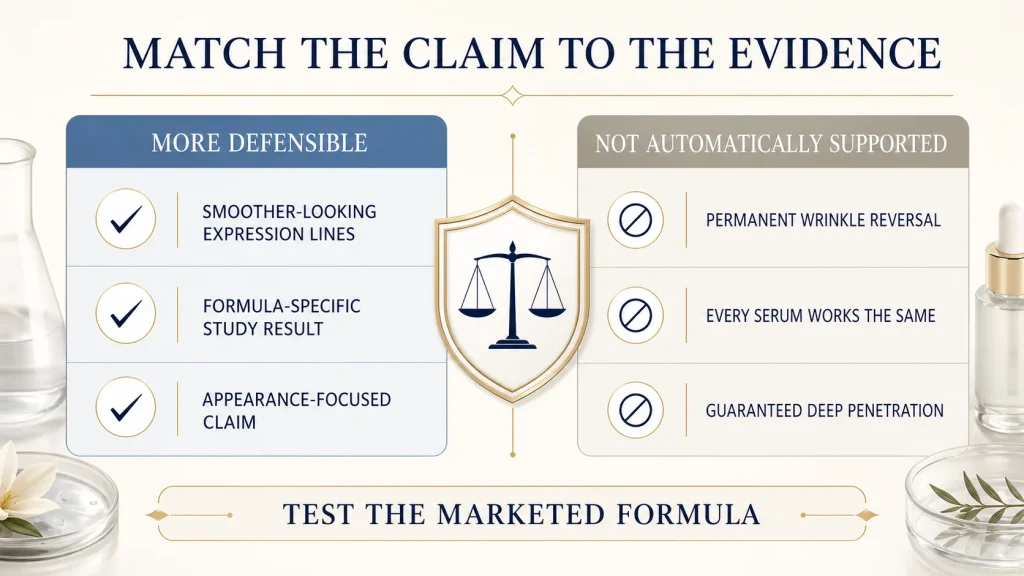
| Evidence position | More defensible wording | Wording that needs stronger or different substantiation |
| Finished formula improves a validated wrinkle-appearance measure | Helps improve the appearance of expression lines | Eliminates or permanently reverses wrinkles |
| Formula-specific controlled result | In a study of this finished formula and protocol | Clinically proven ingredient result for every product |
| Ingredient is part of a tested cosmetic concept | Formulated with Acetyl Hexapeptide-8 for smoother-looking skin | Works like an injection or paralyzes facial muscles |
| Vehicle study shows formulation affects deposition | Delivery depends on the finished formulation | Guaranteed deep penetration |
The wording should follow the evidence, not the other way around. If a brand wants to claim a particular percentage, timeframe or facial area, its substantiation file should support that exact statement. Supplier studies can help design the program, but the marketed product remains responsible for its own claims.
Where Skinkind Cosmetics Acetyl Hexapeptide-8 Fits
Skinkind Cosmetics supplies Acetyl Hexapeptide-8 in powder and solution formats for cosmetic formulation work.[8] The choice should begin with the technical file, not with an assumed consumer dose. Brands should confirm what the supplied percentage represents, request relevant specifications and storage guidance, and calculate the final active-equivalent concentration before planning efficacy work.
The most defensible commercial value is not a universal claim that the raw material “works.” It is the ability to connect verified material identity, an appropriate finished formula and a claim-specific test plan. Genopep can support the ingredient-format discussion, while the brand and its testing partners establish what the final product actually delivers.
Conclusion
Does Acetyl Hexapeptide-8 really work? The balanced answer is that specific topical and microstructure-patch formulas have produced positive wrinkle-appearance measurements, especially in peri-orbital studies. At the same time, limited passive skin penetration and strong dependence on formulation and study design prevent those findings from becoming a universal promise for every peptide serum.
For brands and formulators, the next step is not to choose the largest published number. It is to verify the supplied material, calculate active content, build a stable and suitable vehicle, and test the marketed formula against the exact claim. That process turns Acetyl Hexapeptide-8 clinical study evidence into a responsible product-development decision.
Frequently Asked Questions
Does acetyl hexapeptide-8 really work?
Specific formulas containing Acetyl Hexapeptide-8 have improved peri-orbital wrinkle measurements in controlled studies. The result is formula- and protocol-specific, however. It does not establish that every product containing the ingredient will produce the same improvement.
What are the results of acetyl hexapeptide-8?
Published results include lower wrinkle roughness or depth measurements in defined topical studies and selected improvements with a dissolving microstructure patch. Percentages, treatment periods and facial areas differ, so results should be reported with their study conditions rather than combined into one universal number.
Does Argireline really reduce wrinkles?
An Argireline formula has reduced measured peri-orbital wrinkle parameters in a randomized placebo-controlled study. A responsible interpretation is that the tested formula improved wrinkle appearance under those conditions—not that the raw material guarantees wrinkle reduction in every finished product.
Can Argireline reverse existing wrinkles?
Current studies support measured appearance changes during defined use periods. They do not demonstrate permanent reversal, removal of every wrinkle type or persistence after discontinuation. Finished-product claims should therefore focus on the tested visible outcome.
Is Argireline stronger than retinol?
There is no adequate head-to-head clinical trial that ranks Acetyl Hexapeptide-8 against retinol. They have different formulation, tolerance and evidence contexts. Product teams should choose or combine them according to the target user, formula feasibility and intended claim rather than an unsupported strength ranking.
CTA
Explore Acetyl Hexapeptide-8 powder and solution formats from Skinkind Cosmeticsand request the composition, active-content and formulation information needed to evaluate the ingredient in your finished product.
- How Does Acetyl Hexapeptide-8 Work?
- Do Topical Peptides Really Work for Wrinkles?
- How Long Does Acetyl Hexapeptide-8 Take to Work?
- Where Can You Use Acetyl Hexapeptide-8 on the Face?
References
1. Blanes-Mira C, Clemente J, Jodas G, et al. A synthetic hexapeptide (Argireline) with antiwrinkle activity. International Journal of Cosmetic Science. 2002;24(5):303-310. DOI record
2. Wang Y, Wang M, Xiao S, et al. The anti-wrinkle efficacy of argireline, a synthetic hexapeptide, in Chinese subjects: a randomized, placebo-controlled study. American Journal of Clinical Dermatology. 2013;14(2):147-153. PubMed record
3. Kraeling MEK, Zhou W, Wang P, Ogunsola OA. In vitro skin penetration of acetyl hexapeptide-8 from a cosmetic formulation. Cutaneous and Ocular Toxicology. 2015;34(1):46-52. PubMed record
4. Hoppel M, Reznicek G, Kählig H, et al. Topical delivery of acetyl hexapeptide-8 from different emulsions: influence of emulsion composition and internal structure. European Journal of Pharmaceutical Sciences. 2015;68:27-35. PubMed record
5. An JH, Lee HJ, Yoon MS, Kim DH. Anti-Wrinkle Efficacy of Cross-Linked Hyaluronic Acid-Based Microneedle Patch with Acetyl Hexapeptide-8 and Epidermal Growth Factor on Korean Skin. Annals of Dermatology. 2019;31(3):263-271. Full-text record
6. Kikuchi K, Suetake T, Kumasaka N, Tagami H. Improvement of photoaged facial skin in middle-aged Japanese females by topical retinol: a vehicle-controlled, double-blind study. Journal of Dermatological Treatment. 2009;20(5):276-281. PubMed record
7. U.S. Food and Drug Administration. Wrinkle Treatments and Other Anti-aging Products.
8. Skinkind Cosmetics. Acetyl Hexapeptide-8, CAS 616204-22-9, Anti-Wrinkle and Firming Peptides.