Professional Cosmetics Peptide Supplier | GENOPEP



How Does Acetyl Hexapeptide-8 Work? Understanding Its SNAP-25 and SNARE-Inspired Mechanism
Acetyl Hexapeptide-8 is a synthetic hexapeptide designed from a SNAP-25-related sequence. In laboratory mechanism studies, it interfered with the formation or stability of the SNARE complex involved in calcium-dependent vesicle fusion and neurotransmitter release. For topical cosmetics, however, skin delivery and finished-formula validation determine whether this mechanism translates into visible results.
Introduction
Acetyl Hexapeptide-8 is often introduced as “Botox in a bottle.” The phrase is memorable, but it compresses a multistep scientific story into a comparison that can easily be misunderstood. A topical six-amino-acid cosmetic ingredient is not the same material, delivery route or intervention as an injected botulinum neurotoxin. The useful question is therefore not whether the two are equivalent, but what the acetyl hexapeptide-8 mechanism actually proposes and what must happen before that molecular rationale can matter in a finished skincare product.
This article separates three layers that should not be merged: the laboratory-derived acetyl hexapeptide-8 mechanism of action, the ability of a topical vehicle to deposit peptide in skin, and evidence generated by the finished formula. That distinction helps formulators and brands use mechanism language accurately without dismissing the ingredient or overstating what the available research proves.
What Is Acetyl Hexapeptide-8?
Acetyl Hexapeptide-8 is a synthetic peptide used as a skin-conditioning ingredient in cosmetic formulations. Its CAS number is 616204-22-9, and its sequence is Ac-Glu-Glu-Met-Gln-Arg-Arg-NH2, commonly abbreviated as Ac-EEMQRR-NH2.[1] It is widely associated with the name Argireline. Older publications and commercial descriptions may call it Acetyl Hexapeptide-3, but current ingredient identity and purchasing documents should be checked against the applicable INCI name, CAS number, composition and sequence rather than relying on an older synonym.
Skinkind Cosmetics lists Acetyl Hexapeptide-8 in powder and solution formats. The current page presents powder specifications at not less than 95% or 98% HPLC purity and solution options including 500 ppm and 1,000 ppm, with customization available. Those values describe different commercial formats, not interchangeable active doses. The exact composition, active content, analytical basis and batch acceptance criteria should be confirmed through the current TDS, composition statement and COA for the material purchased.
What Do SNAP-25 and the SNARE Complex Normally Do?
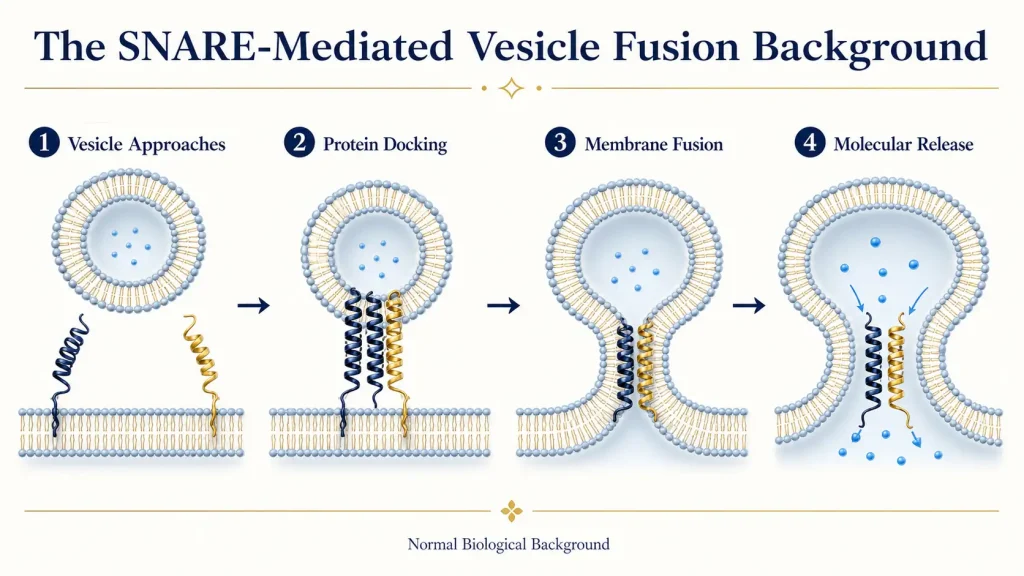
Before examining the Argireline mechanism, it helps to understand the biological background. Cells release signaling molecules from small membrane-bound vesicles. In regulated exocytosis, proteins on the vesicle and target membrane assemble into a SNARE complex that draws the two membranes together. SNAP-25 is one of the membrane-associated components in this protein machinery. When the appropriate calcium-dependent trigger occurs, the docked vesicle can fuse with the membrane and release its contents.
At a neuromuscular junction, this process is involved in acetylcholine release and the signaling sequence that precedes muscle contraction. This background explains why the words SNAP-25, SNARE complex and neurotransmitter release appear in discussions of expression lines. It does not, by itself, establish that a topical cosmetic peptide reaches that anatomical target in human use.
How Is Acetyl Hexapeptide-8 Proposed to Affect This Pathway?
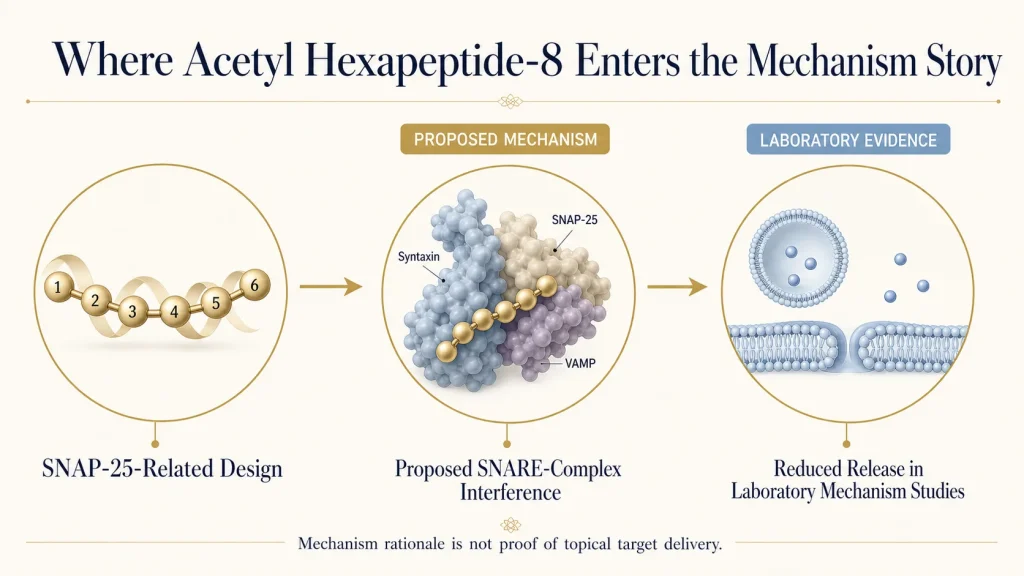
The original mechanism paper described Acetyl Hexapeptide-8 as a SNAP-25-related peptide designed to interfere with regulated secretion. In experimental systems, the researchers reported that it destabilized or interfered with formation of the SNARE complex and inhibited catecholamine release, although it was less potent than botulinum neurotoxin A.[1] The proposed acetyl hexapeptide-8 mechanism is therefore competitive or disruptive at the level of protein-complex assembly, not enzymatic cleavage of SNAP-25.
If less functional SNARE machinery is assembled in a relevant experimental model, vesicle fusion and molecular release can be reduced. Cosmetic marketing then connects this laboratory rationale to softer-looking dynamic expression lines. The scientific wording matters: the evidence supports a proposed pathway and laboratory observations; it does not prove that every serum containing the ingredient inhibits neurotransmitter release in living facial muscle.
The original paper also reported an oil-in-water emulsion study in which a formula containing 10% of the commercial hexapeptide preparation produced up to a 30% reduction in wrinkle depth after 30 days.[1] This is formula- and protocol-specific evidence, not a universal result for all Acetyl Hexapeptide-8 products. It should also not be confused with 10% pure peptide unless the commercial preparation’s active content is known.
Why This Is Not the Same as an Injectable Treatment
Botulinum neurotoxin A is a much larger biological toxin delivered by injection to a selected anatomical site, where its light chain enzymatically cleaves SNAP-25. Acetyl Hexapeptide-8 is a small cosmetic peptide applied on the skin and proposed to interfere with SNARE assembly or stability. The two therefore differ in identity, route, target access, biochemical action, dose control, evidence standard and regulatory status.
For cosmetic communication, “helps reduce the appearance of expression lines” is materially different from claiming to paralyze muscle, block neuromuscular transmission or replace an injectable procedure. FDA explains that a product intended to make wrinkles less noticeable through cosmetic effects may be a cosmetic, while claims to affect body structure or function can place a product in drug or device territory.[6] Claim wording must therefore follow the market, finished-formula evidence and qualified regulatory review.
The Skin Barrier Is the Missing Step
The largest gap between a plausible molecular model and topical performance is peptide skin penetration. Acetyl Hexapeptide-8 is hydrophilic, and intact skin is designed to limit the passage of water-soluble molecules. A 2015 diffusion-cell study applied the ingredient to human cadaver skin and recovered about 99.7% in skin-surface washes. Approximately 0.22% was found in the stratum corneum, 0.01% in the viable epidermis, and none in the dermis or receptor fluid.[2]
These findings do not prove that all topical formulas are ineffective, because vehicle, dose, contact time and testing model can change deposition. They do show why a mechanism diagram cannot substitute for delivery data. A 2025 review similarly concluded that the ability of topically applied Acetyl Hexapeptide-8 to reach neuromuscular junctions remains uncertain.[5] The defensible conclusion is that delivery is a formulation problem to be measured, not an assumption to be hidden.
Why Vehicle and Formula Design Matter
Vehicle architecture can influence how a hydrophilic peptide partitions, releases and deposits. In a 2015 porcine-skin study, a multiple water-in-oil-in-water emulsion increased Acetyl Hexapeptide-8 penetration compared with simple oil-in-water and water-in-oil emulsions. The study also found better delivery from water-rich systems than from an oil-rich water-in-oil emulsion.[3] This supports the practical importance of cosmetic peptide formulation, but it does not demonstrate delivery to facial muscle or guarantee visible efficacy in consumers.
Formulators must also distinguish three percentages. HPLC purity describes the proportion of peptide-related material in a powder under the stated analytical method. Peptide content in a supplied solution may be expressed in ppm. The supplier solution’s use level is the percentage of that entire raw material added to a formula. Final active peptide concentration is calculated from the verified active fraction, not inferred from the solution use level alone.
How to Read the Current Product-Page Mechanism
The Skinkind Cosmetics product page currently presents the ingredient through familiar supplier language: SNARE-complex inhibition, reduced acetylcholine release, relaxation of facial-muscle contraction and improvement in expression lines. It also retains a 32% wrinkle-depth figure over 28 days. These statements remain part of the product-page information. In this evidence-led article, however, they are placed in context rather than treated as proof that every finished topical formula reaches muscle or reproduces the same numerical result.
The page claim, the original laboratory mechanism and finished-product substantiation are three different evidence categories. Brands using the 32% figure should confirm its source report, material identity, active-equivalent dose, tested vehicle, subject population, measurement method and statistical analysis before transferring it to packaging or advertising. This is especially important when the marketed formula differs from the formula behind the figure.
What the Mechanism Means for Brands and Formulators
A responsible development program treats the acetyl hexapeptide-8 mechanism as the beginning of an evidence chain:
1. Confirm ingredient identity: INCI name, CAS number, sequence and complete supplied composition.
2. Calculate active-equivalent dose: convert powder assay or solution ppm into final active concentration.
3. Design the vehicle: consider peptide solubility, compatibility, processing temperature, pH, preservation and release.
4. Verify stability and deposition: test the ingredient in the intended formula and packaging, using an appropriate analytical method.
5. Substantiate the appearance claim: evaluate the finished product against a defined endpoint, control and protocol.
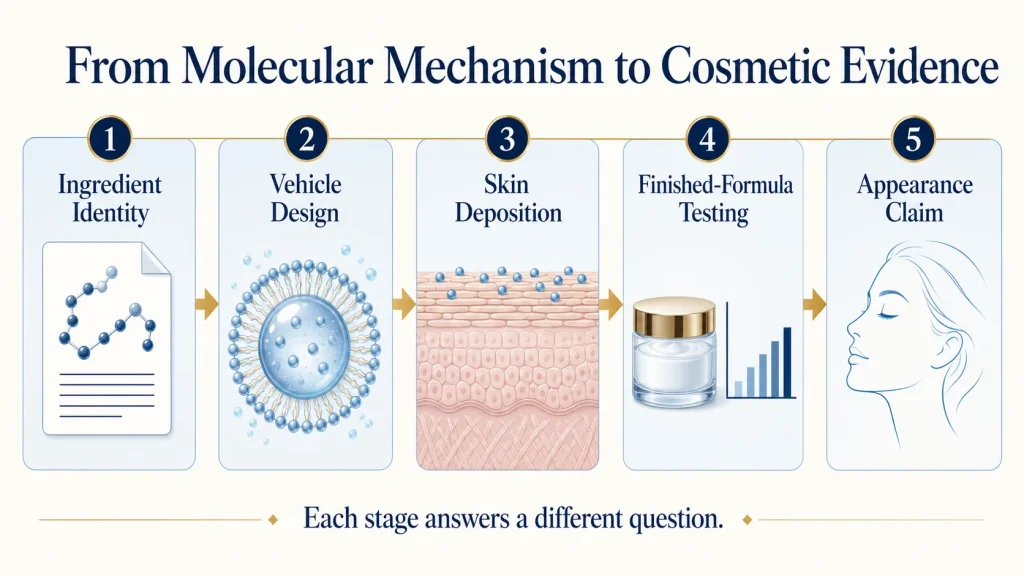
This chain prevents two common errors: treating a molecular pathway as if it were a finished-product result, and rejecting a promising ingredient simply because unoptimized delivery is limited. Mechanism, material quality, formula design and human-use evidence answer different questions. A credible B2B ingredient story shows how they connect.
Conclusion
The acetyl hexapeptide-8 mechanism is scientifically interesting because it was designed around a SNAP-25-related sequence and, in laboratory systems, interfered with SNARE-complex formation or stability and reduced regulated molecular release.[1] That is the molecular rationale behind its use in expression-line skincare.
For topical cosmetics, the complete answer must continue beyond that mechanism. Skin barrier limits, vehicle performance, verified active content, stability and finished-formula testing determine whether the concept becomes a supportable cosmetic claim. The most credible position is neither “topical Botox” nor “mechanism without value,” but a clearly bounded, formulation-dependent ingredient rationale that should be validated in the actual product.
Frequently Asked Questions
What is the mechanism of action of acetyl hexapeptide-8?
Acetyl Hexapeptide-8 was designed from a SNAP-25-related sequence. Laboratory research proposed that it interferes with formation or stability of the SNARE complex involved in regulated vesicle fusion and molecular release. Whether a topical product reproduces this pathway depends on delivery and finished-formula validation.
How does the Argireline peptide work?
The proposed Argireline mechanism is interference with SNARE-protein assembly rather than enzymatic cleavage of SNAP-25. In laboratory models, this was associated with reduced regulated secretion. Cosmetic claims should focus on the appearance of expression lines unless stronger wording is supported and legally appropriate.
What is the sequence of acetyl hexapeptide-8?
The sequence is Ac-Glu-Glu-Met-Gln-Arg-Arg-NH2, abbreviated Ac-EEMQRR-NH2. Purchasing teams should verify this identity together with the INCI name, CAS number and supplied composition.
Is acetyl hexapeptide-8 the same as Argireline?
Argireline is the commercial name commonly associated with Acetyl Hexapeptide-8. Because commercial preparations can differ in concentration and carrier composition, buyers should not assume that every product using the name has the same specification.
CTA
Explore Acetyl Hexapeptide-8 powder and solution formats from Skinkind Cosmeticsand request the composition, specification and formulation guidance needed for your expression-line skincare concept.
Suggested Internal Links
- Dynamic Wrinkles vs. Static Wrinkles: What Is the Difference?
- Why Do Facial Expressions Turn Into Wrinkles?
- Do Topical Peptides Really Work for Wrinkles?
References
[1] Blanes-Mira C, Clemente J, Jodas G, et al. A synthetic hexapeptide (Argireline) with antiwrinkle activity. International Journal of Cosmetic Science. 2002;24(5):303-310. PMID record
[2] Kraeling MEK, Zhou W, Wang P, et al. In vitro skin penetration of acetyl hexapeptide-8 from a cosmetic formulation. Cutaneous and Ocular Toxicology. 2015;34(1):46-52. PMID record
[3] Hoppel M, Reznicek G, Kählig H, et al. Topical delivery of acetyl hexapeptide-8 from different emulsions: influence of emulsion composition and internal structure. European Journal of Pharmaceutical Sciences. 2015;68:27-35. DOI record
[4] Wang Y, Wang M, Xiao XS, et al. The anti-wrinkle efficacy of argireline, a synthetic hexapeptide, in Chinese subjects: a randomized, placebo-controlled study. American Journal of Clinical Dermatology. 2013;14(2):147-153. PMID record
[5] Wojtyniak K, Pastuszak K, Golda-Cepa M, et al. Acetyl Hexapeptide-8 in Cosmeceuticals – A Review of Skin Permeability and Efficacy. International Journal of Molecular Sciences. 2025;26(12):5722. Full-text record
[6] U.S. Food and Drug Administration. Wrinkle Treatments and Other Anti-aging Products. FDA guidance page
[7] Skinkind Cosmetics. Acetyl Hexapeptide-8, CAS 616204-22-9, Anti-Wrinkle and Firming Peptides. Product page