Professional Cosmetics Peptide Supplier | GENOPEP



Pentapeptide-18 and Expression Lines: Synaptic Vesicle Fusion as Cosmetic Science Context
Introduction to Neuro-Cosmetics and Expression Lines
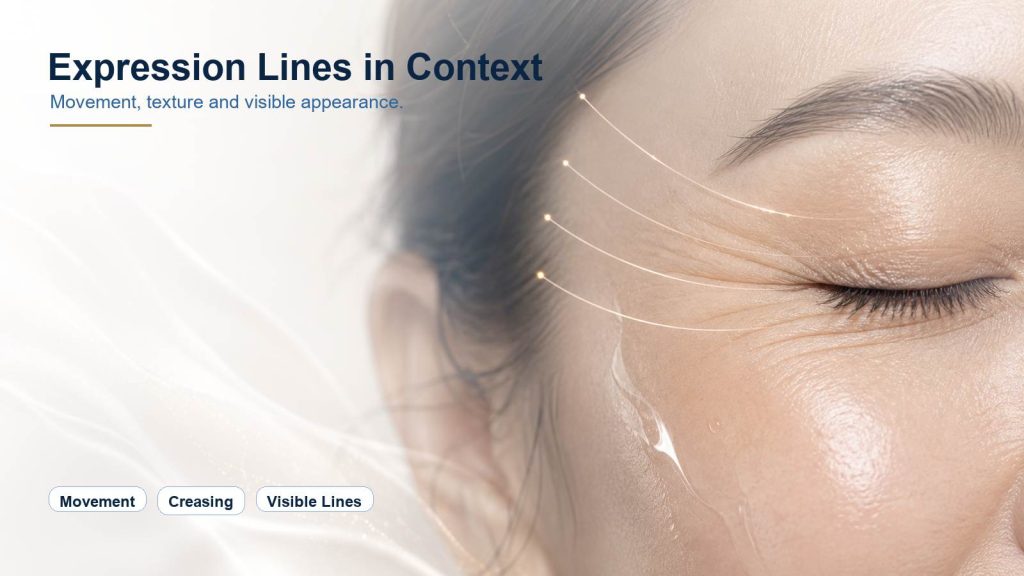
The professional skincare conversation has moved beyond basic epidermal hydration and barrier repair. A more advanced discussion now includes neuro-cosmetics: the study of how skin appearance is shaped not only by the stratum corneum and extracellular matrix, but also by repeated facial movement, sensory perception and mechanism-informed peptide design.
Every facial expression reflects a coordinated neuromuscular event. Action potentials travel along motor neuron axons and signal at the neuromuscular junction. Repeated contraction then creates local mechanical stress on the overlying dermal structure. Over time, that repeated movement can help transform temporary expression lines into more persistent visible creases.
This does not mean the finished product should be written as a nerve or muscle intervention. For skincare brands, the useful point is more practical: expression-line care sits at the intersection of visible skin appearance, repeated facial movement and ingredient storytelling. The article can explain the biology, while finished-product language should stay with cosmetic appearance claims.
The Molecular Cascade of Synaptic Vesicle Fusion
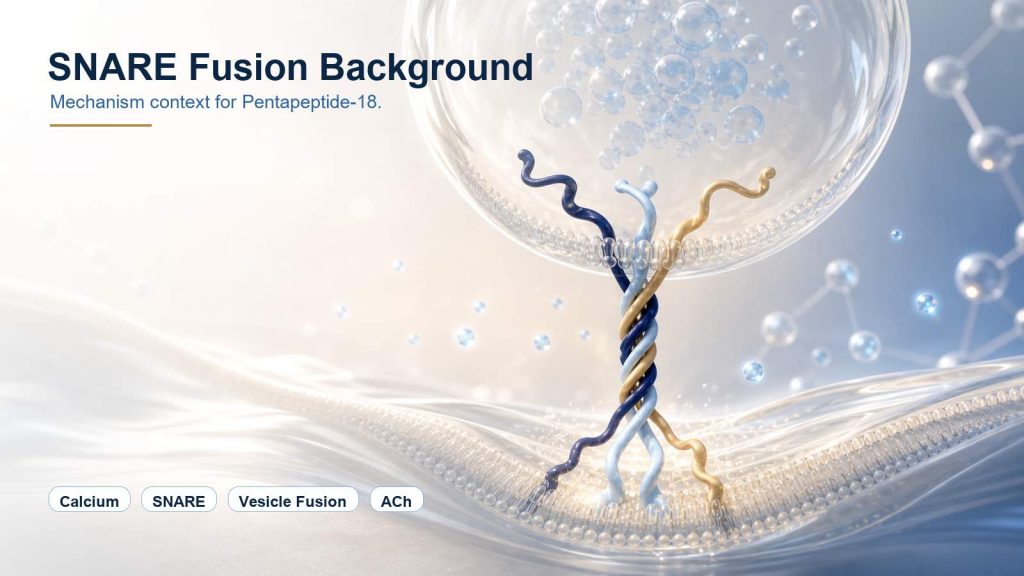
To understand the Pentapeptide-18 mechanism of action as a concept, it is useful to begin with the biology of neurotransmitter exocytosis. When an action potential reaches the presynaptic nerve terminal, membrane depolarization opens voltage-gated calcium channels, including N-type and P/Q-type calcium channels. The resulting calcium influx acts as a rapid trigger for synaptic vesicle mobilization.
The structural engine of this release process is the SNARE complex. Three proteins are central to the assembly: SNAP-25 on the presynaptic plasma membrane, Syntaxin-1 as a membrane protein on the same side, and VAMP, also known as Synaptobrevin, on the synaptic vesicle. These proteins zip together into a stable four-helix bundle, pulling the vesicle toward the membrane and supporting acetylcholine release into the synaptic cleft.
The cascade can be summarized as: action potential arrival -> presynaptic membrane depolarization -> calcium-channel opening -> calcium influx -> SNARE assembly -> synaptic vesicle fusion -> acetylcholine release -> postsynaptic signaling and muscle movement. This sequence is biology background, not a finished-product promise.
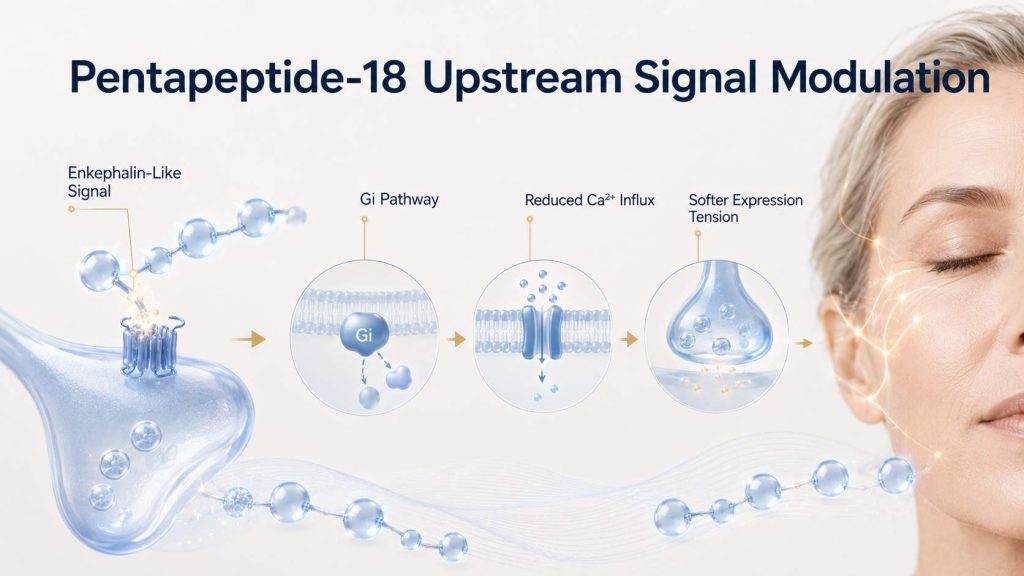
In biological systems, enkephalin and opioid-receptor pathways are examples of upstream feedback networks that can influence presynaptic excitability through GPCR and Gi signaling, cAMP changes, calcium-channel behavior and potassium-channel effects. This pathway is relevant scientific context for Pentapeptide-18. In cosmetic writing, however, it should be framed as bio-inspired rationale rather than proof that a topical product controls neurotransmission.
Why Hydration and Turnover Are Not the Whole Story
Many established skincare technologies remain valuable for expression-line formulas. High-molecular-weight hyaluronic acid and film-forming polymers can bind water, improve surface comfort and create a temporary plumping look on the stratum corneum. Retinoids and alpha-hydroxy acids are usually discussed through epidermal turnover, texture renewal and extracellular-matrix support.
The limitation is not that these ingredients are useless. The limitation is that dehydration lines, texture roughness and movement-related expression lines are not the same problem. A stronger formula story can assign each ingredient family a realistic role instead of asking one mechanism to explain every wrinkle-related claim.
Pentapeptide-18 can be positioned as part of a neuro-inspired peptide approach for expression-line skincare. The safer finished-product language is appearance-based: supports the look of smoother expression lines, helps create a relaxed-looking appearance, and complements hydration or texture-focused ingredients. The article can discuss neurotransmission biology, while the product claim should avoid procedure-like performance language or a fixed biological outcome.
Product Development and Claim Evidence
For skincare brands, the practical value of this topic is not only the mechanism. It is the ability to turn a complex peptide story into a clearer product file: ingredient identity, supplier documentation, use level, formula compatibility, stability, sensory performance and finished-product claim support.
Because expression-line claims are visual claims, a development plan should include appearance-based evidence. Useful options may include expert grading, standardized photography, image analysis, skin-surface measurement and consumer perception over a defined use period. Mechanism literature helps explain why an ingredient is interesting, but it does not replace finished-formula evidence.
The strongest Pentapeptide-18 story therefore keeps two layers separate. The science layer can explain synaptic vesicle fusion, SNARE assembly and upstream feedback biology. The commercial claim layer should use cosmetic language that a consumer can understand and a regulatory reviewer can evaluate.
Conclusion
Pentapeptide-18 does not need to be framed with exaggerated medical language to be compelling. Its stronger role is as a neuro-inspired peptide concept that helps brands explain expression-line care with more scientific depth. The key is to preserve the mechanism while controlling the claim: educate on biology, then promise only what a cosmetic product and its evidence can support.
Genopep can support skincare product teams with peptide ingredient options, formulation positioning and claim-language review for neuro-inspired expression-line products.
References
- Südhof, T. C. (2013). Neurotransmitter release: the last millisecond in the life of a synaptic vesicle. Science, 342(6164), 1324-1333. https://doi.org/10.1126/science.1233232
- Rizo, J., & Xu, J. (2015). The synaptic vesicle release machinery. Annual Review of Biophysics, 44, 339-367. https://doi.org/10.1146/annurev-biophys-060414-034057
- Dolphin, A. C. (2012). Functional roles of voltage-gated calcium channel beta subunits. Biochimica et Biophysica Acta (BBA)-Biomembranes, 1818(7), 1651-1662. https://doi.org/10.1016/j.bbamem.2011.11.026
- Gutstein, H. B., & Akil, H. (2006). Opioid analgesics. Goodman and Gilman’s The Pharmacological Basis of Therapeutics, 11th Ed, 547-590. Used here only as general pathway background, not as cosmetic product evidence.