Professional Cosmetics Peptide Supplier | GENOPEP



Beyond Botulinum: The Evolution of Non-Paralytic Topical Muscle Relaxants in Anti-Aging Chemistry
The Limitations and Risks of Type A Botulinum Toxin
In the hierarchy of aesthetic medicine, intramuscular injections of Botulinum Toxin Type A (BoNTA) have long been considered the benchmark for addressing hyperkinetic facial lines. Despite its widespread clinical use, this neurotoxin presents several structural drawbacks and biological risks that limit its long-term viability for a growing segment of consumers. Mechanistically, BoNTA acts by entering the presynaptic cholinergic nerve terminal and enzymatically cleaving SNAP-25, a crucial component of the SNARE complex. This cleavage causes an irreversible block of acetylcholine release, resulting in localized muscle paralysis. However, this absolute blockade often leads to undesirable side effects, such as the widely criticized “frozen face” syndrome, ptosis, and temporary facial asymmetry due to unpredictable tracking or systemic diffusion into unintended muscle groups.
Furthermore, BoNTA injections suffer from a short biological half-life, typically requiring repeated clinical procedures every three to four months to sustain visible improvements. This chronic re-exposure carries a significant immunological risk: the development of neutralizing antibodies against the core neurotoxin or its complexing proteins. Over time, this antibody mediated resistance renders subsequent treatments clinically ineffective. These drawbacks, combined with injection pain and cost barriers, have fueled a strong market demand for non-invasive topical alternatives. Modern cosmetic chemistry has responded by engineering advanced molecules capable of modulating muscle micro-contractions progressively and safely, positioning these topical compounds as an essential alternative for mature skin care.
Mechanisms of Chemical Neuromodulation in Topicals
The evolution of anti-aging topical chemistry marks a transition from simple epidermal hydration to targeted molecular biology. Early cosmetic formulations relied almost exclusively on occlusive emollients and humectants like high-molecular-weight hyaluronic acid to plump the stratum corneum and mask fine lines through superficial hydration. As the understanding of dermal aging deepened, the industry advanced to signal peptides designed to stimulate fibroblasts. Today, the cutting edge of anti-aging science focuses on biomimetic neuropeptides that can safely manage the neurological signals responsible for dynamic facial wrinkling.
Target Pathway Contrast Matrix
| Dimension | Approach A | Approach B | Approach C |
|---|---|---|---|
| Pathway Name | Downstream Paralyzing Cleavage | Downstream Reversible Competition | Upstream Neuromodulation |
| Representative Approach | Botulinum Toxin Injectables | SNAP-25 Mimetic Peptides | Enkephalin-Mimetic GPCR Agonists |
| Mechanism | Irreversible enzymatic destruction of SNAP-25 protein | Competitive analog binding to disrupt temporary SNARE assembly | Activation of inhibitory Gi pathway → Closure of Ca²⁺ channels |
| Functional Result | Absolute neurotransmitter blockade → Flaccid muscle paralysis | Attenuated vesicle docking → Moderated muscle contraction | Membrane hyperpolarization → Reduced neuron excitability & natural relaxation |
| Positioning Summary | Strong blockade; irreversible; paralysis-oriented | Reversible competition; contraction-softening | Upstream neuromodulation; reduced excitability; natural relaxation |
To fully appreciate the innovation behind modern neuro-cosmetics, one must understand the distinct chemical pathways operating at the presynaptic terminal. Modern topical modulators generally fall into two strategic categories: downstream SNARE complex disruptors and upstream G-protein coupled receptor (GPCR) agonists.
Downstream peptide alternatives, such as Acetyl Hexapeptide-8, mimic the exact N-terminal sequence of SNAP-25. By doing so, they compete with the native protein for a slot in the SNARE complex, disrupting its geometry and reducing the release of acetylcholine. While highly effective, this pathway can be supplemented by upstream neuromodulation.
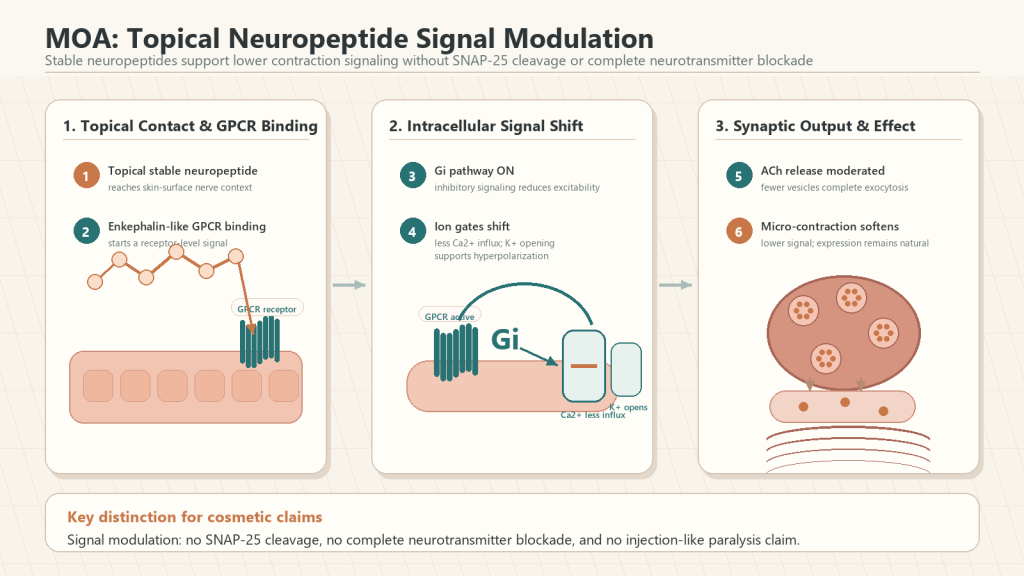
Upstream modulation focuses on enkephalin receptors, a class of GPCRs located on the outer membrane of sensory and motor neurons. When these receptors are bound by bioengineered enkephalin mimetics, they activate an intracellular, inhibitory $G_i$-protein signaling pathway. This cascade closes voltage-gated calcium channels ($Ca^{2+}$) and opens potassium channels ($K^+$), causing membrane hyperpolarization.
By limiting calcium influx, the neuron requires a significantly higher electrical threshold to fire, reducing total vesicle exocytosis without breaking the physical structure of the synapse. Using these stable neuropeptides for mature skin care allows formulators to calm facial micro-contractions progressively. This targeted approach smooths wrinkles while preserving natural facial expressions and avoiding the risks of complete muscle paralysis.
Market Positioning for Next-Generation Peptide Serums
The global beauty market is undergoing a major shift in consumer behavior, driven by a growing preference for progressive, non-invasive anti-aging treatments over painful clinical procedures. While injections offer fast results, an increasing number of consumers are concerned about “frozen face” syndrome, chemical dependencies, and the long-term cost of clinical maintenance. This consumer anxiety creates an excellent market opportunity for high-performance skincare brands. By utilizing peer-reviewed literature on enkephalin mimetics and neural cell pathways, cosmetic developers can justify premium pricing for advanced topical alternatives, establishing them as essential mainstays for mature skin care.
To effectively capture this premium market segment, product marketing should move away from vague, generalized terms like “wrinkle smoothing” and instead highlight verifiable cellular science. Presenting comparative clinical studies—such as data demonstrating how upstream GPCR agonists complement downstream SNARE inhibitors—helps build strong consumer trust. Brands can position these next-generation serums not as weak substitutes for injections, but as essential daily tools to enhance skin wellness, extend the lifespan of clinical treatments, and progressively address aging at its neuro-cellular source.
References
Blanes-Mira, C., Clemente, J., Jodas, G., Gil, A., Fernández-Ballester, G., Ponsati, B., Gutierrez, L., Pérez-Payá, E., & Ferrer-Montiel, A. (2002). A synthetic hexapeptide (Argireline) with anti-wrinkle activity. International Journal of Cosmetic Science, 24(5), 303-310. https://doi.org/10.1046/j.1467-2494.2002.00153.x (Foundational reference establishing SNARE complex competitive inhibition by synthetic peptides).
Schagen, S. K. (2017). Topical peptide treatments with effective anti-aging results. Cosmetics, 4(2), 16. https://doi.org/10.3390/cosmetics4020016 (Comprehensive review of neuropeptides, muscle-relaxing pathways, and clinical integration).
Südhof, T. C. (2013). Neurotransmitter release: the last millisecond in the life of a synaptic vesicle. Science, 342(6164), 1324-1333. https://doi.org/10.1126/science.1233232 (Verifies vesicle fusion thresholds and calcium channel down-regulation cascades).
Physiology, Enkephalin. StatPearls – NCBI Bookshelf. (Updated 2023). NLM ID: 101259419 (Provides accurate medical data on delta-opioid receptor coupling, $G_i$ protein loops, and ion fluxes).