Professional Cosmetics Peptide Supplier | GENOPEP



G-Protein Coupled Receptors (GPCRs) in Cutaneous Biology: A New Frontier for Topical Smoothing
Overview of GPCRs in Dermal Neuro-Signaling
The human integumentary system is no longer viewed merely as a passive physical shield; it is recognized as a complex, fully functional neuroendocrine organ. Within this complex cellular ecosystem, G-Protein Coupled Receptors (GPCRs) serve as primary molecular sentinels, directing communication between external environmental triggers and internal cellular responses. The GPCR superfamily represents the largest group of cell-surface transmembrane receptors in mammalian biology. These receptors are characterized by a conserved structural architecture consisting of a single polypeptide chain that winds through the plasma membrane seven times, forming three intracellular and three extracellular loops.
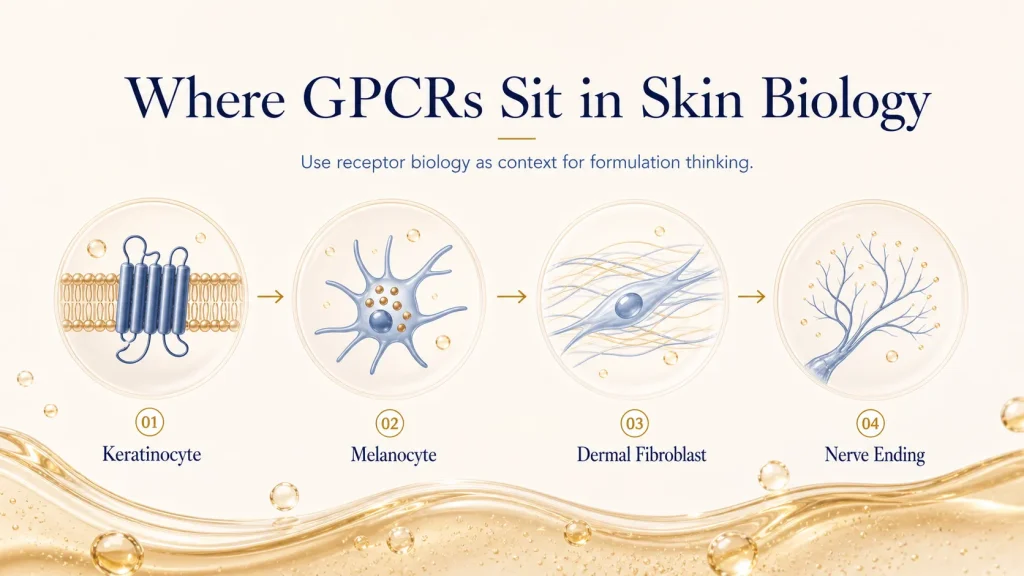
In cutaneous tissue, GPCRs are widely expressed across keratinocytes, melanocytes, dermal fibroblasts, and sensory or motor nerve endings. Among these, the opioid receptor family, including the delta-opioid receptor subtype, is discussed in skin biology in relation to dermal neuro-signaling. These receptors may be present on cutaneous nerve fibers near the dermal-epidermal junction (DEJ). When receptors interact with relevant signaling molecules, they can initiate intracellular signaling events involved in local sensation and neurocutaneous communication. For cosmetic chemists, the practical value is not to claim medical control of nerves or muscles, but to understand receptor-level biology when designing appearance-focused smoothing concepts for mature skin.
Ligand-Receptor Interactions and Intracellular Cascades
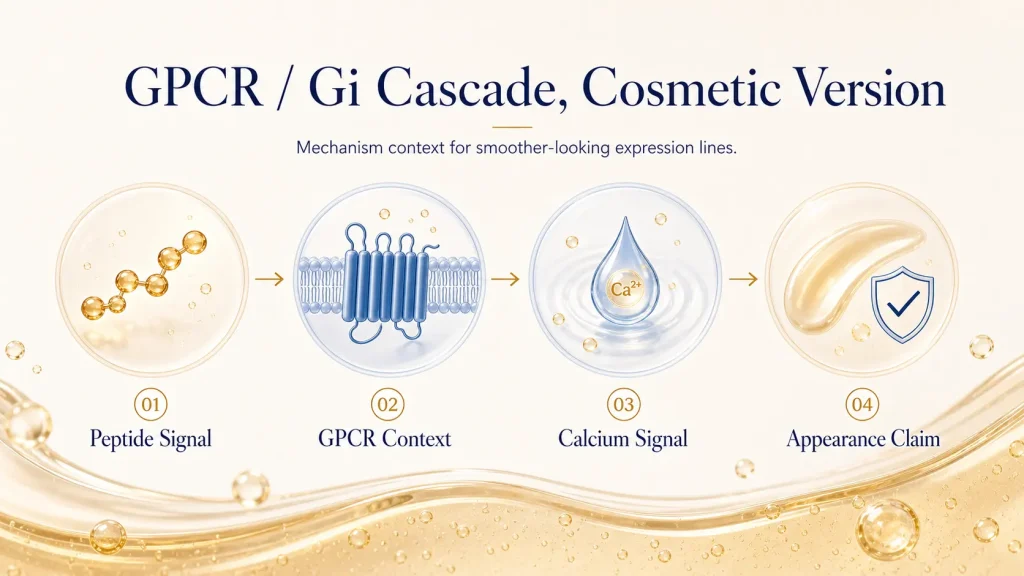
The mechanistic rationale behind topical smoothing concepts relies on precise chemical interactions at the cell membrane. In receptor models, this process begins when a stable enkephalin-mimetic peptide approaches a presynaptic nerve ending and interacts with the extracellular binding pocket of the delta-opioid receptor. This interaction is shaped by non-covalent forces, such as hydrogen bonding and hydrophobic alignment, which help the ligand fit the pocket’s geometry. In the model, ligand recognition triggers a conformational shift that moves through the receptor’s seven transmembrane domains, changing the receptor surface exposed inside the cell.
Before activation, the intracellular domain of a GPCR is associated with an inactive heterotrimeric G-protein complex consisting of alpha (Gαi), beta (Gβ), and gamma (Gγ) subunits, with GDP bound to the Gαi monomer. The change in receptor shape can act as a guanine nucleotide exchange factor (GEF), allowing the Gαi subunit to release GDP and bind GTP. This exchange destabilizes the heterotrimer, causing the Gαi-GTP monomer to split away from the linked Gβγ dimer. Both separated units then participate in downstream signaling pathways inside the cell.
In classical Gi-coupled signaling, the released Gαi-GTP monomer can down-regulate the activity of membrane-bound adenylyl cyclase. This changes the conversion of ATP into cyclic adenosine monophosphate (cAMP), a key secondary messenger involved in cellular response intensity. At the same time, the free Gβγ dimer may interact with voltage-gated N-type calcium channels, which is why calcium-channel context is often included when explaining presynaptic signaling models.
For skincare communication, the final step requires discipline. The model can help explain why enkephalin-mimetic peptides are discussed in relation to smoother-looking expression lines and a more relaxed-looking facial appearance. However, the public claim should remain cosmetic: softer-looking lines, improved comfort perception, and appearance-based smoothing. It should not promise neurotransmitter blockade, receptor control, medical treatment, or injection-like paralysis.
Practical Value for High-End Mature Skincare Formulations
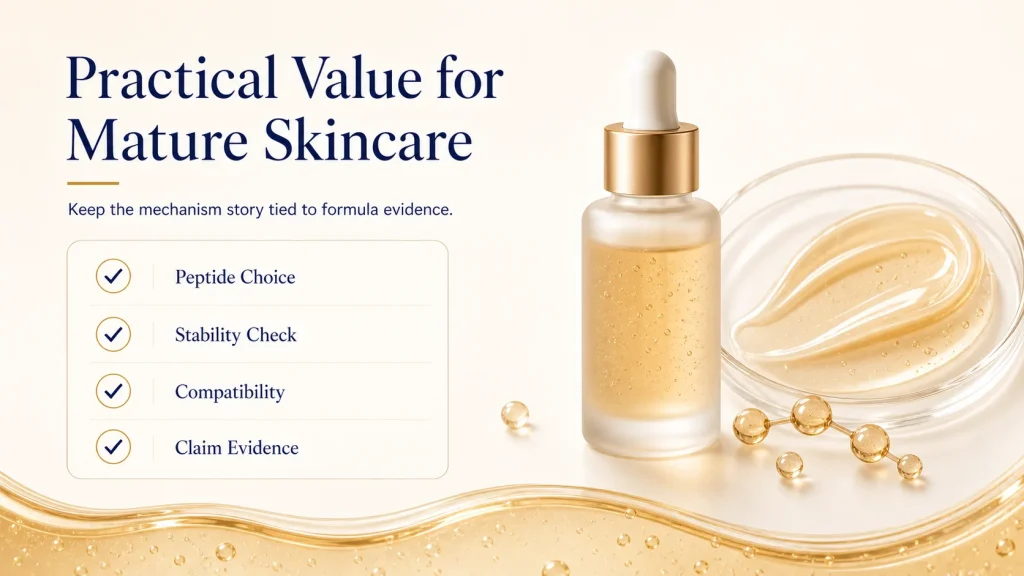
For formulators developing targeted age-care products, GPCR-aware peptide concepts offer a different formulation route from traditional active ingredients. For years, mature skincare has relied heavily on retinoids to improve the look of photoaged skin and on expression-line actives to soften the appearance of repeated facial movement. Retinoids can be effective, but higher-strength or poorly balanced systems may be difficult for sensitive mature skin because redness, scaling, dryness, and barrier discomfort can affect user tolerance. In contrast, stable neuropeptides for mature skin care can be positioned around receptor-aware, surface-compatible, appearance-based smoothing, provided the finished product supports those claims with appropriate testing.
Additionally, GPCR pathways illustrate the importance of signal amplification in skin biology. Because one activated receptor can interact with more than one G-protein complex before returning to baseline, this pathway is relevant to low-use-level formulation thinking. The exact use level, stability profile, compatibility, and finished-product performance still depend on the specific peptide and formula system. This makes stable neuropeptides useful for premium product concepts where smoother-looking expression areas, skin comfort, and natural facial expressiveness need to be discussed together.
For brands developing mature-skin serums, eye-care formulas, creams, or treatment-style products, the strongest route is to combine this receptor-aware story with a responsible claim file. Genopep can support peptide selection and formulation discussion around stable neuropeptide options, finished-product compatibility, and cosmetic wording for smoother-looking, more comfortable, mature skin care. Request a quote with your target product format, claim direction, and market requirements.
References
Roosterman, D., Goetzl, E. J., Homey, B., & Steinhoff, M. (2007). Cutaneous peptidergic neurons and cellular receptors in skin physiology and disease. Physiological Reviews, 87(4), 1159-1217. https://doi.org/10.1152/physrev.00027.2006
Bigliardi, P. L., Tobin, D. J., Gaveriaux-Ruff, C., & Bigliardi-Qi, M. (2009). Opioid receptors in skin homeostasis, epidermal differentiation, and wound healing. Experimental Dermatology, 18(5), 421-430. https://doi.org/10.1111/j.1600-0625.2009.00856.x
Smrcka, A. V. (2008). G protein Gβγ subunits: Central regulators of ion channels and enzyme cascades. Cellular and Molecular Life Sciences, 65(14), 2191-2214. https://doi.org/10.1007/s00018-008-8006-2
Oldham, W. M., & Hamm, H. E. (2008). Heterotrimeric G protein activation by G-protein-coupled receptors. Nature Reviews Molecular Cell Biology, 9(1), 60-71. https://doi.org/10.1038/nrm2299
Reference note: skin-homeostasis and wound-healing literature is used here only as background for cutaneous receptor biology, not as a cosmetic wound-healing claim.