Professional Cosmetics Peptide Supplier | GENOPEP



Copper Peptides vs Retinol: Mechanisms, Benefits, and Product-Development Trade-Offs
Copper peptides and retinol are not interchangeable anti-aging ingredients. Retinol has the stronger direct clinical evidence base for visible photoaging endpoints, while Copper Tripeptide-1 is supported mainly by ingredient-level, cell, preclinical, safety, penetration, and limited finished-formula evidence. Retinol brings conversion, irritation, oxidation, packaging, and market-specific vitamin A requirements. Copper peptides bring metal-complex identity, blue color, pH, oxidation, ligand, and analytical-control questions. The better choice depends on the product concept and the evidence the finished formula can generate
Introduction
Search results often reduce copper peptides vs retinol to a contest: which one is “stronger,” “faster,” or “better for aging skin?” That framing hides the decisions a skincare product team actually has to make. The two ingredient families start from different chemistry, follow different biological routes, require different formulation controls, and sit on unequal evidence bases.
In this comparison, “copper peptides” refers primarily to Copper Tripeptide-1, commonly discussed as GHK-Cu. “Retinol” means the INCI ingredient Retinol, not the prescription drug tretinoin and not every retinoid derivative. Keeping those identities separate matters because evidence for tretinoin cannot be transferred automatically to retinol, and research on GHK-Cu cannot substantiate every product marketed with a generic “copper peptide” story.[1,5-9]
The useful question is therefore: which evidence, risk, sensory profile, regulatory path, and validation workload best match the intended product?
Copper Peptides vs Retinol at a Glance
| Development Dimension | Copper Tripeptide-1 / GHK-Cu | Retinol |
| Ingredient identity | Copper complex of the Gly-His-Lys tripeptide | Vitamin A alcohol and precursor in the retinoid pathway |
| Main research direction | Copper-peptide signaling, matrix remodeling, skin conditioning, repair-related models | Conversion toward retinoic acid, retinoid-receptor signaling, epidermal differentiation, photoaging endpoints |
| Evidence pattern | Strong mechanistic and preclinical interest; smaller and less standardized visible-skin evidence base | Broader clinical evidence for topical retinoids; retinol-specific outcomes still depend on concentration, vehicle, packaging, and study design |
| Common formulation issue | Blue color, metal-complex behavior, pH, competing ligands, oxidation, analytical definition | Light, oxygen and heat sensitivity, conversion, irritation, antioxidant and packaging strategy |
| Sensory/positioning opportunity | Blue, repair-focused, peptide-led or barrier-support concept | Familiar high-recognition active for texture, wrinkles and uneven-looking tone |
| Regulatory watchpoint | General cosmetic safety and claim substantiation; supplier- and formula-specific verification | Market-specific vitamin A limits and labeling, in addition to safety and claim substantiation |
How Their Mechanisms Differ
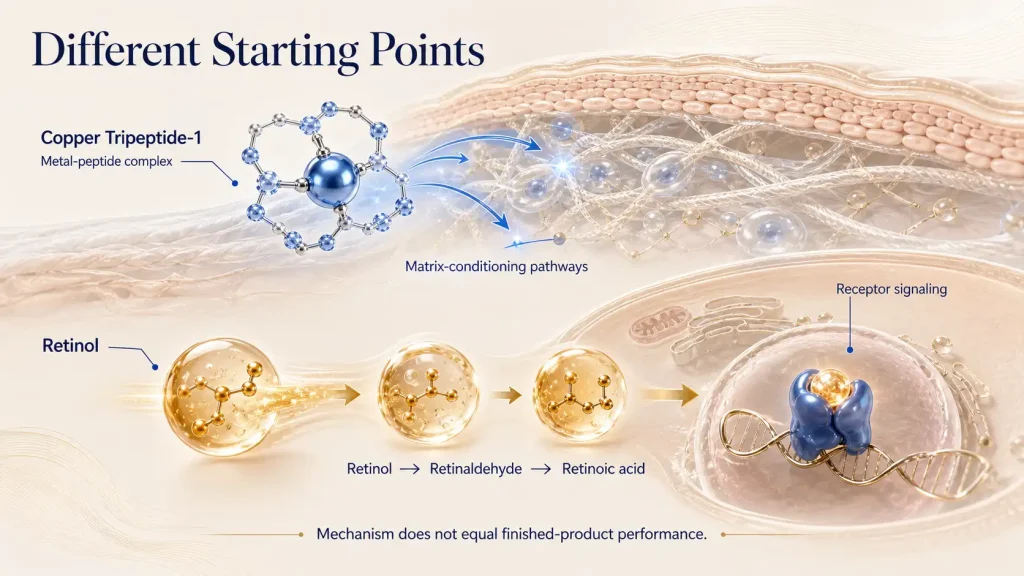
Copper Tripeptide-1: a Metal-Peptide Complex
The Cosmetic Ingredient Review defines Copper Tripeptide-1 as a complex formed by copper and Tripeptide-1, the Gly-His-Lys sequence, and concluded that the reviewed ingredient group was safe in the reported practices of use and concentration.[1] Research on GHK-Cu discusses copper binding, extracellular-matrix regulation, fibroblast responses, antioxidant and remodeling pathways, but much of that literature is cellular, animal, ex-vivo, or review-based.[2-4]
That evidence can justify a development hypothesis. It does not establish that every Copper Tripeptide-1 serum will outperform retinol on wrinkles, pigmentation, firmness, or time to visible results. Delivery and performance still depend on the supplied material, content basis, vehicle, stability, skin model, test method, and finished formula.[3,4]
Retinol: a Precursor in the Retinoid Pathway
Retinol is converted through retinaldehyde toward retinoic acid, which interacts with nuclear retinoid receptors and changes gene transcription related to epidermal differentiation and dermal matrix biology.[5,8] This conversion helps explain why retinol can be active yet generally less direct and often better tolerated than topical retinoic acid. Conversion efficiency also creates formulation and biological variability.
Clinical literature for topical retinoids is broader than for copper peptides. Retinol-specific systematic reviews nevertheless emphasize that products differ in dose, vehicle, duration, comparator, and study quality; evidence for prescription tretinoin should remain clearly separated from evidence for cosmetic retinol.[6-9]
Which Has the Stronger Evidence for Visible Skin Aging?
For visible photoaging endpoints, retinol currently has the more developed direct clinical evidence base. Reviews identify controlled studies reporting changes in fine wrinkles, texture, pigmentation, epidermal thickness, or dermal matrix markers, although outcomes are not uniform across every formulation.[5-9]
Copper Tripeptide-1 has a scientifically interesting mechanism and supportive ingredient-level findings. However, the cited evidence does not provide a matched head-to-head finished-formula trial proving that GHK-Cu is better than retinol. A mechanistic paper, an ingredient penetration study, and a finished-product wrinkle study answer different questions and should not be placed on one ranking scale.[2-4]
Evidence strength also does not decide the entire product brief. A brand may prioritize a peptide-led repair narrative, lower perceived intensity, distinctive blue appearance, or differentiation from crowded retinol products. Another may prioritize a highly recognized active with a stronger consumer search footprint and more established photoaging evidence. Each route still needs substantiation for the exact formula.
Tolerability and Consumer-Use Trade-Offs
Retinoid use can produce dryness, erythema, peeling, burning or stinging, especially during initiation or with a poorly matched formula and routine.[8,9] Retinol is often positioned as more tolerable than prescription retinoic acid, but “more tolerable” does not mean irritation-free. Concentration, delivery, frequency, co-ingredients, packaging integrity, skin condition, and instructions all affect the experience.
Copper Tripeptide-1 is not automatically irritation-free either. The CIR conclusion applies to the practices of use and concentrations described in its assessment, not to every future formula, concentration, impurity profile, delivery system, or combination.[1] Product teams still need safety assessment, compatibility work, suitable directions, and finished-formula testing.
Formulation and Stability Trade-Offs
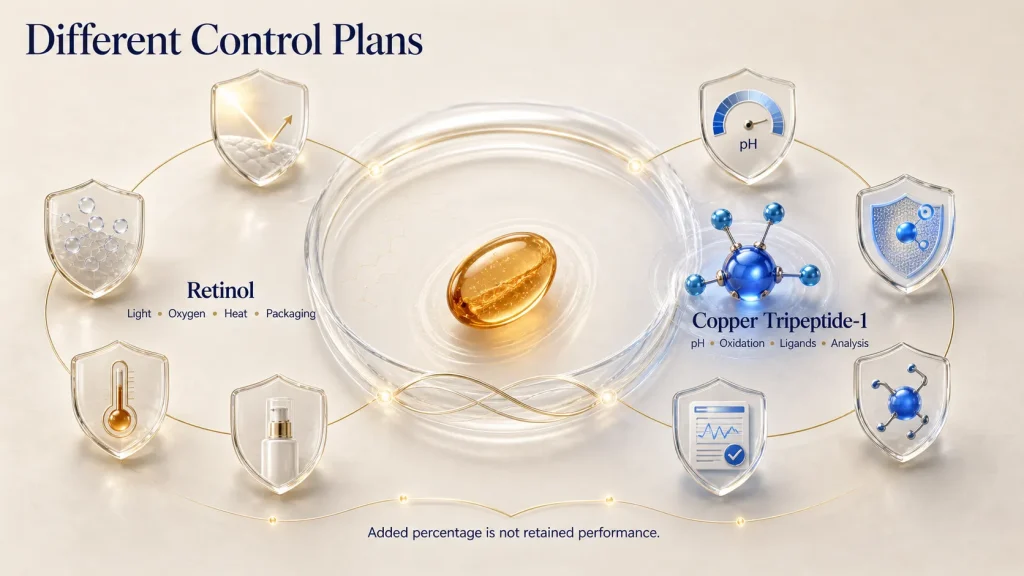
Retinol is highly sensitive to light and oxygen and can degrade into less active products. Vehicle design, raw-material form, processing exposure, antioxidants, headspace, packaging barrier, dispensing system, and shelf-life program are central to development.[5,8] An attractive label percentage has limited meaning if the formula cannot retain an appropriate retinol level through manufacturing, storage, distribution, and consumer use.
Copper Tripeptide-1 has a different stability problem set. Preformulation work describes GHK-Cu as hydrophilic and sensitive to basic and oxidative stress under the studied conditions.[3] Because it is a metal complex, color, peptide content, copper-related measurements, pH, competing ligands, chelators, ionic environment, and packaging interactions may all matter. Blue color is a useful observation, but it cannot replace identity, content, degradation, and stability testing.
Regulatory and Claim Differences Product Teams Should Not Miss
The European Union now restricts Retinol, Retinyl Acetate and Retinyl Palmitate to 0.05% retinol equivalent in body lotion and 0.3% retinol equivalent in other leave-on and rinse-off products, with the prescribed vitamin A label statement. Non-compliant products could no longer be placed on the Union market from 1 November 2025; the transition for making already-placed products available runs to 1 May 2027.[10,11] Teams should verify the current rule and target-market status during development rather than copy a global “standard retinol percentage.”
For Copper Tripeptide-1, the cited CIR assessment supports safety under its reviewed conditions, while supplier specifications and finished-formula safety remain relevant.[1] The absence of the same vitamin A restriction does not remove general cosmetic safety, labeling, substantiation, and market-specific obligations.
In the United States, FDA explains that a product intended merely to make lines less noticeable through cosmetic effects can remain a cosmetic, while claims to alter body structure or function, such as increasing collagen production, can make the product a drug.[12] This boundary applies to both ingredient stories. Ingredient research should be translated into substantiated appearance or skin-conditioning language appropriate to the market and tested product.
A Product-Development Decision Matrix
| Product Brief Question | Copper Tripeptide-1 May Fit Better When… | Retinol May Fit Better When… |
| Core positioning | The concept is peptide-led, repair-focused, blue-signature, or differentiation-led | The concept needs a recognized active associated with photoaging, texture and uneven-looking tone |
| Evidence plan | The team can build formula-specific peptide, stability, safety and visible-endpoint support | The team can support retinol identity, retained content, tolerability and visible-endpoint performance |
| Sensory target | A blue hue is acceptable and a gentle-use story is desired, subject to testing | An amber or protected system and gradual-use instructions fit the consumer journey |
| Formulation capability | The lab can manage metal-complex behavior, pH, oxidation, ligands and copper-related analysis | The lab can manage light/oxygen exposure, antioxidants, conversion-related variability and protective packaging |
| Market plan | The target markets and claims support a Copper Tripeptide-1 concept | The team has assessed market-specific vitamin A limits, warnings and transition status |
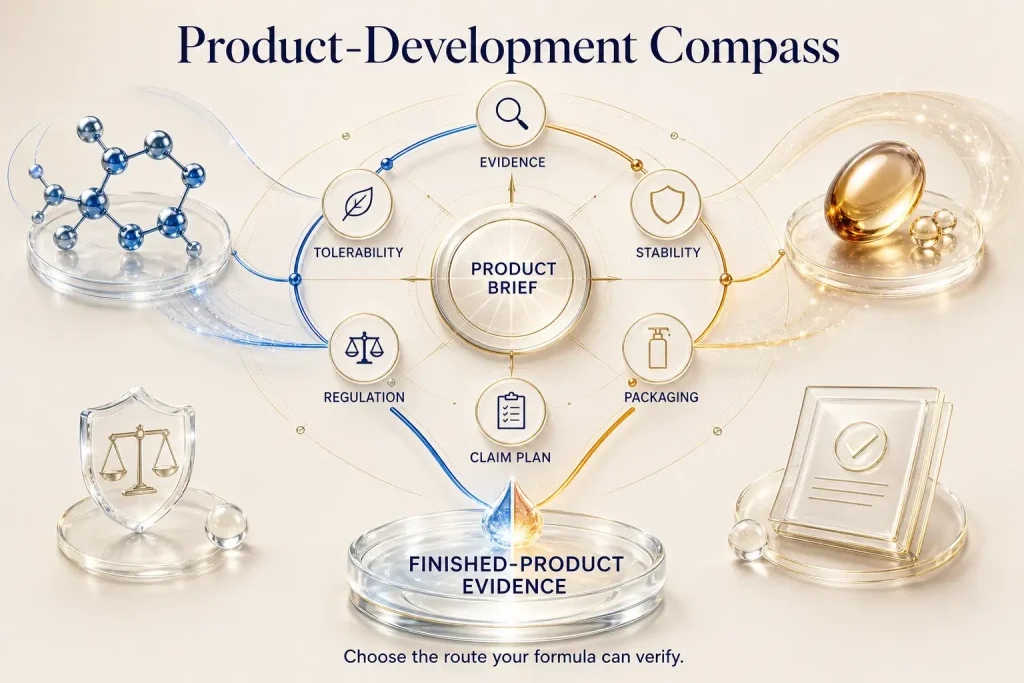
This matrix is a screening tool, not a substitute for bench work. A dual-active concept may be possible, but it creates a separate compatibility and stability question that should be tested rather than answered through internet layering rules. If a combined system increases analytical or tolerability uncertainty, separate products, alternating-use concepts, or a simpler hero-active strategy may be easier to substantiate.
Cosmetic Claim Boundaries
| Overstated Comparison | More Defensible Product-Development Direction |
| Copper peptides are better than retinol | Define the endpoint, exact formula, comparator, duration and evidence before ranking |
| Retinol always works faster | State only timing demonstrated by the tested finished product under defined use conditions |
| Copper peptides rebuild damaged skin | Use substantiated cosmetic appearance or skin-conditioning language |
| Retinol guarantees collagen production | Avoid structure/function promises unless the product follows the applicable drug pathway |
| Blue color proves an active copper peptide | Treat color as an observation and verify identity, content, stability and complex-related specifications |
Conclusion
Copper peptides vs retinol is not a choice between a universally superior and an inferior anti-aging ingredient. Retinol offers the stronger direct evidence base for visible photoaging, together with a familiar consumer story, but it also requires careful tolerability, stability, packaging and vitamin A regulatory work. Copper Tripeptide-1 offers a differentiated peptide and skin-conditioning route, with its own questions around metal-complex identity, blue color, pH, oxidation, ligands and analysis. The defensible decision is the route that best fits the product brief and can be verified in the finished formula.
CTA
If your team is deciding between copper peptides vs retinol, start with the product brief rather than an ingredient popularity ranking. Define the target consumer, visible endpoint, format, color tolerance, packaging, market, claim boundary, validation budget and launch timeline. Genopep and Skinkind Cosmetics can provide current Copper Tripeptide-1 powder or customizable solution information and relevant technical documents. Request the applicable TDS, batch COA, SDS, sample and content basis, then evaluate the exact material in your formula before finalizing claims.
Review Skinkind Cosmetics Copper Tripeptide-1 Formats and Request Technical Documents
Frequently Asked Questions
1. Are copper peptides as good as retinol?
They cannot be ranked universally. Retinol has a more developed direct clinical evidence base for visible photoaging. Copper Tripeptide-1 has meaningful mechanistic and ingredient-level evidence, but fewer standardized head-to-head finished-product data. “As good as” must be tied to a defined endpoint, formula, use period, comparator and study.
2. Which is better for aging skin, retinol or copper peptides?
Retinol may fit a product seeking established photoaging recognition and a stronger clinical literature. Copper peptides may fit a peptide-led, repair-focused or differentiation concept. Tolerability, stability, regulation, consumer instructions and finished-product evidence can change the decision.
3. Are copper peptides more effective than retinol?
The cited literature does not establish a universal effectiveness advantage. Mechanistic activity is not equivalent to a matched clinical comparison. A defensible answer requires the exact Copper Tripeptide-1 and retinol formulas to be tested against the same endpoint and conditions.
4. What are the downsides of copper peptides?
Possible development constraints include blue color, metal-complex and pH behavior, oxidation, interactions with competing ligands or chelators, analytical complexity, and a smaller direct visible-skin evidence base than retinol. Safety and compatibility must still be assessed for the finished formula.
5. Should I use retinol before or after copper peptides?
There is no universal layering order that validates every pair of finished products. Consumers should follow the directions for the specific products and avoid increasing irritation through an overly complex routine. Product developers considering both actives should conduct compatibility, stability, safety and use-condition testing; separating use occasions may simplify the concept but is not a substitute for evidence.
References
1. Johnson W Jr, Bergfeld WF, Belsito DV, et al. Safety Assessment of Tripeptide-1, Hexapeptide-12, Their Metal Salts and Fatty Acyl Derivatives, and Palmitoyl Tetrapeptide-7 as Used in Cosmetics. International Journal of Toxicology. 2018;37(Suppl 3):90S-102S. CIR safety assessment
2. Pickart L, Vasquez-Soltero JM, Margolina A. Regenerative and Protective Actions of the GHK-Cu Peptide in the Light of the New Gene Data. International Journal of Molecular Sciences. 2018;19(7):1987. PMC full text
3. Badenhorst T, Svirskis D, Wu Z. Physicochemical Characterization of Native Glycyl-L-Histidyl-L-Lysine Tripeptide for Wound Healing and Anti-Aging: A Preformulation Study for Dermal Delivery. Pharmaceutical Development and Technology. 2016;21(2):152-160. PubMed record
4. Mazurowska L, Mojski M. Human Skin Penetration of a Copper Tripeptide In Vitro as a Function of Skin Layer. Skin Pharmacology and Physiology. 2010;23(5):266-271. PubMed record
5. Mukherjee S, Date A, Patravale V, Korting HC, Roeder A, Weindl G. Retinoids in the Treatment of Skin Aging: An Overview of Clinical Efficacy and Safety. Clinical Interventions in Aging. 2006;1(4):327-348. PMC full text
6. Spierings NMK. Evidence for the Efficacy of Over-the-Counter Vitamin A Cosmetic Products in the Improvement of Facial Skin Aging: A Systematic Review. Journal of Clinical and Aesthetic Dermatology. 2021;14(9):33-40. PMC full text
7. Sitohang IBS, Makes WI, Sandora N. Topical Tretinoin for Treating Photoaging: A Systematic Review of Randomized Controlled Trials. International Journal of Women’s Dermatology. 2022;8(1):e003. PMC full text
8. Temova Rakuša Ž, Škufca P, Kristl A, Roškar R. Retinoid Stability and Degradation Kinetics in Commercial Cosmetic Products. Journal of Cosmetic Dermatology. 2021. PubMed record
9. Mambwe B, Mellody KT, Kiss O, et al. Cosmetic Retinoid Use in Photoaged Skin: A Review of the Compounds, Their Use and Mechanisms of Action. International Journal of Cosmetic Science. 2025;47(1):45-57. PMC full text
10. Scientific Committee on Consumer Safety. Revision of the Scientific Opinion on Vitamin A (Retinol, Retinyl Acetate, Retinyl Palmitate), SCCS/1639/21. 2022. European Commission opinion
11. European Commission. Commission Regulation (EU) 2024/996 Amending Regulation (EC) No 1223/2009 as Regards the Use of Vitamin A and Other Substances. EUR-Lex official text
12. U.S. Food and Drug Administration. Wrinkle Treatments and Other Anti-Aging Products. FDA guidance
13. Skinkind Cosmetics / GENOPEP. Copper Tripeptide-1 (CAS: 49557-75-7) Anti-Aging Peptides. Product page