Professional Cosmetics Peptide Supplier | GENOPEP



Is Acetyl Hexapeptide-8 Safe in Cosmetics? What the Evidence Actually Says
Acetyl Hexapeptide-8 has been assessed by the Expert Panel for Cosmetic Ingredient Safety as safe in cosmetics at concentrations up to 0.005% under the practices reviewed. Above 0.005%, the Panel found the available data insufficient to determine safety; that does not mean higher concentrations were proven unsafe. Brands must calculate the active concentration, not confuse it with a diluted raw-material dose, and substantiate the safety of the finished formula.
Introduction
Is acetyl hexapeptide-8 safe? The responsible answer is conditional rather than absolute. A peer-reviewed Cosmetic Ingredient Review safety assessment concluded that Acetyl Hexapeptide-8 Amide – synonymous with Acetyl Hexapeptide-8 in that assessment – is safe in cosmetics at concentrations up to 0.005% under the practices reviewed.[1] For concentrations above 0.005%, the Panel concluded that the available data were insufficient to determine safety.
This conclusion is useful but easy to misread. It is not an FDA approval, proof that every finished product is safe, or evidence that every concentration above 0.005% is harmful. Interpretation requires attention to identity, active content, exposure, intended use and the complete formula.
What Is Acetyl Hexapeptide-8?
Acetyl Hexapeptide-8 is a synthetic six-amino-acid peptide used in skincare. The assessment identifies CAS No. 616204-22-9 and describes Acetyl Hexapeptide-8 Amide as a skin-conditioning ingredient.[1] It is also associated with the name Argireline, although brands should verify the INCI name and composition supplied with their own material.
Its synthetic origin does not make it automatically unsafe. FDA notes that a natural or organic source does not guarantee safety and should not be assumed safer than a synthetic source.[4] Safety depends on identity, amount, exposure and how the complete product is used.
What the CIR Safety Assessment Actually Concluded
The Expert Panel for Cosmetic Ingredient Safety reviewed relevant data and concluded that Acetyl Hexapeptide-8 Amide is safe in cosmetics at concentrations up to 0.005% in the practices of use assessed. The published conclusion also states that available data are insufficient to determine safety at concentrations greater than 0.005%.[1]
“Insufficient data” means the Panel did not have enough information to support a positive safety determination for the higher range. It should not be rewritten as “proven unsafe,” ignored, or softened into “safe at any level.” A higher active concentration needs qualified assessment and evidence appropriate to the proposed exposure.
The 0.005% figure is also not a universal legal maximum issued by FDA. FDA explains that, apart from color additives, cosmetic ingredients generally do not receive premarket approval; the company marketing the product is responsible for ensuring safety under labeled or customary conditions of use.[3] CIR findings are a valuable part of the evidence base, but they do not replace the manufacturer’s finished-product responsibility.
Raw-Material Dose Is Not the Same as Active Concentration
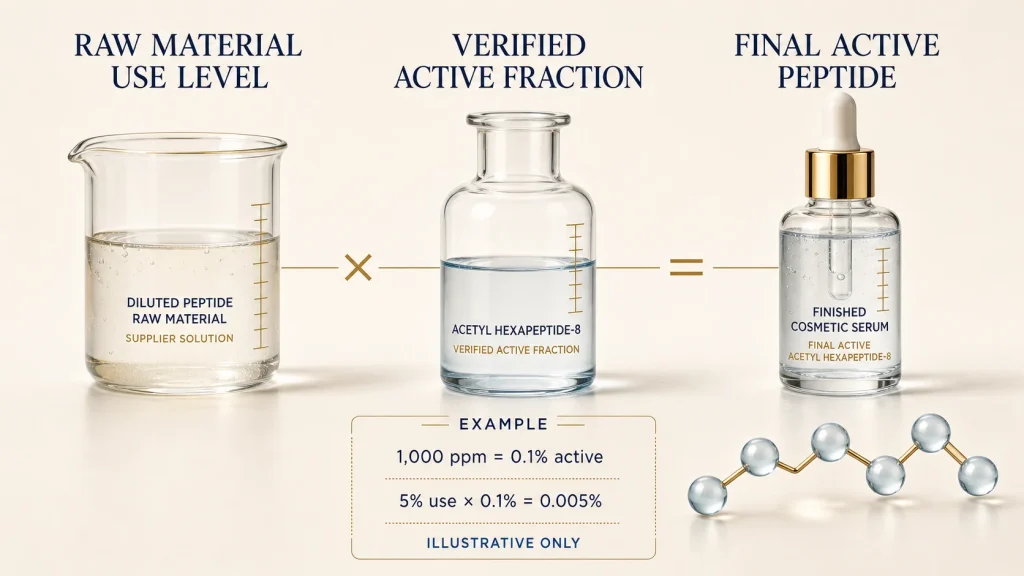
This distinction is central to acetyl hexapeptide-8 safety. Cosmetic peptides may be supplied as a high-purity powder or as a dilute solution containing water, humectants, preservatives or other carriers. A recommendation to use 1%, 5% or another percentage of a supplier solution does not mean the finished formula contains that percentage of Acetyl Hexapeptide-8.
The calculation is:
Raw-material use level x verified active fraction = final active concentration
For illustration only, a solution containing 1,000 ppm active peptide contains 0.1% active. If that solution is used at 5% of a formula, the final active concentration is 0.005%. This example is arithmetic, not a specification for every commercial product. R&D and regulatory teams should use the composition statement, TDS and batch-relevant documentation for the specific Skinkind Cosmetics material being purchased.
Ingredient Safety Does Not Automatically Prove Finished-Product Safety
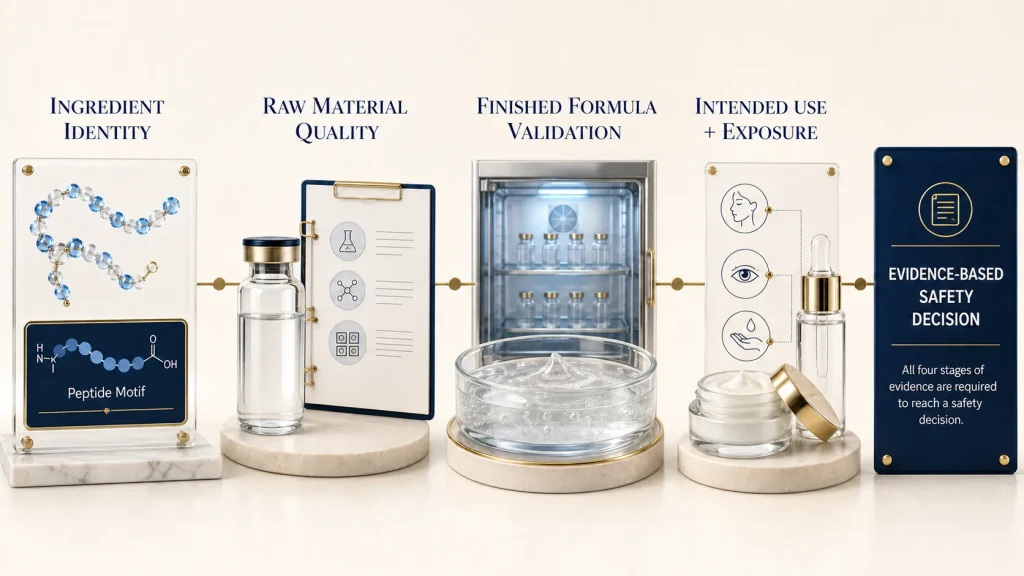
An ingredient conclusion addresses only part of a cosmetic product. Formula pH, preservation, impurities, microbiological quality, packaging, stability, application area and frequency can all change the risk profile. An eye serum, face cream and aerosol powder do not create identical exposure.
FDA states that available ingredient and similar-formula data may be used, but additional testing may be needed to assess the finished product.[3] In the EU, Regulation (EC) No 1223/2009 requires a premarket safety assessment and cosmetic product safety report that consider intended use and anticipated ingredient exposure.[6]
What About Sensitive Skin and the Eye Area?
No cosmetic ingredient can be promised to cause zero reactions. Suitability depends on the whole INCI list and finished product, not on a peptide alone. Fragrance, preservatives, solvents, botanical extracts or other actives may contribute to irritation or sensitization.
Products intended for use near the eyes should be specifically developed and assessed for that area. A general ingredient safety assessment does not automatically authorize eye-area positioning. Consumers should follow the label, stop using a product if unexpected redness, burning or rash occurs, and seek professional advice when needed; these steps are consistent with FDA consumer guidance.[4]
What Safety Documents Should Brands Request?
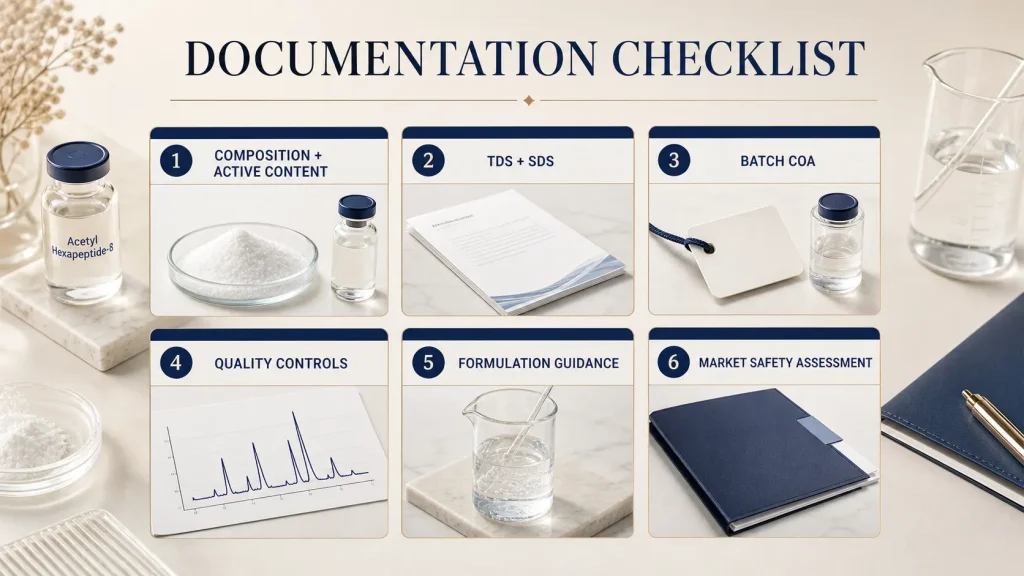
For purchasing and formulation teams, a credible peptide safety review begins with traceable documentation. The exact package varies by supplier and market, but a useful dossier normally includes:
- Confirmed INCI name, CAS number and complete composition
- Active peptide content or ppm value and the applicable test method
- Technical data sheet, safety data sheet and batch certificate of analysis
- Purity, relevant impurities, microbiological limits and contaminant controls
- Recommended processing, storage and handling conditions
- Stability, compatibility and packaging guidance available for the material
- Regulatory status statements relevant to the target market
These documents support raw-material qualification, but they are not a finished-product safety report. Formula-specific stability, microbiological protection, compatibility, packaging and safety work remain necessary. Skinkind Cosmetics and Genopep can provide ingredient information and formulation guidance; the product owner and qualified assessors remain responsible for the marketed cosmetic.
How to Communicate Safety Without Overclaiming
Safety language should reflect the evidence. “Reviewed for cosmetic use at the assessed concentration” is more precise than “completely safe,” while “supported by supplier documentation and finished-formula assessment” is more defensible than “FDA approved.” FDA also notes that it does not define “hypoallergenic.”[4]
Claims must also remain cosmetic. FDA distinguishes cosmetics from products intended to treat disease or affect the body’s structure or function.[5] Describing Acetyl Hexapeptide-8 as supporting smoother-looking skin or improving the appearance of expression lines is different from claiming paralysis, injectable equivalence or permanent alteration of muscle function.
Conclusion
So, is acetyl hexapeptide-8 safe? Current expert assessment supports its safety in cosmetics at active concentrations up to 0.005% under the reviewed practices of use.[1] Above that concentration, the available evidence was judged insufficient, not proof of harm and not permission to assume safety. The decisive steps are to verify ingredient identity, convert the supplier dose into final active concentration and assess the complete product for its intended market and use.
For brands, the strongest safety story is not an absolute slogan. It is a traceable chain of composition data, batch quality, realistic exposure, qualified assessment and disciplined claims.
Frequently Asked Questions
Is acetyl hexapeptide-8 safe to use?
At concentrations up to 0.005% under the cosmetic uses reviewed, the Expert Panel for Cosmetic Ingredient Safety concluded that Acetyl Hexapeptide-8 Amide is safe. Safety above 0.005% could not be determined from the available data. The finished formula and its intended use still require assessment.
What is acetyl hexapeptide-8 used for in cosmetics?
It is used as a skin-conditioning peptide and is commonly included in cosmetic concepts for smoother-looking skin and the appearance of expression lines. The permissible wording and strength of any benefit claim depend on finished-product evidence and the target market.
Is acetyl hexapeptide-8 natural?
Acetyl Hexapeptide-8 is a synthetic peptide. Synthetic does not automatically mean unsafe, just as natural does not automatically mean safe. Identity, purity, concentration, exposure and finished-formula performance are more relevant to a safety assessment than the marketing category “natural.”
Who should not use peptides on skin?
There is no single class-wide rule that everyone in a particular group must avoid all cosmetic peptides. People with a known allergy to any formula component, or those who develop redness, burning or rash, should stop using the product and seek appropriate advice. Products should be used only on the areas and in the manner directed by the label.
Are peptides safe in cosmetics?
“Peptides” are a broad ingredient class, so one conclusion cannot cover every peptide, concentration and formula. Each ingredient needs relevant identity and safety data, and each finished product needs assessment for its exposure and intended use. Evidence for Acetyl Hexapeptide-8 should not be generalized to unrelated peptides.
Do peptides age your face?
There is no evidence that cosmetic peptides as a class accelerate facial aging. However, a poorly tolerated or irritating finished product can temporarily make skin look dry, red or less smooth. Product suitability should be judged from the complete formula and the user’s response, not from a fear-based claim about all peptides.
CTA
Explore Acetyl Hexapeptide-8and request the composition, specification and formulation guidance needed to evaluate it for your skincare concept.
References
1. Johnson W Jr, Bergfeld WF, Belsito DV, et al. Safety Assessment of Acetyl Hexapeptide-8 Amide as Used in Cosmetics. International Journal of Toxicology. 2025;44(2_suppl):54S-63S. https://pubmed.ncbi.nlm.nih.gov/40673537/
2. Expert Panel for Cosmetic Ingredient Safety. Post Meeting Announcement, March 1-2, 2021: Acetyl Hexapeptide-8 Amide. https://cir-safety.org/sites/default/files/Post_Meeting_Announcement_March_2021_v2.pdf
3. U.S. Food and Drug Administration. Product Testing of Cosmetics. https://www.fda.gov/cosmetics/cosmetics-science-research/product-testing-cosmetics
4. U.S. Food and Drug Administration. Using Cosmetics Safely. https://www.fda.gov/cosmetics/resources-consumers-cosmetics/using-cosmetics-safely
5. U.S. Food and Drug Administration. FDA Authority Over Cosmetics: How Cosmetics Are Not FDA-Approved, but Are FDA-Regulated. https://www.fda.gov/cosmetics/cosmetics-laws-regulations/fda-authority-over-cosmetics-how-cosmetics-are-not-fda-approved-are-fda-regulated
6. European Parliament and Council. Regulation (EC) No 1223/2009 on Cosmetic Products, consolidated text. Articles 3, 10 and 11. https://eur-lex.europa.eu/legal-content/EN/TXT/?uri=CELEX:02009R1223-20260501
7. Skinkind Cosmetics. Acetyl Hexapeptide-8 (CAS 616204-22-9) Anti-Wrinkle and Firming Peptides. https://www.skinkindcosmetics.com/products/product/cosmetic-peptide/facial-care/anti-wrinkle-firming/acetyl-hexapeptide-8-cas-616204-22-9-anti-wrinkle-and-firming-peptides/