Professional Cosmetics Peptide Supplier | GENOPEP



Skincare for Expression Lines: What Can It Really Do?
Skincare can make some expression lines look less noticeable, especially by improving hydration, surface smoothness and protection from additional UV-related aging. Retinoids have stronger evidence for mild fine lines than many cosmetic ingredients, while peptide results depend on the specific formula and evidence. Topical skincare does not reliably reproduce or replace an in-clinic procedure, so expectations should focus on gradual appearance improvement rather than wrinkle removal.
Introduction
People who notice forehead lines, crow’s-feet or smile lines often want to know whether a daily routine can help without an in-clinic procedure. The short answer is yes, within limits. Skincare for expression lines can improve how the skin surface looks and feels, support the factors that make lines more or less visible and help reduce additional UV-related aging.
The difficult part is defining “reduce.” A moisturizer may make a fine line look softer within a short time because hydrated skin appears fuller. A retinoid may gradually improve mild fine lines and texture. A well-designed peptide formula may add a focused expression-line story. None of these outcomes means that a topical product has removed a wrinkle or recreated the action of an injectable procedure.
Can Skincare Actually Reduce Expression Lines?
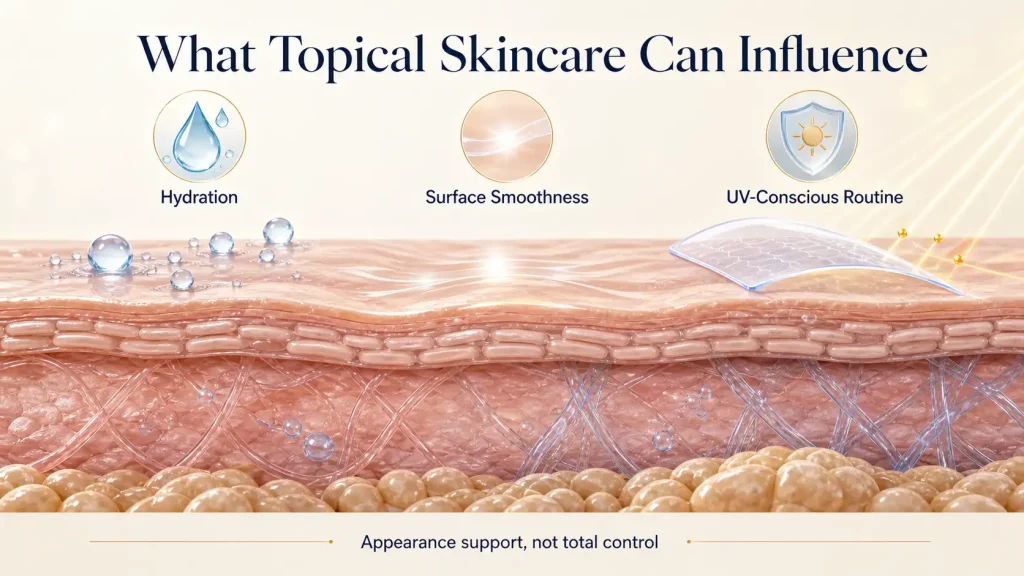
The answer depends on the type and depth of the line, the condition of the surrounding skin and the meaning of the claim. Early expression lines may be visible mainly during movement. More persistent lines remain noticeable when the face is relaxed. Topical skincare cannot stop normal facial movement, but it can improve some of the skin conditions that influence how strongly a line is seen.
For cosmetic communication, the most defensible language focuses on appearance: helping lines look less noticeable, supporting smoother-looking skin or improving the look of fine lines. The U.S. Food and Drug Administration distinguishes this type of cosmetic positioning from claims that a product removes wrinkles or changes the structure or function of the body.[3]
Four Ways a Routine Can Support Expression-Line Care
1. Hydration Can Soften the Look of Superficial Lines
Moisturizers trap or supply water at the skin surface and can make superficial fine lines look temporarily fuller and smoother. The American Academy of Dermatology notes that moisturizing can reduce the appearance of some fine lines, while the FDA uses moisturizing as an example of an appearance-focused cosmetic claim.[1][3]
This is useful, but it should not be confused with permanent structural change. If a line becomes more visible when the skin is dry, hydration may noticeably improve its appearance. A deeper persistent crease is unlikely to disappear simply because more humectant or emollient has been applied.
2. Daily Photoprotection Helps Limit Additional UV-Related Aging
UV exposure contributes to visible skin aging and can make lines more apparent over time. Daily broad-spectrum sun protection does not erase an existing expression line, but it helps manage a major modifiable contributor to future skin aging. The AAD places sunscreen and moisturizer at the foundation of an anti-aging routine.[1]
For product teams, this creates an important messaging distinction. A serum or cream designed for expression line skincare can sit within a routine that includes photoprotection, but an anti-wrinkle peptide or moisturizer should not be presented as providing SPF unless the finished product is actually tested and regulated for that purpose.
3. Retinol and Retinoids Have Better Evidence, but Need Tolerance Planning
Retinol is a type of retinoid commonly used in over-the-counter skincare. Dermatology guidance describes retinoid products as an option for mild fine lines and wrinkles, uneven tone and texture. Results develop gradually, and irritation, dryness or sensitivity can limit use for some people.[2]
This matters when a brand develops skincare for expression lines. A formula story should not simply list the strongest-sounding actives. The product format, application frequency, moisturizer support, daytime photoprotection and target user’s tolerance all affect whether a routine can be used consistently.
4. Peptides Can Add a Focused but Formula-Specific Strategy
Peptide skincare is attractive because it allows a product to address a specific cosmetic concern without relying on one universal anti-aging claim. However, “contains peptides” is not evidence that every finished formula will produce the same result. Peptide identity, effective content, vehicle, stability, packaging and finished-product testing all matter.
Published human research has reported improvement in wrinkle measurements with a specific Argireline-containing formulation, including a randomized placebo-controlled study of 60 subjects.[4] That finding supports further formulation interest, but it does not establish a universal result for every product containing Acetyl Hexapeptide-8.
Why Formulation and Skin Delivery Matter
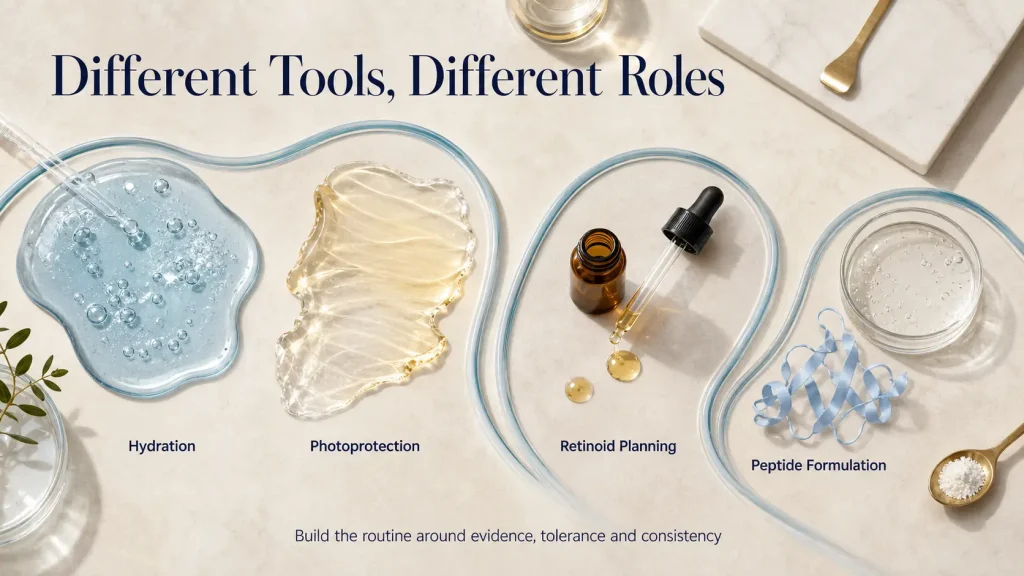
Acetyl Hexapeptide-8 is hydrophilic, and ordinary topical delivery through the lipophilic stratum corneum is challenging. In an in vitro study using human cadaver skin, most of the applied peptide was washed from the surface, a small amount was found mainly in the stratum corneum and none was detected in the dermis under the study conditions.[5]
Other research using porcine skin found that emulsion composition changed delivery, with water-rich systems performing differently from an oil-rich water-in-oil emulsion.[6] Together, these studies show why the vehicle and finished formula cannot be treated as an afterthought. They also show why a mechanism proposed from laboratory research should not automatically become a consumer promise.
What Skincare Cannot Realistically Promise
Topical skincare should not promise to eliminate established wrinkles, permanently prevent expression lines or reproduce the action of an injectable treatment. It should also avoid presenting normal smiling, squinting or frowning as harmful behavior that consumers need to suppress.
A more credible message is that expression lines are influenced by repeated movement and the condition of the surrounding skin. Skincare can support hydration, surface quality, photoprotection and a targeted ingredient strategy, while results vary with line depth, age, exposure, adherence and the finished formula.
How Long Should Consumers Evaluate a Formula?
Different parts of a routine operate on different timelines. Hydration may change the look of superficial lines relatively quickly. Broader improvements in texture or mild fine lines usually require consistent use over weeks rather than days. The AAD advises that many products need at least six weeks and sometimes up to three months before users can judge the result.[1]
For a brand, the safest approach is to base timing claims on finished-product testing rather than borrowing a schedule from an ingredient study. Consumer instructions should also encourage consistent use as directed instead of suggesting that applying more product will create faster results.
What This Means for Skincare Product Development
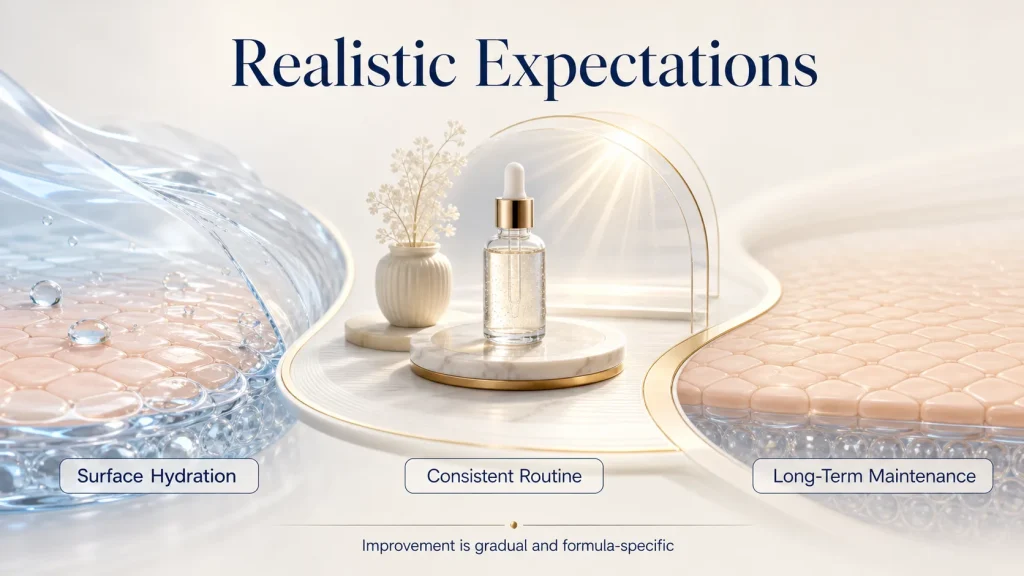
A credible non-invasive wrinkle care concept is usually a system, not a single hero claim. Humectants and emollients can improve immediate skin feel and appearance. Barrier-supportive ingredients can improve comfort. Retinol may fit products designed for suitable users, while a peptide can add a more focused expression-line narrative. Packaging, sensory quality and irritation management influence whether the formula is used consistently.
Claims should then match the evidence available for the finished product. “Helps improve the appearance of expression lines” and “supports smoother-looking skin” stay within an appearance-focused cosmetic frame. “Removes wrinkles,” “paralyzes facial muscles” or “works like an injectable” creates a very different scientific and regulatory burden.[3]
Where Acetyl Hexapeptide-8 Fits
Acetyl Hexapeptide-8, CAS 616204-22-9, is a cosmetic peptide commonly positioned in expression-line and anti-wrinkle formulations. Skinkind Cosmetics offers the ingredient within the Genopep facial-care portfolio in powder and solution formats.[7]
Its most defensible role is as one component of a complete expression line skincare concept. Product teams still need to confirm effective peptide content, the complete INCI of a supplied solution, processing conditions, stability, packaging and the evidence required for the intended finished-product claim.
Teams can review the Acetyl Hexapeptide-8 product page and discuss whether a powder, solution or broader multi-ingredient system best fits the intended format and claim strategy.
Conclusion
Skincare for expression lines can be worthwhile without pretending to be an in-clinic procedure. Hydration can quickly soften the look of superficial lines, photoprotection helps manage future UV-related aging, retinoids have useful evidence for mild fine lines and peptides can support a targeted formula story when the finished-product evidence is handled carefully.
The realistic objective is not wrinkle removal. It is a smoother-looking, better-supported skin surface, a routine consumers can follow and claims that match what the complete formula can substantiate.
Frequently Asked Questions
Can skincare get rid of smile lines?
Skincare may make shallow smile lines look softer by improving hydration and surface smoothness, and a consistent routine may help manage UV-related aging. It cannot guarantee that a persistent crease will disappear. Results depend on line depth, skin condition, product evidence and consistent use.
Can retinol reduce expression lines?
Retinol is used to improve skin texture and mild fine lines, so it may help the overall appearance of some expression lines over time. It can also cause dryness or irritation and is not suitable for everyone. Product strength, frequency, tolerance and daytime sun protection need to be considered.
Can you get rid of expression lines without Botox?
Some expression lines can be made less noticeable with hydration, sun protection, retinoid-based care or a well-substantiated cosmetic formula. However, topical skincare and botulinum toxin procedures are not equivalent and should not be presented as interchangeable. Persistent or deeper lines may remain visible despite a good routine.
Are expression lines permanent?
Early expression lines may appear mainly during facial movement and fade when the face relaxes. Some become more persistent as skin elasticity, hydration and structural support change over time. Not every line follows the same path, and skincare may improve appearance without permanently removing the crease.
CTA
Explore Acetyl Hexapeptide-8 for realistic expression-line skincare formulation concepts.
View the Acetyl Hexapeptide-8 Product Page
References
1. American Academy of Dermatology Association. “Wrinkle Remedies: How to Reduce the Signs of Aging.”
2. American Academy of Dermatology Association. “Retinoid or Retinol?”
3. U.S. Food and Drug Administration. “Wrinkle Treatments and Other Anti-Aging Products.”
4. Wang, Y., Wang, M., Xiao, X. S., Huo, J., Zhang, W. D., & Li, H. B. (2013). “The Anti-Wrinkle Efficacy of Argireline, a Synthetic Hexapeptide, in Chinese Subjects: A Randomized, Placebo-Controlled Study.” American Journal of Clinical Dermatology, 14(2), 147-153.
5. Kraeling, M. E. K., Zhou, W., Wang, P., & Ogunsola, O. A. (2015). “In Vitro Skin Penetration of Acetyl Hexapeptide-8 from a Cosmetic Formulation.” Cutaneous and Ocular Toxicology, 34(1), 46-52.
6. Hoppel, M., Reznicek, G., Kahlig, H., Kotisch, H., Resch, G. P., & Valenta, C. (2015). “Topical Delivery of Acetyl Hexapeptide-8 from Different Emulsions: Influence of Emulsion Composition and Internal Structure.” European Journal of Pharmaceutical Sciences, 68, 27-35.
7. Skinkind Cosmetics / Genopep. “Acetyl Hexapeptide-8 (CAS: 616204-22-9) – Anti-Wrinkle and Firming Peptides.”