Professional Cosmetics Peptide Supplier | GENOPEP



What Happens to Collagen as Skin Ages—and Can Skincare Help?
Collagen changes with age in three connected ways: skin produces less new collagen, existing fibers become increasingly fragmented and disorganized, and the altered dermal matrix gives fibroblasts a weaker mechanical environment for maintaining normal collagen turnover. Ultraviolet exposure can accelerate this process. Skincare cannot replace an aged dermal matrix overnight, but daily photoprotection, evidence-backed retinoid use and well-validated cosmetic formulas can help reduce additional damage or improve selected visible signs over time.
Introduction
“Boosts collagen” is one of the most familiar phrases in anti-aging skincare, yet it compresses several different biological questions into two words. Is the product intended to reduce an external driver of collagen damage? Is an ingredient associated with collagen-related signaling in cells? Has the complete formula changed a skin biomarker, a measured skin property or only the appearance of fine lines? These are not interchangeable evidence levels.
For brands, formulators and skin aging R&D teams, the useful starting point is not a promise of “more collagen.” It is a clear model of what aging skin collagen is losing: amount, organization, mechanical integrity and the cellular feedback that supports renewal. That model makes it easier to choose realistic product roles, tests and claims.
Collagen Is a Living Matrix, Not a Static Filling Material
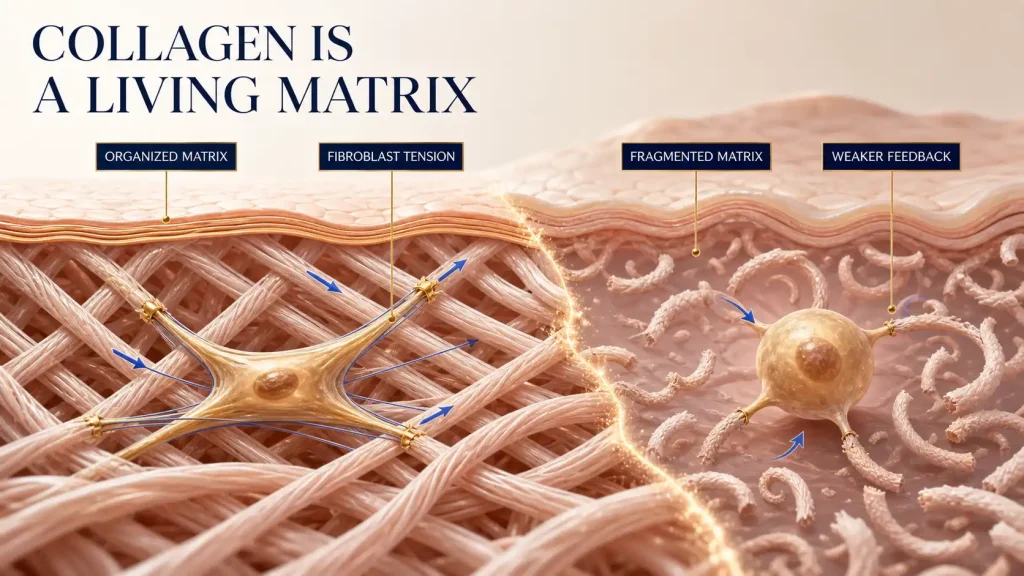
Most dermal collagen is organized into a three-dimensional extracellular matrix. Fibroblasts synthesize matrix components, attach to collagen fibers and respond to the physical and biochemical environment around them. In younger, healthier dermis, intact fibers provide both structural resistance and attachment points that help fibroblasts maintain normal shape and function.[2]
This is why collagen aging is not simply a tank becoming less full. A matrix can lose quantity while also becoming more fragmented, coarsely distributed or mechanically weaker. Those structural changes affect how cells interact with their surroundings. The resulting feedback can further reduce collagen production and sustain an aged matrix state.[2][3]
What Changes as Skin Ages?
1. New Collagen Production Becomes Less Efficient
Human studies and mechanistic reviews describe lower procollagen production in chronologically aged and photodamaged skin. One contributing factor is impaired transforming growth factor beta signaling, a pathway involved in extracellular-matrix homeostasis. Reduced mechanical tension around fibroblasts can also make these cells less effective at producing and organizing new matrix.[2][3]
2. Collagen Breakdown and Fragmentation Accumulate
Matrix metalloproteinases are part of normal tissue remodeling, but aging-related oxidative stress and ultraviolet exposure can shift the balance toward excessive breakdown. Collagen fragments accumulate because long-lived matrix fibers are damaged faster than the tissue can fully replace them. Fragmented fibers provide poorer structural support and weaken the dermal environment in which fibroblasts operate.[2][3]
3. Fiber Architecture Becomes Less Organized
Young dermal collagen is commonly described as abundant, densely packed and well organized. Aged collagen is more fragmented and coarsely distributed. This loss of architecture contributes to lower dermal strength and is associated with visible wrinkling and reduced elasticity, although facial appearance also reflects elastin, glycosaminoglycans, fat compartments, muscle movement, bone structure and gravity.[3]
4. Cross-Linking Does Not Automatically Mean Better Support
Cross-linking helps stabilize a healthy matrix, but age-related non-enzymatic cross-links and glycation can make collagen more rigid and less amenable to normal turnover. “More cross-linked” therefore does not automatically mean firmer or younger-looking skin. The type, location and biological context of cross-linking matter.
Intrinsic Aging and Photoaging Reach the Matrix by Different Routes
Intrinsic aging reflects time-dependent changes in cells, signaling, oxidative stress and tissue renewal. Photoaging adds repeated ultraviolet exposure. UV-generated reactive oxygen species can activate signaling that increases matrix metalloproteinases while suppressing procollagen pathways. Over time, chronic exposure superimposes additional collagen fragmentation on natural aging.[2]
This distinction is commercially important. A product cannot stop chronological aging, but reducing avoidable UV exposure can address a major external driver. In the United States, FDA labeling permits Broad Spectrum SPF 15 or higher sunscreens to claim reduction of early skin-aging risk when used as directed together with other sun-protection measures.[4] Market wording and product classification must still follow local regulation.

Can Skincare Help? Use a Role-Based Answer
The most defensible answer separates prevention of additional damage, biological modulation, surface appearance and finished-product proof.
| Skincare Role | What It Can Reasonably Mean | Evidence Needed |
| Photoprotection | Reduce a major external driver of premature skin aging | Required sunscreen tests, compliant labeling and use directions for the target market |
| Retinoid-based renewal | Support epidermal and dermal remodeling; evidence depends on retinoid, concentration, vehicle and regimen | Ingredient literature plus finished-formula tolerability and performance data |
| Hydration and barrier support | Improve water retention, smoothness and the visibility of dehydration lines | Instrumental hydration or barrier measures and controlled visible-skin assessment |
| Antioxidant strategy | Help manage formula- and exposure-specific oxidative-stress pathways | Stability, delivery, relevant assay and finished-formula substantiation |
| Peptide concept | Explore sequence-specific signaling or matrix-support positioning | Ingredient identity, delivery and stability work, then formula-specific testing |
Retinoids have some of the clearest topical evidence for photoaged skin, but “retinoid” is not one uniform material. In a controlled human biopsy study, long-term topical tretinoin increased a marker of collagen I formation in photodamaged skin compared with vehicle.[5] Separate work with topical retinol in aged, sun-protected human skin reported changes in extracellular-matrix production and fibroblast activity.[6] These findings do not mean that every retail retinol formula will reproduce the same result or tolerance profile.
Hydration can make skin look smoother more quickly, but that should not be described as rebuilding dermal collagen. Conversely, a cell-culture collagen signal may be biologically interesting without producing an immediately visible change in a finished product. Good communication names the layer and endpoint actually studied.

Where Copper Tripeptide-1 Fits
Copper Tripeptide-1, commonly discussed as GHK-Cu, is a copper-binding tripeptide used in cosmetic product concepts. Published reviews describe collagen- and matrix-related observations from fibroblast, tissue-remodeling and limited topical research.[7] These findings make GHK-Cu skincare relevant to matrix-support research, but they do not justify treating every Copper Tripeptide-1 raw material or finished serum as clinically proven to rebuild collagen.
The current Skinkind Cosmetics product page lists Copper Tripeptide-1 in powder and solution formats and identifies different specification, packaging and storage considerations for each.[1] For a development team, that information defines the commercial material to evaluate; it does not replace formula compatibility, stability, delivery, safety and claim-substantiation work.
A Practical Evidence Ladder for Collagen-Support Skincare
For collagen-support skincare, teams should ask five questions in order:
- What material is being tested? Confirm INCI identity, form, concentration or purity basis, composition and batch documents.
- What model produced the result? Separate biochemical, cell-culture, ex vivo, animal and human findings.
- Can the active remain available in the formula? Evaluate pH, oxidation, interactions, packaging and supported shelf life.
- What endpoint does the finished formula change? Distinguish hydration, roughness, elasticity, wrinkle appearance, biomarkers and direct matrix measurements.
- What wording does the evidence support in the target market? Keep cosmetic appearance claims distinct from therapeutic repair or structural promises.
This ladder prevents a common evidence jump: moving directly from an ingredient experiment to a finished-product promise. It also helps purchasing, formulation, quality, marketing and regulatory teams use the same definition of “works.”
Product-Development Implications
A credible collagen-support concept usually combines more than one role. Photoprotection addresses avoidable UV exposure. A carefully selected active system may target renewal or matrix-related signaling. Humectants, emollients and barrier-support ingredients improve the skin environment and visible finish. Packaging and use instructions protect formula integrity and help users follow a tolerable regimen.
The claim plan should be designed before the efficacy study. If the intended claim is “improves the appearance of fine lines,” a controlled visible or instrumental wrinkle endpoint may be appropriate. If the claim directly references collagen, the team needs a method capable of supporting that specific statement. Supplier literature can inform study design, but only evidence applicable to the finished formula should carry the final product claim.
Frequently Asked Questions
1. Does skin stop making collagen after a certain age?
No. Collagen production does not switch off at one universal age, but its efficiency and regulation change over time. Intrinsic aging, accumulated UV exposure, matrix fragmentation and individual biology all affect the balance between synthesis and breakdown.
2. Can a moisturizer rebuild collagen?
A moisturizer can improve hydration, softness, barrier condition and the appearance of dehydration lines. Those are valuable cosmetic outcomes, but they should not automatically be described as rebuilding dermal collagen unless the finished formula has suitable direct evidence.
3. Is photoaging the same as natural skin aging?
No. They overlap in visible and molecular outcomes, but photoaging adds chronic ultraviolet exposure to time-dependent aging. That difference matters because UV exposure is a modifiable external factor.
4. Does Copper Tripeptide-1 increase collagen in finished skincare products?
Ingredient and laboratory literature provides a rationale for studying collagen- and matrix-related effects, but the finished-product answer depends on the exact material, use level, delivery, stability, complete formula and study design. A raw-material mechanism is not the same as finished-product clinical proof.
5. What is the most defensible first step for a collagen-support product?
Define the intended cosmetic outcome and evidence level before selecting the active story. Then connect ingredient qualification, formula compatibility, packaging, stability, safety and efficacy testing to that claim. This is more reliable than beginning with a broad “collagen booster” phrase and searching for evidence afterward.
CTA
If your team is evaluating Copper Tripeptide-1 for a collagen-support skincare concept, send Skinkind Cosmetics the intended product type, target market, desired raw-material form, formulation stage, expected use range, pH, packaging direction and required documents. Genopep can help align the sample and commercial specification with the development questions your team still needs to validate.
Review Copper Tripeptide-1 formats for a formula-specific evaluation
References
1. Skinkind Cosmetics / GENOPEP. Copper Tripeptide-1 product information: powder and solution formats, specifications, packaging and storage. Product page
2. Rittié L, Fisher GJ. Natural and Sun-Induced Aging of Human Skin. *Cold Spring Harbor Perspectives in Medicine*. 2015;5(1):a015370. Full text
3. Shin JW, Kwon SH, Choi JY, et al. Molecular Mechanisms of Dermal Aging and Antiaging Approaches. *International Journal of Molecular Sciences*. 2019;20(9):2126. Full text
4. U.S. Food and Drug Administration. Questions and Answers: FDA Announces New Requirements for Over-the-Counter Sunscreen Products Marketed in the U.S. FDA guidance
5. Griffiths CEM, Russman AN, Majmudar G, Singer RS, Hamilton TA, Voorhees JJ. Restoration of Collagen Formation in Photodamaged Human Skin by Tretinoin. *New England Journal of Medicine*. 1993;329:530-535. PubMed
6. Shao Y, He T, Fisher GJ, Voorhees JJ, Quan T. Molecular Basis of Retinol Anti-Ageing Properties in Naturally Aged Human Skin In Vivo. *International Journal of Cosmetic Science*. 2017;39(1):56-65. PubMed
7. Pickart L, Margolina A. GHK Peptide as a Natural Modulator of Multiple Cellular Pathways in Skin Regeneration. *BioMed Research International*. 2015;2015:648108. Full text