Professional Cosmetics Peptide Supplier | GENOPEP



How Long Does Acetyl Hexapeptide-8 Take to Work? Understanding Study Timelines and Visible Results
Published studies commonly evaluated visible wrinkle outcomes after approximately four weeks or 30 days, rather than immediately. A 2013 randomized placebo-controlled study used twice-daily application for four weeks, while the original Acetyl Hexapeptide-8 study reported a 30-day formula evaluation. These timelines apply to the tested formulas and protocols, not every Acetyl Hexapeptide-8 product.
Introduction
How long does acetyl hexapeptide-8 take to work? The most defensible short answer is that published wrinkle studies have commonly evaluated results at about four weeks or 30 days, but no universal onset time applies to every serum or cream.[1][2] The ingredient, commercial raw material, vehicle, finished formula, use pattern and measurement method all influence what can be observed and when.
This distinction matters to brands as much as it does to consumers. A supplier study can provide a useful starting point for an expression line skincare concept, yet a timeline becomes a product claim only when it is supported by the product actually sold. “Visible in 28 days” is not created by repeating a number; it is created by a defined endpoint, a controlled protocol and evidence that matches the finished formula.
What Does “Work” Mean in Skincare?
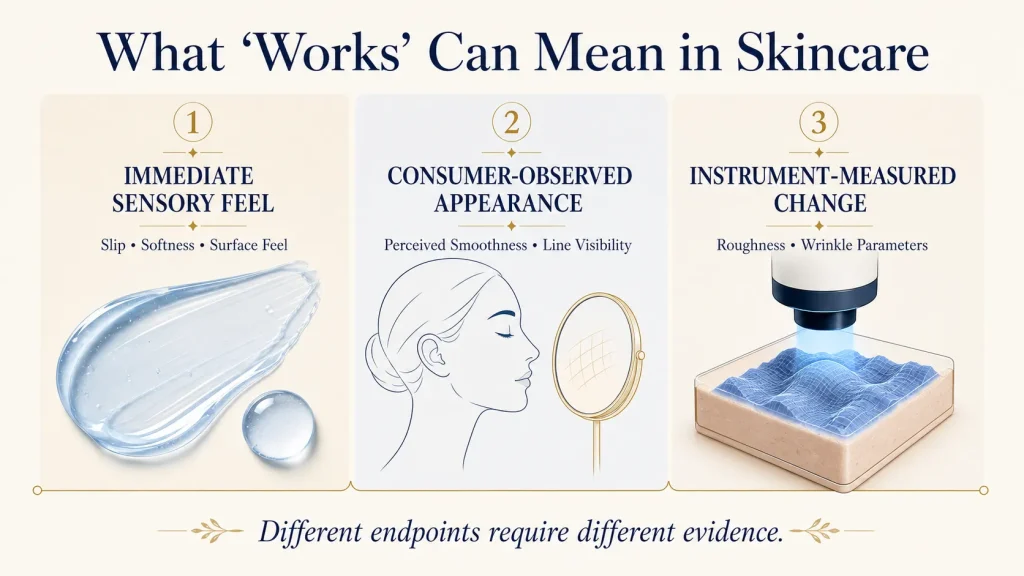
Before discussing a peptide serum results timeline, the endpoint must be defined. A product can feel smoother immediately because of humectants, emollients, silicones or film-forming materials. That sensory effect is real, but it is not proof that Acetyl Hexapeptide-8 has already changed a wrinkle parameter. Surface hydration, consumer-perceived smoothness and instrumentally measured wrinkle depth are different outcomes.
For a credible study, “work” might mean a statistically supported change in skin-replica roughness, three-dimensional image parameters, investigator grading or consumer assessment. Each method has its own sensitivity and limitations. A result at week four cannot automatically answer whether a difference was present at day three if day three was never measured.
What Published Study Timelines Actually Show
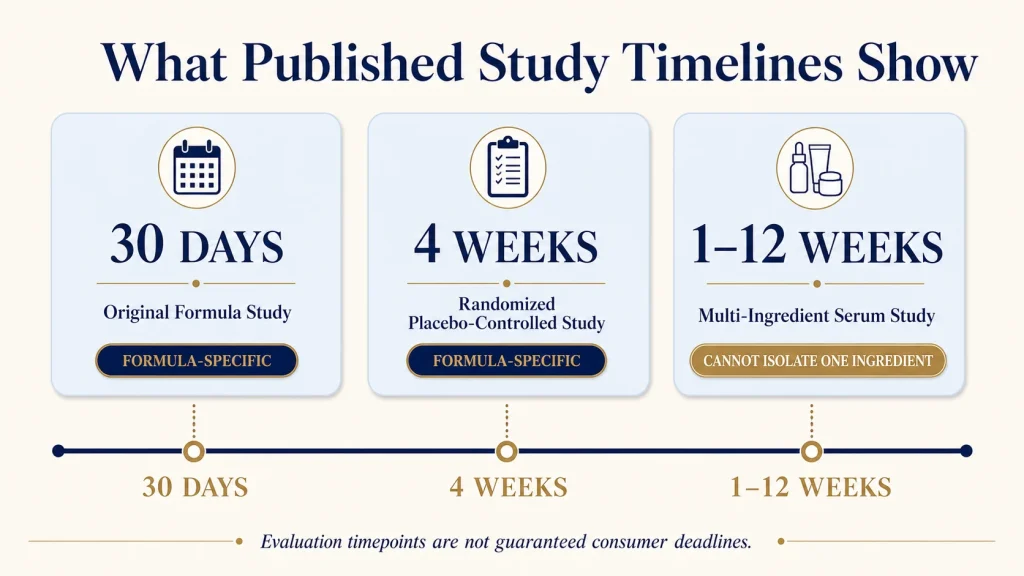
The original 2002 paper evaluated an oil-in-water emulsion containing 10% of the commercial hexapeptide preparation on healthy women. After 30 days, the study reported up to a 30% reduction in wrinkle depth.[1] The phrase “commercial preparation” is important: the reported 10% should not be rewritten as 10% pure peptide unless the active content of that supplied preparation is documented.
A 2013 randomized placebo-controlled study enrolled 60 Chinese participants and assigned Argireline or placebo in a 3:1 ratio. The material was applied to peri-orbital wrinkles twice daily for four weeks. The paper reported a study-defined subjective total efficacy of 48.9% in the Argireline group versus 0% with placebo, while objective skin-replica roughness parameters decreased in the Argireline group.[2] The 48.9% value is not the same as a 48.9% reduction in wrinkle depth.
A 2026 paper reported improvement in static wrinkle appearance beginning within the first week for one tested serum and continued evaluations through 12 weeks.[5] However, the serum also contained another neuropeptide, gluconolactone, niacinamide and Laminaria extract. It is relevant evidence for the finished multi-ingredient formula, not proof that Acetyl Hexapeptide-8 alone works in one week.
Does Argireline Work Immediately?
Does Argireline work immediately? Current evidence does not justify a universal immediate wrinkle claim for Acetyl Hexapeptide-8 itself. The frequently cited controlled study measured the outcome after four weeks, and the original formula study reported a 30-day endpoint.[1][2] A consumer may notice a product’s hydration, slip or film quickly, but those effects may come from the vehicle rather than the peptide.
For the same reason, an Argireline before and after image requires controls. Lighting, expression, camera distance, head angle, moisturization and image processing can change the apparent depth of lines. Brands should standardize photography and pair it with an objective or validated grading method whenever the image supports a quantitative or time-specific claim.
Why Results Differ Between Products
The question “how long does Argireline take to work” cannot be separated from material identity and acetyl hexapeptide-8 formulation. Skinkind Cosmetics currently lists powder formats with at least 95% or 98% HPLC purity and solution options including 500 ppm and 1,000 ppm. These are different raw-material formats. HPLC purity, solution peptide content, supplier-solution use level and final active concentration are not interchangeable numbers.
Vehicle structure also changes delivery. A 2015 porcine-skin study found that a multiple water-in-oil-in-water emulsion increased Acetyl Hexapeptide-8 penetration compared with simple oil-in-water and water-in-oil emulsions.[4] Conversely, a human cadaver-skin study recovered about 99.7% of an applied formulation in surface washes, with only small fractions detected in the stratum corneum and viable epidermis and none in the dermis or receptor fluid.[3] These findings explain why a molecular mechanism alone cannot set a finished-product timeline.
Other variables include peptide stability, pH, preservation, packaging, application amount, twice-daily versus once-daily use, test area, wrinkle type, baseline severity, age, sun exposure and adherence. A 28-day claim borrowed from another formula ignores all of these variables.
How to Read the Current Product-Page Timeline
The Skinkind Cosmetics product page currently retains a statement that wrinkle depth was reduced by 32% after 28 days. That information should remain part of the product-page record, but it is not identical to the original paper’s report of up to 30% after 30 days.[1][6] The two figures should not be silently merged or substituted for one another.
Before using the 32% and 28-day statement in finished-product advertising, a brand should request the underlying report and verify the tested material, active-equivalent dose, complete vehicle, number and characteristics of subjects, application frequency, measurement method, control and statistical analysis. If the marketed formula differs, the claim should be validated again on that finished product.
Can Acetyl Hexapeptide-8 Reverse Existing Wrinkles?
“Reverse” is usually too broad for a cosmetic ingredient claim. Dynamic expression lines appear during movement, while static lines remain visible at rest and also reflect cumulative changes in skin structure, hydration and photodamage. A topical formula may improve the appearance or measured roughness of certain lines without restoring skin to an earlier biological state.
For consumer-facing copy, “helps reduce the appearance of expression lines” is more accurate than “reverses existing wrinkles.” It also keeps the claim focused on cosmetic appearance rather than implying permanent anatomical or muscle-level change.
How Brands Can Establish a Defensible Timeline
A useful cosmetic efficacy testing plan should begin with the claim, not with a convenient number from another product. Brands can use the following sequence:
1. Define the endpoint: wrinkle depth, roughness, visible grading, hydration or consumer perception.
2. Confirm the tested formula: document peptide identity, final active concentration, vehicle and packaging.
3. Standardize use: application area, amount, frequency and accompanying skincare.
4. Predefine checkpoints: for example baseline, an early exploratory visit, four weeks and a longer follow-up when relevant.
5. Use appropriate controls and analysis: placebo or vehicle control, standardized imaging, validated instruments and a prespecified statistical plan.
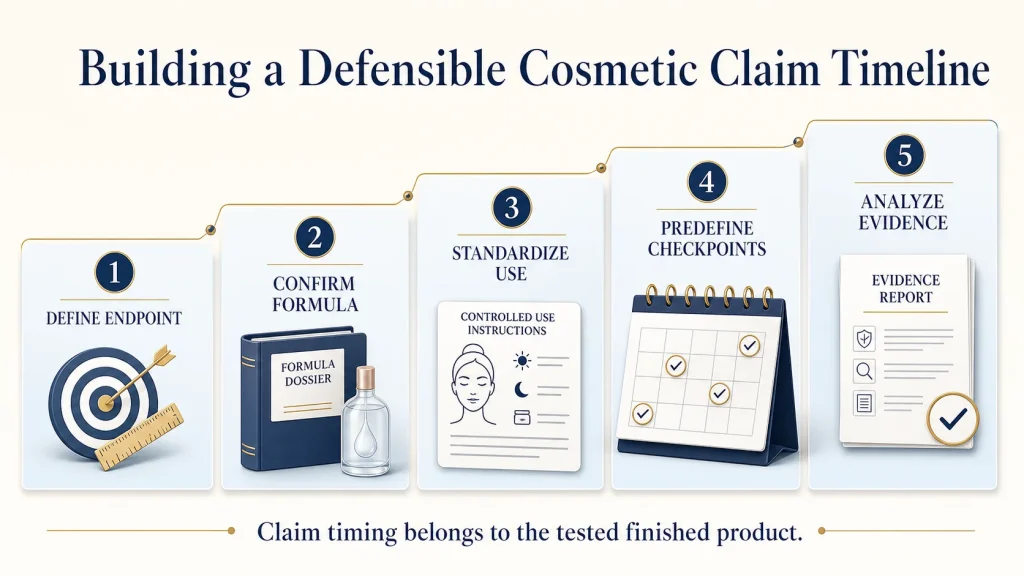
This approach allows a brand to answer “how long does acetyl hexapeptide-8 take to work” for its own formula. Without finished-product testing, four weeks or 30 days should be presented as published study reference points, not guaranteed consumer deadlines.
Conclusion
Published evidence gives brands a practical starting window: Acetyl Hexapeptide-8-related wrinkle outcomes have been evaluated after four weeks or approximately 30 days in frequently cited studies.[1][2] A newer multi-ingredient serum study included earlier and longer checkpoints, but it cannot isolate the peptide’s individual contribution.[5]
The responsible answer is therefore formula-specific. Active-equivalent dose, delivery, stability, use pattern and measurement design determine the supportable timeline. A credible brand does not promise that every user will see the same result on the same day; it states what was tested, when it was measured and which finished formula produced the evidence.
Frequently Asked Questions
How long does Argireline take to work?
Frequently cited studies evaluated wrinkle-related outcomes after four weeks or 30 days. Those are study-specific timepoints, not a guarantee for every product. The actual timeline depends on the raw material, active-equivalent dose, vehicle, stability, use pattern and finished-formula evidence.
Can Argireline reverse existing wrinkles?
It is more accurate to say that an appropriately tested formula may help improve the appearance of certain expression lines. “Reverse” can imply permanent restoration or structural change that typical cosmetic evidence does not establish.
What percentage of Argireline is best?
There is no universal best percentage. A study’s 10% may refer to a commercial peptide preparation rather than 10% pure Acetyl Hexapeptide-8. Formulators should calculate final active concentration using the verified composition, ppm value, TDS and COA for the supplied material.
Is Argireline a replacement for Botox?
No direct equivalence should be claimed. Acetyl Hexapeptide-8 is a topical cosmetic peptide, while botulinum neurotoxin is an injected medical treatment with a different material identity, delivery route, biochemical action, dose control and evidence framework.
CTA
Explore Acetyl Hexapeptide-8 powder and solution formats from Skinkind Cosmeticsand request the active-content, formulation and testing guidance needed to establish a defensible product-claim timeline.
Internal Links
- Dynamic Wrinkles vs. Static Wrinkles: What Is the Difference?
- Do Topical Peptides Really Work for Wrinkles?
- How Does Acetyl Hexapeptide-8 Work?
References
[1] Blanes-Mira C, Clemente J, Jodas G, et al. A synthetic hexapeptide (Argireline) with antiwrinkle activity. International Journal of Cosmetic Science. 2002;24(5):303-310. PMID record
[2] Wang Y, Wang M, Xiao XS, et al. The anti-wrinkle efficacy of argireline, a synthetic hexapeptide, in Chinese subjects: a randomized, placebo-controlled study. American Journal of Clinical Dermatology. 2013;14(2):147-153. PMID record
[3] Kraeling MEK, Zhou W, Wang P, et al. In vitro skin penetration of acetyl hexapeptide-8 from a cosmetic formulation. Cutaneous and Ocular Toxicology. 2015;34(1):46-52. PMID record
[4] Hoppel M, Reznicek G, Kählig H, et al. Topical delivery of acetyl hexapeptide-8 from different emulsions: influence of emulsion composition and internal structure. European Journal of Pharmaceutical Sciences. 2015;68:27-35. DOI record
[5] Zhu M, He X, Zhu Z, et al. The effect of a serum containing acetyl hexapeptide-8, dipeptide diaminobutyroyl benzylamide diacetate and gluconolactone on skin biomarkers, wrinkles and skin texture: ex vivo and clinical studies. International Journal of Cosmetic Science. 2026. PMID record
[6] Skinkind Cosmetics. Acetyl Hexapeptide-8, CAS 616204-22-9, Anti-Wrinkle and Firming Peptides. Product page