Professional Cosmetics Peptide Supplier | GENOPEP



How Does Skin Repair Itself? A Simple Guide to Renewal and Barrier Recovery
Skin repairs itself through several coordinated processes. Basal keratinocytes continually generate new epidermal cells, differentiating cells build the stratum corneum, and barrier lipids reorganize around corneocytes to limit water loss and outside exposure. Mild barrier disruption can recover when the trigger is reduced, but cosmetics support this process rather than medically healing wounds or skin disease.
Introduction
“Skin repair” is used so broadly that it can describe very different biological events. A consumer may mean that dry, tight skin feels comfortable again. A formulator may mean that transepidermal water loss has decreased after a barrier challenge. A clinician may be discussing inflammation, infection or wound closure. These are related to skin function, but they are not interchangeable outcomes.
For skincare product teams, the useful question is therefore not simply “Does this ingredient repair skin?” It is: which part of renewal or barrier recovery is the formula intended to support, how will that outcome be measured, and what wording is justified by the finished-product evidence?
When readers ask “how does skin repair itself,” the answer must therefore begin with a defined endpoint. Recovery from temporary dryness, restoration after a controlled barrier challenge and clinical wound healing involve different evidence, timelines and responsibilities. Clear definitions prevent a cosmetic benefit from being stretched into a medical promise.
What Does “Skin Repair” Mean in Cosmetic Care?
In everyday cosmetic care, skin repair usually combines two ideas. The first is **epidermal renewal**: new keratinocytes are produced, move upward, differentiate and eventually become the flattened corneocytes at the surface. The second is **barrier recovery**: the stratum corneum and other epidermal junctions restore a more effective boundary against water loss and external exposure.[1–4]
This is different from treating an open wound, infection, eczema flare or another diagnosed condition. Cosmetics may improve hydration, comfort and the appearance of dry or rough skin. They should not be presented as substitutes for medical assessment when skin is bleeding, persistently inflamed, intensely painful, infected or otherwise clinically compromised.
How Epidermal Renewal Works
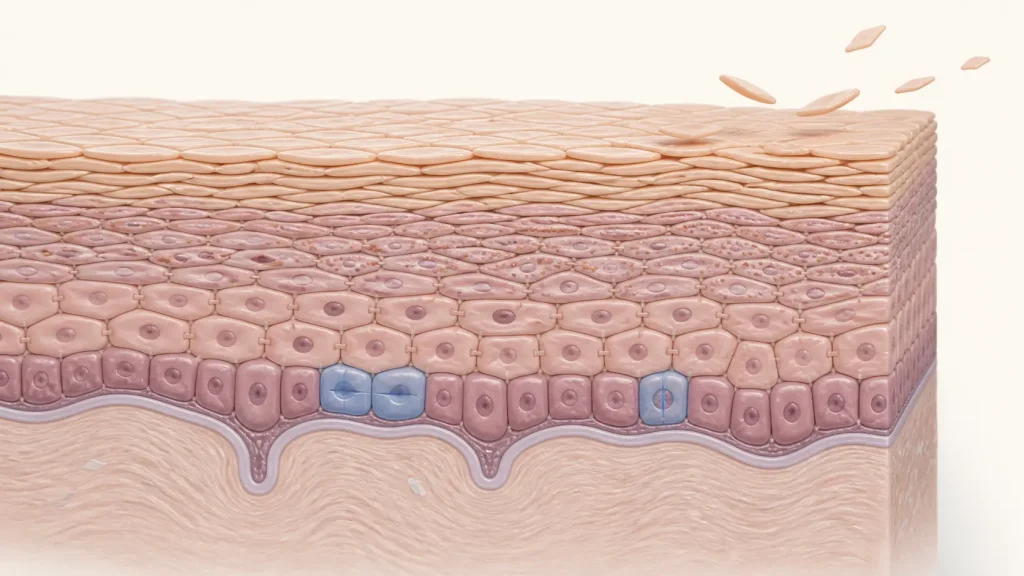
The epidermis is a continuously renewing, stratified tissue. Stem and progenitor cells in the basal layer generate keratinocytes. As these cells leave the basal layer, they pass through a tightly regulated differentiation program, producing structural proteins and lipids before becoming corneocytes in the stratum corneum.[1,2]
At the surface, old corneocytes are gradually released through desquamation. New cell production, upward movement, differentiation and shedding must remain coordinated. If shedding is accelerated too aggressively while new barrier structures are still forming, the surface may become rough, tight or more reactive rather than “renewed.”
Popular descriptions often assign one fixed number of days to an entire skin-renewal cycle. In practice, estimates vary with the method used, anatomical site, age and skin condition. A single universal timetable is therefore less useful than understanding that epidermal homeostasis is continuous and responsive to its environment.
How Does the Skin Barrier Repair Itself?
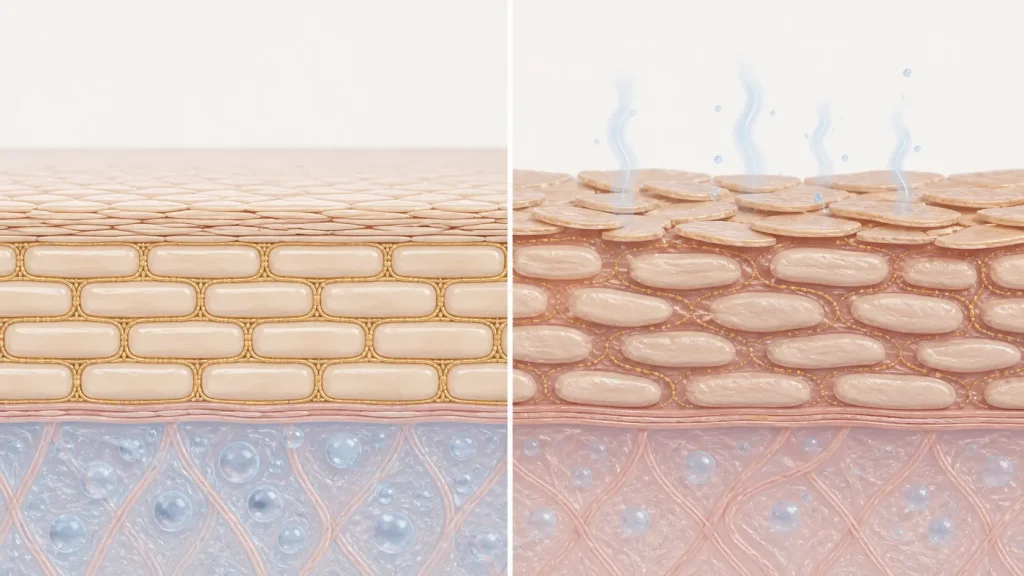
The stratum corneum is often described as a “brick-and-mortar” structure. Corneocytes provide the brick-like cellular units, while an organized extracellular lipid matrix fills the spaces between them. Ceramides, cholesterol and free fatty acids are major components of this matrix. Corneocyte envelopes, filaggrin-derived natural moisturizing factors, enzymes, antimicrobial components and tight junctions also contribute to barrier homeostasis.[3,4]
When the barrier is mildly disrupted, the epidermis responds by adjusting lipid synthesis and processing, cell differentiation and junctional organization. The objective is not to create an impermeable seal. Healthy skin must retain enough water while still supporting normal shedding, immune surveillance and biochemical activity.
Transepidermal water loss, or TEWL, is frequently used in research to assess the water-permeability aspect of barrier function. Higher TEWL can accompany a disrupted barrier, but the measurement is influenced by temperature, humidity, body site, age and the instrument used.[5] It is valuable for controlled comparisons, not a stand-alone diagnosis or a complete description of skin health.
What Can Disrupt or Slow Barrier Recovery?
Barrier difficulty is rarely caused by one dramatic event. More often it reflects repeated exposure that removes surface lipids, increases irritation or does not allow enough recovery time between challenges.
Over-Cleansing and Repeated Solvent Exposure
Frequent washing, harsh surfactants or repeated contact with solvents can remove lipids and proteins from the stratum corneum. The practical issue is not that all cleansing is harmful; it is whether cleansing intensity, frequency and product design are appropriate for the user and use context.
Excessive Exfoliation and Irritant Stacking
Acids, retinoids and physical exfoliation can each be appropriate in a well-designed routine, but excessive frequency or multiple strong products used together may outpace the user’s tolerance. Stinging, persistent redness, tightness and worsening flaking are signals to simplify the routine rather than add another “repair active.”
UV, Low Humidity and Environmental Stress
Ultraviolet exposure can affect epidermal and dermal biology, while cold or low-humidity conditions can increase the challenge of retaining water at the surface. Pollution and other environmental exposures may add oxidative and inflammatory stress, although their real-world effects vary with exposure and individual susceptibility.[5]
What Can Skincare Realistically Do?
A cosmetic routine cannot command the skin to heal on demand. It can, however, reduce avoidable disruption and create conditions that support comfort, hydration and normal barrier function.
| Formula or Routine Function | What It Can Contribute | What It Does Not Prove |
| Gentle cleansing | Removes soil with less unnecessary lipid disruption | That cleansing alone repairs a damaged barrier |
| Humectants | Increase water binding in the stratum corneum | Permanent correction of an underlying disorder |
| Emollients and occlusives | Improve softness, fill surface irregularities and reduce water evaporation | Regeneration of all epidermal structures |
| Physiological lipids | Support a barrier-oriented formula architecture | Clinical treatment unless the finished product is tested and regulated for that use |
| Sunscreen and exposure management | Reduce an important source of future environmental damage | Immediate reversal of existing damage |
Moisturizers commonly combine humectants, emollients and occlusives because these functions are complementary.[6] Formula quality still matters: sensory profile, pH, preservative system, ingredient tolerance, packaging and real use frequency can determine whether a theoretically sound product works well in practice.
Where Do Peptides Fit in Barrier-Support Formulas?
Peptides are a broad ingredient category, not one uniform mechanism. Some are used as signaling or matrikine-inspired ingredients; others are designed for sensory, conditioning or targeted appearance claims. Their relevance depends on sequence, chemical modification, delivery, concentration, stability and the surrounding formula.
Copper Tripeptide-1, also known as GHK-Cu, is the copper complex of the tripeptide glycyl-L-histidyl-L-lysine. Published literature discusses extracellular-matrix signaling and skin-quality applications, but much of the mechanistic evidence comes from laboratory or preclinical work, while human cosmetic evidence is more limited and formulation-specific.[7,8]
For that reason, Copper Tripeptide-1 is best positioned as one part of a barrier-support or skin-renewal concept—not as proof that a finished cosmetic heals wounds, repairs DNA, rebuilds the barrier or reverses aging. A product claim should be supported by testing on the finished formula under its intended conditions of use.
A Practical Framework for Product Teams
Before using “barrier repair” in a brief, brand and R&D teams can work through five questions.
- Define the consumer observation: dryness, tightness, roughness, visible flaking, post-active discomfort or another concern.
- Define the cosmetic endpoint: hydration, reduced TEWL under controlled conditions, improved visible smoothness, better comfort or stronger perceived resilience.
- Build the full formula: cleanser compatibility, humectants, emollients, occlusives, lipids, active ingredients, pH and preservation.
- Validate stability and use conditions: packaging, light, temperature, interaction risks and realistic application frequency.
- Match the claim to the evidence: ingredient rationale supports the concept; finished-product testing supports the finished-product claim.
Product teams evaluating a peptide component can review the available powder and solution specifications on the Skinkind Cosmetics Copper Tripeptide-1 product page. The listed information is a starting point for technical discussion, not a replacement for compatibility, stability, safety and efficacy validation in the final formula.[9]
In a development program, measurements should be selected before marketing language is finalized. Hydration, TEWL, visible scaling, redness, subject-reported comfort and expert grading answer different questions. The protocol should standardize acclimatization, application, environmental conditions and comparison points wherever possible. A short hydration study cannot substantiate every version of “repair,” just as ingredient literature cannot establish the performance of an untested vehicle.
Genopep and Skinkind Cosmetics can provide the ingredient specification and technical discussion needed to begin evaluation, while the brand or finished-product manufacturer remains responsible for confirming formula performance and market-appropriate claims.
FAQ
Can the skin barrier heal itself?
Mild, temporary barrier disruption can often improve as epidermal cells continue to differentiate and barrier lipids are replenished. Recovery is more likely when the triggering exposure is reduced and the routine supports hydration and comfort. Persistent, painful or inflamed symptoms may indicate a condition that needs professional assessment.
What actually fixes the skin barrier?
There is no universal “fix” or single miracle ingredient. A practical approach reduces repeated irritation and uses a compatible routine with gentle cleansing plus an appropriate combination of humectants, emollients, occlusives and, where suitable, barrier lipids. The finished formulation matters more than any isolated ingredient label.
How long does it take to repair the skin barrier?
There is no reliable universal timetable. Recovery depends on the type and severity of disruption, body site, age, skin condition, environment and whether the trigger continues. A fixed promise such as “repairs the barrier in seven days” requires direct evidence from the specific finished product and study design.
Should I put moisturizer on a damaged skin barrier?
For ordinary dryness or mild irritation, a well-tolerated moisturizer can help reduce water loss and improve comfort. Choose a simple formula appropriate for the user and stop if it causes marked burning or worsening redness. Open wounds, infection, severe rash or significant pain should be assessed by a qualified healthcare professional.
Should I exfoliate a damaged skin barrier?
If skin is stinging, persistently red, tight or actively flaking, adding stronger exfoliation may increase the challenge. Simplifying the routine and allowing comfort to return is generally more sensible than trying to remove every visible flake. Once the skin is comfortable, exfoliation frequency can be reassessed according to tolerance and product instructions.
Conclusion
Skin renewal and barrier recovery are continuous, coordinated processes—not instant switches activated by one ingredient. Epidermal cell differentiation, stratum corneum structure, lipid organization, hydration and exposure management all contribute. Skincare can support these processes, but responsible product development separates a credible formulation rationale from proof of finished-product performance.
That is why “how does skin repair itself” cannot be answered by an ingredient list alone. Biology supplies the recovery processes; formulation can support the surrounding conditions; finished-product testing determines what the product can credibly claim.
CTA
Developing a barrier-support or skin-renewal peptide formula? Review Copper Tripeptide-1 formats and request technical documentation or an evaluation sample from Skinkind Cosmetics.
Explore Copper Tripeptide-1 and Request a Sample
References
1. Sotiropoulou PA, Blanpain C. Development and homeostasis of the skin epidermis. *Cold Spring Harbor Perspectives in Biology*. 2012;4(7):a008383. https://pubmed.ncbi.nlm.nih.gov/22751151/
2. Goleva E, Berdyshev E, Leung DYM. Epithelial barrier repair and prevention of allergy. *Journal of Clinical Investigation*. 2019;129(4):1463–1474. https://pmc.ncbi.nlm.nih.gov/articles/PMC6436854/
3. Yokouchi M, Kubo A. Maintenance of tight junction barrier integrity in cell turnover and skin diseases. *Experimental Dermatology*. 2018;27(8):876–883. https://pubmed.ncbi.nlm.nih.gov/30019465/
4. Kezic S, Jakasa I. Filaggrin and skin barrier function. *Current Problems in Dermatology*. 2016;49:1–7. https://pubmed.ncbi.nlm.nih.gov/26844893/
5. Green M, Kashetsky N, Feschuk A, Maibach HI. Transepidermal water loss: environment and pollution—a systematic review. *Skin Health and Disease*. 2022;2(2):e104. https://pmc.ncbi.nlm.nih.gov/articles/PMC9168018/
6. Purnamawati S, Indrastuti N, Danarti R, Saefudin T. The role of moisturizers in addressing various kinds of dermatitis: a review. *Clinical Medicine & Research*. 2017;15(3–4):75–87. https://pmc.ncbi.nlm.nih.gov/articles/PMC5849435/
7. Mortazavi SM, Mohammadi Vadoud SA, Moghimi HR. Topically applied GHK as an anti-wrinkle peptide: advantages, problems and prospective. *BioImpacts*. 2025;15:30071. https://pmc.ncbi.nlm.nih.gov/articles/PMC11830136/
8. Aldag C, Nogueira Teixeira D, Leventhal PS. Skin rejuvenation using cosmetic products containing growth factors, cytokines, and matrikines: a review of the literature. *Clinical, Cosmetic and Investigational Dermatology*. 2016;9:411–419. https://pmc.ncbi.nlm.nih.gov/articles/PMC5108505/
9. Skinkind Cosmetics. Copper Tripeptide-1 (CAS: 49557-75-7) product information. https://www.skinkindcosmetics.com/products/product/cosmetic-peptide/facial-care/anti-aging/copper-tripeptide-1-cas-49557-75-7-anti-wrinkle-and-firming-peptides/