Professional Cosmetics Peptide Supplier | GENOPEP



GHK-Cu vs AHK-Cu: What Changes, What the Evidence Supports, and How Formulators Should Choose
GHK-Cu and AHK-Cu are related copper-bound tripeptides, but they are not interchangeable names for one ingredient. GHK-Cu contains glycine-histidine-lysine, whereas AHK-Cu contains alanine-histidine-lysine. GHK-Cu has the broader published record in skin and extracellular-matrix research; AHK-Cu is more narrowly associated with hair-follicle and dermal-papilla models. The better choice depends on the product brief, exact supplied material, formulation validation and claim evidence.
Introduction
Search results often turn GHK-Cu vs AHK-Cu into a quick contest between a “skin peptide” and a “hair peptide.” That shorthand is useful only as a starting point. One amino-acid substitution creates a different peptide ligand, while the available research also differs sharply in model, endpoint and maturity. A cosmetic product team therefore needs to compare identity and evidence before comparing benefits.
This article stays within topical cosmetic development. It does not provide injection, reconstitution or medical-treatment instructions. Hair-growth, wound-healing and disease-oriented studies are used only to map research history; they do not automatically establish a finished cosmetic claim.
GHK-Cu vs AHK-Cu: Start with Molecular Identity
| Comparison Point | GHK-Cu | AHK-Cu |
| Peptide sequence | Gly-His-Lys | Ala-His-Lys |
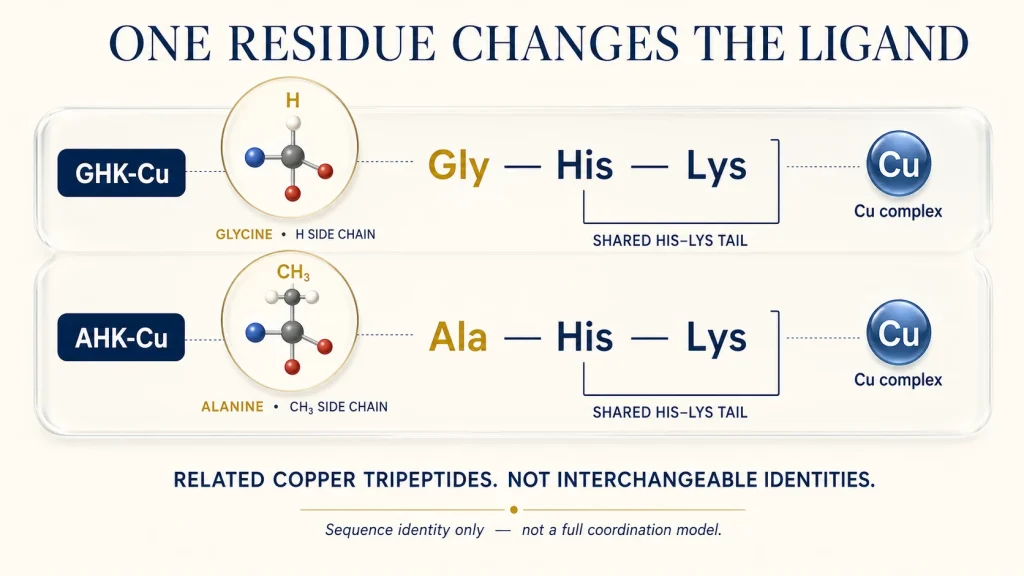
| First amino acid | Glycine, with a hydrogen side chain | Alanine, with a methyl side chain |
| Copper-bound shorthand | GHK-Cu | AHK-Cu |
| Common cosmetic positioning | Facial skincare, age-support and remodeling concepts | Scalp and hair-appearance concepts |
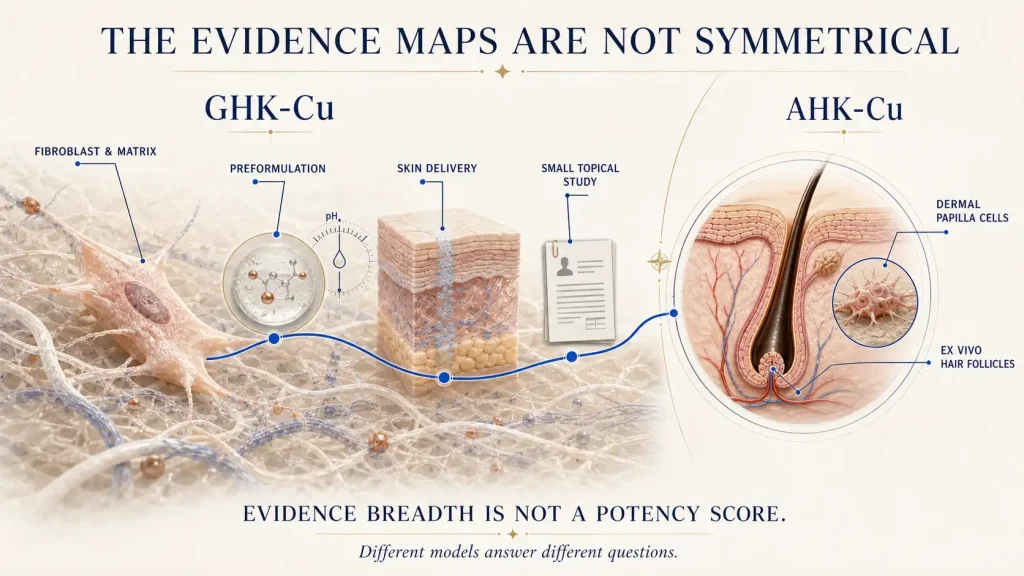
| Evidence emphasis | Fibroblast, extracellular-matrix, skin delivery and some topical-product research | A key ex vivo human-hair-follicle and in vitro dermal-papilla-cell study |
| Identity control | Confirm Copper Tripeptide-1, copper-complex form and batch specification | Confirm the exact AHK-Cu chemical form, label name and batch specification |
| Main development question | Can the complex remain defined and stable in the intended skin formula? | Does the supplied material and evidence fit the intended scalp or hair claim? |
What Does One Amino-Acid Change Actually Mean?
Replacing glycine with alanine adds a methyl side chain at the N-terminal residue. That is a small structural change, but it creates a different ligand and can affect steric environment, hydrophobicity, copper coordination behavior, analytical retention and interaction with biological targets. It is not scientifically sound to assume that AHK-Cu is simply a stronger or weaker grade of GHK-Cu.
Structural studies have characterized GHK-Cu as a defined Cu(II)-peptide complex, including its coordination environment and redox behavior.[1] PubChem identifies AHK-Cu as a copper complex derived from L-alanyl-L-histidyl-L-lysine.[2] These identity records establish that the materials are related but distinct; they do not establish superior cosmetic performance for either one.
Their Evidence Maps Are Not Symmetrical
GHK-Cu has a comparatively broad research history. Published studies include fibroblast collagen synthesis, extracellular-matrix remodeling, physicochemical stability, skin penetration and topical use after laser resurfacing.[3-7] The results are not uniformly positive: in a small randomized post-laser study, objective erythema and wrinkle outcomes did not differ significantly between groups, although participant satisfaction favored the GHK-Cu regimen.[7] That mixed result is useful because it prevents mechanism research from being presented as guaranteed finished-product efficacy.
AHK-Cu has a narrower and more application-specific record. A 2007 study evaluated AHK-Cu in cultured human dermal papilla cells and ex vivo human hair follicles. It reported increased follicle elongation and dermal-papilla-cell proliferation under the study conditions, while the reduction in apoptotic-cell count was not statistically significant.[8] This is relevant exploratory evidence for scalp and hair-product concepts, but it is not a randomized clinical trial of a marketed cosmetic and does not establish treatment of hair-loss disorders.
Which Copper Peptide Fits the Product Brief?
The comparison should begin with the intended user experience and claim architecture, not the popularity of an ingredient name.
| Product-Development Priority | More Natural Starting Point | Why | What Still Requires Validation |
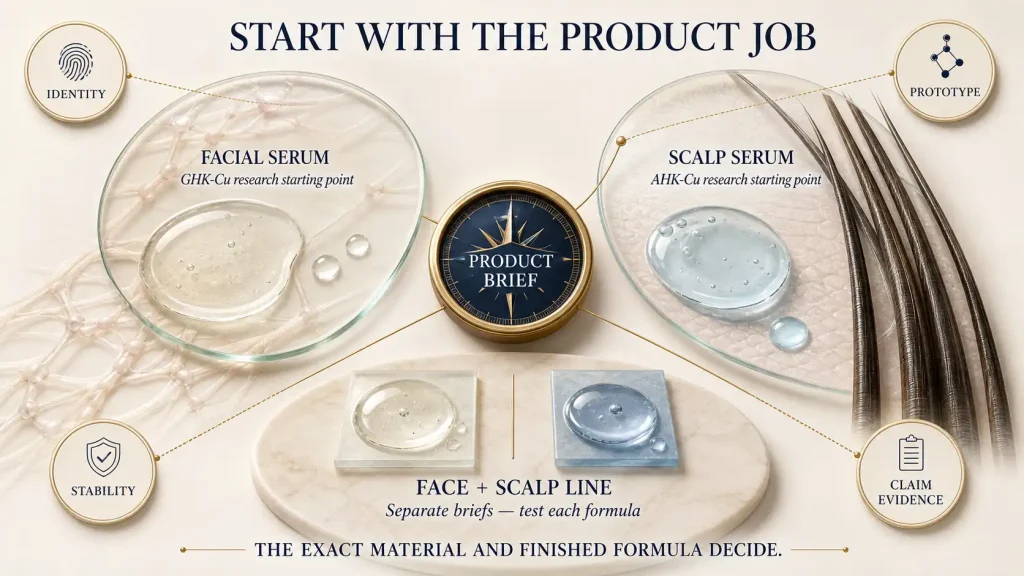
| Blue copper-peptide facial serum | GHK-Cu | Recognizable Copper Tripeptide-1 identity and broader skin-research story | Color, complex integrity, delivery, tolerability and finished-product claims |
| Firmness or visible skin-quality concept | GHK-Cu | More direct relationship to fibroblast and extracellular-matrix literature | Human relevance, dose, vehicle, endpoints and comparator |
| Scalp serum or fuller-hair-appearance concept | AHK-Cu | Published research is more directly connected to follicles and dermal papilla cells | Finished-product scalp safety, deposition, use conditions and cosmetic claim wording |
| Multi-benefit face-and-scalp line | Separate briefs, or both after testing | Different evidence narratives may support different products | Avoid copying one dossier across both materials; test each formula independently |
| Low-color or highly color-controlled product | Neither by default | Both copper complexes may affect appearance | Compare actual grades, use levels, vehicle and package under stability conditions |
Formulation and Quality-Control Questions
Both ingredients should be treated as defined copper-peptide materials, not as generic blue powders. A raw-material file should distinguish HPLC purity, peptide content, copper content, water or counterions, solution concentration and complex identity. A blue appearance is a useful observation, but color alone cannot confirm identity, concentration or performance.
GHK-Cu preformulation research shows that stability can change with pH, oxidative or hydrolytic stress and selected excipients.[5] Comparable formulation assumptions should not be transferred to AHK-Cu without material-specific data. For either peptide, product teams should define the target pH, order of addition, temperature exposure, competing chelators, redox-active ingredients, preservation system, packaging and light conditions before accelerated and real-time stability work.
| QC Question | GHK-Cu / Copper Tripeptide-1 | AHK-Cu Material |
| Identity | Confirm peptide sequence and copper-complex identity | Confirm Ala-His-Lys sequence, supplied copper form and naming basis |
| Content basis | Separate peptide content, copper specification, purity and solution concentration | Use the same separation; do not infer content from color or trade shorthand |
| Analytical method | Review method specificity for intact peptide and complex-related controls | Require material-specific method suitability and reference standard |
| Stability plan | Track assay or identity, pH, color, odor, viscosity and degradation indicators | Establish an independent stability profile rather than copying GHK-Cu conditions |
| Claim file | Connect each claim to the tested material and finished formula | Keep follicle-model data distinct from consumer cosmetic performance evidence |
Can GHK-Cu and AHK-Cu Be Used Together?
There is no general scientific rule that automatically forbids a topical formula containing both peptides. There is also no basis for assuming that the combination is synergistic. A combined concept should explain the distinct role of each material, confirm that both complexes remain analytically detectable, and evaluate whether the added complexity improves a defined finished-product endpoint.
For consumers, raw peptides should not be mixed or reconstituted at home. Use directions should come from the tested finished product. For manufacturers, compatibility should be established through prototypes, analytical recovery, stability, microbiology where relevant, package compatibility, safety assessment and claim substantiation.
Bottom Line for Product Teams
GHK-Cu is usually the more evidence-connected starting point for a facial skincare brief, while AHK-Cu may be the more directly relevant research lead for a scalp or fuller-hair-appearance concept. That is a product-positioning distinction, not proof that one peptide is universally stronger. The final decision should be based on the exact supplied material, a tested prototype and the claim endpoint the brand intends to support.
Frequently Asked Questions
1. Which is better, AHK-Cu or GHK-Cu?
Neither is universally better. GHK-Cu is the more evidence-aligned starting point for many facial skincare and extracellular-matrix concepts. AHK-Cu may be more relevant when the brief is explicitly focused on scalp and hair appearance. Compare the exact materials and finished prototypes against one defined endpoint
2. Can I mix AHK-Cu with GHK-Cu?
Consumers should not mix raw peptides. In professional cosmetic development, the combination is a testable hypothesis rather than a guaranteed incompatibility or synergy. Confirm identity, concentration, pH, complex stability, preservation, packaging and finished-product safety.
3. Is AHK-Cu a copper peptide?
Yes. AHK-Cu is the copper complex of the tripeptide alanine-histidine-lysine. It is related to, but chemically distinct from, GHK-Cu. Purchasing and regulatory teams should confirm the exact supplied form and current label name in the supplier dossier.
4. Can you use AHK-Cu on your face?
That depends on the tested finished product, not the peptide shorthand alone. A manufacturer would need face-use safety, stability and performance data for the specific formula. AHK-Cu’s best-known published study concerns hair follicles and dermal papilla cells, so it should not be presented as equivalent to GHK-Cu’s broader skin evidence without additional substantiation.
5. Can AHK-Cu help with hair loss?
Laboratory and ex vivo findings suggest that AHK-Cu can affect hair-follicle elongation and dermal-papilla-cell behavior under experimental conditions.[8] That does not prove that a cosmetic product treats androgenetic alopecia or another hair-loss disorder. Cosmetic claims should remain focused on scalp condition and the appearance of fuller or healthier-looking hair unless stronger product-specific clinical and regulatory support exists.
CTA
If your team is comparing GHK-Cu vs AHK-Cu for a facial serum, scalp serum or multi-product peptide line, begin with exact material identity and the intended claim endpoint. Skinkind Cosmetics can provide current information for Copper Tripeptide-1 powder and customizable solution formats. Request the applicable TDS, batch COA, SDS, sample, peptide-content basis, copper-related specification, storage information and analytical method, then benchmark the actual GHK-Cu material against a separately documented AHK-Cu candidate in your target formula and packaging system.
Review Skinkind Cosmetics Copper Tripeptide-1 Formats and Request Technical Documents
References
1. Hureau C, Eury H, Guillot R, et al. X-ray and Solution Structures of Cu(II) GHK and Cu(II) DAHK Complexes: Influence on Their Redox Properties. Chemistry – A European Journal. 2011;17(36):10151-10160. PubMed record
2. National Center for Biotechnology Information. PubChem Compound Summary for CID 168431292, AHK-Cu. PubChem record
3. Maquart FX, Pickart L, Laurent M, et al. Stimulation of Collagen Synthesis in Fibroblast Cultures by the Tripeptide-Copper Complex Glycyl-L-Histidyl-L-Lysine-Cu2+. FEBS Letters. 1988;238(2):343-346. PubMed record
4. Siméon A, Monier F, Emonard H, et al. The Tripeptide-Copper Complex Glycyl-L-Histidyl-L-Lysine-Cu2+ Stimulates Matrix Metalloproteinase-2 Expression by Fibroblast Cultures. Life Sciences. 2000;67(18):2257-2265. PubMed record
5. Badenhorst T, Svirskis D, Wu Z. Physicochemical Characterization of Native Glycyl-L-Histidyl-L-Lysine Tripeptide for Wound Healing and Anti-Aging: A Preformulation Study for Dermal Delivery. Pharmaceutical Development and Technology. 2016;21(2):152-160. PubMed record
6. Mazurowska L, Mojski M. Human Skin Penetration of a Copper Tripeptide In Vitro as a Function of Skin Layer. Skin Pharmacology and Physiology. 2010;23(5):266-271. PubMed record
7. Miller TR, Wagner JD, Baack BR, Eisbach KJ. Effects of Topical Copper Tripeptide Complex on CO2 Laser-Resurfaced Skin. Archives of Facial Plastic Surgery. 2006;8(4):252-259. PubMed record
8. Pyo HK, Yoo HG, Won CH, et al. The Effect of Tripeptide-Copper Complex on Human Hair Growth In Vitro. Archives of Pharmacal Research. 2007;30(7):834-839. PubMed record
9. Johnson W Jr, Bergfeld WF, Belsito DV, et al. Safety Assessment of Tripeptide-1, Hexapeptide-12, Their Metal Salts and Fatty Acyl Derivatives, and Palmitoyl Tetrapeptide-7 as Used in Cosmetics. International Journal of Toxicology. 2018;37(Suppl 3):90S-102S. Journal record
10. Mortazavi SM, Mohammadi Vadoud SA, Moghimi HR. Topically Applied GHK as an Anti-Wrinkle Peptide: Advantages, Problems and Prospective. BioImpacts. 2025;15:30071. PMC full text
11. Skinkind Cosmetics / GENOPEP. Copper Tripeptide-1 (CAS: 49557-75-7) Product Information. Product page