Professional Cosmetics Peptide Supplier | GENOPEP



Dynamic Wrinkles vs Static Wrinkles: What Is the Difference and Why Does It Matter for Skincare?
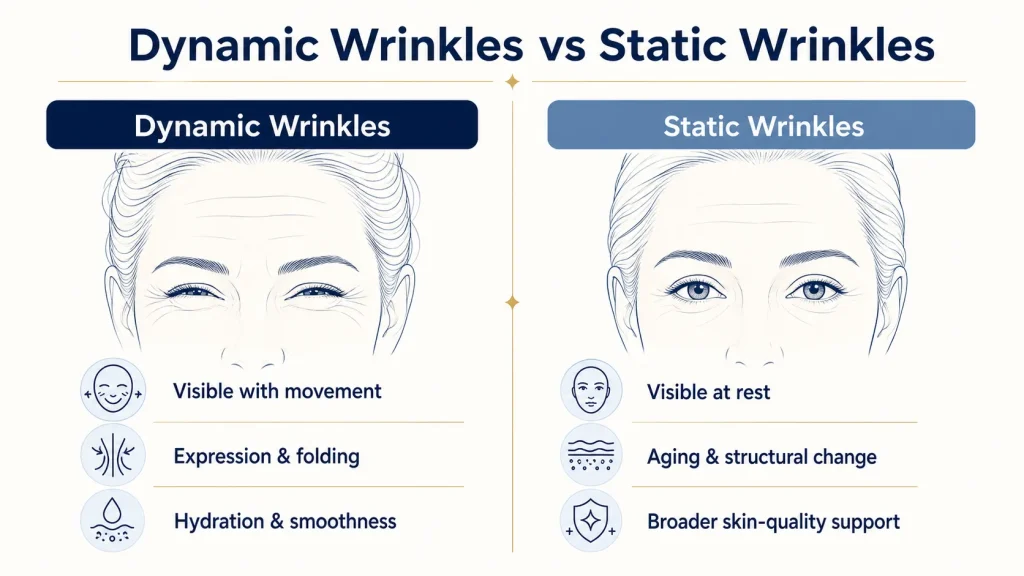
Dynamic wrinkles appear mainly when facial muscles move, while static wrinkles remain visible when the face is relaxed. Repeated expression can contribute to persistent creases as skin gradually loses elasticity, but aging, UV exposure and structural changes also matter. Distinguishing the two helps skincare teams build more precise expression-line and wrinkle-care formulas.
Introduction
“Wrinkle” is often used as a catch-all term, yet the lines visible around the eyes, forehead and mouth do not all behave in the same way. Some appear only when a person smiles, squints or raises the eyebrows. Others remain visible after the face returns to a neutral expression. This is the practical difference at the heart of dynamic wrinkles vs static wrinkles.
For skincare teams, the distinction changes how a concern is interpreted, which formats feel relevant and what a cosmetic claim can reasonably promise. An expression-line formula should not be presented in the same way as one designed for broader age-related skin quality.
Dynamic Wrinkles vs Static Wrinkles: The Core Difference
What Are Dynamic Wrinkles?
Dynamic wrinkles, also called expression lines or dynamic facial lines, are most visible during facial movement. They form where the skin repeatedly folds as the underlying muscles create an expression. Common examples include horizontal forehead lines when the eyebrows rise, glabellar lines when a person frowns and crow’s feet when the eyes narrow during a smile.
Dynamic lines can appear at a young age because facial movement is normal; they do not automatically indicate premature aging. In more resilient skin, the fold becomes much less visible when the expression stops. Rebound varies between individuals and can change over time.
What Are Static Wrinkles?
Static wrinkles remain visible when the face is at rest. They may follow the path of an earlier expression line but no longer depend on a smile or frown to be seen. These facial wrinkles can appear around the eyes, forehead, cheeks and mouth.
Static wrinkles are not simply “deeper dynamic wrinkles.” Repeated folding can contribute, but elasticity, structural support, dryness, UV exposure, smoking, pollution and genetics also matter. DermNet likewise describes facial lines as multifactorial.[1]
| Comparison | Dynamic Wrinkles | Static Wrinkles |
| When visible | Mainly during facial movement | Visible even when the face is relaxed |
| Common areas | Forehead, glabella and eye area | Forehead, eye area, cheeks and mouth area |
| Main contributors | Repeated expression and skin folding | Repeated folding, aging, reduced elasticity, UV exposure and structural change |
| Early appearance | Can appear at a young age during expression | Usually becomes more noticeable as persistent changes develop |
| Skincare focus | Expression-line appearance, hydration and surface smoothness | Hydration, surface smoothing, barrier support and broader age-related skin quality |
Why Facial Expressions Create Dynamic Lines
Every smile, squint and frown changes facial geometry. As a muscle contracts, the overlying skin folds along repeatable paths, so expression lines appear in recognizable locations.
The fold itself is not damage; expression is normal communication. The skincare question is how well skin returns to rest and how repeated folding interacts with its changing mechanical properties.
With age, skin generally becomes thinner, drier and less elastic. Changes in structural support, renewal and moisture retention contribute to wrinkle formation.[2] As rebound slows, an expression line may remain visible for longer.
How Dynamic Lines Can Become Static Wrinkles
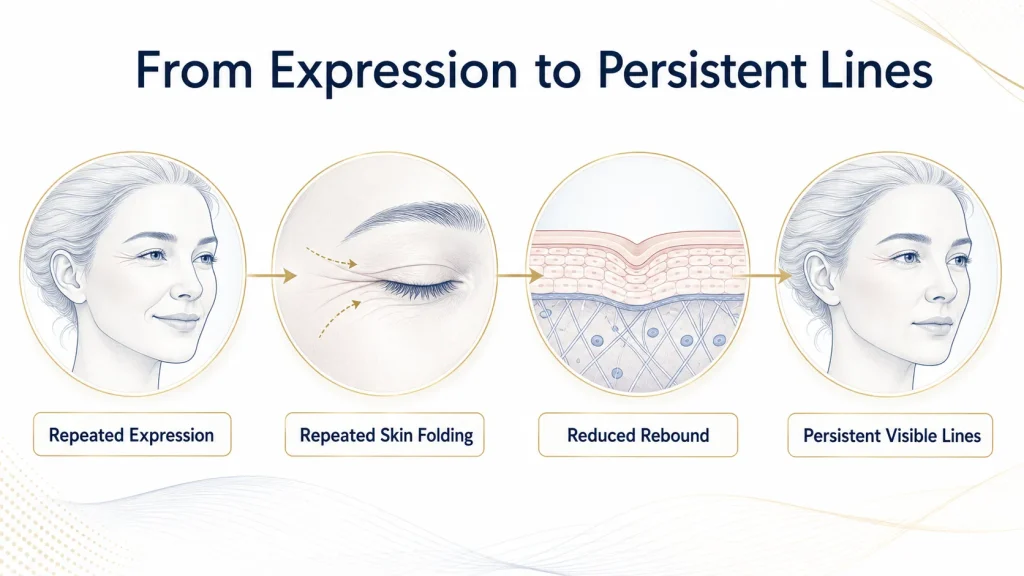
The transition from a temporary expression line to a persistent wrinkle is gradual, not a switch that happens on a specific birthday. A useful model is:
Repeated Expression → Repeated Skin Folding → Reduced Rebound → More Persistent Visible Lines
An eight-year longitudinal study followed 122 women aged 10 to 72. Expression-line patterns at baseline predicted persistent-wrinkle patterns eight years later. The researchers concluded that repeated skin flexure contributes to persistent wrinkles, while hydration, skin characteristics and life stage can affect progression.[3]
Not every dynamic line becomes fixed, and movement is not the only cause. Repeated folding helps explain where persistent lines may appear; skin condition and movement patterns help determine the outcome.
Static Wrinkles Involve More Than Facial Movement
Aging changes the environment in which folding occurs. Mayo Clinic lists reduced elasticity and dryness, deeper structural changes, UV radiation, smoking, pollution, repeated expressions and family history among wrinkle-related factors.[4]
UV exposure can accelerate structural change. Dryness can make superficial lines more obvious, while reduced dermal support changes the surface response to movement. A static wrinkle may therefore reflect repeated folding layered onto wider skin changes.
For product teams, one mechanism or ingredient cannot credibly explain every wrinkle. Stronger concepts define the primary concern while treating the finished formula as a system.
What the Difference Means for Skincare Product Development
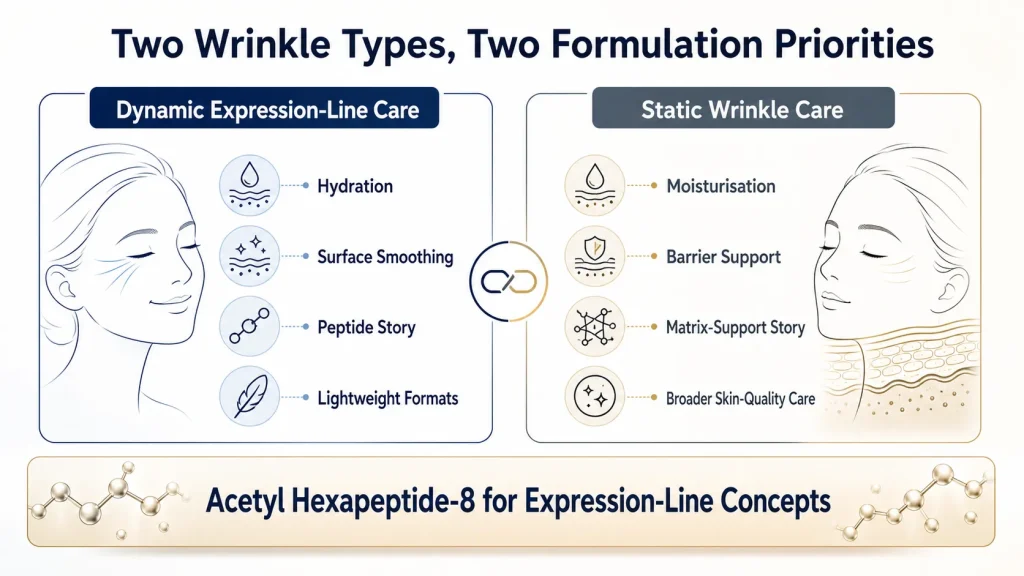
For dynamic expression-line care, brands often favor lightweight serums, targeted eye products and a smooth skin feel. Hydration can temporarily soften superficial lines, while an anti-wrinkle peptide supports a more specific narrative. Claims should focus on improving the appearance of expression lines.
For persistent static wrinkles, the story usually needs to be broader. Moisturisation, barrier support, smoothing, antioxidant positioning and matrix-support peptides may contribute. A cosmetic does not erase a fixed wrinkle; it can address several aspects of mature or environmentally stressed skin.
This also prevents vague “anti-aging” positioning. A brand can prioritize expression-line appearance, all-over smoothness, visible firmness, barrier comfort or a layered combination. Genopep content on neuro-inspired expression-line care and multi-peptide formulations offers further context.
Where Acetyl Hexapeptide-8 Fits in an Expression-Line Strategy
Acetyl Hexapeptide-8, CAS 616204-22-9, is a cosmetic peptide positioned for expression-line and anti-wrinkle formulas. Skinkind Cosmetics offers it within the Genopep facial-care portfolio in powder and solution formats.
Within this framework, its clearest role is in an expression-line concept, not as a universal answer to facial aging. It may suit an eye serum, targeted serum, essence or multi-peptide formula. The finished product still needs an appropriate base, hydration, sensorial, stability and claim-support plan.
For a ready-to-use multi-peptide route, Geno-Wrinkle Pro shows how an expression-line peptide can sit within a wider wrinkle-care matrix. For a single-ingredient project, the Acetyl Hexapeptide-8 product page provides product forms and an inquiry route.
Conclusion
The central difference between dynamic wrinkles and static wrinkles is when the line remains visible. Dynamic lines appear mainly with facial movement; static lines remain visible at rest. Repeated expression can influence where persistent wrinkles later develop, but age-related structural change, UV exposure, dryness and other factors shape the final result.
For skincare development, expression-line concepts can emphasize targeted formats, hydration, smooth feel and relevant peptides, while persistent-wrinkle concepts need a broader strategy. Teams can review how Acetyl Hexapeptide-8 may support an expression line skincare concept.
Frequently Asked Questions
What is the difference between static and dynamic wrinkles?
Dynamic wrinkles are most visible during facial movement, such as smiling, squinting or frowning. Static wrinkles remain visible when the face is relaxed. Repeated folding can contribute to the development of persistent lines, but static wrinkles are also influenced by aging, UV exposure, dryness and changes in skin structure.
Do dynamic wrinkles turn static?
Dynamic wrinkles can gradually become more persistent, especially where the skin repeatedly folds and no longer rebounds as quickly. However, not every dynamic line becomes a static wrinkle. Genetics, skin characteristics, UV exposure, hydration and other intrinsic and environmental factors influence how quickly persistent lines develop.
Can dynamic wrinkles go away?
Because dynamic wrinkles depend on facial movement, they normally become less visible when the expression ends. In younger or more resilient skin, they may disappear almost completely at rest. As rebound changes, the lines may remain visible for longer. Skincare can support hydration and surface smoothness but should not promise complete wrinkle removal.
Is Botox used for static or dynamic wrinkles?
Botulinum toxin products are prescription injectable drugs generally associated with movement-related facial lines, whereas topical cosmetics are regulated and used differently. Static wrinkles may involve structural and environmental factors beyond muscle movement. Consumers considering medical procedures should consult a qualified healthcare professional rather than treating topical skincare as an equivalent substitute.[5]
CTA
Explore how Acetyl Hexapeptide-8 can support expression-line skincare concepts.
References
1. DermNet. “Facial Lines and Wrinkles.”
2. Cleveland Clinic. “Wrinkles & Fine Lines: Types, Causes & Prevention.” Medically reviewed; updated July 27, 2022.
3. Hillebrand, G. G., Liang, Z., Yan, X., & Yoshii, T. (2010). “New Wrinkles on Wrinkling: An 8-Year Longitudinal Study on the Progression of Expression Lines into Persistent Wrinkles.” British Journal of Dermatology, 162(6), 1233–1241. (Authors were Procter & Gamble employees; the study was funded by Procter & Gamble.)
4. Mayo Clinic. “Wrinkles: Symptoms and Causes.” Updated December 12, 2023.
5. U.S. Food and Drug Administration. “Wrinkle Treatments and Other Anti-Aging Products.”
6. Skinkind Cosmetics / Genopep. “Acetyl Hexapeptide-8 (CAS: 616204-22-9) – Anti-Wrinkle and Firming Peptides.”