Professional Cosmetics Peptide Supplier | GENOPEP



Acetyl Hexapeptide-8 vs Pentapeptide-18: How Multi-Peptide Matrices Support Expression-Line Care
The Neuro-Skin Axis: Re-evaluating the Signaling Pathway of Expression Lines
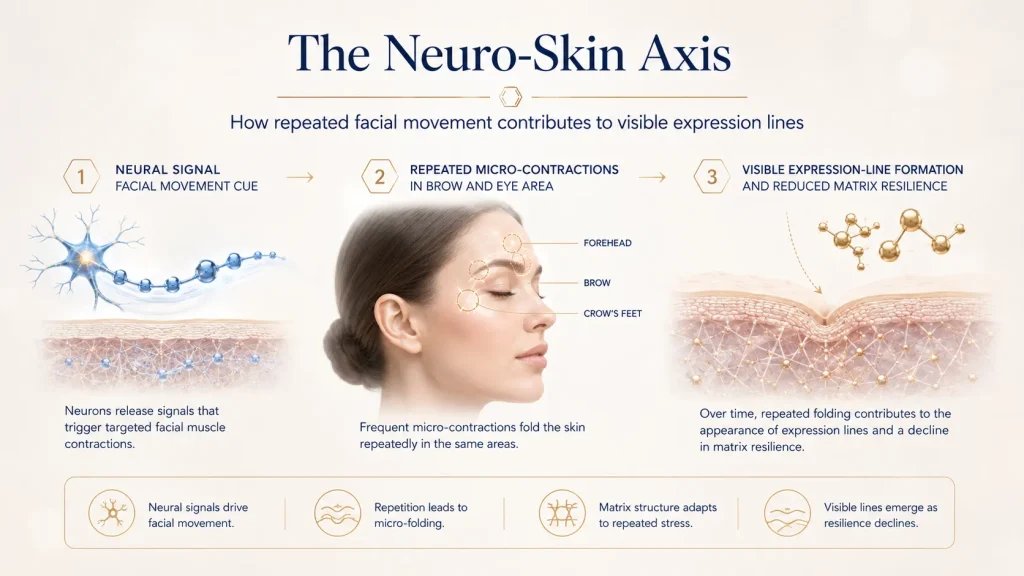
In the rigorous field of B2B dermatological formulation for 2026, the understanding of dynamic wrinkles has evolved beyond mere muscle movement. Expression lines are now increasingly discussed through the lens of the Neuro-Skin Axis—a signaling network where neural cues, repeated facial movement, keratinocytes, fibroblasts, and the dermal matrix all contribute to the visible appearance of aging. One important biological driver of dynamic lines is repeated facial contraction, which is associated with neurotransmitter signaling at the neuromuscular junction. When the brain sends a signal for facial movement, calcium ions enter the pre-synaptic neuron, triggering the fusion of neurotransmitter vesicles with the cell membrane. For professional-grade cosmetic formulation, the goal is not to block this process like a drug, but to support a more refined approach to expression-line care by addressing both signal-related visible tension and the skin’s structural environment.
As skin ages, repeated facial movement, environmental exposure, and declining matrix resilience can make expression lines more visible and persistent. Consequently, relying on a single mechanism of cosmetic support is no longer sufficient for the high-performance demands of the modern B2B market. A multi-stage, multi-peptide approach is increasingly relevant for brands that want to build a more complete and technically defensible expression-line product.
SNARE-Inspired Pathway Support: The Role of Acetyl Hexapeptide-8
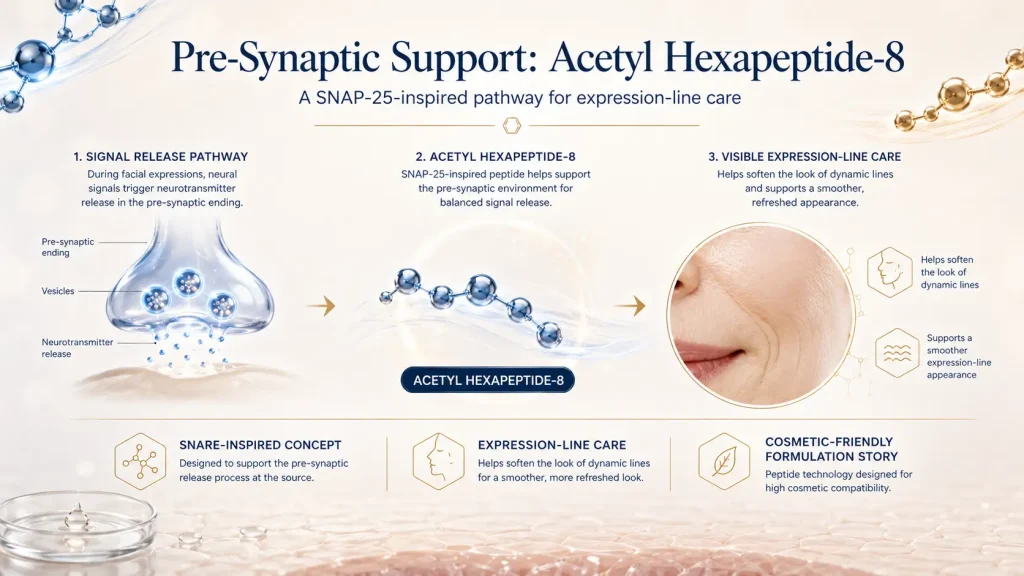
The first tactical layer of advanced peptide matrices often involves SNARE-inspired pathway support. The SNARE (Soluble NSF Attachment Protein Receptor) Complex is a tripartite protein bridge composed of three critical proteins: VAMP (Synaptobrevin), Syntaxin, and SNAP-25. In a normal physiological state, these three proteins must assemble to form a stable coiled-coil structure that pulls the neurotransmitter vesicle toward the cell membrane. This fusion is an important step in the release of Acetylcholine into the synaptic cleft.
The Molecular Mimicry of Acetyl Hexapeptide-8
Acetyl Hexapeptide-8 is commonly used in cosmetic formulations for expression-line care. It is often described as a SNAP-25-inspired peptide that may help soften the appearance of dynamic wrinkles by supporting pathways associated with neurotransmitter release. Rather than acting like a pharmaceutical neurotoxin, Acetyl Hexapeptide-8 is valued in cosmetic science because it offers a more surface-appropriate and formulation-friendly approach to expression-line appearance management.
Unlike Botulinum Toxin, which acts through a pharmaceutical mechanism, Acetyl Hexapeptide-8 provides a cosmetic alternative for brands seeking a softer, non-invasive story around expression-line care. It is better positioned as helping reduce the look of repeated facial tension rather than paralyzing muscle activity. In professional B2B formulations, achieving the optimal concentration of this peptide is critical for balancing efficacy, skin comfort, and claim support.
The Enkephalin-Like Pathway: Supporting a Second Layer of Expression-Line Care
A significant limitation of historical “single-active” formulations is the biological redundancy of visible aging. Even when one signal-related pathway is addressed, repeated facial activity, stress, environmental exposure, and matrix weakening can still contribute to persistent expression lines. To overcome this limitation, modern cosmetic science increasingly favors a multi-peptide strategy rather than relying on one single active.
Pentapeptide-18 and Enkephalin-Inspired Cosmetic Signaling
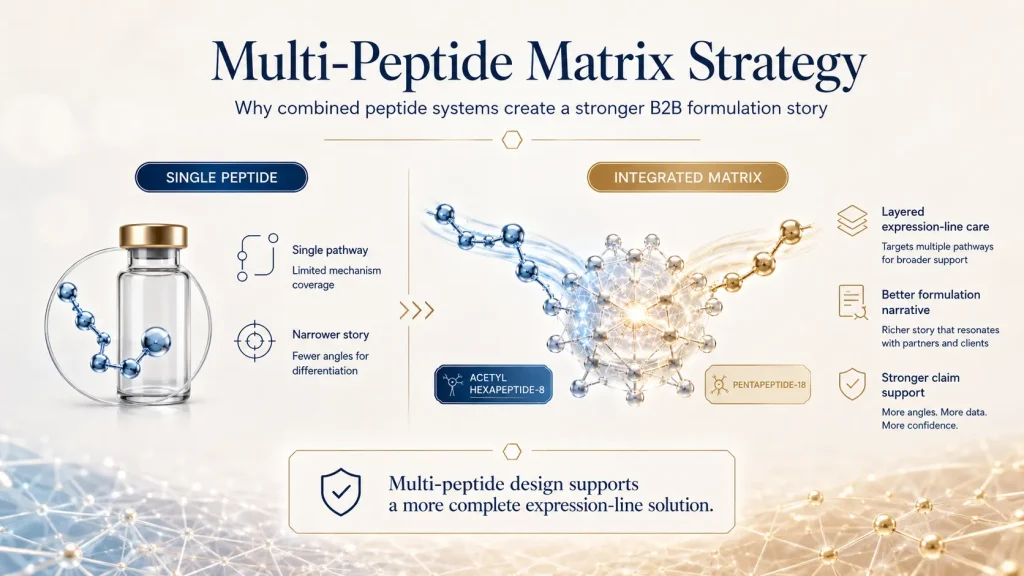
To address this complementary layer, next-generation matrices often integrate Pentapeptide-18, which is commonly positioned as an enkephalin-inspired peptide for expression-line care. In cosmetic formulation language, it is better described as supporting pathways associated with visible facial tension rather than directly blocking post-synaptic activity. This makes it a useful partner to Acetyl Hexapeptide-8 in a broader expression-line care matrix.
By combining Acetyl Hexapeptide-8 and Pentapeptide-18, formulators can build a more layered neuro-inspired cosmetic story. One pathway supports expression-line appearance through a SNAP-25-inspired approach, while the other adds an enkephalin-like support angle for visible facial tension. For B2B buyers, this provides a more complete technical rationale than a single-peptide claim and supports the development of high-performance anti-aging products with a stronger formulation story.
Synergistic Matrix Stability and Delivery Optimization
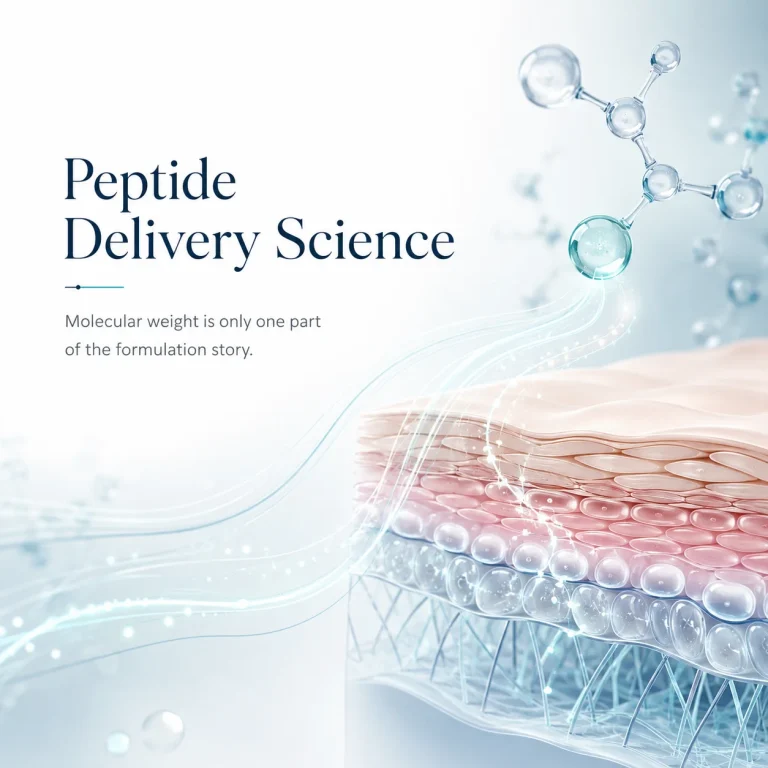
The success of a multi-peptide matrix depends not only on molecular synergy but also on formulation stability. Peptides can be sensitive to pH shifts, enzymatic degradation, and formulation incompatibility. In an aqueous solution, the matrix must be designed within a skin-compatible pH range and supported by an appropriate solvent, preservative, and stabilization system to help maintain peptide integrity.
Formulators must also consider compatibility when working with palmitoylated peptides or other structural peptides in the same matrix. While Acetyl Hexapeptide-8 and Pentapeptide-18 are generally used in water-based systems, their interaction with other actives requires careful calibration to reduce risks such as precipitation, instability, or performance loss. By optimizing the matrix environment, brands can ensure that each INCI is supported within a more reliable formulation architecture, providing a stronger technical story for the professional market.
Evidence and Claim Support: Evaluating Integrated Signaling Modulation
Available supplier data and published cosmetic research suggest that neuro-inspired peptides such as Acetyl Hexapeptide-8 and Pentapeptide-18 may help improve the appearance of expression lines. However, for B2B product development, brands should evaluate the complete formula through stability testing, instrumental assessment, consumer perception studies, and claim-support documentation before making market-facing efficacy claims.
References
- Blanes-Mira, C., et al. (2002). “A synthetic hexapeptide (Argireline) with antiwrinkle activity.” International Journal of Cosmetic Science, 24(5), 303–310.
- Lipotec S.A. Technical Literature. “Leuphasyl® / Pentapeptide-18: Mechanism and Cosmetic Application.”
- Published reviews on bioactive peptides in cosmetic anti-aging formulations.
- Supplier and formulation documentation for Acetyl Hexapeptide-8 and Pentapeptide-18 in cosmetic applications.