Professional Cosmetics Peptide Supplier | GENOPEP



2026 Global Peptide Compliance Redpaper: Navigating the “Biological Modification” Claim Trap
Introduction
As of March 2026, the global cosmetic peptide landscape is undergoing a “seismic shift” in regulation. Authorities are no longer merely checking for ingredient safety; they are auditing the biological logic behind marketing claims. For professional skincare brands, navigating this landscape requires a deep understanding of the thin line between “Beauty” and “Medicine.”
1. Global Regulatory Landscape: The 2026 “Co-Regulation” Era
The pressure is coming from three major fronts simultaneously. Understanding their specific focus is critical for global supply chain management.
| Region | Regulatory Body | 2026 Focus Area | Enforcement Action |
| China | NMPA | Efficacy claim justification & Labeling accuracy. | Mandatory clinical proof; AI keyword filtering. |
| EU | SCCS (Omnibus VIII) | CMR substances & “Pseudo-medical” claims. | Recall of products with “regenerative” claims. |
| USA | FDA (MoCRA Updated) | Facility registration & Serious Adverse Event reporting. | Warning letters for “Drug-like” structural claims. |
2. Deep Dive: The “Red-Yellow-Green” Claim Framework
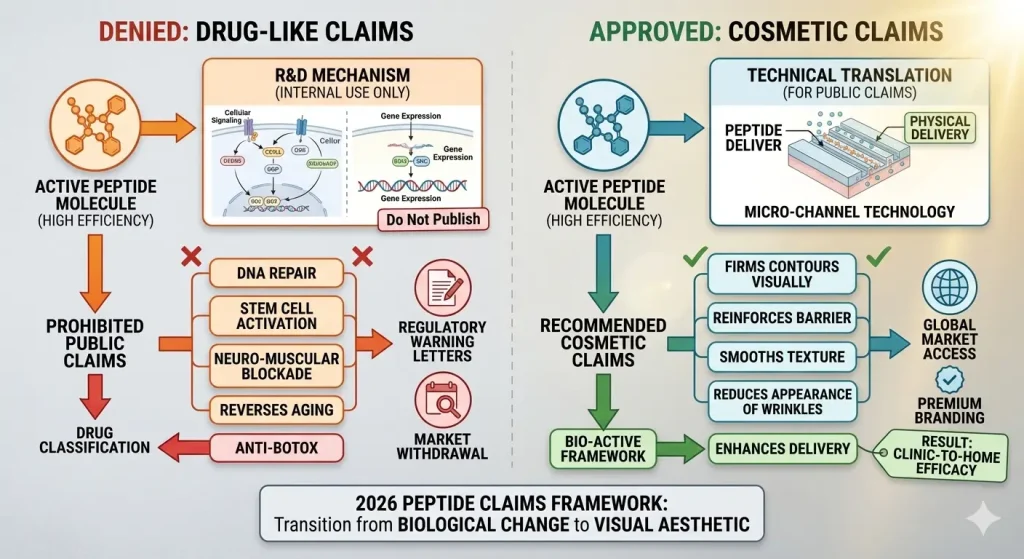
Regulators are now targeting phrases that imply a structural or functional change to the human body (Biological Modification).
🔴 Red Zone: Prohibited Phrasing (High Risk of Reclassification)
These terms often trigger an automatic reclassification of the product from a “Cosmetic” to a “Drug” or “Medical Device.”
- Gene/DNA Level: “DNA Repair,” “Epigenetic modification,” “Gene activation.”
- Medical Comparisons: “Safe alternative to Botox,” “Medical-grade healing,” “Suture-like lifting.”
- Cellular “Commands”: “Stem cell reprogramming,” “Inhibits neurotransmitters,” “Reverses cellular aging.”
🟡 Yellow Zone: Cautious Phrasing (Requires Heavy Clinical Data)
These terms are permissible only if backed by rigorous, third-party human efficacy trials.
- Regenerative Language: “Stimulates collagen synthesis,” “Deep cellular repair,” “Skin remodeling.”
- Structural Terms: “Rebuilds basement membrane,” “Restructures dermal matrix.”
🟢 Green Zone: Safe & Effective Phrasing (Recommended)
Focus on the visual sensory experience and barrier maintenance.
- Appearance Focus: “Visually firms facial contours,” “Reduces the appearance of deep wrinkles.”
- Protective Focus: “Reinforces skin’s moisture barrier,” “Protects skin from environmental stressors.”
Global Peptide Compliance
3. The “Technical Translation” Strategy
The challenge for R&D is explaining complex peptide mechanisms without sounding “medicinal.”
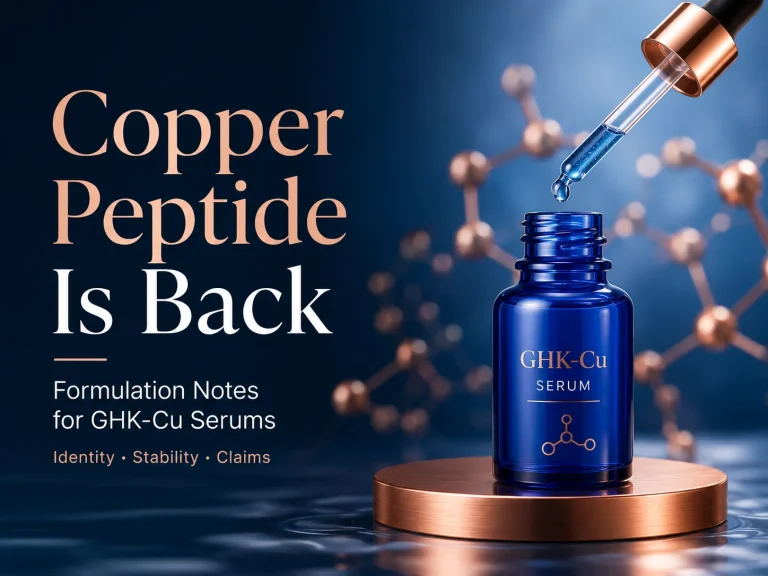
Case Study: How to Market a Copper Peptide (GHK-Cu)
- The Forbidden Claim: “Heals damaged tissue by activating repair genes.”
- The 2026 Compliant Claim: “Optimizes the skin’s self-protection environment, providing a visible soothing effect and enhancing surface resilience.”
4. GENOPEP’s Roadmap for B2B Partners
To ensure our clients lead the market in 2026, we suggest adopting the Bio-Active Compliance System:
Step 1: Claim Decoupling
Review all marketing assets. Separate “Technical Mechanisms” (for internal R&D) from “Public Claims” (for consumer packaging).
Step 2: Physical Efficacy Proof
Shift the focus to Micro-Channel Technology. By proving that a peptide physically penetrates the stratum corneum more efficiently, you explain how it works without needing to claim it changes the DNA.
Step 3: Global Dossier Harmonization
Ensure your product’s dossier satisfies both NMPA (China) and SCCS (EU) standards simultaneously to avoid costly reformulations during expansion.
Conclusion: Compliance is a Competitive Advantage
In the 2026 market, the most successful brands will be those that offer Professional Efficacy backed by Absolute Compliance. At GENOPEP, we don’t just supply peptides; we provide the regulatory intelligence to ensure your brand’s future is secure.
If you are unsure whether your product is compliant, contact us for a free compliance risk review.