Professional Cosmetics Peptide Supplier | GENOPEP



GLP-1 Era Skincare: Can Peptides Help Support Firmer-Looking Skin?
GLP-1 skincare is not really about putting a weight-loss drug story into a cream. For cosmetic brands, the search demand starts with phrases like “Ozempic face,” but the formulation question is more precise: can a topical product help skin look better supported when rapid body change makes dryness, crepiness, fine lines, or loss of visible firmness more noticeable?
The boundary matters. The American Academy of Dermatology notes that GLP-1 receptor agonists are approved for obesity and diabetes, not for skin disease, while dermatologists are increasingly watching hair, skin, nutrition, and cosmetic concerns during treatment [1]. That makes this a beauty-adjacent medical topic. A responsible skincare article should acknowledge the trend, then move quickly into cosmetic formulation, not medical advice.
What Peptides Can and Cannot Do
Topical peptides cannot replace lost facial fat, restore deep volume, or treat a medication-related side effect. Those are not cosmetic claims. Where peptides become relevant is the skin envelope: hydration, smoother-looking texture, the appearance of elasticity, and the look of resilience. A 2026 systematic review of randomized trials found peptides to be generally well tolerated, with measurable benefits for hydration and brightness, modest wrinkle findings, and less consistent effects on elasticity [2]. That is useful evidence, but it calls for careful wording.
That is why “firming” should be written as an appearance claim, not a tissue-rebuilding promise. A strong GLP-1 era formula should not say it reverses “Ozempic face.” It can say it supports the appearance of firmer-looking, smoother, better hydrated skin when the user wants a more conditioned look during or after visible body change.
The Better Brief: Support the Skin Envelope
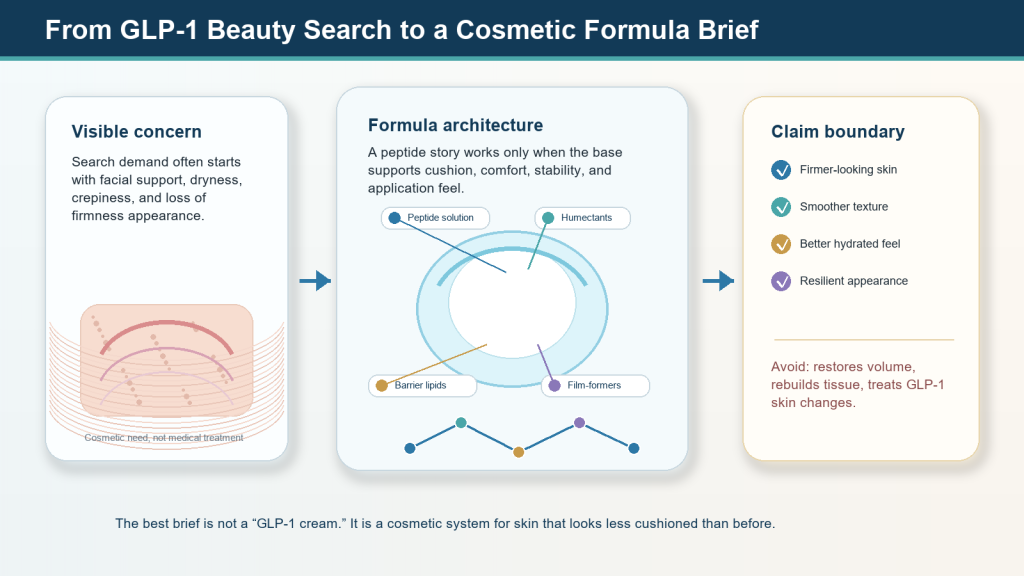
The best product brief is not “make a GLP-1 cream.” It is “build a cosmetic system for skin that looks less cushioned than before.” That system needs more than one active. A peptide solution may provide the technical performance story, while humectants support water content, barrier lipids improve comfort, film-formers add an immediate surface-support feel, and antioxidants or niacinamide help the formula fit the wider skin-longevity conversation.
This is where peptide choice becomes practical. Signal peptides may fit firmness and smoothness positioning. Copper peptides can carry a more technical skin-quality story, but they bring color, pH, chelation, and oxidation questions. Lipid-modified peptides may improve formula handling, but they still need compatibility work. Peptides are not interchangeable labels; each sequence and delivery format changes the stability and claim strategy.
Different product formats also need different answers. A face serum should feel elastic and non-sticky under sunscreen or makeup. A neck cream needs slip, film formation, and enough cushion for a mobile area. A body firming lotion must balance spreadability, cost-in-use, and a realistic peptide level for larger application zones. One peptide story cannot simply be copied into all three formats.
Formulation Checks Before the Claim
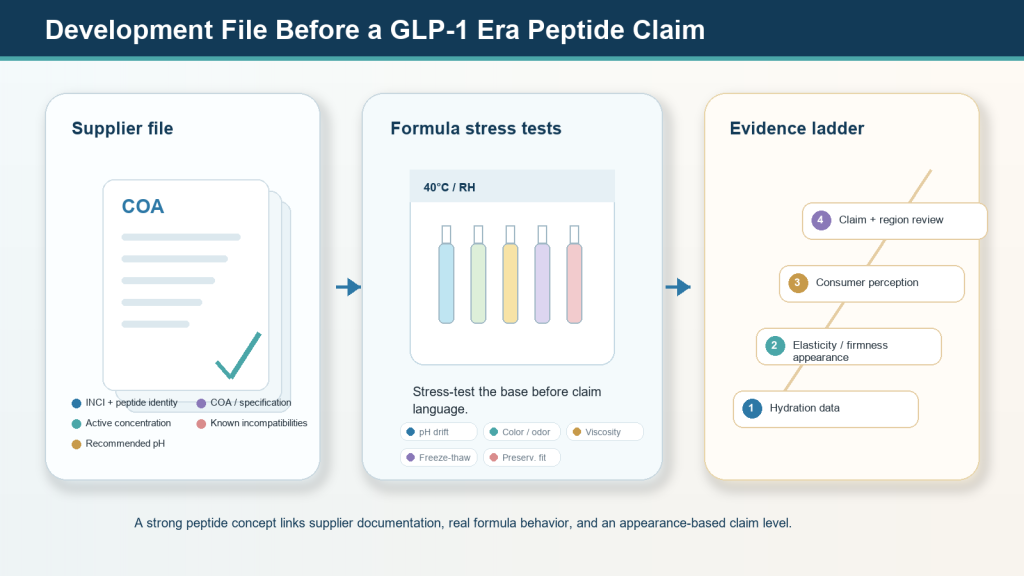
For formulators, the first screen should be stability, not storytelling. Check pH drift, color change, odor, viscosity, preservative compatibility, and heat-cool or freeze-thaw behavior. If the peptide is presented as a meaningful active, the supplier should be able to explain identity, active concentration, recommended use range, solvent or carrier system, and known incompatibilities.
Evidence should match the strength of the claim. A hydration-led peptide formula may need corneometer data and consumer perception. A firmer-looking skin claim may require instrumental elasticity or firmness-appearance testing, plus before-and-after photography under controlled conditions. A skin-longevity story may need a broader file: ingredient rationale, stability, safety, and a clear explanation of why the selected peptides belong in the system.
The claim boundary is not optional. FDA guidance reminds brands that cosmetic claims must be truthful and not misleading; claims that imply treating disease or affecting the structure or function of the body can move a product into drug territory [4]. In this context, “supports the appearance of firmer-looking skin” is a safer cosmetic direction than “restores volume,” “rebuilds tissue,” or “treats GLP-1 skin changes.”
What B2B Buyers Should Ask a Peptide Supplier
A serious GLP-1 era peptide brief should start with supplier questions: What is the peptide identity and INCI name? Is the stated concentration the peptide active level or the solution level? What pH range is recommended? Has the peptide been evaluated with common humectants, emulsifiers, electrolytes, chelators, or preservatives? Can the supplier provide COA, specification, stability notes, and sample formula direction?
This is also where Genopep’s role should be concrete. The value is not chasing the GLP-1 trend as a slogan. The value is helping brands translate a fast-moving consumer concern into single cosmetic peptides, multi-peptide solution options, compatible product formats, and documentation that a formulation, procurement, and regulatory team can actually use.
For brands building a face, neck, or body concept around the GLP-1 era, the next step is not a miracle claim. It is a better brief: target area, product format, peptide direction, sensory goal, stability requirement, and claim level. Request a quote from Genopep to discuss which peptide solution route fits your formula before you move into samples.
References
American Academy of Dermatology. The role of GLP-1s in dermatology. January 1, 2026.
Vogue. 2026’s Biggest Skincare Trends to Try Now. January 5, 2026.
U.S. Food and Drug Administration. Cosmetics Labeling Claims.