Professional Cosmetics Peptide Supplier | GENOPEP



PDRN vs Peptides: Which Regenerative Skincare Story Is More Formulation-Ready?
Why PDRN Suddenly Became a Skincare Keyword
PDRN has moved quickly from aesthetic-medicine conversations into everyday skincare search. Beauty media now treats polydeoxyribonucleotide, often described as DNA-derived fragments, as part of the broader “regenerative beauty” wave coming from K-beauty and skin-booster culture. That makes it a useful traffic topic for brands, but the B2B question is more practical: which story can be specified, stabilized, and claimed responsibly in a topical cosmetic formula?
Peptides and PDRN are not interchangeable. Cosmetic peptides are short amino-acid sequences selected for a defined formulation role, such as signal support, carrier activity, soothing concepts, brightening concepts, or barrier-oriented claims. PDRN is a polynucleotide-based material with a different origin story and a different evidence base. For formulators and purchasing teams, the comparison should not be “which sounds newer?” It should be “which gives us the clearest development file?”
What PDRN Offers, and Where the Gap Begins
PDRN is attractive because it carries scientific language: nucleotide fragments, tissue-repair literature, adenosine A2A receptor discussion, and professional-treatment associations. Recent reviews have discussed PDRN extraction and novel cosmeceutical applications, while separate clinical literature has reviewed PDRN in wound healing and tissue-regeneration contexts. This background gives marketers a story that feels modern and research-linked.
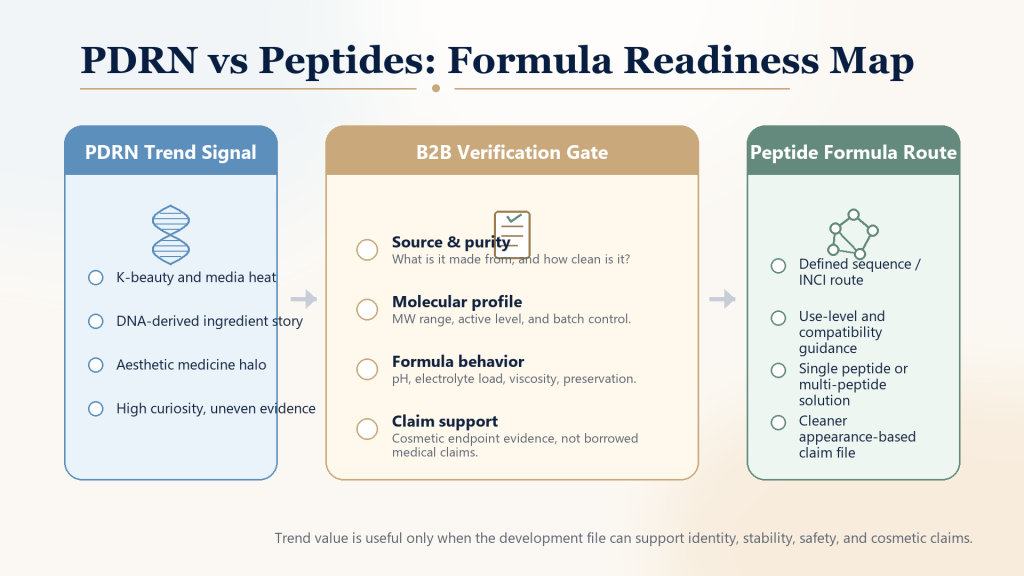
The gap is that many of the strongest PDRN signals do not come from ordinary leave-on skincare. They may involve injectable formats, post-procedure use, medical endpoints, or conditions far away from a daily serum or cream. A topical product team therefore needs to ask basic but uncomfortable questions: What is the PDRN source? What is the molecular-weight distribution? What is the active content? How is residual protein, impurity, odor, preservation, and batch consistency controlled? What evidence supports the exact cosmetic claim being made?
Why Peptides Are Often More Formulation-Ready
Peptides have their own limitations, and not every peptide ingredient deserves the same level of confidence. Still, cosmetic peptides often start with a clearer technical structure. A supplier can usually define the sequence, INCI direction, active concentration, recommended use level, solubility, pH comfort zone, temperature sensitivity, and compatibility concerns. Modified short peptides, including lipidated peptides, can also be designed with topical formulation behavior in mind.
That documentary clarity matters. It helps a brand decide whether to develop a single-peptide serum, a multi-peptide solution, a peptide-plus-hyaluronic-acid product, or a richer cream that needs stronger compatibility screening. For Genopep, this is where the peptide solution model becomes commercially useful: a customer can evaluate individual cosmetic peptides, but also explore ready-to-use multi-peptide formulation solutions when speed, simplicity, and concept fit matter.
The Claim Boundary: Regenerative-Inspired, Not Medical
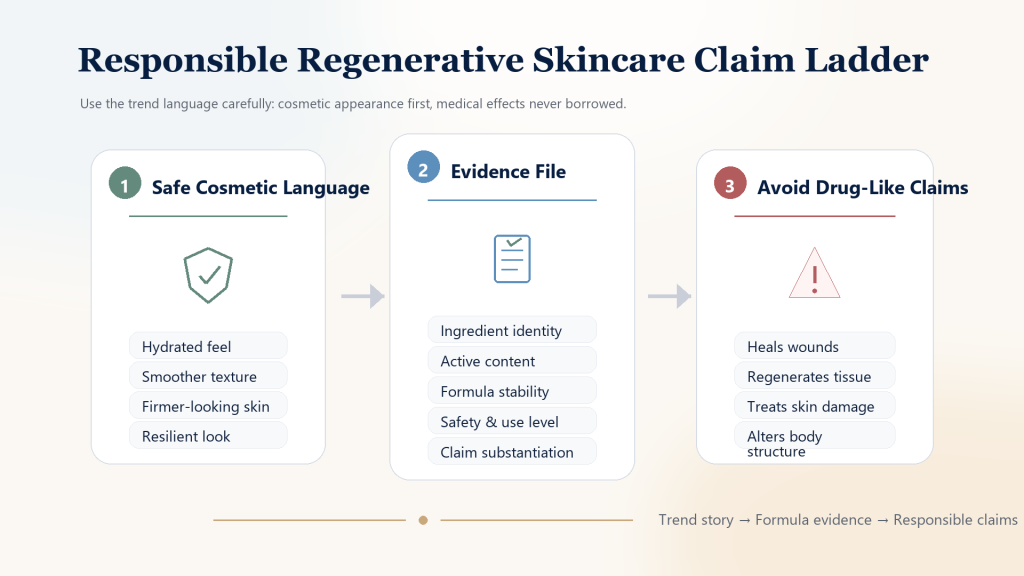
The word “regenerative” is the risky part of this trend. In cosmetics, a safer route is to translate the concept into appearance and sensory language: smoother-looking texture, hydrated feel, firmer-looking appearance, improved comfort, or a more resilient-looking skin surface. Claims such as “heals wounds,” “repairs damaged tissue,” “regenerates skin,” or “treats inflammation” can move a product toward drug-like territory in markets such as the United States, and they also demand much stronger evidence under EU-style claim-substantiation expectations.
This is not a reason to avoid trend topics. It is a reason to build them well. A strong PDRN-versus-peptide story can say: PDRN is a consumer conversation about regenerative beauty, while cosmetic peptides offer one practical route for building topical formulas with defined ingredients, stability planning, and responsible appearance-based claims.
A Practical Development Checklist
Before building a concept around PDRN, peptides, or both, ask suppliers for the same kind of file discipline: specification, COA, active-content information, recommended use level, safety documentation, stability guidance, preservation compatibility, and claim-support data. For PDRN, add source, extraction method, molecular-weight profile, impurity control, and country-specific regulatory review. For peptides, add sequence identity, modification type, solvent system, pH range, and compatibility with electrolytes, acids, preservatives, and packaging.
In many topical formulas, the smartest answer may not be PDRN or peptides. It may be a trend-aware formula architecture: use the PDRN conversation as a consumer-interest bridge, then support the actual product with a peptide system, humectants, barrier lipids, film formers, and a claim file that the brand can defend. This approach feels less dramatic than a viral headline, but it is far more useful when a buyer asks what can be scaled.
Bottom Line for B2B Brands
PDRN may win the headline right now. Peptides often win the formulation file. For brands developing a regenerative-inspired serum, cream, mask, neck product, or body-care concept, the best next step is to compare the ingredient story with the practical development requirements. Genopep can support that discussion with cosmetic peptide options and multi-peptide formulation solutions designed for B2B evaluation. If your team is planning a trend-led peptide product, request a quote and share the target format, claim direction, and market requirements.
References
1. Allure. “PDRN Has Quickly Taken Over Skin Care.” 2026. https://www.allure.com/story/what-is-pdrn-skin-care-salmon-sperm
2. Nguyen TH, Wang SL, Nguyen VB. “Recent advances on polydeoxyribonucleotide extraction and its novel application in cosmeceuticals.” International Journal of Biological Macromolecules, 2024. DOI: 10.1016/j.ijbiomac.2024.137051. https://pubmed.ncbi.nlm.nih.gov/39486723/
3. Colangelo MT, Galli C, Guizzardi S. “The effects of polydeoxyribonucleotide on wound healing and tissue regeneration: a systematic review of the literature.” Regenerative Medicine, 2020. DOI: 10.2217/rme-2019-0118. https://pubmed.ncbi.nlm.nih.gov/32757710/
4. Frontiers in Pharmacology. “Role of peptide-cell surface interactions in cosmetic peptide application.” 2023. https://www.frontiersin.org/journals/pharmacology/articles/10.3389/fphar.2023.1267765/full
5. FDA. “Cosmetics Labeling Claims.” https://www.fda.gov/cosmetics/cosmetics-labeling/cosmetics-labeling-claims
6. European Commission. Commission Regulation (EU) No 655/2013 laying down common criteria for cosmetic product claims. https://health.ec.europa.eu/publications/commission-regulation-6552013_en
7. Cosmetics Europe. “Guidelines for Cosmetic Product Claim Substantiation.” https://cosmeticseurope.eu/wp-content/uploads/2024/10/Guidelines_for_Cosmetic_Product_Claim_Substantiation.pdf
8. Genopep product category pages. https://www.skinkindcosmetics.com/products/product/