Professional Cosmetics Peptide Supplier | GENOPEP



The Myth of the Single Molecule: Why Multi-Peptide Complexes Are Replacing Hero Ingredient Marketing
The Myth of the Single Molecule
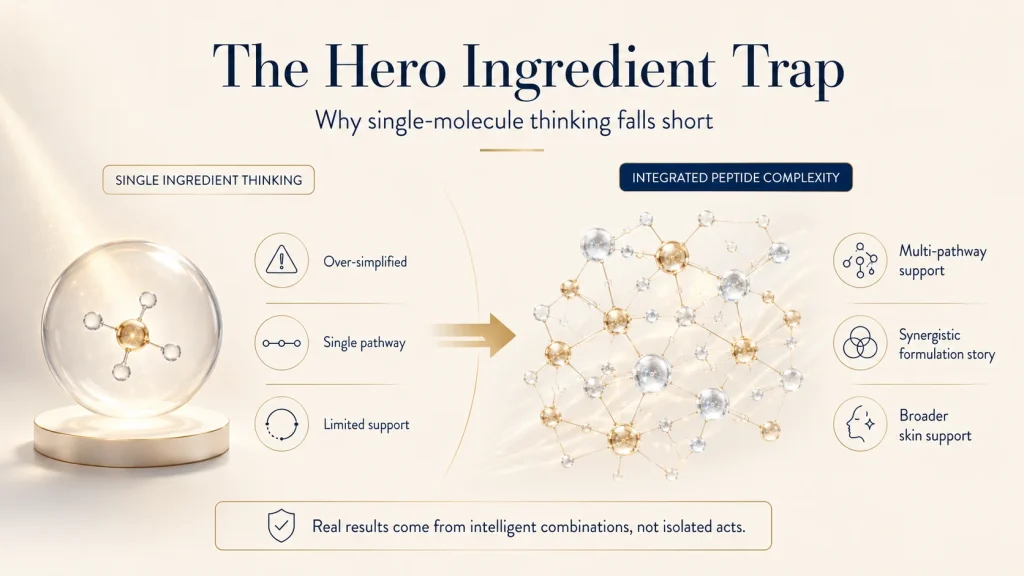
For over a decade, the global skincare industry was built on what we now recognize as a convenient myth—the “Hero Ingredient” narrative. Whether it was a 2% concentration of pure Retinol, a single patented copper peptide, or an isolated plant stem cell extract, brands competed fiercely on the perceived potency of one molecule. Marketing campaigns promised that this single active could visibly improve signs of photodamage, soften the look of wrinkles, and support a more elastic-looking skin appearance.
But by 2026, this narrative is losing authority. The market conversation is clearly moving away from isolated “hero ingredient” claims and toward multi-pathway, synergistic positioning. For B2B brands, this shift is not just a messaging trend—it reflects a deeper correction in how skin biology is being understood.
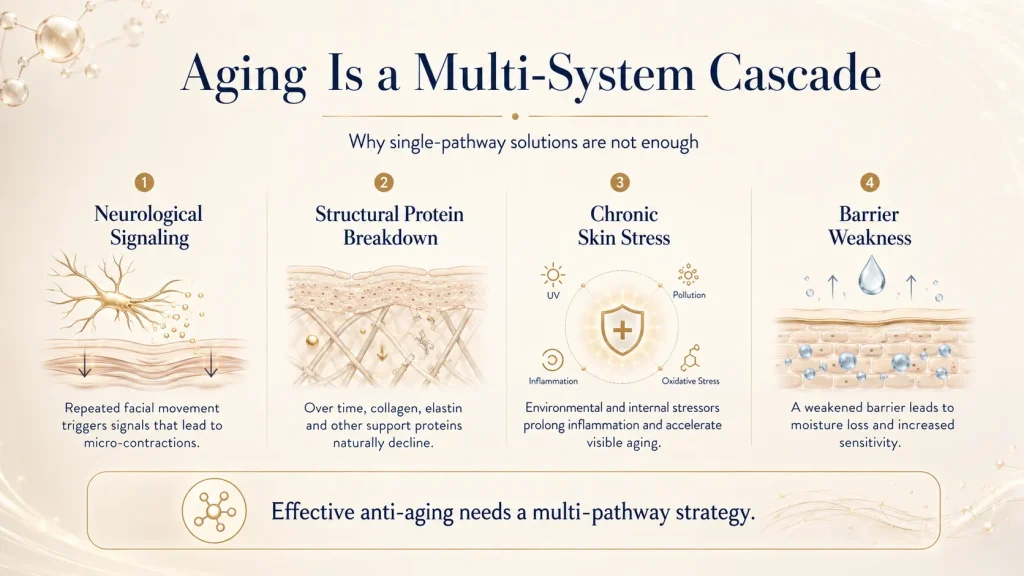
The Biological Reality of Aging: Skin aging is not a single-point failure. It is a cascading, multi-dimensional decline across interconnected biological systems. A single peptide addressing only one pathway may leave several other visible aging processes insufficiently supported.
Neurological Signaling: Continuous micro-contractions at the neuromuscular junction contribute to dynamic expression lines that deepen over time. Collagen-supporting actives alone may be insufficient when repeated facial movement continues to reinforce dynamic expression lines.
Structural Protein Breakdown: The dermal matrix gradually loses resilience with age, while collagen, elastin, and the dermal-epidermal junction all play a role in how firm, smooth, and supported the skin appears.
Chronic Skin Stress: Low-grade persistent stress in the skin environment can undermine repair-focused formulas. For brands, this means anti-aging products need a broader story than “one molecule, one result.”
The Rise of the Multi-Peptide Complex
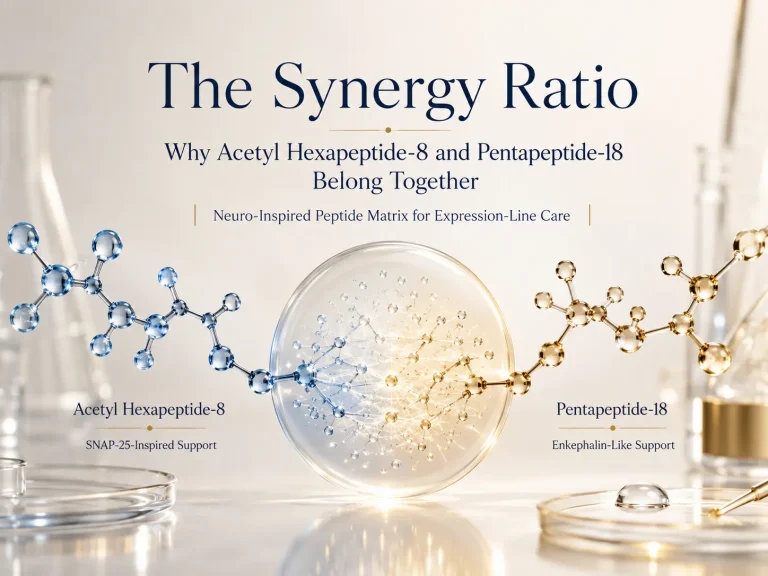
The new benchmark for high-performance anti-aging formulation is what the industry increasingly describes as the Multi-Peptide Complex or Multi-Peptide Matrix. By integrating multiple peptides with distinct cosmetic support roles, formulators can create a more complete “Multi-Pathway Support” system—where the combined formulation story is stronger than the performance narrative of any single isolated active.
Multi-Peptide Clinical Story: Published cosmetic research and supplier-backed testing on documented peptide complexes show why multi-peptide systems can provide a stronger technical foundation than isolated ingredient claims. The key point for B2B brands is not to copy one famous complex, but to understand why documented peptide combinations are easier to turn into a credible, evidence-backed product story.
Simultaneous Architecture Support: Youthful-looking skin depends on multiple structural elements, including collagen, elastin, and the dermal-epidermal junction. A well-designed matrix can be built to support multiple structural pathways rather than over-relying on one isolated target.
Skin Stress and Comfort Support: Certain peptide systems are also positioned around soothing and anti-stress support, helping brands build a broader story around skin comfort, visible resilience, and matrix protection.
Barrier Reinforcement: Barrier-supporting peptides and complementary actives can help reinforce the stratum corneum story, supporting hydration, comfort, and reduced TEWL-focused positioning.
Strategic Advantage for B2B Brands
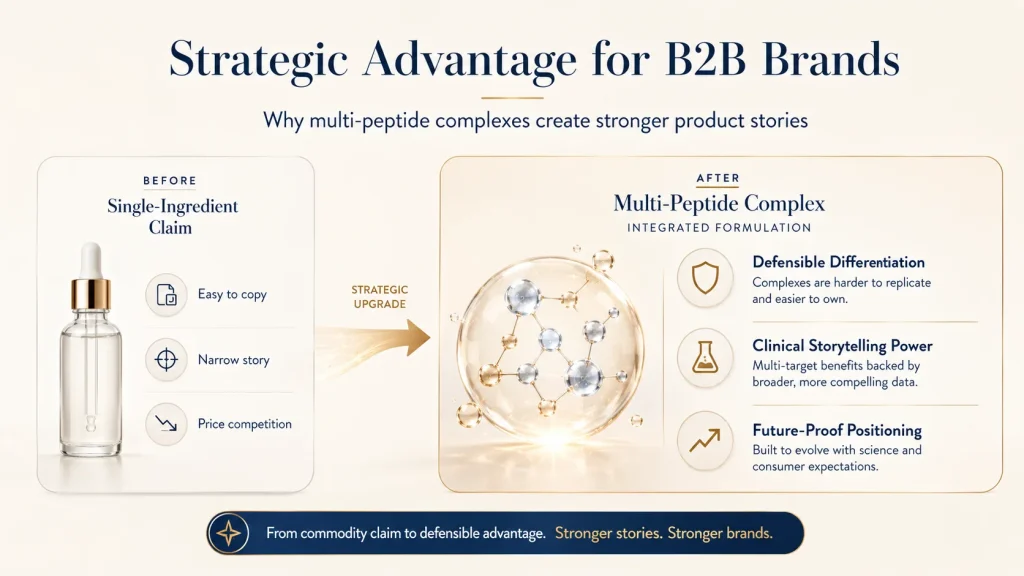
For B2B skincare brands, the shift to a Multi-Peptide Complex represents a significant strategic upgrade. It moves marketing away from exhausting price wars over commodity ingredients and toward a more sophisticated narrative of systematic, multi-pathway performance.
Defensible Differentiation: A proprietary peptide matrix cannot be easily copied. Replicating a multi-peptide formulation requires understanding precise ratios, compatibility, stabilization strategy, delivery environment, and pH requirements—knowledge that goes far beyond matching a single concentration.
Clinical Storytelling Power: Instead of marketing a single percentage point, brands can present a broader technical story around multiple dimensions of skin quality, such as wrinkle appearance, firmness, surface smoothness, skin comfort, and radiance.
Future-Proof Positioning: As consumer sophistication grows and ingredient literacy increases, brands that invest early in multi-pathway science will appear more advanced, while single-ingredient marketing may look increasingly outdated.
In 2026, the question is no longer whether a product contains one famous active. The more important question is whether the formula is built as a system. For brands that want to create a premium anti-aging hero product, the future belongs to documented, stable, and well-designed multi-peptide complexes.