Professional Cosmetics Peptide Supplier | GENOPEP



Beyond the Needle: How Peptides Are Reframing the “Botox Fatigue” Market
The Rise of “Botox Fatigue” in 2026
For over two decades, botulinum toxin type A has been one of the most recognised professional solutions for expression line reduction. According to the International Society of Aesthetic Plastic Surgery, botulinum toxin remains the most common non-surgical aesthetic procedure worldwide, with millions of procedures performed each year. However, a significant shift in consumer psychology is emerging in 2026 that the industry can no longer ignore.
In this article, “Botox Fatigue” does not describe a medical side effect or diagnosis. Instead, it refers to a growing cultural and psychological weariness among consumers who have relied on repeated injectable routines for years. These are educated buyers—many of whom started treatments in their late twenties—who are now reassessing their relationship with invasive procedures, high maintenance costs, and facial aesthetics that may not always feel natural.
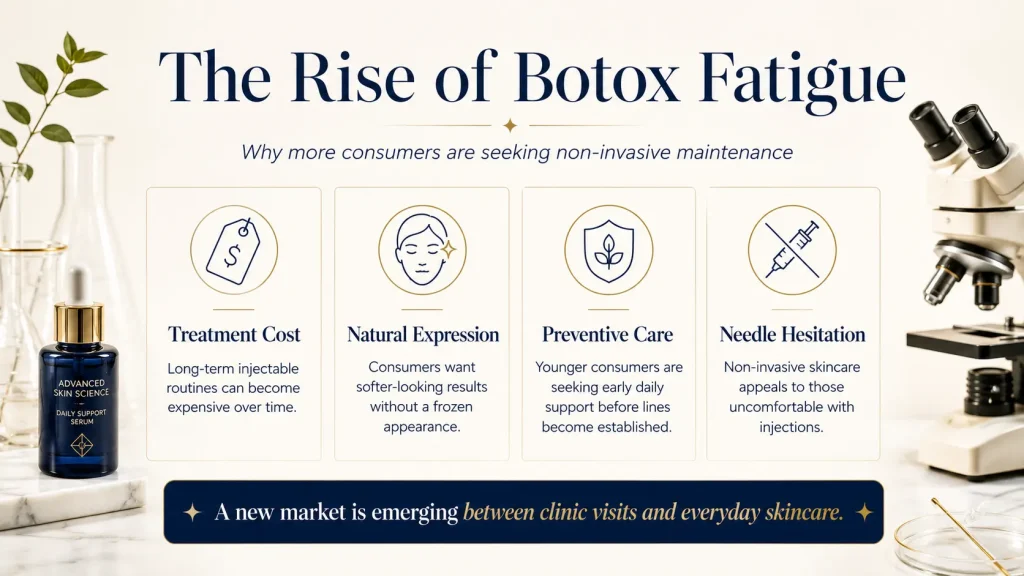
Invasive Procedure Hesitation: For some consumers, quarterly treatments over many years can add up to tens of thousands of dollars, depending on dose, location, and provider. This financial and emotional burden pushes consumers to seek more sustainable, at-home maintenance solutions that can support their appearance between professional visits.
Expression Preservation Demand: A growing group of consumers are becoming more sensitive to the “frozen” aesthetic associated with injectable neuromodulators. Even when procedures are skillfully administered, some consumers want to maintain what may be called “emotional authenticity”—the ability to express joy, concern, and surprise naturally.
The Pre-Juvenation Movement: Consumers in their mid-to-late twenties and early thirties are increasingly seeking preventive skincare strategies before expression lines become deeply established. This creates a meaningful growth segment for topical solutions that support early-stage expression-line care.
Needle Hesitation and Accessibility: Needle fear remains a meaningful barrier for a portion of consumers. Even as cosmetic injections become more normalised, many people still prefer non-invasive, daily-use options that fit more comfortably into a skincare routine.
The Science Behind Peptidic Alternatives
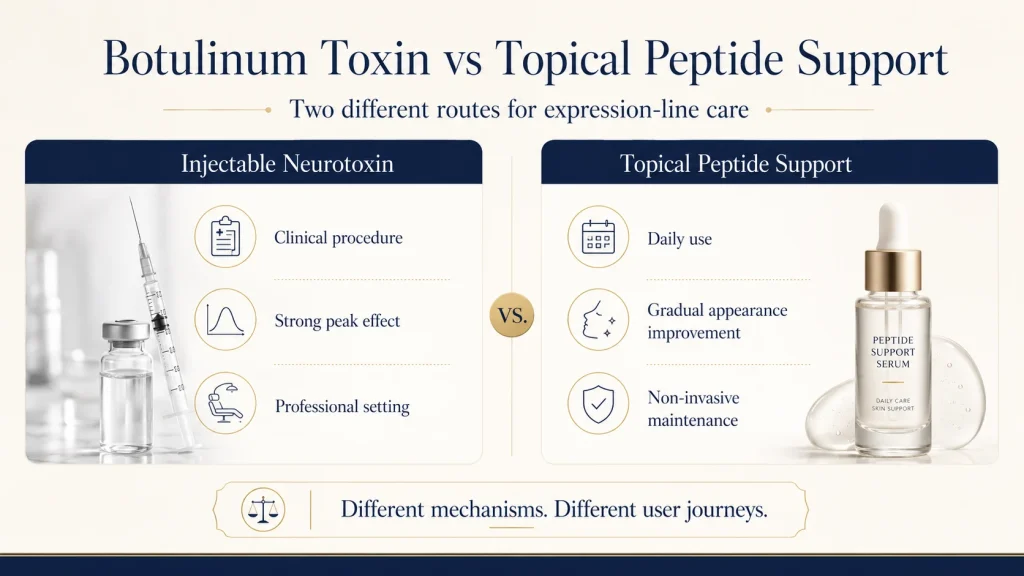
The comparison between topical peptides and botulinum toxin requires careful scientific distinction. Topical peptides should not be positioned as equivalent to injectable neurotoxins. Their more credible role is daily, non-invasive expression-line maintenance and support between professional treatments.
Botulinum toxin works through a professional clinical mechanism involving SNAP-25, a protein essential for acetylcholine release at the neuromuscular junction. This strong intervention is precisely why injectable treatments can deliver visible results, but it is also why they belong in a professional medical or aesthetic setting.
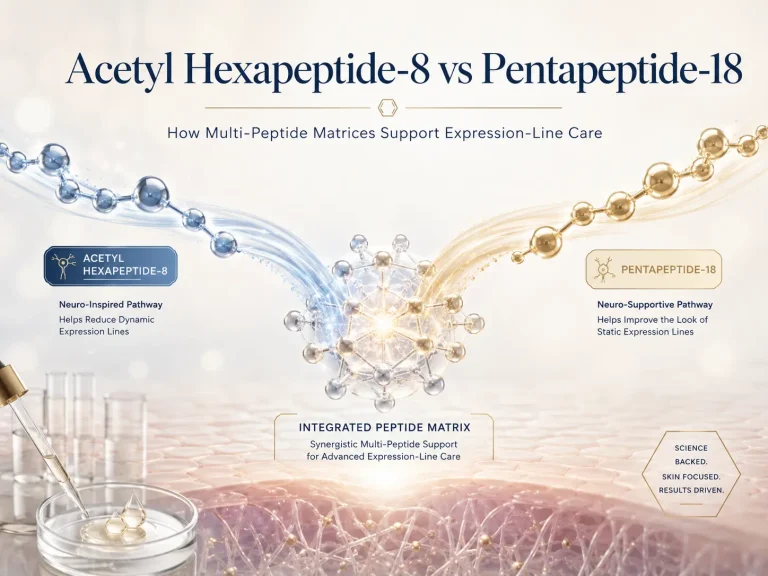
SNARE-Inspired Peptide Support: Certain cosmetic peptides, such as Acetyl Hexapeptide-8, also known commercially as Argireline®, are commonly described as SNARE-inspired peptides. In cosmetic formulation language, they may help support pathways associated with neurotransmitter release and the visible appearance of dynamic expression lines. This creates a modulation story rather than a blockade story—a nuanced but critically important difference.
The Soft Expression-Line Effect: Instead of claiming muscle paralysis, topical peptide products should be positioned around a softer appearance of expression lines without the frozen look associated with injectable neuromodulators. A frequently cited study reported that a 10% Argireline formulation reduced wrinkle depth by around 30% after 30 days of twice-daily use, supporting its role as a cosmetic ingredient for expression-line appearance care.
Cumulative Daily Maintenance: Injectable neurotoxins are professional procedures with a stronger peak effect that gradually changes over several months. Topical peptide matrices, by contrast, are better positioned as steady, cumulative maintenance tools that build with consistent daily use. This profile aligns naturally with the ritual and repeat-use nature of skincare routines.
Synergistic Matrix Support: When expression-line peptides are combined with collagen-supporting peptides, barrier-supporting ingredients, and hydration systems in a single matrix, the product story becomes stronger. The expression-line peptide helps support the appearance of dynamic lines, while the structural and barrier components help address the visible skin quality around those lines.
Capturing the Market: Strategic Positioning for Brands
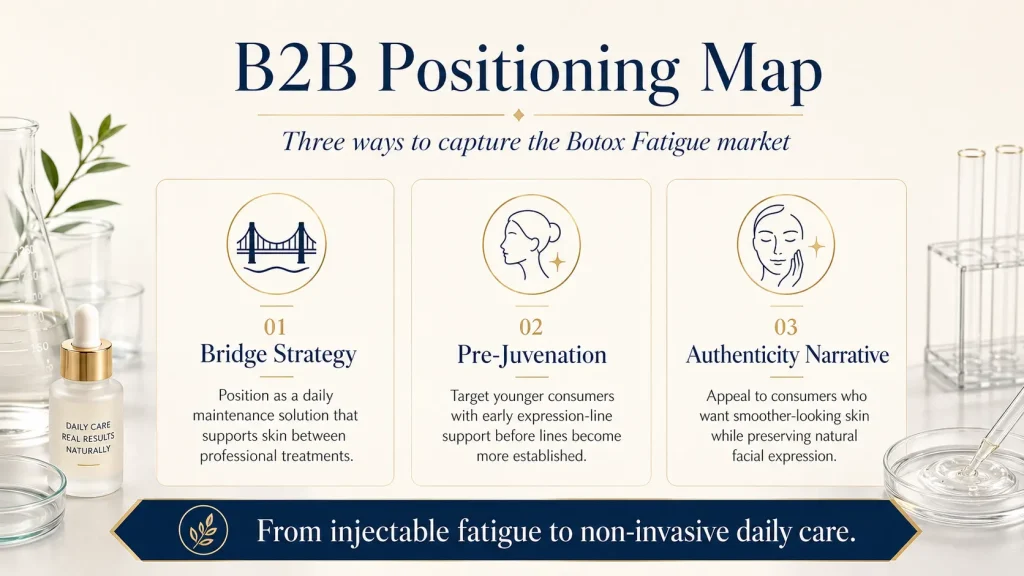
For B2B brands, the “Botox Fatigue” segment represents an opportunity to position products as sophisticated maintenance solutions rather than cheap substitutes. The messaging must emphasise what peptide-based skincare can credibly offer: daily maintenance, natural-looking expression support, and a non-invasive route to visible improvement.
The Bridge Positioning Strategy: Position the product not as a replacement for injectables, but as a complementary daily maintenance solution that supports the skin between professional treatments. This approach respects the consumer’s existing investment while adding value to their routine.
The Pre-Juvenation Angle: Target the 25–35 demographic with messaging around “staying ahead of the line”—supporting expression-line care before dynamic lines become more visible and persistent.
The Authenticity Narrative: Appeal to consumers who value emotional expressiveness. The goal is not a frozen face, but skin that looks smoother, well-maintained, and still authentically expressive.
For skincare brands, the opportunity is not to compete directly with injectable procedures. The smarter opportunity is to build a product category around non-invasive maintenance, visible expression-line care, and natural-looking anti-aging routines. In the “Botox Fatigue” era, peptide complexes can help brands offer consumers a more flexible, more accessible, and more emotionally comfortable path to looking well cared for.