Professional Cosmetics Peptide Supplier | GENOPEP



The Synergy Ratio: Why Acetyl Hexapeptide-8 and Pentapeptide-18 Belong Together
The Neuro-Architecture of Wrinkles: Understanding the Synaptic Transmission
In the professional dermatological science of 2026, the formation of dynamic wrinkles is understood as a direct consequence of repeated, high-frequency facial muscle contractions associated with the nervous system. The neuromuscular junction (NMJ) is the biological site where these commands are executed. For a muscle to contract, the presynaptic neuron releases acetylcholine (ACh) into the synaptic cleft. This release process is not simple diffusion; it is a highly orchestrated molecular event that depends on the fusion of synaptic vesicles with the neuronal membrane. In youthful skin, this system functions efficiently, but as skin loses elasticity, the repeated mechanical stress of these contractions contributes to the formation of persistent furrows known as expression lines.
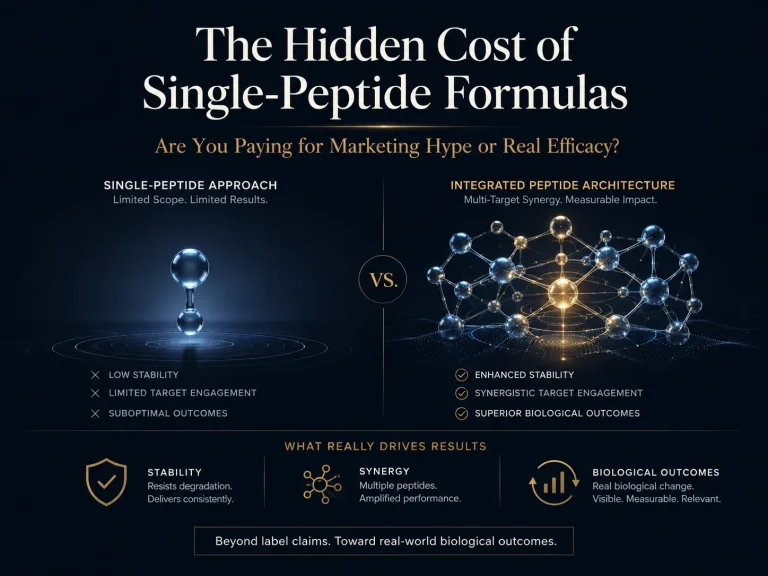
To achieve stronger expression-line care in professional skincare, it is no longer sufficient to target a single point in this complex signaling cascade. The historical approach of using a single active ingredient often fails to provide the level of visible smoothing expected by the modern consumer without relying on invasive clinical procedures. In 2026, the paradigm is shifting toward multi-pathway, neuro-inspired cosmetic support: a strategy that involves the simultaneous use of complementary peptides within the expression-line care process. This strategy relies on the “Synergy Ratio”—the precise combination of cosmetic actives that support different stages of the visible expression-line pathway, helping reduce the appearance of facial tension while preserving the skin’s natural expressiveness.
Acetyl Hexapeptide-8: The SNARE-Inspired Peptide in Expression-Line Care
Acetyl Hexapeptide-8 is arguably one of the most recognised biomimetic peptides in the history of neuro-inspired cosmetics. Its cosmetic mechanism story is focused on the final, critical step of the neurotransmitter release process: vesicle fusion. For a synaptic vesicle to fuse with the neuronal membrane and release its cargo of acetylcholine, a set of proteins must assemble into a stable structure known as the SNARE complex. This complex is composed of three primary proteins: VAMP (synaptobrevin), Syntaxin, and SNAP-25. The assembly of these proteins acts like a biological winch, pulling the vesicle close to the membrane until the two lipid bilayers merge, allowing the neurotransmitter to enter the synaptic cleft.
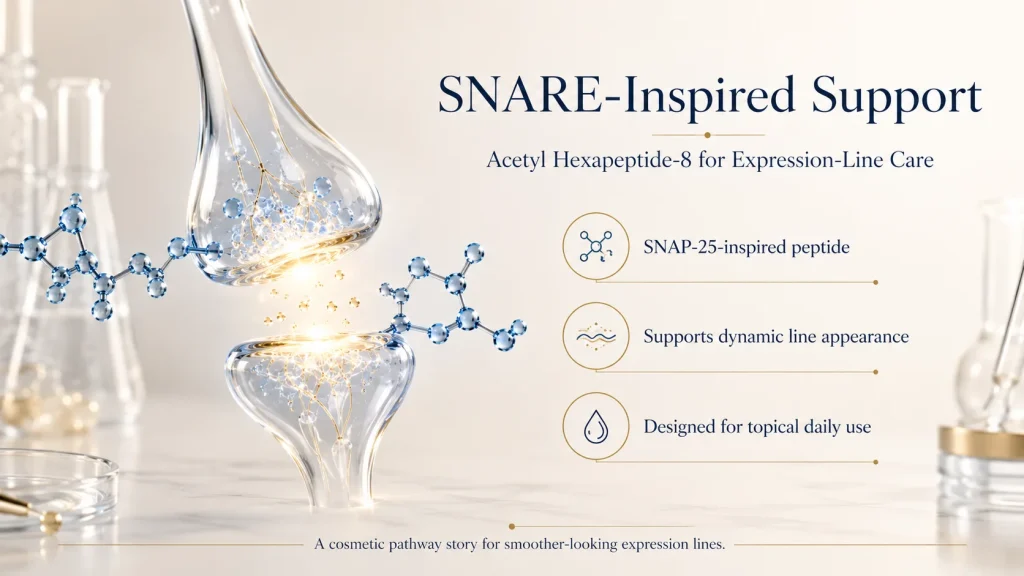
SNAP-25-Inspired Support: The Molecular Story of Acetyl Hexapeptide-8
Acetyl Hexapeptide-8 is a synthetic hexapeptide inspired by the N-terminal sequence of the SNAP-25 protein. Because of this structural inspiration, it is commonly described in ingredient literature as a SNAP-25-inspired peptide for expression-line care. In cosmetic formulation language, it is positioned as helping support pathways associated with neurotransmitter release and the visible appearance of dynamic expression lines. This mechanism story allows formulators to explain why Acetyl Hexapeptide-8 is relevant to expression-line care without presenting it as equivalent to injectable botulinum toxin.
Published and supplier-backed studies generally support the use of Acetyl Hexapeptide-8 in expression-line appearance care, but its real-world performance depends heavily on formulation design, delivery environment, usage level, and the complete matrix around it. Unlike botulinum toxin, which acts through a pharmaceutical procedure, Acetyl Hexapeptide-8 provides a topical cosmetic route for brands seeking a softer, non-invasive story around expression-line care. This supports the 2026 consumer demand for smoother-looking skin without losing natural facial expression.
Pentapeptide-18: The Enkephalin-Like Support Layer
While Acetyl Hexapeptide-8 is commonly associated with a SNAP-25-inspired story, Pentapeptide-18 provides a complementary support angle in the expression-line care sequence. In advanced cosmetic positioning, Pentapeptide-18 is often described as an enkephalin-inspired peptide. Rather than presenting it as directly controlling calcium channels or acting like a drug, it is more appropriate to describe it as supporting pathways associated with visible facial tension and expression-line appearance.
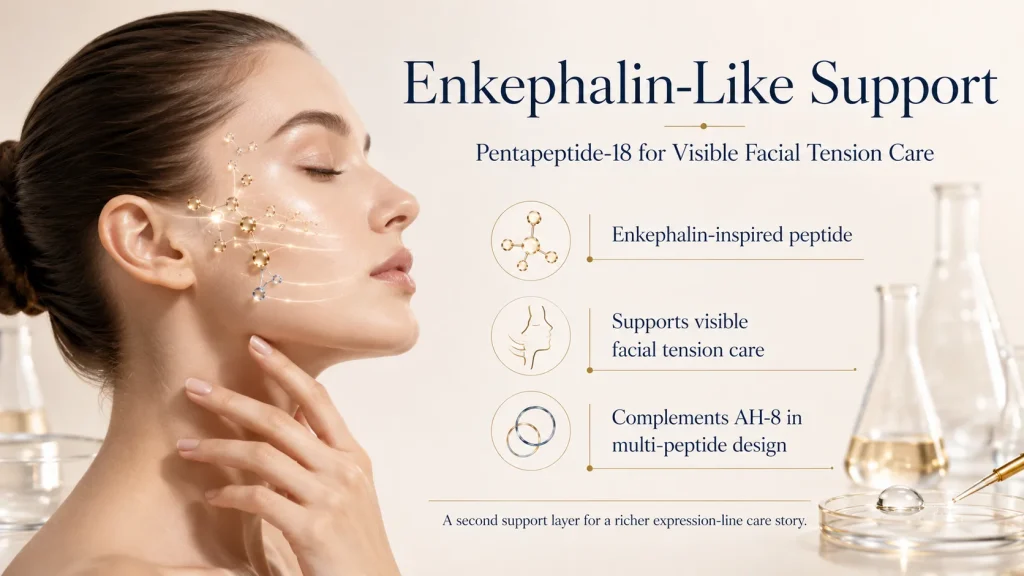
Enkephalin-Like Cosmetic Signaling
Pentapeptide-18 is a specialized peptide inspired by natural enkephalin-like signaling concepts. In B2B formulation language, its value lies in adding a second layer to the expression-line story. While Acetyl Hexapeptide-8 supports a SNAP-25-inspired angle, Pentapeptide-18 adds an enkephalin-like support narrative. This gives formulators a broader and more defensible way to explain why a dual-peptide system can be more compelling than a single-peptide claim.
In a 2026 B2B formulation context, Pentapeptide-18 is useful for brands that want to move beyond single-peptide products and build a richer expression-line care story. This dual-layer approach is particularly relevant for consumers who no longer feel that single-peptide products deliver enough visible differentiation. By combining complementary peptides in a stable formulation environment, brands can build an advanced anti-wrinkle story while managing skin comfort and formulation practicality.
The Bio-Synergy Model: Why 1+1 Equals 3 in Neuro-Inspired Cosmetics
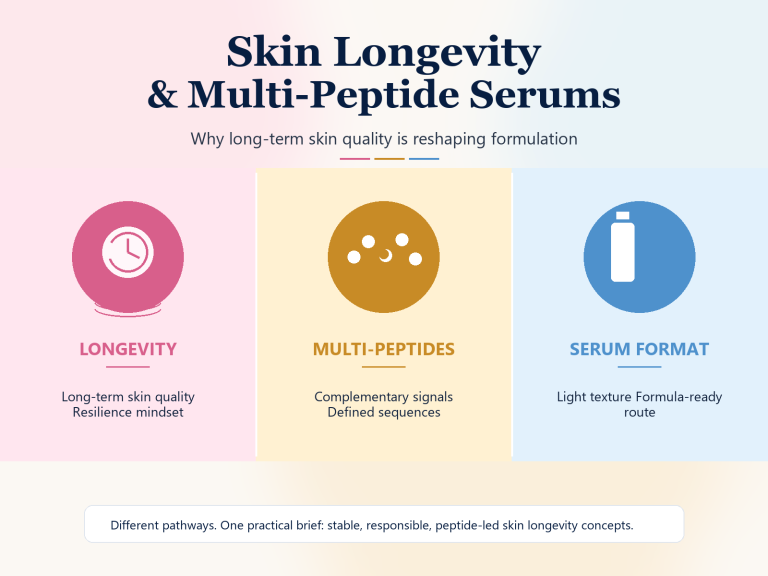
The integration of Acetyl Hexapeptide-8 and Pentapeptide-18 represents a strong example of modern neuro-inspired cosmetic formulation. This is not merely a combination of two ingredients; it is a layered peptide strategy where each peptide contributes a distinct but complementary formulation narrative. In a B2B environment, this can be understood as a multi-layer expression-line care model. One peptide supports the SNAP-25-inspired story, while the other adds an enkephalin-like support angle. Together, they create a more sophisticated product logic than either peptide alone.
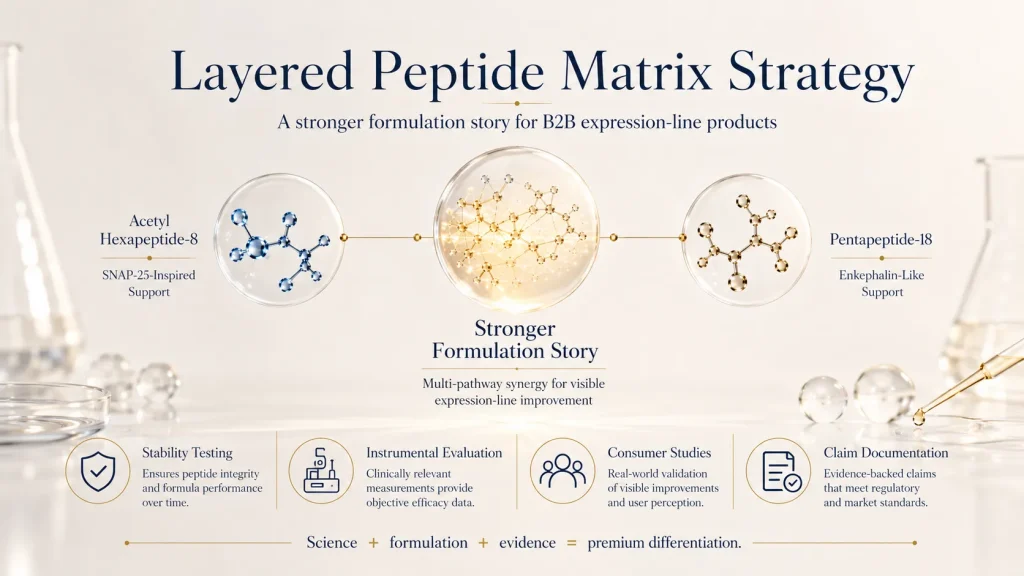
Validating the Synergy Ratio
For B2B brands, the value of the synergy ratio should not be communicated through unsupported clinical percentages or drug-like claims. Instead, the final formula should be validated through stability testing, instrumental evaluation, consumer perception studies, and claim-support documentation. This allows the brand to build a credible technical foundation around the dual-peptide system without overstating the biological mechanism.
In practice, the strongest commercial message is not that Acetyl Hexapeptide-8 and Pentapeptide-18 “block” the skin’s neural activity. The stronger and safer message is that the two peptides allow brands to build a more complete neuro-inspired expression-line care matrix. This supports a premium product story based on complementary mechanisms, formulation design, and visible skin quality improvement.
References
Blanes-Mira, C., et al. (2002). “A synthetic hexapeptide (Argireline) with antiwrinkle activity.” International Journal of Cosmetic Science, 24(5), 303–310.
Published reviews on cosmetic peptides and anti-aging formulation strategies.
Supplier and formulation documentation for Acetyl Hexapeptide-8 and Pentapeptide-18 in cosmetic applications.
Reviews on skin aging mechanisms, expression lines, and topical anti-aging strategies.