Professional Cosmetics Peptide Supplier | GENOPEP



Cyclic vs Linear Peptides in Complex Formulas: What a Stability Experiment Really Shows
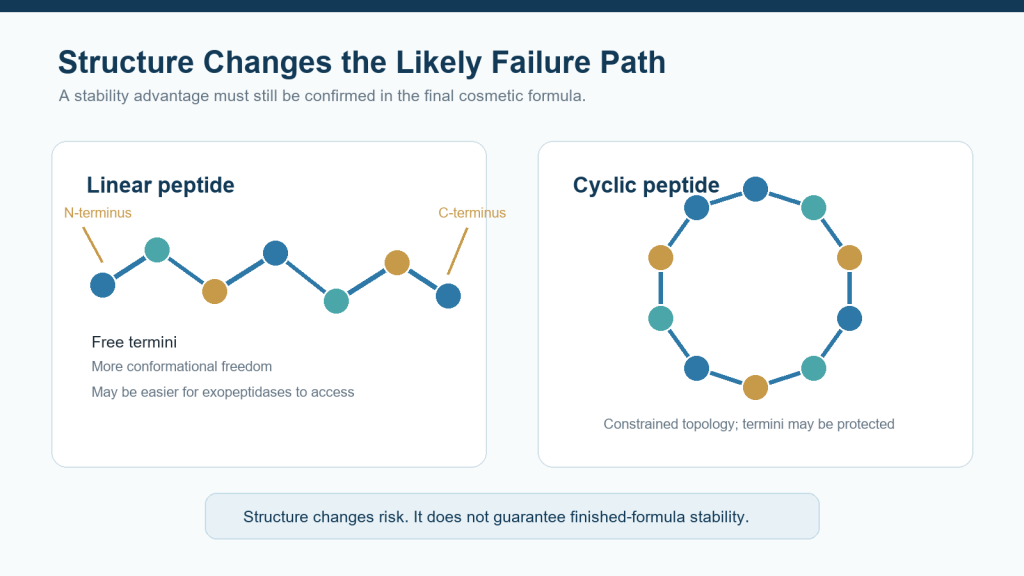
A peptide chain looks vulnerable; a peptide ring looks protected. That visual intuition is one reason cyclic peptides attract attention in cosmetic R&D. Yet the famous stability advantage of cyclization usually refers to enzymatic degradation. A serum or cream creates a different challenge: heat, pH, oxygen, surfactants, electrolytes, metal ions, preservatives, and packaging can all change the outcome.
So the honest answer to cyclic peptide vs linear peptide stability is not a slogan. Cyclization can be a powerful design tool, but finished-formula stability is a measured property. A useful experiment compares matched structures in the actual vehicle and quantifies how much intact peptide remains over time.
Why the Ring Can Help – and Why It May Not
Linear peptides have accessible N- and C-termini and often sample many conformations. Cyclization can remove or shield termini, reduce conformational freedom, and make some sequences less recognizable to exopeptidases. This matters after application, where peptides may meet enzymes at the skin surface or in biological test systems.
Published experiments show that the advantage is real but conditional. In a solution study of related RGD peptides, the cyclic peptide was about 30-fold more stable at pH 7, while its disulfide bridge became a weakness above pH 8 [1]. In another serum study, cyclization improved the stability of short antimicrobial peptide hexamers, but the benefit did not extend to longer 11-residue analogues [2].
The lesson is not that cyclic always wins. The type of ring matters. Head-to-tail, side-chain, lactam, and disulfide cyclization create different chemical liabilities and different activity profiles. A more rigid peptide may resist cleavage yet lose solubility, compatibility, or biological activity if the active conformation is altered.
A Complex Cosmetic Formula Changes the Question
Shelf stability inside a cosmetic product is not the same as proteolytic stability. Most well-preserved formulas are not full of active proteases, but they do expose peptides to water, temperature, pH shifts, oxidation, trace metals, interfaces, and other ingredients. A cyclic peptide that is strong in serum can still degrade in a high-pH system or interact poorly with a surfactant-rich base.
This is why visual stability is not enough. A formula can remain clear, white, and pleasant while the peptide concentration falls. Researchers evaluating cosmeceutical peptides have used LC-MS/MS to track peptide integrity in protease-containing systems, illustrating the value of an analytical method that measures the molecule itself rather than the appearance of the vehicle [3].
Cosmetics Europe also notes that cosmetic products vary too widely for one universal stability protocol. The test should reflect the product type, packaging, storage conditions, and foreseeable stresses [4]. For peptide formulations, that implies the final base matters as much as the peptide structure.
What a Credible Paired Stability Experiment Should Include
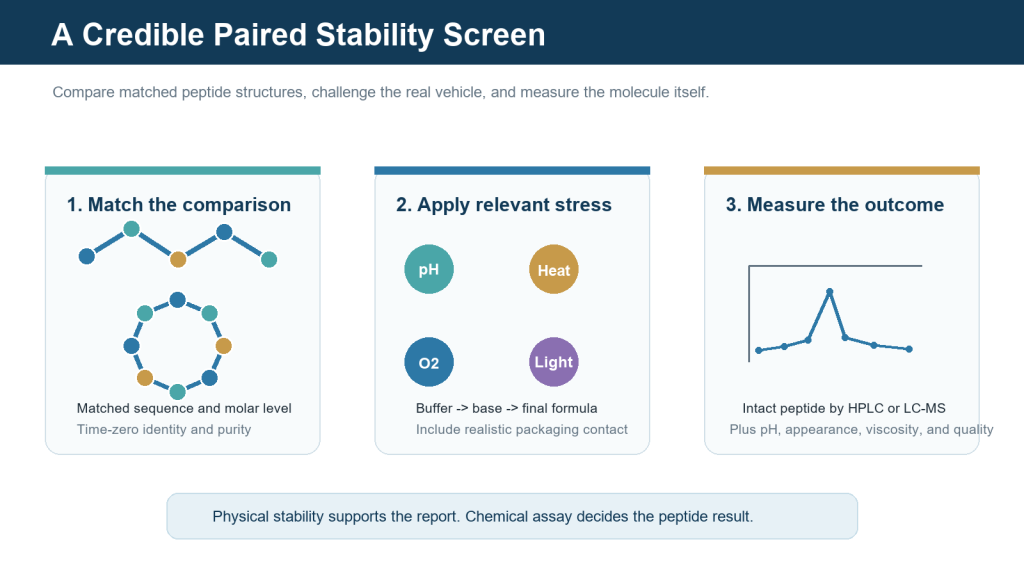
A useful cyclic-versus-linear report starts with a fair comparison: the same or closely matched amino acid sequence, the same molar peptide level, the same solvent history, and time-zero identity and purity data. If the cyclic version requires a different counterion or solubilizer, that difference should be recorded because it may influence the result.
The screen should move through three levels: a simple aqueous buffer, a representative serum or emulsion base, and the final complex formula. Each level can be challenged at the intended pH, elevated temperature, light or oxygen exposure where relevant, and realistic packaging contact. Freeze-thaw and centrifugation may help assess physical robustness, but they do not replace chemical assay.
At each time point, measure intact peptide with a stability-indicating HPLC or LC-MS method, then record degradants where possible. Also monitor pH, appearance, odor, viscosity, color, and microbiological quality. A blank formula without peptide helps separate formula changes from peptide-related changes.
How to Read the Result
If the cyclic peptide retains more intact active under the same stress conditions, it has earned a formulation advantage for that specific system. If the difference disappears in the final formula, the vehicle may already be protective, or another degradation route may dominate. If the linear peptide performs well and is easier to dissolve or scale, it may remain the better commercial choice.
The most interesting result is often not a winner but a failure map: which pH range is safe, which stress creates degradation, whether a metal ion or preservative changes recovery, and whether a ready-to-use peptide solution simplifies incorporation. That information is more valuable to a formulator than a broad claim that one topology is more stable.
The Useful Takeaway for Cosmetic R&D
Cyclic peptides deserve attention because structure can change resistance, conformation, and formulation behavior. But the ring is a hypothesis, not a guarantee. For complex cosmetic formulas, the strongest development decision comes from pairing structural design with real analytical data.
Genopep supports single cosmetic peptides, custom cyclic peptide structures, and peptide solution development for formulation projects. If you are comparing a linear peptide with a cyclic alternative, request a quote to discuss the target structure, intended product base, and the stability questions worth testing first.
References
[1] Bogdanowich-Knipp SJ, et al. Solution stability of linear vs. cyclic RGD peptides. Journal of Peptide Research. 1999;53(5):530-541. doi:10.1034/j.1399-3011.1999.00052.x
[2] Strøm MB, et al. The pharmacophore of short cationic antibacterial peptides. Influence of backbone cyclization on the serum stability of antimicrobial peptides. Journal of Peptide Science. 2010;16(8):431-437. doi:10.1002/psc.1256
[3] Errante F, et al. Susceptibility of cosmeceutical peptides to proteases activity: Development of dermal stability test by LC-MS/MS analysis. Journal of Pharmaceutical and Biomedical Analysis. 2021;194:113775. doi:10.1016/j.jpba.2020.113775
[4] Cosmetics Europe. Guidelines on Stability Testing of Cosmetic Products. March 2004.