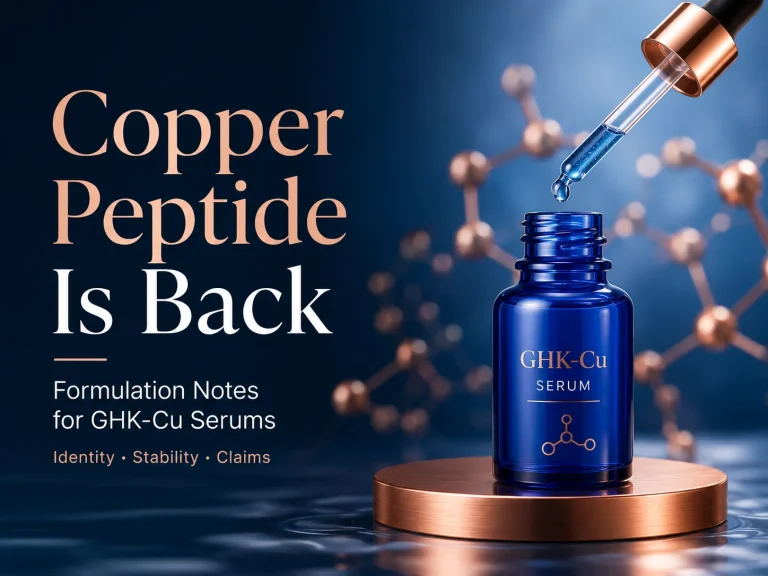
Professional Cosmetics Peptide Supplier | GENOPEP



Why “Blue Peptide” Serums Are Having a Moment in 2026
Blue peptide serums are having a moment because they solve a very modern skincare problem: how to make a technical formula visible in one second. A clear or white serum can be elegant, but it often needs explanation. A blue serum immediately feels biotech, fresh, precise, and peptide-led. For brands fighting for attention in article thumbnails, product pages, social feeds, and distributor decks, that visual code is powerful.
The trend also fits the wider 2026 skincare mood. Consumers are still interested in radiance and firmness, but beauty media has been tracking a shift toward more mechanism-led language: skin longevity, barrier-friendly actives, peptides, copper peptides, and formulas that appear more transparent about how they work. Blue peptide serums sit neatly inside that conversation. They look scientific before a consumer even reads the ingredient list.
For B2B teams, however, the first question is not whether the color is attractive. The first question is what makes the product blue. In some concepts, the blue identity may come from a copper peptide such as Copper Tripeptide-1 or a GHK-Cu solution. In other concepts, it may come from a permitted colorant, a botanical material, a complexed mineral system, or a combination of ingredients. Those routes are not equivalent for documentation, stability, claims, or global launch review.
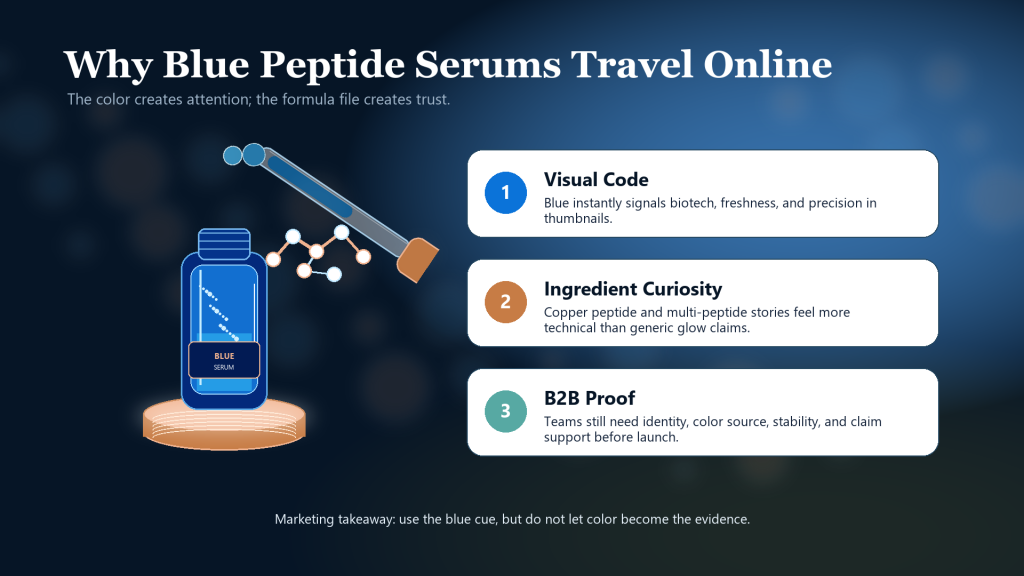
This distinction matters because a blue color can easily become a claim by implication. If the product is blue and the marketing copy says “peptide serum,” buyers and consumers may assume the color is proof of copper peptide content. If the color is mainly aesthetic, that should be clear inside the brand file and launch review. If the color is connected to a copper peptide, the supplier discussion should include identity, active basis, recommended use level, assay approach, and compatibility guidance.
The science story should also stay responsible. GHK-Cu has a long research history, and a 2018 review in the International Journal of Molecular Sciences summarizes research around skin appearance, collagen-related pathways, glycosaminoglycans, and protective effects. That gives brands a useful technical direction. It does not turn every blue serum into a fully validated performance story. For cosmetics, the safer and more credible language is appearance-led: smoother-looking skin, firmer-looking skin, better conditioned feel, hydration, and support for healthy-looking skin.
A good blue peptide serum brief should connect three layers: the visual hook, the peptide logic, and the formula proof. The visual hook explains why the product deserves attention. The peptide logic explains whether the formula is built around copper peptide, a multi-peptide solution, or a broader skin-quality complex. The formula proof covers pH, color behavior, heat and light exposure, packaging contact, microbial robustness, and claim support. Without all three layers, the blue story can feel beautiful but thin.
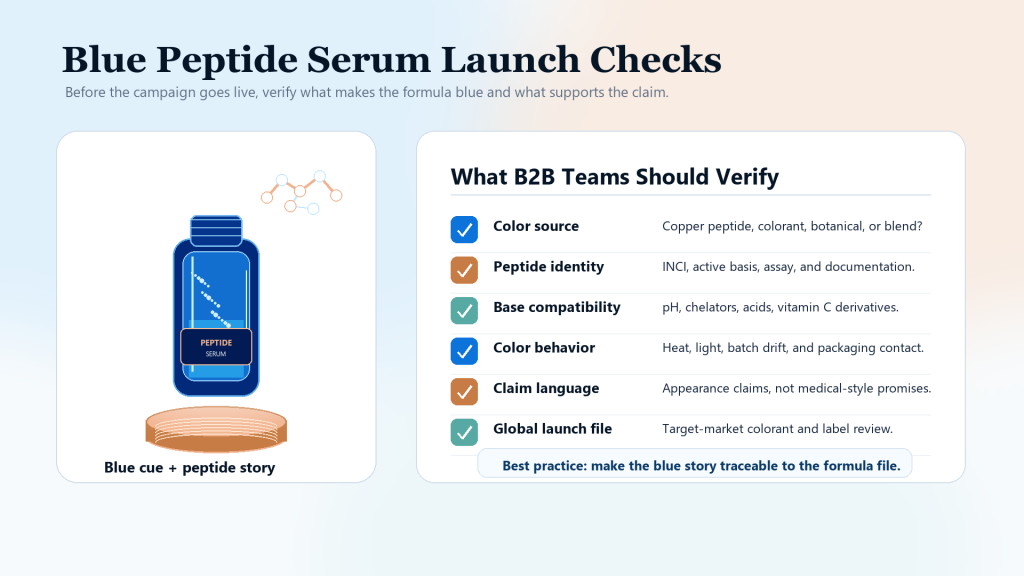
Stability is especially visible in blue products. A small color shift that might be ignored in a beige cream can look dramatic in a transparent blue serum. Development teams should check color under accelerated and real-time conditions, review the effect of chelators and electrolytes, evaluate compatibility with acids or vitamin C derivatives, and test the chosen package rather than a generic lab bottle. The goal is not just to keep the formula pretty; it is to keep the product story consistent from batch to shelf.
Packaging strategy should follow the formula route. A clear bottle may showcase the blue shade, but it can increase light exposure. A cobalt bottle may protect the concept and reinforce the color story, but it makes the fill color less visible. A dropper can look premium, while an airless pump may support better control for certain bases. B2B teams should choose packaging after the stability plan, not before it.
Claim review is the final filter. The U.S. FDA explains that products intended to diagnose, cure, mitigate, treat, prevent disease, or affect the structure or function of the body may be regulated as drugs rather than cosmetics. That is a useful boundary for blue peptide serums, because biotech-looking products can tempt brands into drug-like wording. A stronger commercial route is to keep the claim file disciplined and let the formula, sensory profile, and documentation carry the trust.
For Genopep, the opportunity is to help brands move beyond a blue bottle. A customer may need a single copper peptide, a ready-to-use peptide solution, or a multi-peptide concept that supports firmness appearance, skin comfort, hydration, or premium skin-quality positioning. The right route depends on the desired color behavior, formula base, target market, cost structure, and launch timeline.
If you are planning a blue peptide serum for 2026, start with the question behind the color: what does the blue signal mean, and how will the formula prove it responsibly? Genopep can support single cosmetic peptides and peptide solution development for blue peptide serum concepts. Request a Quote to discuss peptide route, base compatibility, color behavior, documentation needs, and claim boundaries.