Professional Cosmetics Peptide Supplier | GENOPEP



NAD+ Skincare Is Trending: Where Do Peptides Fit in Longevity Formulas?
NAD+ Skincare Is a Longevity Conversation, Not a Shortcut
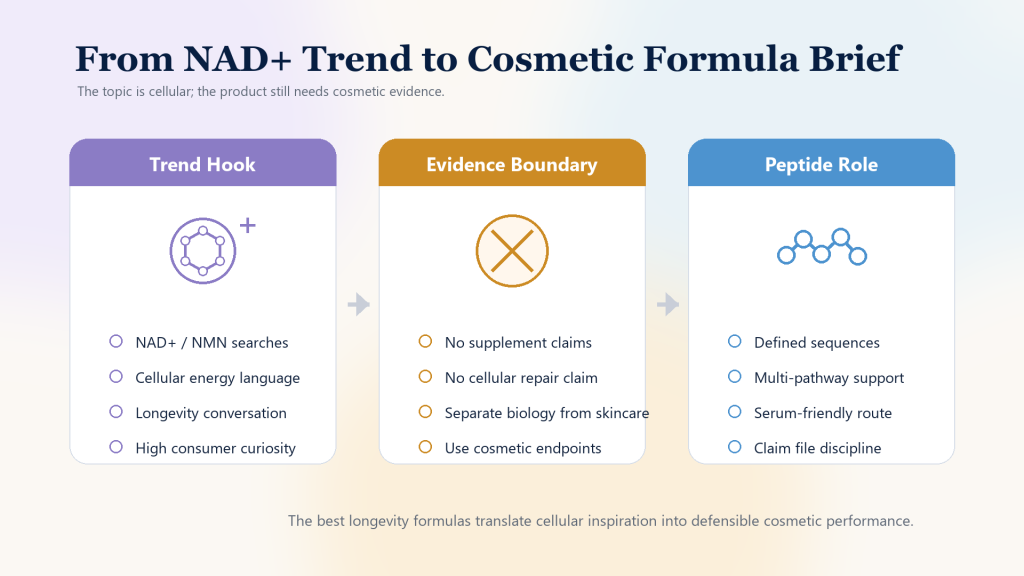
NAD+ skincare is trending because it borrows language from one of the biggest wellness conversations of the decade: cellular energy, longevity, mitochondrial function, sirtuins, and healthy aging. For consumers, that language feels more advanced than a traditional anti-aging cream. For formulators and purchasing teams, it creates a more difficult question: what can actually be built, stabilized, and claimed in a topical cosmetic formula?
The key is to separate biological inspiration from cosmetic execution. NAD+ is biologically important, and precursors such as niacinamide, NMN, and NR keep the topic visible. But a daily serum should not promise to restore cellular NAD+, reverse biological aging, repair DNA, or treat skin damage. A responsible brand can use the trend as an entry point, then build the product around ingredients and claims that belong in cosmetics.
Why Peptides Belong in Longevity Formulas
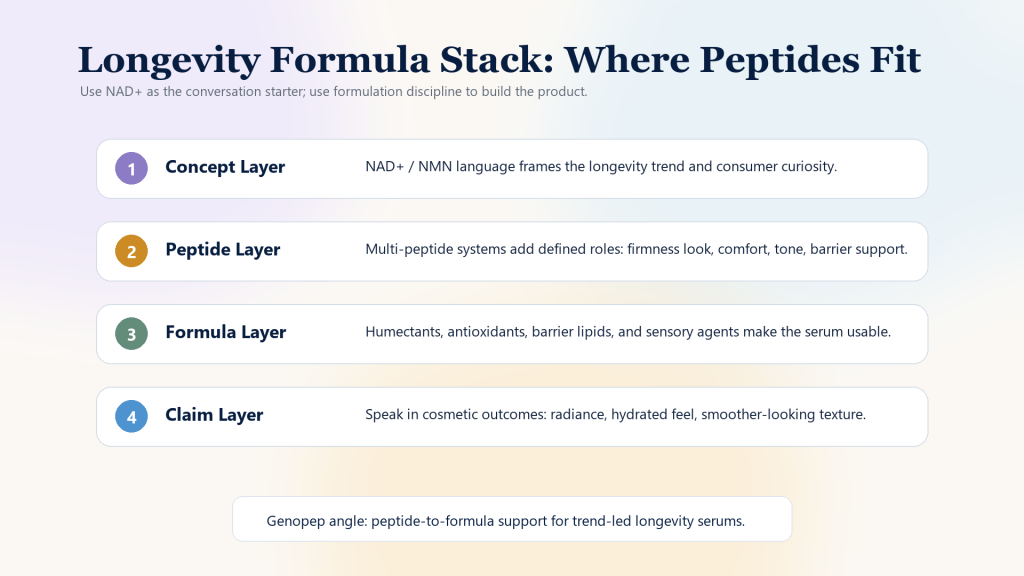
Peptides fit the NAD+ skincare conversation because they give brands a practical bridge. They do not need to imitate NAD+ biology. Their value is more formulation-driven: defined sequences, known cosmetic positioning, use-level guidance, pH and compatibility planning, and the ability to combine several peptide roles in one serum concept. That makes peptides useful when a brand wants a longevity-inspired product without making drug-like promises.
A multi-peptide system can support a broader skin-quality story: firmer-looking skin, smoother-looking texture, improved comfort, hydrated feel, barrier-support positioning, and a more radiant appearance. These are not the same as cellular rejuvenation claims. They are cosmetic outcomes that a product team can connect to a formula brief, ingredient documentation, and consumer-facing language.
Where Niacinamide, NMN, and Peptides Differ
Niacinamide is the most familiar topical B3 ingredient in cosmetic formulation. It has a long history in skincare for barrier appearance, uneven tone, fine-line appearance, and overall skin quality. NMN and NR are more strongly associated with supplement and longevity research conversations, and their cosmetic use requires extra caution around evidence, stability, market rules, and claim language. Peptides sit in a different lane: they are selected by sequence and function, not by being NAD+ precursors.
That distinction helps formulators avoid confusion. A longevity serum might use niacinamide for a mature B3 skincare story, peptides for defined cosmetic support, and other ingredients for hydration, antioxidant positioning, or barrier comfort. It does not need to claim that every ingredient is acting through NAD+ biology.
Formulation Questions Brands Should Ask
Before building a NAD+ skincare concept, ask which ingredient is carrying which part of the story. Is the formula using niacinamide, NMN, NR, a peptide system, or a combination? What is the recommended use level? What is the pH range? Does the ingredient tolerate heat? Does it change color, odor, viscosity, or preservation performance over time? Is the claim supported by data from the final formula, supplier studies, or broader literature?
For a peptide solution, the useful questions are concrete: peptide identity, active content, solvent system, compatibility notes, recommended addition phase, target pH, preservation compatibility, safety documentation, and claim-support direction. This is where Genopep’s B2B value becomes practical. Customers can evaluate individual cosmetic peptides or explore ready-to-use multi-peptide formulation solutions when speed and concept clarity matter.
Responsible Claims for NAD+ Longevity Skincare
The safest cosmetic claims stay visible and sensory: brighter-looking skin, improved radiance, smoother-looking texture, hydrated comfort, more resilient-looking skin, or support for a healthy-looking barrier. Claims such as restoring cellular energy, reversing aging, repairing DNA, activating longevity pathways, or treating inflammation should not be used for ordinary cosmetic products unless the product is regulated and evidenced for that level of claim.
NAD+ skincare will likely remain attractive because it sounds modern and science-led. The winning B2B products will be the ones that translate that interest into a formula buyers can evaluate: clear ingredients, stable systems, appropriate use levels, and responsible cosmetic claims. If your team is planning a NAD+ inspired peptide serum or longevity formula, request a quote from Genopep with your target format, claim direction, market, and preferred peptide approach.
References
1. Imai S, Guarente L. It takes two to tango: NAD+ and sirtuins in aging/longevity control. NPJ Aging and Mechanisms of Disease, 2016. https://pubmed.ncbi.nlm.nih.gov/26785480/
2. McReynolds MR, Chellappa K, Baur JA. Age-related NAD+ decline. Experimental Gerontology, 2020. https://pubmed.ncbi.nlm.nih.gov/32001234/
3. Bissett DL, Oblong JE, Berge CA. Niacinamide: A B vitamin that improves aging facial skin appearance. Dermatologic Surgery, 2005. https://pubmed.ncbi.nlm.nih.gov/16029679/
4. Haykal D et al. Reprogramming Skin Aging: A Regenerative and Epigenetic Perspective on Cutaneous Longevity. Journal of Cosmetic Dermatology, 2026. https://pubmed.ncbi.nlm.nih.gov/41792029/
5. Tauser RG et al. A State-of-the-Art Overview on (Epi)Genomics and Personalized Skin Rejuvenating Strategies. Pharmaceutics, 2025. https://pubmed.ncbi.nlm.nih.gov/41471101/
6. FDA. Cosmetics Labeling Claims. https://www.fda.gov/cosmetics/cosmetics-labeling/cosmetics-labeling-claims
7. European Commission. Commission Regulation (EU) No 655/2013 laying down common criteria for cosmetic product claims. https://health.ec.europa.eu/publications/commission-regulation-6552013_en
8. Cosmetics Europe. Guidelines for Cosmetic Product Claim Substantiation. https://cosmeticseurope.eu/wp-content/uploads/2024/10/Guidelines_for_Cosmetic_Product_Claim_Substantiation.pdf