Professional Cosmetics Peptide Supplier | GENOPEP



Why Skin Longevity Is Making Multi-Peptide Serums More Relevant in 2026
Skin Longevity Is Changing the Skincare Brief
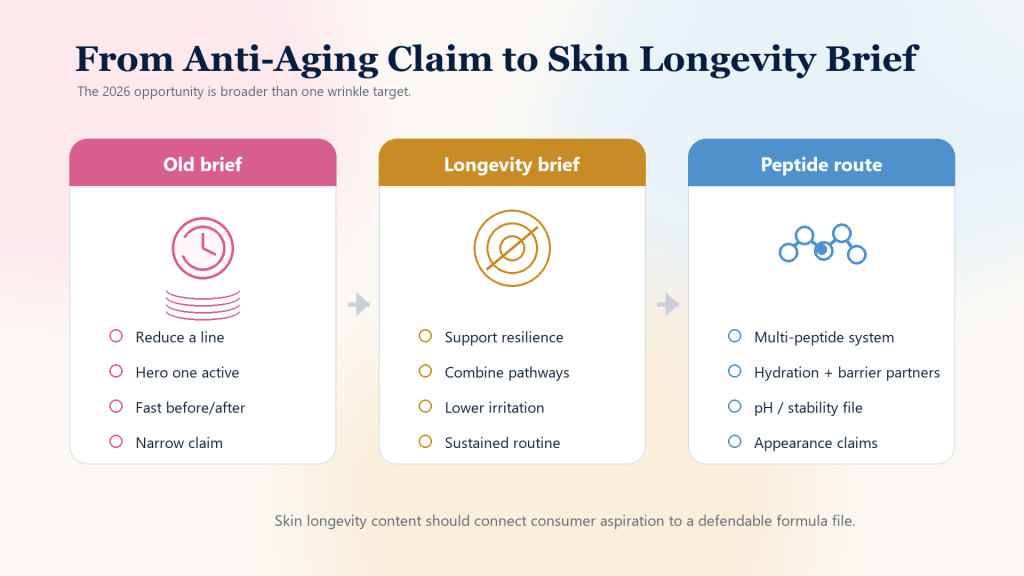
Skin longevity is becoming a more useful phrase than traditional anti-aging because it points to long-term skin quality, not only wrinkle correction. In 2026, professional dermatology and aesthetic discussions increasingly connect cutaneous longevity with resilience, barrier function, repair capacity, inflammation control, pigmentation balance, extracellular matrix support, and routine consistency. For B2B skincare brands, that changes the product brief: the goal is not a single dramatic active, but a formula architecture that can support better-looking skin over time.
This is why multi-peptide serums are becoming more relevant. Peptides are not magic anti-aging switches, and no responsible supplier should present them that way. Their strength is that different peptide types can be selected for different cosmetic roles, then built into a stable serum concept with humectants, barrier-support ingredients, antioxidants, soothing agents, and a claim file that stays within cosmetic language.
Why One Peptide Is Rarely the Whole Longevity Story
Skin aging is multi-factorial. Visible changes can involve collagen and elastin organization, hydration, barrier comfort, oxidative stress, dullness, uneven tone, environmental stress, and slower-looking recovery after irritation. A single peptide may have a clear story, but skin longevity usually asks for a broader, more balanced system. That is where multi-peptide thinking becomes commercially useful.
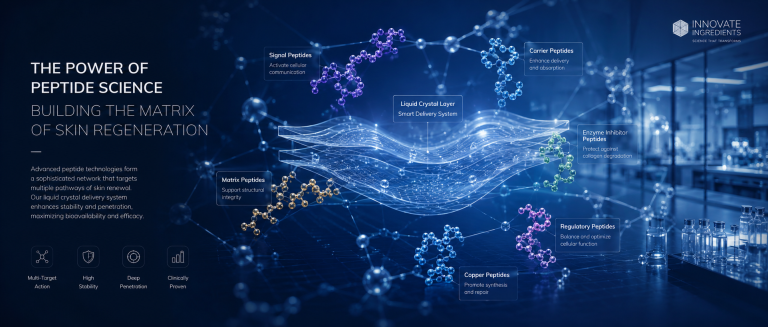
A multi-peptide serum can combine complementary concepts: signal-oriented peptides for firmer-looking skin, carrier or copper peptide concepts for vitality positioning, soothing or barrier-friendly peptides for comfort, and brightening-support peptides where the claim is appropriate. The point is not to add as many peptide names as possible. The point is to design a system where each peptide has a reason to be there.
Why Serum Is the Natural Format
Serums fit the skin-longevity conversation because they are lightweight, easy to layer, and credible as a daily treatment step. They can carry a defined peptide system without forcing the product into an overly rich texture. From a development perspective, serum formats also make it easier to control pH, solubility, clarity, viscosity, preservative compatibility, and packaging choices than many more complex emulsions.
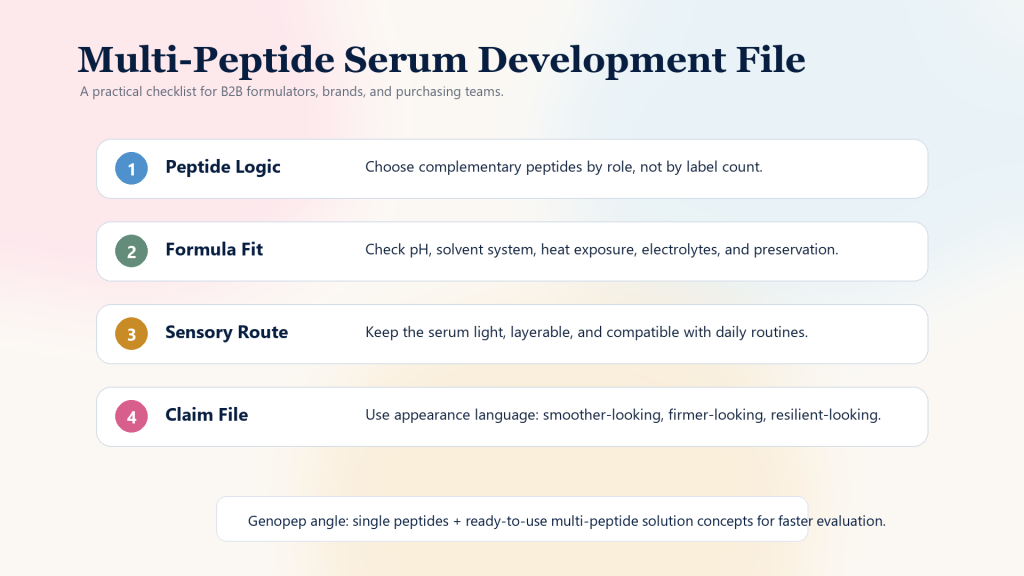
This does not mean every peptide belongs in every serum. Some peptides are sensitive to high heat, aggressive pH, strong electrolyte systems, or incompatible actives. A serious formulation brief should define the active level, addition phase, target pH, preservation system, expected color, odor, viscosity, and stability test plan before the marketing name is finalized.
What Brands Should Ask Suppliers
For a skin longevity serum, purchasing teams should ask for more than an INCI list. Useful supplier information includes peptide identity, active content, recommended use level, solvent or carrier system, pH guidance, heat sensitivity, compatibility notes, preservative considerations, safety documentation, and claim-support data. If the product uses a ready-to-use multi-peptide solution, the brand should also understand how the peptide blend is positioned and what formula formats it is intended to support.
Genopep’s role is strongest when the discussion moves from trend to formulation. A customer may need an individual cosmetic peptide for a specific claim direction, or a multi-peptide solution to speed early development and reduce formulation complexity. Either way, the best brief starts with the product format, target market, desired texture, claim boundary, and stability expectations.
Responsible Claims for Skin Longevity
The safest cosmetic language stays with visible and sensory outcomes: smoother-looking texture, firmer-looking skin, hydrated comfort, improved radiance, more resilient-looking skin, or support for a healthy-looking barrier. Claims that imply reversing biological aging, changing cellular lifespan, treating inflammation, or repairing tissue damage belong in a much higher evidence category and should not be borrowed for a daily cosmetic serum.
The opportunity is still strong. Skin longevity gives brands a more modern, less fear-based way to talk about aging, while multi-peptide serums give formulators a practical format for building that story. If your team is planning a skin longevity serum, request a quote from Genopep with your target claims, format, market, and preferred peptide direction. The better the brief, the faster the peptide discussion becomes useful.
References
1. Haykal D, Gold M, Lain E, Green J, Farris PK. Reprogramming Skin Aging: A Regenerative and Epigenetic Perspective on Cutaneous Longevity. Journal of Cosmetic Dermatology, 2026. DOI: 10.1111/jocd.70788. https://pubmed.ncbi.nlm.nih.gov/41792029/
2. Tauser RG et al. A State-of-the-Art Overview on (Epi)Genomics and Personalized Skin Rejuvenating Strategies. Pharmaceutics, 2025. DOI: 10.3390/pharmaceutics17121585. https://pubmed.ncbi.nlm.nih.gov/41471101/
3. Bjerring P et al. International Expert Consensus on Integrated Skincare Active Ingredients for Pretreatment and Posttreatment Use With Medical Aesthetic Procedures to Enhance Skin Benefits. Journal of Cosmetic Dermatology, 2026. DOI: 10.1111/jocd.70880. https://pubmed.ncbi.nlm.nih.gov/42087526/
4. Ash M et al. The Innovative and Evolving Landscape of Topical Exosome and Peptide Therapies: A Systematic Review of the Available Literature. Aesthetic Surgery Journal Open Forum, 2024. DOI: 10.1093/asjof/ojae017. https://pubmed.ncbi.nlm.nih.gov/38633728/
5. FDA. Cosmetics Labeling Claims. https://www.fda.gov/cosmetics/cosmetics-labeling/cosmetics-labeling-claims
6. European Commission. Commission Regulation (EU) No 655/2013 laying down common criteria for cosmetic product claims. https://health.ec.europa.eu/publications/commission-regulation-6552013_en
7. Cosmetics Europe. Guidelines for Cosmetic Product Claim Substantiation. https://cosmeticseurope.eu/wp-content/uploads/2024/10/Guidelines_for_Cosmetic_Product_Claim_Substantiation.pdf