Professional Cosmetics Peptide Supplier | GENOPEP



How to Evaluate a Cosmetic Peptide Solution Supplier
To evaluate a cosmetic peptide solution supplier, verify one exact material across four levels: identity and composition, controlled technical documents, a traceable sample lot, and repeat-lot performance against an approved specification. Start with the product code, INCI composition, specification, TDS, SDS and lot-specific COA. Then test the sample in the intended formula, record the sample lot, and define which changes or batch trends require review. A certificate or a clean-looking sample can support one part of the decision, but neither qualifies the whole supply relationship.
Qualify one exact material rather than a company name
A supplier can be responsive, established and well documented while a particular grade remains unsuitable for one project. The reverse can also happen: a technically promising sample may arrive from a company whose change control, document maintenance or repeat supply is not yet clear. The useful unit of evaluation is therefore not the supplier logo alone. It is the relationship among a legal supplier entity, a manufacturing or release site where relevant, an exact product code and grade, and the lot that will enter development.
This distinction matters for a pre-blended peptide solution. The trade name may remain unchanged while peptide concentration, carrier system, preservative, analytical method, manufacturing site or storage guidance changes. A qualification record should state which of those attributes were reviewed. Otherwise, a later shipment can match the trade name while no longer matching the technical assumptions used in the original trial.
Skinkind Cosmetics presents ready-to-integrate and customized options within its Pro Peptide Solutions category. That page is useful for identifying candidates. It does not replace the current grade-specific documents, sample assessment or purchasing approval needed for a particular formula. [8]
Build a connected document set
The first document request should be small enough to review and complete enough to expose gaps. For many cosmetic peptide solutions, a practical starting set is the composition or INCI statement, product specification, TDS, SDS and a representative or lot-specific COA. Additional declarations depend on the composition, target market and company risk assessment. Requesting every certificate on a generic checklist can create a large folder without answering the material questions.
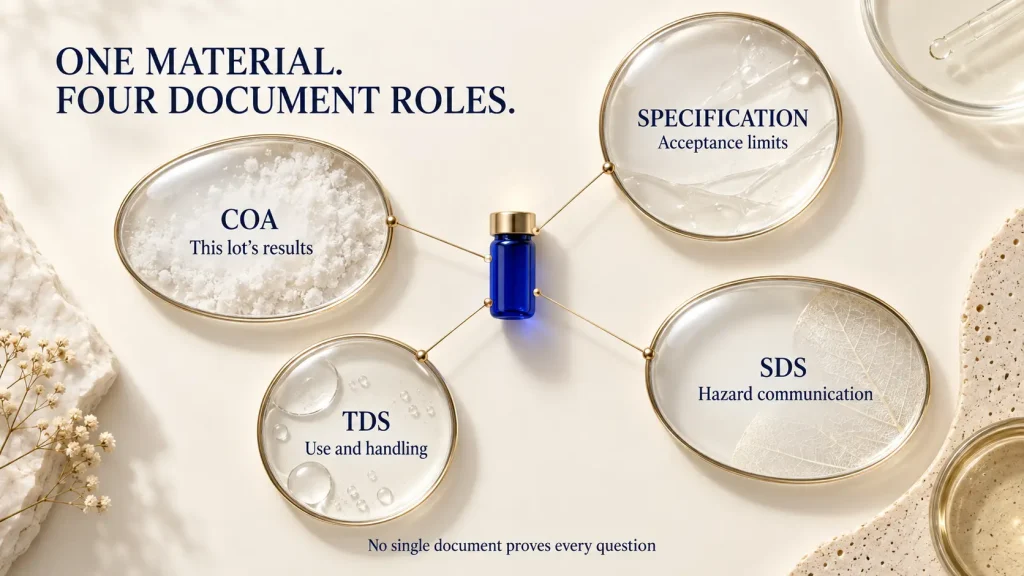
| Document | Primary job | What to verify | What it does not establish |
| Composition or INCI statement | Identifies declared components and naming | Product code, grade, carrier, peptide identity, revision | Safety approval, exact batch result or formula compatibility |
| Specification | Defines supplier acceptance criteria | Parameter, limit or range, unit, method reference, version | The result for the lot delivered |
| COA | Reports results for a stated lot | Product and lot match, result, specification, method, date and approval | Universal performance or equivalence to another grade |
| TDS | Communicates use, processing, storage and technical context | Current revision, intended applications, conditions and limitations | Workplace hazard communication or lot release |
| SDS | Communicates hazards and handling information | Product identifier, supplier, composition information, handling, storage and revision | Cosmetic approval, efficacy or complete formula safety |
These cosmetic raw material documents must refer to the same material. Compare the supplier name, product name, product code, grade, revision date and units across the set. Read a peptide solution COA against the matching specification rather than as a standalone quality claim. If the specification says pH at one temperature or method while the COA reports a different condition, ask whether the values are intended to be comparable. A polished certificate does not repair a broken identity chain.
Read INCI as identity information rather than approval
INCI names provide standardized identification for cosmetic ingredient declarations. PCPC explicitly states that an INCI assignment does not mean an ingredient is approved, safe, legally compliant in every region or interchangeable with another material carrying the same name. Different grades can share an INCI name while differing in attributes or physical characteristics. [1]
For a peptide solution, ask what the declared list represents: the sold mixture, the peptide component, or a preliminary marketing summary. Confirm the carrier and other intentionally added components needed for formula review and labeling. If proportions are confidential, define which information can be reviewed under an appropriate confidentiality process. Confidentiality can change how information is shared; it does not remove the finished-product manufacturer’s need to complete safety, regulatory and formulation work.
For EU-oriented review, CosIng can help locate nomenclature and regulatory context, but the European Commission notes that a database entry does not itself authorize cosmetic use and that the database is informative rather than legally determinative. Check the applicable regulation and annexes for the intended market instead of treating a search result as approval. [7]
Use the SDS for hazard communication
An SDS is essential when it is required for hazard communication and useful for handling review, but it has a defined job. OSHA describes a standardized 16-section structure covering identification, hazards, composition information, first aid, handling, storage, stability and other topics. It does not describe the SDS as a cosmetic efficacy dossier or as proof that a complete finished formula is safe. [2]
Check that the SDS product identifier matches the material offered and that the revision is current. Review the storage and incompatibility information relevant to receiving and laboratory handling. If the SDS lists broad concentration ranges or withholds details under an applicable trade-secret provision, do not assume it is also the complete composition statement needed for labeling or safety assessment. Resolve the document roles directly with the supplier.
Examine the quality system without turning a certificate into a shortcut
Quality-system information helps a buyer understand how documents, deviations, complaints and changes are controlled. EFfCI publishes a certifiable GMP framework designed for cosmetic ingredient manufacturing and maintains an official directory of certified sites. If a supplier claims certification, verify the exact legal entity or site, the issuing body, certificate scope and current status rather than relying on a logo copied into a brochure. [5]
Certification remains one input. It does not prove that one peptide solution meets your composition, analytical, regulatory or formula requirements. FDA’s cosmetic GMP checklist illustrates the operational questions behind quality control: raw-material identity and lot status, storage that prevents mix-up or deterioration, sampling or examination, acceptance specifications, reserve samples and records. These principles support a concrete supplier discussion even when the buyer’s market or quality system uses a different framework. [3,4]
Define the sample evaluation before the sample arrives
A free sample is not automatically representative of routine supply. Request the sample product code, lot number, date or release status where available, pack condition, storage instructions and the COA for that lot or an explanation of what document is being provided. On receipt, record the condition of the shipper and primary container, label identity, lot, quantity, seal status and any temperature indicator that was actually part of the shipment. Do not invent a temperature requirement after delivery; compare the shipment with the documented conditions for that grade.
Write the trial question before opening the container. A peptide sample evaluation may ask whether the material can be incorporated into one intended base, whether it changes appearance or pH, whether the process remains reproducible, and what further stability, microbiological, safety or performance work is needed. Use the same base, batch size, process record and observation schedule when comparing candidates. Where carrier effects matter, include an appropriate vehicle or carrier control if the necessary information and materials are available.
| Sample stage | Record | Decision supported |
| Request | Exact grade, intended formula, target market, sample lot and documents | Whether the sample can answer the project question |
| Receipt | Package condition, label, lot, seal and documented shipping conditions | Whether identity and handling remain traceable |
| Bench trial | Actual addition, process, observations, controls and deviations | Whether the candidate merits further testing |
| Review | Results, unresolved questions, next tests and approval status | Proceed, hold, reject or request clarification |
Treat batch consistency as a series
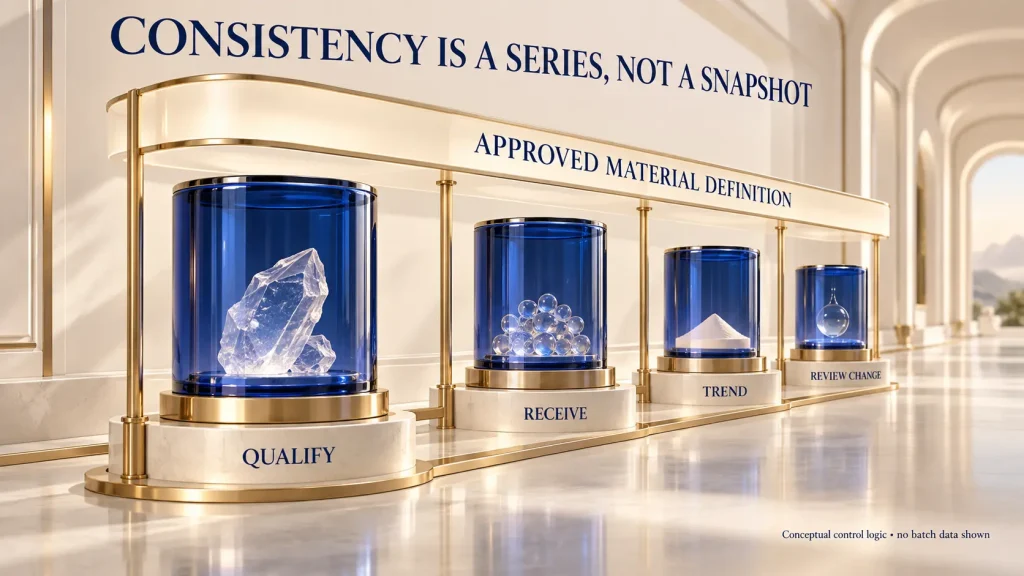
Batch-to-batch consistency is not established by one strong COA. It is built from a stable product identity, an approved specification, comparable analytical methods, lot-specific results, incoming controls and change information over time. A buyer may review multiple historical COAs where available, but those documents are useful only when their product code, units, methods and acceptance limits remain comparable.
Do not create a pass-fail trend from values that answer different questions. A pH result, an HPLC relative-purity result, a peptide-content assay and a microbiological count are separate attributes. Confirm whether a result is measured, calculated, reported as a limit, or recorded as conforming without a numerical value. If the supplier changes the method, establish whether old and new results can be bridged before interpreting a shift as material drift.
Eurachem’s current method-validation guide emphasizes fitness for purpose, sampling and sample handling, performance characteristics, documentation and ongoing internal quality control. The guide is generic rather than cosmetic-peptide-specific, so it supports questions about analytical reliability but does not prescribe which test every peptide solution must use. [6]
Agree on change notification before repeat purchasing
Supplier qualification can become stale even when every shipment passes its listed COA. Agree which changes require advance notice or technical review. Relevant examples may include peptide identity or concentration basis, carrier or preservative composition, product code, specification, analytical method, manufacturing or release site, primary packaging, storage condition and stated shelf life. The actual list should match the project’s risk and the supplier’s quality agreement or commercial arrangement.
A change notice is useful only when it reaches the people who can assess it. Record a quality or regulatory contact in addition to the commercial contact, and define what information should accompany a change. If a distributor is involved, clarify who controls the source documents, who releases the lot, who receives complaints and who can investigate a deviation. Distribution itself is not a defect; an opaque responsibility chain is the problem.
Compare commercial service after technical comparability
MOQ, price, lead time, payment route and delivery options matter, but they should be compared after the candidate grades are described on a common technical basis. A lower price can reflect a different peptide content, carrier, document scope, pack size, order volume or release model. Do not convert a commercial difference into a quality conclusion without evidence.
Technical response quality is itself useful operational evidence. Ask one specific question and note whether the answer identifies the exact grade, document revision and responsible team. Also review the process for complaints, nonconforming material, replacements and technical escalation. Promises made during sampling should be recorded if they influence approval; otherwise they may disappear when the project moves from sales to routine ordering.
Use a gated approval record
One score can hide a critical failure. A better supplier record uses gates: identity and documents must be adequate for review; the sample must answer the defined formulation question; quality and supply controls must be acceptable for the planned relationship. Price can compare candidates that have passed the necessary gates, but it should not compensate for an unresolved material identity.
| Qualification gate | Minimum decision record | Typical next action |
| Identity and documents | Exact entity, code, grade, composition basis, current specification and document status | Clarify gaps before testing |
| Sample and formula | Traceable sample lot, controlled trial, observations, deviations and unresolved questions | Continue validation, hold or reject |
| Quality and supply | Release path, change notification, complaint route, pack, MOQ and lead-time assumptions | Approve with controls or negotiate terms |
| Repeat purchase | Incoming lot identity, COA review, trend and change status | Release, investigate or requalify |
The conclusion should state what was approved and what remains conditional. “Supplier approved” is incomplete if only one peptide solution was reviewed. Record the product and grade, intended application, approved document versions, sample lot, decision date, responsible functions and requalification triggers. This turns cosmetic ingredient supplier qualification into a maintainable control rather than a one-time collection of PDFs.
Frequently Asked Questions
1. What documents should a cosmetic peptide solution supplier provide?
A practical starting package usually includes a composition or INCI statement, current product specification, TDS, SDS and a representative or lot-specific COA. Additional identity, contaminant, origin, regulatory, stability or quality-system documents depend on the exact composition, intended market and buyer risk assessment. Check that every document refers to the same product code and grade.
2. Is a COA the same as a specification?
No. The specification defines the supplier’s acceptance criteria for the grade. A COA reports results or conformance for a stated lot. Compare the lot, parameter, unit, method and acceptance limit. A generic COA template or a certificate for a different lot does not report the material actually received.
3. Does an INCI name prove that a peptide solution is approved or safe?
No. INCI supports standardized ingredient identification and labeling. It does not itself establish approval, safety, regional compliance, grade purity or interchangeability. The finished-product manufacturer still needs composition, safety and regulatory assessment appropriate to the intended use and market.
4. Should every peptide solution lot be sent to an independent laboratory?
There is no universal rule for every cosmetic peptide solution. Define incoming controls from the material risk, supplier history, available methods, intended use and company quality system. Independent confirmation may be appropriate during qualification, after a significant change or when a discrepancy requires investigation. A test is useful only when its method and sample answer the decision question.
5. How many lots are needed to prove batch-to-batch consistency?
No single lot count proves consistency for every material. Review enough comparable lots to support the intended decision, then continue monitoring incoming supply. The specification, analytical method, change history, manufacturing context and buyer’s own controls matter as much as the number of certificates. Define a requalification trigger instead of treating the initial review as permanent.
Request a qualification-ready supplier package from Genopep
When contacting Genopep, provide the intended product type, target market, development stage, candidate use level, excluded carriers or preservatives, estimated order scale and the qualification questions your team must answer. Ask Skinkind Cosmetics for the current documents available for the exact grade and identify whether you need a representative COA, a sample-lot COA or batch documents for an order.
Review the available Pro Peptide Solutions, then request a sample or technical consultation with the product code and project brief. The next useful outcome is a traceable candidate package and a defined test plan, not a larger collection of unconnected claims. [8,9]
References
1. Personal Care Products Council — INCI FAQs. INCI identity, approval and interchangeability boundaries.
2. US Occupational Safety and Health Administration — Hazard Communication Standard: Safety Data Sheets. SDS structure and hazard-communication purpose.
3. US Food and Drug Administration — Cosmetic Ingredient Suppliers: Fact Sheet. US regulatory resource map for cosmetic raw-material suppliers.
4. US Food and Drug Administration — Good Manufacturing Practice Guidelines and Inspection Checklist for Cosmetics. Raw-material identity, lot control, sampling, specifications, reserves and records.
5. European Federation for Cosmetic Ingredients — GMP Standard. Cosmetic-ingredient GMP framework and certified-site directory context.
6. Eurachem — The Fitness for Purpose of Analytical Methods, third edition. General analytical-method validation, sampling, documentation and quality-control context.
7. European Commission — Cosmetic Ingredient Database. CosIng purpose and regulatory-status disclaimer.
8. Skinkind Cosmetics — Pro Peptide Solutions. Commercial category and candidate-selection context; current controlled documents remain decisive.
9. Skinkind Cosmetics — Contact Us. Sample, quotation and technical-consultation route.