Professional Cosmetics Peptide Supplier | GENOPEP



Sunless Tanner vs Bronzer and Melanin Inspired Cosmetics
The distinction between color sources
The useful distinction in Sunless Tanner vs Bronzer is the source of color. A bronzing tint supplies visible cosmetic color; a DHA self-tanner forms color through reactions at the skin surface. A formula can combine both. A melanin-inspired ingredient concept introduces a separate biological question and needs evidence beyond a darker-looking photograph or the presence of a peptide.
Category Names Do Not Fully Describe the Product
A brand asks for a sunless glow. The formulator needs to know whether the user should see color during application, after a development period, or through a repeated-use routine. The commercial phrase alone does not answer that question. A category label can describe the desired appearance while leaving the color mechanism and the intended observation unresolved.
FDA notes that neither “sunless tanner” nor “bronzer” has a defined meaning in its laws or regulations. Its consumer explanation distinguishes DHA-based surface coloration from temporary cosmetic bronzing products, while recognizing combinations. This is a US regulatory explanation, not a worldwide naming standard. [1]
For a development team, the practical consequence is to write the proposed functions separately. “Instant bronze body lotion” and “developing self-tan lotion with an application tint” may initially look similar on a mood board. They create different instructions, observations and claims. An attractive launch name should follow the product brief rather than substitute for it.
For cross-border projects, keep the original category expression beside its intended meaning in the working brief. A translation such as “tanning lotion” may lose the distinction between a removable tint and developing color. Ask the receiving team to repeat the intended user experience in plain language before agreeing the label. This is a communication check, not a claim that one language has a single correct category name or that translation settles local labeling requirements.
Three Different Sources of Color
Added cosmetic color is present in the formula before application. In a bronzing product, the team selects the visible finish, coverage and distribution of that color. Development questions include whether it looks too opaque, settles unevenly or changes the appearance of skin texture. Those questions concern the applied cosmetic film and how people use it.
DHA coloration is different. Research by Nguyen and Kochevar describes pigment formed when DHA reacts with amino acids in the stratum corneum, the outer skin layer. Their experiments also show that hydration and reaction conditions affect pigment development. A result obtained in that research is not a universal development schedule for every commercial formula. [2]
Biological pigmentation concerns melanin production and its cellular handling. Calling a cosmetic “melanin-inspired” may describe an ingredient rationale, but it does not establish that the finished product changes this biology in users. The biological proposition should remain separate from the visible-color description until suitable evidence connects them.
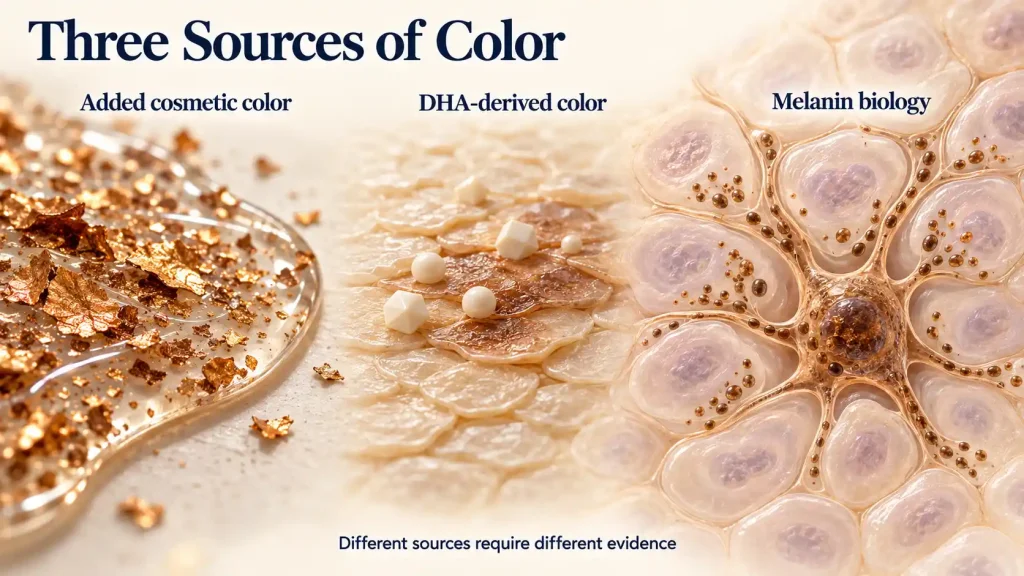
The distinction matters when interpreting a claim. “Warmer-looking skin” describes an appearance. “Increases melanin” proposes a biological change. “Contains a pigmentation-related peptide” describes composition. Even when all three phrases appear in one brief, the same photograph cannot be assumed to substantiate all three.
A Tinted Self Tan Can Combine Functions
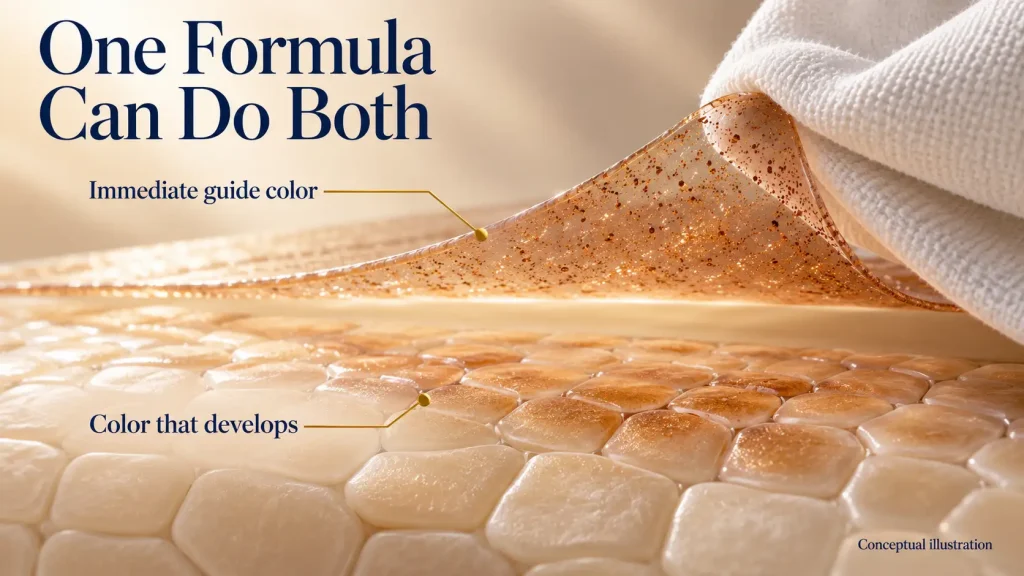
A tinted self-tanner can supply an immediate guide color while another component contributes to color that develops after application. The guide can help a user see where the product has been spread. It should not be mistaken for proof that the later color has already formed, or that the first visible shade predicts the final shade.
An observable market example is St. Tropez Luxe Crème Whipped Mousse. Its official page describes both a tinted application and developing self-tan wear; the listed ingredients include DHA and cosmetic colorants. This illustrates how functions can overlap within one marketed product. It is not independent verification of that product’s performance claims. [3]
For an illustrative hybrid brief, separate the first-use appearance from the later appearance after the specified routine. Decide what the user should expect when the guide color is removed and what instructions explain that transition. Evaluate the two functions under their respective conditions. A good initial tint does not settle whether the developed shade is even or whether the wear instructions are clear.
Describe the Appearance More Precisely
Color depth, warmth, coverage and shine are different parts of a visual brief. A team using “bronzed” to mean a warmer shade may disagree with a team using it to mean deeper color. Before requesting samples, describe which attribute matters and provide a reference that everyone can discuss under the same viewing conditions. A single attractive campaign photograph rarely explains every attribute the development team needs to reproduce.
The phrase “natural-looking” needs the same care. In an illustrative brief, ask whether it means less visible coverage, a particular warmth, a subtle change from baseline or an even appearance around application boundaries. Specify which people and application areas will inform that assessment. A supplier cannot resolve these choices simply by offering a material with “natural” in its description; ingredient origin and the intended visual judgment remain different parts of the discussion.
Removal language also deserves its own definition. A rinse instruction, removal with a cleanser and a fabric-contact observation answer different questions. For a hybrid, specify whether the instruction concerns the application tint or the complete product appearance. Avoid turning “some color remains after rinsing” into a mechanistic conclusion. First establish what was applied, what routine was followed and which color contributors the comparison can actually distinguish.
Descriptive Modifiers Are Not Color Mechanisms
“Gradual Self-Tanner” proposes a pattern of use and appearance over time. A useful brief must specify what “gradual” means for that product and how it will be observed. The phrase does not identify which ingredient causes the color, establish a fixed number of applications or guarantee that the same routine gives every user the same shade.
“Natural DHA Self-Tanner” adds an ingredient-origin proposition. Ask what the supplier means by “natural,” which material or process the statement covers and which documentation supports it. Treat origin and finished-product performance as separate questions. The modifier does not by itself show a more natural-looking shade, improved tolerance or an advantage over a different DHA source.
“Hyaluronic Acid Self-Tanner” adds a skin-care ingredient story. Specify the hydration or sensory outcome being proposed and assess it independently from the color outcome. “Sunless Tanning Solution” describes a broad use or supply concept. It does not tell the buyer whether the material is a finished product, a concentrate or a mixture requiring further formulation.
“Peptide Self-Tanner” identifies an ingredient association. Before using that phrase as a benefit claim, explain whether the peptide is proposed to contribute to visible color, another cosmetic endpoint or simply the product’s composition. This gives purchasing and R&D a shared question to ask rather than leaving marketing language to determine the presumed function.
Where Palmitoyl Tetrapeptide-20 Fits
Palmitoyl Tetrapeptide-20 provides a specific example of why the distinction matters. A published study investigated pigmentation-related activity in laboratory models, isolated human hairs and a human hair study. It offers relevant mechanistic context, but its human observations do not establish tanning performance for a body lotion. The application, tissue and finished formula must match the proposed claim. [4]
For a product brief using the Palmitoyl Tetrapeptide-20 ingredient, identify its proposed role without treating the ingredient page as the study report. Request the exact supplied composition and the supporting evidence for the intended use. A peptide-containing tinted lotion can be described accurately without attributing all its visible color to the peptide. [5]
Match the Observation to the Proposed Function
| Proposed function / 拟议功能 | Observation to define / 需要定义的观察 | Separate question / 应单独回答的问题 |
| Immediate bronzing / 即时古铜色 | Appearance of the applied film / 涂抹后膜层的外观 | Removal and fabric transfer / 去除及织物转移 |
| Developing self-tan / 后续自美黑显色 | Color after the intended development and rinse routine / 按预定显色及冲洗程序后的颜色 | Shade distribution and later wear / 色度分布与后续妆效 |
| Pigmentation-related peptide / 色素相关多肽 | Endpoint appropriate to the proposed role / 与拟议作用相符的终点 | Attribution beyond the base and added colors / 排除基底及外加颜色后的归因 |
The questions above are development prompts, not a validated test protocol. They help a team decide what its eventual evaluation must distinguish before selecting methods, controls and claim wording with the relevant specialists.
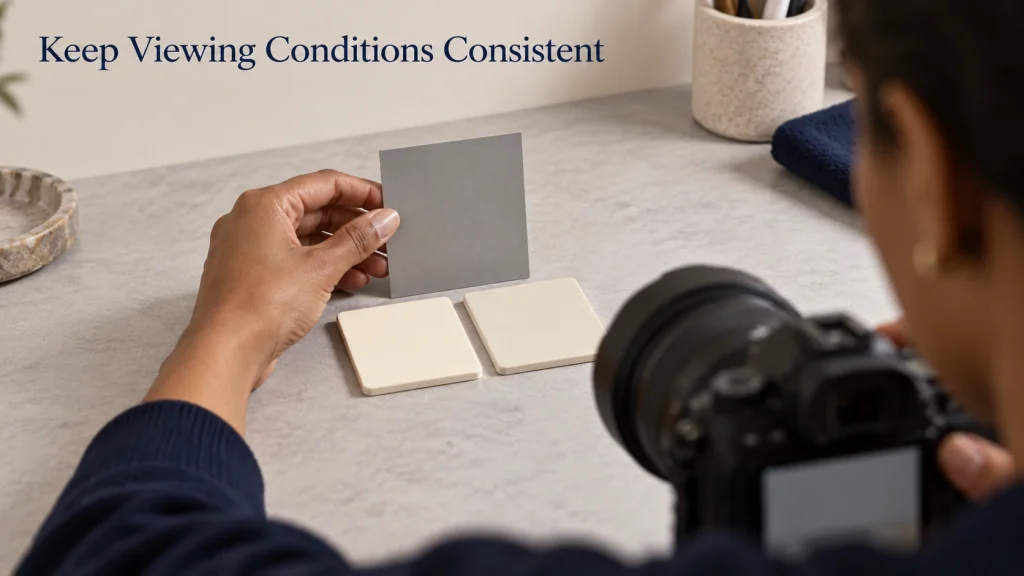
For color photography, plan consistent lighting, camera settings, distance and positioning. Include a suitable reference and document when images were taken relative to application and cleansing. Otherwise an apparent difference can reflect the image conditions or a remaining surface film. A photograph records appearance under those conditions; it does not identify the molecular source of the color.
If a combined formula looks darker, ask what comparison would explain the contribution of its components. Depending on the research question, a specialist may propose appropriate base-formula and component controls. Decide that before interpreting the result. A total color change can support an appearance endpoint while leaving an ingredient-specific mechanism unresolved.
A useful final brief also separates skin appearance from color transferred to clothing and from the feel of the product during wear. “Even-looking,” “comfortable” and “low transfer” concern different observations. They should not be bundled into a single “better tan” conclusion when only one has been evaluated.
Write the Product Brief Before the Launch Promise
Consider three illustrative briefs. An event-day bronzing lotion prioritizes the visible finish during wear and clear removal instructions. A developing self-tan with a guide color needs an explanation of both the application stage and the later shade. A peptide-containing body-care concept needs a defined role for the peptide and evidence appropriate to that role. None of these briefs is completed by the word “glow.”
For each concept, state the intended user, application area, visible result, routine and circumstances in which the result will be assessed. Then list the proposed contributors to color and any separate skin-care benefit. This makes disagreements visible early: a request for an immediately wearable tint is different from a request for an ingredient-associated pigmentation effect.
A helpful purchasing inquiry can therefore be short but specific. For example, a brand might describe a leave-on body lotion with an immediate application tint and a separately assessed developing shade, then ask whether a proposed peptide has evidence relevant to an additional role. This is an illustrative inquiry, not a recommended formula. It allows the supplier to identify which questions its material documentation addresses and which require application work. Record unanswered questions as development tasks rather than converting them into provisional benefits in the launch copy.
Keep sun protection separate from cosmetic color. FDA warns that sunless tanning products do not provide protection unless they contain sunscreen ingredients and are labeled with an SPF. Do not translate a bronze appearance or a melanin-related ingredient narrative into an untested UV-protection promise. [1]
Frequently Asked Questions
1. Is a bronzer the same as a self-tanner?
Not necessarily. The useful questions are whether the formula supplies immediate cosmetic color, forms color after application, or does both. Read the composition, intended routine and supported claims together instead of relying on the front-of-pack category name.
2. Why is a self-tanner already brown when applied?
It may contain an application tint as well as a developing-color system. Check the particular formula and instructions. The visible starting tint should not be treated as evidence that all subsequent color has already formed.
3. Does gradual self-tanner mean melanin production?
No. “Gradual” describes a proposed progression in appearance or use. It does not identify the mechanism. A melanin-production claim requires evidence addressing that biological proposition, beyond the observation of progressively darker-looking skin.
4. Does adding Palmitoyl Tetrapeptide-20 prove peptide-driven tanning?
No. Ingredient inclusion establishes composition. Demonstrating a color contribution requires evidence for the supplied material in the intended formula and use, with a design that can distinguish that contribution from other color sources.
5. How should a brand brief a supplier about a sunless-color concept?
Describe when the user should see color, what should happen after the intended rinse or removal routine, and which separate skin-care benefit is proposed. State the target market and ask which documents and application-specific studies are available rather than assuming the category name guarantees performance.
CTA
Discuss a defined sunless-color brief with Genopep through Skinkind Cosmetics. For a Palmitoyl Tetrapeptide-20 concept, share your target market, format, intended color timeline and proposed ingredient role. Contact the team to ask about the supplied composition, available technical documents and the evidence relevant to your intended application. Confirm document and study availability before setting the launch claim.
References
1. US Food and Drug Administration. Sunless Tanners and Bronzers. US category explanation, DHA surface coloration, temporary cosmetic bronzing and sunscreen distinction. Accessed 15 October 2026.
2. Nguyen BC, Kochevar IE. Factors influencing sunless tanning with dihydroxyacetone. British Journal of Dermatology. 2003;149(2):332–340. doi:10.1046/j.1365-2133.2003.05434.x. Primary research on DHA coloration and reaction conditions, not a universal finished-product timetable.
3. St. Tropez. Luxe Crème Whipped Mousse official product page. Observed commercial example of tinted application plus developing self-tan; listed ingredients include DHA and colorants. Marketing statements are not independent efficacy evidence. Accessed 15 October 2026.
4. Almeida Scalvino S, Chapelle A, Hajem N, et al. Efficacy of an agonist of alpha-MSH the palmitoyl tetrapeptide-20 in hair pigmentation. International Journal of Cosmetic Science. 2018;40(5):516–524. doi:10.1111/ics.12494. Primary pigmentation research with a human hair application, not a clinical body-skin tanning study.
5. Skinkind Cosmetics. Palmitoyl Tetrapeptide-20 ingredient page. Commercial product context and inquiry link only; product-page language is not independent confirmation of finished-formula claims. Accessed 15 October 2026.