Professional Cosmetics Peptide Supplier | GENOPEP



How to Formulate with Peptide Solutions
When formulating with peptide solutions, use the current instructions for the exact commercial ingredient to define a starting pH range, addition stage and temperature exposure. Then verify that process in the complete formula. A peptide name alone cannot establish compatibility, and a clear batch at the correct final pH does not demonstrate chemical stability throughout storage.
Start with the process the formula will actually experience
Imagine a development brief that says only “add the peptide during cool-down.” One operator adds it immediately after emulsification; another waits until the base has thickened, adjusts the pH, and then introduces the concentrate. Both can report that they followed the instruction. Their addition conditions may still differ substantially. This is a hypothetical example, but it exposes a real gap in a loosely written manufacturing method.
A useful peptide solution formulation brief identifies the supplied material, the intended base, and the operations that connect them. Request the full INCI composition, carrier system, recommended use level, storage conditions and formulation guidance for the selected grade. Ask whether a stated limit applies to the unopened concentrate, a diluted intermediate or the finished product. Those are different materials, even when the same peptide is present.
This guide proposes a development approach, not a production recipe. Its questions can be used when discussing Pro Peptide Solutions with Genopep. Product-specific instructions and your own qualification work must supply the actual numbers. A category page is a starting point for selecting materials; it cannot approve your factory process.
Separate the three pH questions
The pH of the supplied solution is a raw-material property. The recommended pH of a finished formula is a development condition. The local environment encountered during addition is a process question. Copying the first number into a finished-product specification leaves the other two unanswered. For peptide formulation pH, establish which question each supplier statement actually addresses before choosing a target.
Build the target around the overlap between the selected peptide material and the rest of the formula. Consider the preservative system, thickener, other actives and intended product use. If the documented ranges do not overlap, repeatedly adjusting the same beaker is unlikely to resolve the design conflict. Revisit the ingredient choice or the base, then test the revised combination. Avoid choosing a midpoint simply because it looks reassuring on paper.
Make pH results comparable. Define the sample preparation, suitable electrode, measurement temperature and equilibration procedure. Record any dilution rather than switching silently between neat and diluted samples. METTLER TOLEDO explains that temperature affects both the electrode response and the sample itself, and recommends comparing samples at the same temperature. Automatic compensation should not be treated as a universal correction for every formula’s temperature-dependent chemistry. [2]
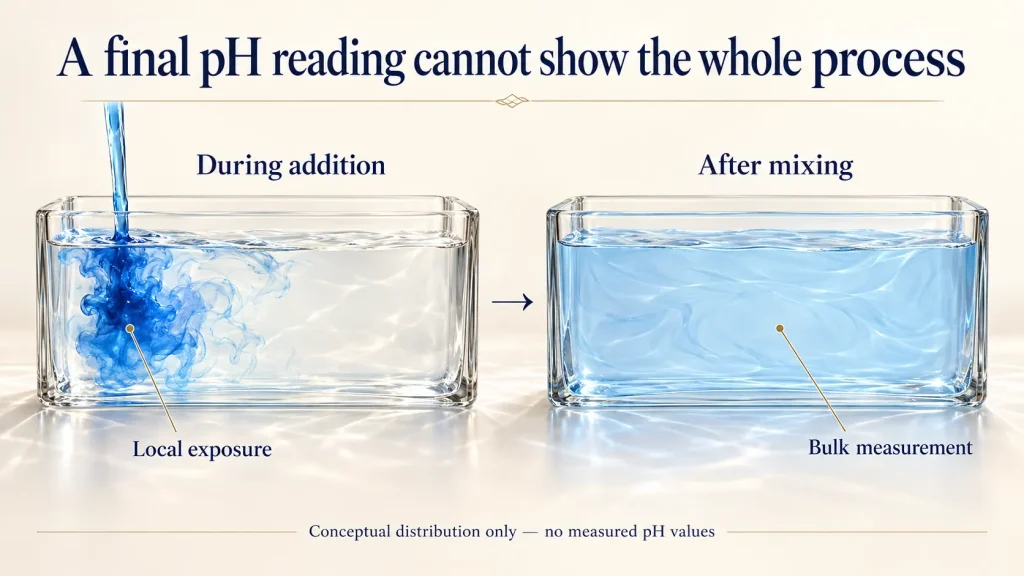
A satisfactory final reading cannot reconstruct what happened at an addition point. As a process-development precaution, avoid pouring concentrated pH adjuster directly onto a peptide-rich pocket. Use an addition and mixing method suited to the formula, then allow the sample to equilibrate before measurement. This is a recommendation to investigate local exposure, not a claim that every brief contact necessarily damages every peptide.
Read temperature together with duration
“Below 40°C” is often repeated as though it were a universal boundary. Supplier instructions can be more specific. DSM’s April 2020 guidance for SYN-TC describes processing up to two hours at 80°C while still recommending incorporation below 40°C near the end of production. That named example distinguishes a preferred addition practice from a separately described exposure condition. It is not a temperature allowance for other peptide products or for Genopep materials. [1]
For your selected material, request the conditions behind the recommendation. Was the ingredient tested alone or in a base? Which measurement supported the conclusion? Does the information cover the proposed hold, or only a short addition step? Record the heating and cooling history after the peptide enters the batch. A peak temperature without its duration gives an incomplete description, especially when a production delay keeps material warm longer than intended.
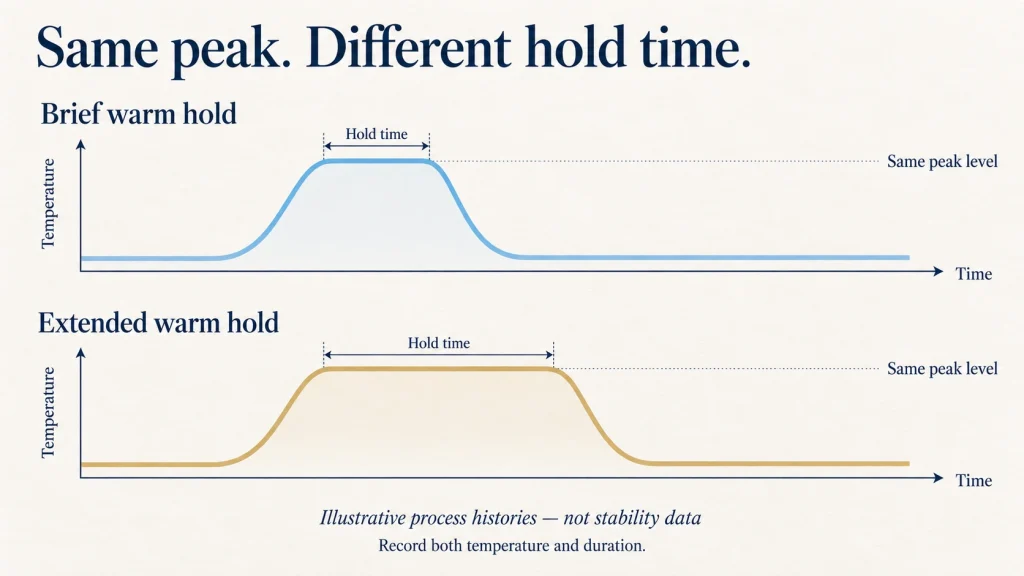
If an excursion occurs, retain the batch record and investigate before deciding whether to release, rework or reject. Neither a normal appearance nor a generic internet limit resolves the question. Compare the actual exposure with relevant supplier information and an appropriate analytical assessment. Do not translate an accelerated storage result into a manufacturing allowance without checking whether the sample, duration and conditions are comparable.
Write an addition order that can be reproduced
A reasonable starting sequence for some emulsions is to prepare the base, complete operations requiring higher temperature, and bring it toward the peptide’s documented addition conditions before dosing. This sequence is conditional. A supplier may specify a different phase or method, and a cold-process gel has no identical emulsification stage. “Add last” can also be impractical if the cooled base is already too viscous to distribute the solution consistently.
Specify the addition location and rate, the mixing equipment, and the period allowed for incorporation. Identify whether pre-dilution is permitted, what liquid would be used, and how long an intermediate may be held. Diluting a supplied solution changes its composition; it does not automatically create a stable stock that can wait indefinitely for the next batch. Obtain support for that intermediate or prepare only what the qualified process requires.
Keep the scale-up description more informative than an rpm setting. Vessel geometry, impeller design, batch size and viscosity help explain whether mixing conditions are comparable. Plan how uniformity will be assessed using a suitable sampling strategy. Excess aeration, poor circulation or incomplete incorporation can be practical concerns without assuming that ordinary mixing necessarily breaks short peptide chains. State the observed problem before assigning a chemical cause.
Test peptide compatibility with useful controls
A list saying “compatible with niacinamide, vitamin C and retinol” is too broad to approve a formula. Ask which vitamin C form, which retinoid system, which levels and which base were evaluated. The same marketing ingredient category can cover different supplied materials. For copper-containing peptide products, request guidance specific to that complex rather than transferring conclusions from an unrelated peptide blend. Consumer layering advice does not establish manufacturing compatibility.
The following small screening set is a planning example, not a prescribed test standard. It helps separate base behavior from effects introduced with the commercial solution. Where a matched carrier control is unavailable, document that limitation rather than describing the comparison as fully controlled. Use the same observation conditions across samples, and define in advance which findings would trigger a closer investigation.
| Trial | Question | Limitation |
| Base alone | Does the base change on its own? | Cannot assess the added solution. |
| Base plus matched carrier | Does the carrier alter the system? | Requires a genuinely matched control. |
| Base plus peptide solution | What changes after incorporation? | Appearance alone cannot identify the cause. |
| Complete candidate formula | Does the intended combination remain acceptable? | Requires broader qualification in its package. |
Change one clearly defined factor during an exploratory comparison when that helps interpret the result. After finding a promising condition, check relevant interactions in the complete formula. An isolated screen can narrow the problem; it cannot establish the shelf life of a more complex commercial product. Keep the original observations, including unfavorable ones, so later changes can be compared with the same baseline.
Check the peptide as well as the appearance
Plan physical observations and chemical measurements as separate parts of peptide stability work. Color, odor, pH, viscosity and phase separation can reveal useful changes. They cannot establish how much intact peptide remains. Conversely, a satisfactory peptide assay does not mean that a separating emulsion is an acceptable product. Define acceptance criteria around the intended formula and the decisions each measurement must support.
Published formulation research illustrates the breadth of this task. Ruiz and colleagues described emulsion and gel formulations containing an anti-aging peptide and assessed them using laboratory analysis, rheology and in-vitro release work. That study does not validate a different commercial blend or establish its clinical benefit; it provides an example of looking beyond a single visible observation. [3]
If a laboratory proposes an assay, ask how the peptide is recovered from your matrix and distinguished from interfering ingredients or degradation products. Consider recovery checks and suitable controls with the analyst. An assay that works on a neat raw material may need further development for a rich cream. Agree on the analyte, sampling points and reporting basis before commissioning a storage study, otherwise the final report may answer a different question from the development brief.
Include preservation and the intended package
Before samples enter storage, decide what the initial result represents. A measurement on the supplied concentrate cannot serve as the finished cream’s initial assay. Take a representative sample after the defined incorporation and equilibration steps, and preserve the associated manufacturing record. When practical, keep a retained sample of the ingredient lot as well. These records can help investigate a later change without pretending that the concentrate and cream are directly interchangeable analytical samples.
Agree on how borderline results will be handled. An unexpected assay change may warrant a review of sampling, extraction and analytical variability before it is attributed to processing. A repeated result outside a justified acceptance criterion needs a documented decision, not a favorable interpretation based only on the product still looking attractive. This matters when development staff, an external laboratory and a contract manufacturer each see only part of the evidence.
The CE–CTFA cosmetic stability guidance treats product stability as broader than a raw-material check and includes interaction with packaging. Use that general principle to design a formula-specific study covering relevant physical, chemical and microbiological quality. The 2004 document is guidance, not a universal test schedule or a substitute for current requirements in the intended market. [4]
A preserved concentrate does not automatically preserve the product into which it is diluted. Evaluate the complete formula’s antimicrobial protection using an appropriate method and risk assessment. ISO 11930 addresses that subject; it does not establish peptide content, delivery or wrinkle efficacy. Keep those evidence categories separate in the development dossier. [5]
Choose samples and storage conditions that represent the intended product and package, with justified stress conditions where useful. Record fill, closure and dispensing observations alongside the analytical plan. When a package, fragrance or other ingredient changes late in development, assess whether earlier conclusions still apply. A previous passing result belongs to the system that was actually tested.
Frequently asked questions
1. What is the best pH for peptide solutions?
There is no single best value for all commercial peptide solutions. Start with the selected grade’s guidance, distinguish raw-material pH from finished-formula recommendations, and find a workable range for the complete system. Verify the target with a consistent measurement method and a stability plan.
2. Are all peptides damaged above 40°C?
Do not use that statement as a universal rule. Temperature tolerance depends on the supplied material and exposure conditions. Obtain product-specific guidance and assess the actual temperature–time history. A preferred cool-down addition temperature and a demonstrated exposure limit answer different questions.
3. Should a peptide solution always be added last?
Follow the supplier’s recommended phase and your qualified manufacturing sequence. Late addition may be suitable, but it must still allow uniform incorporation and any necessary controlled adjustment. Document the stage precisely enough that another operator can reproduce it.
4. Can peptide solutions be combined with vitamin C or niacinamide?
Evaluate the exact supplied ingredients, levels, pH and base rather than relying on a general yes-or-no list. Request relevant compatibility information, then test the full combination. A conclusion about one peptide formulation does not automatically transfer to another.
5. Does a clear solution prove the peptide is stable?
Clarity is an appearance observation. It cannot confirm peptide identity, retained content or absence of relevant degradation. Use an appropriate analytical method alongside physical and microbiological evaluations for the decisions the product requires.
Bring the proposed process into the supplier discussion
For the next development conversation, share the product format, intended market, draft composition, proposed pH, addition stage and temperature–time conditions. Include the intended package and the tests already planned. This gives a supplier a concrete basis for identifying missing information or a process condition that needs investigation before scale-up.
Explore Pro Peptide Solutions from Genopep on Skinkind Cosmetics, then request the current documentation for the material you are considering. The useful outcome is a specific candidate and a testable process proposal. Final suitability remains a conclusion to establish in your own formula, manufacturing conditions and package. [6]
References
1. DSM — SYN-TC formulation guidelines, April 2020. Named commercial-product example only; not a Genopep specification.
2. METTLER TOLEDO — Temperature effects on pH measurement. Instrument and sample-temperature considerations.
3. Ruiz MA et al. — Preparation and stability of cosmetic formulations with an anti-aging peptide. Journal of Cosmetic Science. 2007;58(2):157–171. Abstract reviewed; no extrapolated efficacy claim.
4. CE–CTFA — Guidelines on stability testing of cosmetic products, 2004. General historical guidance, not a universal schedule.
5. ISO 11930:2019 — Cosmetics — Microbiology — Evaluation of the antimicrobial protection of a cosmetic product. Public scope consulted; full test procedure not reproduced.
6. Skinkind Cosmetics — Peptides Solution. Category context and commercial enquiry destination.