Professional Cosmetics Peptide Supplier | GENOPEP



Peptide Solution Pricing and Cost in Use for Skincare Formulas
Compare peptide solution cost in use by defining the exact supplied material, its content basis, the proposed formula addition and the quotation’s delivery scope. Multiply the price per kilogram of solution by its mass fraction in the finished formula to estimate the direct ingredient contribution. Then assess order commitments and development costs separately. A lower kilogram price, higher concentration or smaller nominal dose does not establish equivalent cosmetic performance or a better overall purchase.
Two prices that do not yet describe the same purchase
A buyer receives two peptide-solution quotations. One has the lower price per kilogram; the other recommends a lower addition level. The purchasing sheet looks ready for a decision, but the products may contain different peptide identities, carriers or content bases. One quotation may include transport to the receiving site while the other stops earlier in the delivery chain. Ranking the two prices immediately would hide those differences.
The useful question is how each technically suitable candidate contributes to the intended formula and purchasing plan. Start by agreeing what must remain comparable. That may be a particular peptide identity and content, or a broader finished-product development objective. These are different comparisons. A cost calculation cannot turn unlike ingredient systems into interchangeable materials.
The Pro Peptide Solutions category from Skinkind Cosmetics presents cosmetic formulation candidates and customized peptide-combination development. For a commercial comparison, ask Genopep for the quotation and current technical information for the exact grade under consideration. A category description is not a batch specification, a binding price or evidence that all candidates require the same formulation work. [1]
Establish the material and measurement basis first
A peptide supplier quotation should identify the product code or grade, supplied form, pack size and quoted quantity. Pair it with the relevant composition and specification information. Determine whether a content figure concerns a named peptide, the sum of defined peptides, a larger ingredient complex or another reported measure. Do not divide price by an undefined active percentage and call the result a comparison of peptide value.
Units matter. NIST distinguishes mass fraction from concentration expressed against volume, and defines density as mass divided by volume. If one document gives milligrams per millilitre and another gives milligrams per kilogram, conversion needs the appropriate density and reporting conditions. The words ppm or percent alone should not settle the basis. Confirm how the supplier defines the quantity before calculating a formula contribution. [2]
Analytical purity is another field. It should not automatically be treated as the mass of peptide in each kilogram of supplied solution. Where pricing is justified by a purity or content statement, ask which method and material it describes. Keep that answer attached to the cost sheet so a later quotation update does not silently change the calculation’s denominator.
Calculate the solution contribution to the finished formula
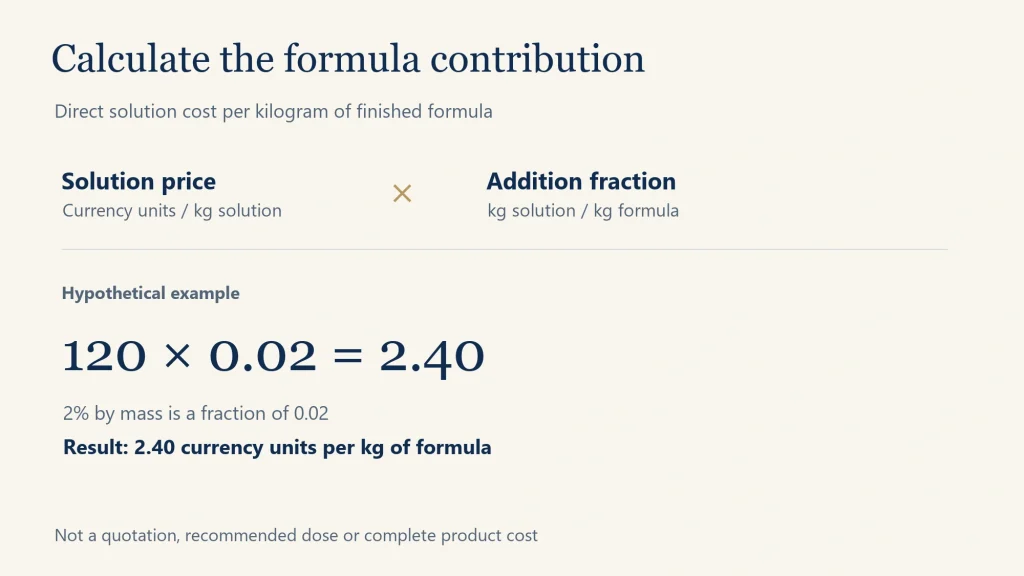
For a mass-based formula, multiply the solution price per kilogram by the fraction of solution added. An addition of 2% means a fraction of 0.02. This gives the solution’s direct contribution per kilogram of finished formula at that price basis. For a defined batch, multiply by the batch mass. The result covers this ingredient line; it does not include the rest of the base, filling, packaging, testing or overhead.
Consider a deliberately simplified example. Both fictional solutions contain the same single peptide on a confirmed mass basis. Solution A contains 500 mg/kg and is added at 2%; Solution B contains 1,000 mg/kg and is added at 1%. Assume no relevant content loss during manufacture. Both then contribute a nominal 10 mg of that peptide per kilogram of final formula. These assumptions isolate the arithmetic; they are not claims about available products.
| Hypothetical input or result | Solution A | Solution B |
| Solution price | 120 currency units/kg | 180 currency units/kg |
| Peptide content | 500 mg/kg | 1,000 mg/kg |
| Formula addition | 2% by mass | 1% by mass |
| Nominal peptide contribution | 10 mg/kg formula | 10 mg/kg formula |
| Solution needed for 100 kg formula | 2 kg | 1 kg |
| Direct solution cost for that batch | 240 currency units | 180 currency units |
At those fictional prices, B has the higher price per kilogram of solution and the lower direct contribution to the formula cost. The calculation explains why cosmetic peptide solution pricing needs a stated use basis. It establishes neither superiority nor equivalence: different carriers, impurities, peptide forms or processing behaviour could still change the development decision. A multi-peptide blend requires more careful comparison than this single-peptide example.
Translate batch cost into the planned sale unit
The same example can be expressed at unit scale without changing its assumptions. If a planned unit contains 30 g of formula, Solution A’s direct contribution is 2.40 multiplied by 0.03 kg, or 0.072 currency units per unit. Solution B contributes 1.80 multiplied by 0.03 kg, or 0.054. This is a nominal fill-mass calculation. It excludes filling allowances and every other product cost. Keeping the small result visible helps a buyer judge whether the ingredient-price difference is material enough to justify further comparison work.
A 30 mL label cannot simply replace 30 g in that calculation. Establish the appropriate formula density and filling basis first. For an actual production model, use the quantity consumed and the number of saleable units recorded, explaining any allocations for retained samples or rejects. Do not insert an assumed industry loss percentage to make the example look operational. The distinction between nominal development costing and observed production costing should remain clear when the budget reaches the commercial team.
Compare useful formulation options rather than theoretical doses
An attractive calculated dose still needs technical justification. Use a proposed addition appropriate to the exact grade, base and development objective. A content-normalized comparison can help identify questions, but it should not override formulation instructions or replace evidence for the finished product. Reducing the addition solely to make the cost sheet look better may also change the supplied carrier contribution and the rationale for the intended claim.
Keep formula suitability and performance questions separate from arithmetic. FDA’s cosmetics testing guidance allows relevant existing safety information and recognizes that gaps may require additional testing. EU cosmetic-claims rules require support relevant to the claim, including appropriate justification when ingredient properties are transferred to a finished product. Neither a lower finished formula ingredient cost nor a matching nominal peptide amount resolves those questions. [5,6]
Put delivery costs on the same boundary
Before comparing invoice totals, state the currency, quantity tier, quote validity, payment terms and delivery basis. Ask which transport, handling, insurance or clearance costs are included, which party arranges them and which remain to be estimated. Keep recoverable taxes separate from nonrecoverable costs according to the buyer’s accounting treatment; do not add every tax line indiscriminately to ingredient consumption.
ICC explains that Incoterms 2020 rules allocate delivery responsibilities, costs and risks. A quotation should specify the chosen rule, the named place or port and the applicable version. An Incoterms label alone does not provide a product-quality specification, payment agreement or complete commercial contract. Read the actual quotation and confirm the missing arrangements with the counterparties. [4]
Allocate shipment-level charges on a consistent, documented basis. If one parcel carries several ingredients, explain how the relevant charge is distributed instead of attributing the entire shipment to whichever peptide quotation is being challenged. Mark provisional freight estimates and refresh them before ordering. A transparent estimate is more useful than a precise-looking delivered price whose exclusions are unknown.
Separate consumption cost from the first order commitment
A formula may consume one kilogram of solution while the available order requires a larger pack. The full purchase is a cash commitment; it is not necessarily the cost consumed by that single batch. Record expected use of the remainder, storage requirements, supplier-confirmed dating and restrictions after opening. Do not assume unused material will remain suitable indefinitely or will automatically be consumed by future sales.
A peptide solution MOQ should be checked for the exact grade and packaging arrangement. Ask whether a sample, trial order and repeat production order have different terms. Treat any volume discount alongside the amount genuinely needed within the planning horizon. A lower unit price can coexist with greater cash tied up or more unused stock. Neither outcome is universal; use the project’s demand and receiving records.
Keep recurring costs and launch work in separate columns
CIPS describes total cost of ownership as broader than purchase price, covering acquisition, use and end-of-life costs. For a peptide project, apply that principle through explicit cost categories rather than a generic savings promise. Keep the recurring ingredient and operating contribution separate from one-time work needed to establish the formula. This allows the team to see what repeats with production and what belongs to development. [3]
| Cost item | Basis to record | Decision use |
| Solution consumption | Actual formula quantity and price scope | Compare direct ingredient contribution |
| Delivery allocation | Shipment scope and allocation method | Compare equivalent receiving boundaries |
| Unused stock | Expected use and confirmed dating | Assess order exposure |
| Development work | Agreed tasks and responsible party | Budget work before production |
| Repeat-order changes | Grade, pack and quotation revisions | Identify costs needing reassessment |
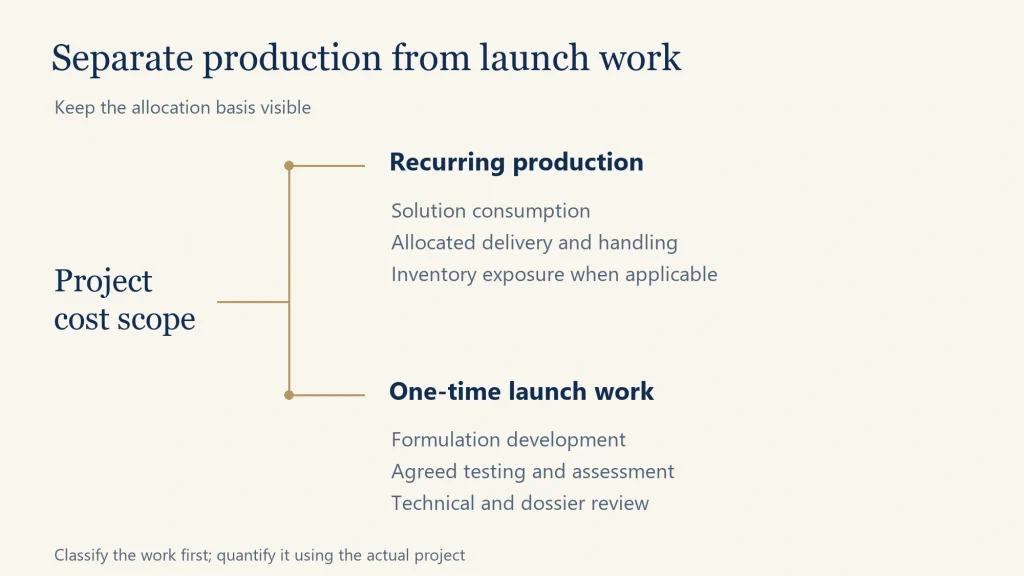
Ask what technical support, samples and documentation are included, available on request or separately charged. Avoid counting a service twice if it is already included in the quote. Conversely, an unavailable report should remain an open scope question, not become a zero-cost assumption. Assign an owner and an estimate basis to each development task before presenting the overall budget.
Close the quotation scope before accepting an order
Ask the supplier to confirm which product revision and packaging arrangement the final offer covers. If a trial used a different grade, establish whether the order is still for the evaluated material before approving the price. List unresolved items separately from the accepted commercial terms. A provisional sample discussion should not quietly become a commitment to an unconfirmed bulk specification, nor should a preferred price substitute for written confirmation of what will be supplied.
The first order and a repeat order may also have different economics. A development charge might apply once, while a recurring small-pack fee may persist. Ask whether those lines change with an agreed order size and distinguish a confirmed term from a hoped-for future discount. Where the buyer plans staged purchases, compare the actual staged scenario with the bulk alternative, including the handling and unused-stock assumptions already recorded. That makes the discussion negotiable without suggesting that the supplier must offer a particular concession.
Revisit the comparison when an assumption changes
The useful cost sheet has a revision date and traceable inputs. Retain the quotation version, technical grade, addition basis, batch size, delivery scope and inventory assumptions. If an input is not confirmed, label it as provisional. Do not bury a missing content basis inside a calculated price with several decimal places.
Once trials or production provide better information, update the model. Actual consumption, dispensing losses or a revised base may alter the contribution. Keep observed records distinct from planning allowances; a handling allowance is not proof of a measured loss. Where a formula or claim changes, technical reviewers should assess what evidence remains relevant before procurement treats the cheaper option as accepted.
Frequently Asked Questions
1. How do I calculate peptide solution cost in use?
For a mass-based formula, multiply the quoted solution price per kilogram by its addition fraction. Multiply again by the defined batch mass for the batch contribution. State whether the price includes delivery. This is the solution’s ingredient contribution, not the complete cost of the finished product.
2. Is a higher concentration always less expensive to use?
No. It may permit a different addition in a technically justified comparison, but price, peptide identity, content basis, carrier and formula requirements still matter. A lower calculated addition should not be adopted merely to reduce the budget or assumed to preserve the same finished-product evidence.
3. Can I compare two multi-peptide blends by total ppm?
Total ppm is insufficient if the reporting basis or included peptides differs. Confirm which identities and amounts it covers. Equal totals do not establish equal composition, cosmetic performance or compatibility. Use the total as one documented input and keep the remaining technical comparison visible.
4. Does the minimum order quantity equal my batch ingredient cost?
No. The minimum order determines the purchase commitment, while the formula consumes a defined quantity. Track the remaining stock and assess its expected use and suitability. Any inventory cost allocation should be explained rather than charging every purchased kilogram to the first batch without a stated reason.
5. What should I send to receive a comparable quotation?
Send the exact candidate or development brief, proposed order quantity, pack requirement, intended base and addition basis, destination and requested delivery scope. State which samples, technical information or development services are needed. Ask for quote validity and exclusions so the comparison can be updated before ordering.
Request a quotation matched to the formulation brief
Review Pro Peptide Solutions for a cosmetic development candidate, then send your quotation brief to Genopep. Include the grade or intended concept, formula type, proposed addition basis, trial and production quantities, packaging requirement, destination and target market. Ask Skinkind Cosmetics to identify the current pricing scope and relevant grade-specific information. Discuss unresolved technical assumptions before choosing on cost alone. [1,7]
References
1. Skinkind Cosmetics — Pro Peptide Solutions. Cosmetic formulation candidates and customized combination development; not a universal price or batch specification.
2. NIST — Guide to the SI Chapter 8. Definitions of mass fraction, concentration and density.
3. CIPS — Total Cost of Ownership. General procurement cost-scope framework; no peptide-specific savings result.
4. ICC — Incoterms 2020. Delivery obligations, costs and risks; confirm the actual rule and named place.
5. US FDA — Product Testing of Cosmetics. Relevant existing safety information and additional work where needed.
6. European Commission — Regulation 655/2013. Cosmetic claim evidential support and ingredient-to-product extrapolation.
7. Skinkind Cosmetics — Contact Us. Technical and quotation enquiry route.