Professional Cosmetics Peptide Supplier | GENOPEP



Planning Preservation for Peptide Serums and Creams
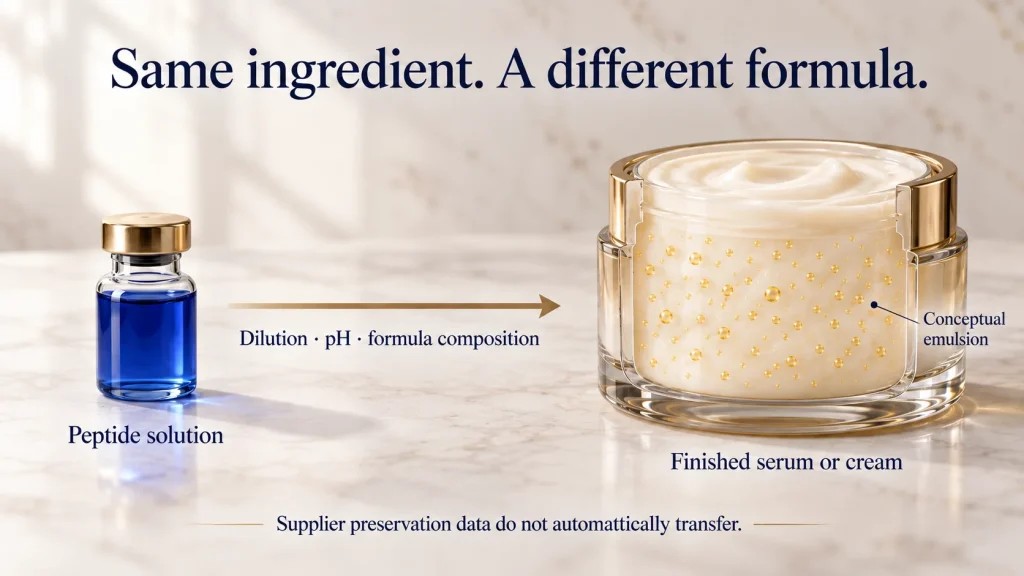
Peptide serum preservation needs to be evaluated for the complete formula and its intended use. A peptide solution may carry preservatives into a formulation, but its supplier data do not automatically establish protection after dilution and reformulation. Confirm composition, review the finished product’s microbiological risk, and agree suitable testing with a qualified laboratory. Keep preservation evidence separate from peptide stability and cosmetic efficacy; a satisfactory result in one area cannot answer all three questions.
The question hidden inside a supplier specification
A development team receives a preserved peptide solution and adds it to a new facial serum. The prototype is clear, the viscosity is acceptable, and the ingredient certificate meets the purchasing specification. Someone asks whether another preservation review is necessary. This is an illustrative development scenario, not a reported batch. The useful question is what the existing documents actually cover: the supplied solution in its original container, or the new serum with its own composition, production process and use conditions.
The distinction belongs in the project brief before the formula is frozen. Treating preservation as a late purchasing adjustment can leave the team changing pH, sensory properties or the ingredient list after other studies have started. Early planning creates room to compare candidates and identify missing information. It also gives the supplier a concrete enquiry: which composition and compatibility documents are needed for this particular product, rather than a request for a universal preservative recommendation.
When evaluating Pro Peptide Solutions from Skinkind Cosmetics, identify the exact commercial grade and request the documents applicable to that grade. The category page provides a starting point for choosing a peptide solution; it is not a preservation report for a buyer’s finished skincare formula.[1] This article addresses topical cosmetic development. It does not provide injectable preparation instructions, a microbial culture protocol or a ready-to-use preservative recipe.
What travels into the formula, and what does not
An ingredient list identifies components, but may not provide the quantitative information needed for a formulation calculation. Ask which substances are present for preservation, which have another technical purpose, and which concentration basis applies. Include relevant carrier information and any restrictions on disclosure. If exact details are proprietary, agree a workable confidential exchange between the supplier, manufacturer and assessor. An SDS alone should not be treated as a complete quantitative formulation disclosure.
For peptide solution preservatives, calculate carry-in using compatible units and the documented concentration basis. On a consistent mass basis, the contribution from a supplied component is its concentration in the ingredient multiplied by the ingredient’s inclusion fraction. Add contributions from other raw materials before reviewing the total. This mass-balance calculation tells the team how much is nominally introduced. It does not demonstrate antimicrobial performance, permitted use in a market, or adequate protection throughout the product’s life.
Avoid two opposite shortcuts. Adding a full default system without checking carry-in can create unnecessary duplication. Removing the finished-formula system because a solution is described as preserved can leave an unsupported assumption. The development task is to assemble a quantitative picture, identify what remains uncertain, and evaluate a candidate in the actual product. Keep the supplier’s original test material, formulation version and storage scope attached to any preservation data supplied.
Put the product’s risk profile ahead of the ingredient story
FDA identifies several contamination routes, including ingredients or water, manufacturing conditions, inadequate preservation, packaging, transport or storage, and consumer handling.[2] For a development brief, turn those routes into product-specific questions. Identify the application site, intended user, exposure pattern and production setting. A face cream used from an open pot deserves a different discussion from a product dispensed without direct finger access, even when both contain the same peptide solution.
A microbiological risk assessment should document the reasoning behind any low-risk designation. ISO 29621 provides a framework for identifying such finished products.[4] A name such as waterless, natural, concentrated or airless is not the assessment itself. If an aqueous peptide solution is introduced into a product developed as anhydrous, revisit the classification rather than inheriting it from the earlier base. Ask the assessor what measurements and use assumptions are needed to support the conclusion.
Use the table below as a development conversation, not as a list of automatic failure mechanisms. These are review prompts. The appropriate conclusions depend on the documented raw materials, final composition and applicable testing. Assign each unresolved item to a person or partner, and record the decision when it is made; a table of unanswered questions cannot authorize a launch.
| Review item | Question to resolve | Record to retain |
| Composition | What enters from every supplied blend? | Versioned quantitative formula |
| pH and matrix | Which conditions are supported for this candidate? | Supplier limits and formula measurements |
| Exposure | How will product be made, stored and accessed? | Manufacturing and intended-use description |
| Evidence | Which test or documented rationale supports protection? | Laboratory report and assessed scope |
A serum and a cream need their own development decisions
Start the preservation discussion with the complete candidate formula, not only the peptide’s preferred conditions. Ask whether the proposed pH range is supported by both the exact peptide material and the selected preservation system. Specify how pH is measured in this matrix and what range the manufacturing specification permits. A single initial reading does not define the acceptable range over storage. Where guidance is incomplete, record that uncertainty and plan suitable investigations rather than choosing an arbitrary midpoint.
For a clear serum, include the complete solvent, humectant and polymer system in the laboratory brief. For a cream, include the emulsion type and all phases, not simply the total water content. Ask the formulator and preservation specialist whether the candidate needs matrix-specific evaluation or method adaptation. ISO 11930’s public scope distinguishes its principal water-soluble or water-miscible application from products requiring modification, including those with water as the internal phase.[3] Do not copy a serum report onto a cream.
Adding peptides late in the process may be sensible for an ingredient’s documented handling conditions, but it leaves practical questions to resolve. How is the addition mixed uniformly? What is the approved bulk hold before filling? Which raw-material opening and transfer procedures are used? Place these questions beside the temperature and pH instructions in the batch-development record. A compatible benchtop addition does not establish that the full manufacturing route has been reviewed.
Ask the laboratory a precise question
Three questions often arrive under the same label of testing: what is recoverable in the sample now, how does the candidate perform under a defined preservation assessment, and how does it behave during storage or use? Define the question before commissioning work on cosmetic preservation efficacy. ISO 17516 concerns microbiological quality; ISO 11930 addresses evaluation of overall antimicrobial protection.[3][5] A release-quality result and a preservative challenge test serve different purposes. Neither should be substituted for the other without a documented, applicable rationale.
Send the laboratory the formula identifier, quantitative composition through the agreed confidential route, sample batch, manufacturing stage, package and intended use. Ask it to identify the method and edition used, any applicable amendment, deviations, interpretation and limitations. As reviewed on 4 October 2026, ISO’s catalogue lists ISO 11930:2019 with Amendment 1:2022, and shows revision activity for both ISO 11930 and ISO 17516.[3][5] Check the applicable publication when commissioning a study rather than relying on an old report’s heading.
Method suitability is worth discussing explicitly. FDA’s BAM chapter describes sample preparation that accounts for the product matrix and media that partly inactivate common preservation systems.[6] Ask the laboratory how it addresses residual antimicrobial interference and recovery in your particular sample. Request the relevant suitability or control information with the report. A bare statement that nothing was recovered should not be expanded into a promise that the product is sterile or protected under every future condition.
Agree the disposition of an unsatisfactory or ambiguous result before the report arrives. The next step may be investigation of sample identity, method suitability, formula, production hygiene or package use conditions. It is not automatically an increase in preservative concentration. Any change needs its own composition, safety and market review, followed by an appropriate evidence decision. This article deliberately omits organism preparation, inoculation procedures and pass criteria; those belong to the qualified laboratory’s controlled method.
Include the product that people will actually open
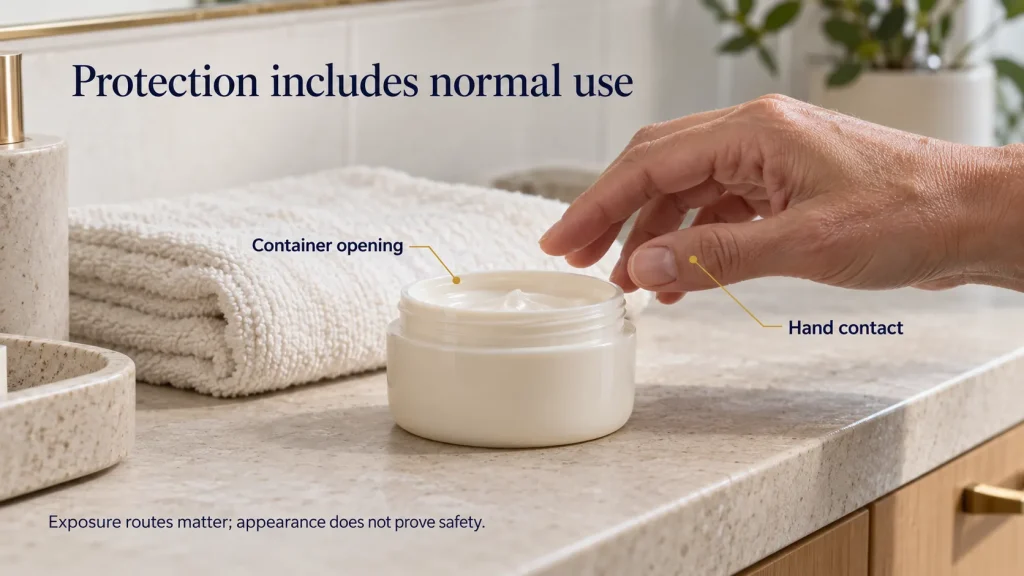
A packaging drawing is a description of the container, not evidence that all contamination routes have been removed. Document the opening, dispensing mechanism, closure and whether the product is intended to be refilled. Discuss foreseeable contact and the instructions that accompany use. A lower-exposure design can be relevant to the assessment, but calling a package airless should not close the preservation review. Evaluate the assembled product and the assumptions on which the proposed protection strategy relies.
Keep stability and preservation connected without merging their conclusions. FDA notes that shelf life varies with the product, handling and storage, and describes degradation of preservation systems among potential changes over time.[7] Ask whether aged samples or additional use-related work are needed for this project’s evidence plan. Specify the conditions and the question each sample answers. A convenient short study should not be converted into an unsupported shelf-life claim.
Define what a later change will reopen
Before accepting a report, trace the sample back to the development record. Was it the complete formula, a base without the peptide blend, or a supplier’s demonstration formula? Was the nominated packaging actually part of the evaluation, or only mentioned in the submission? If the report and project disagree, ask for clarification in writing. The report may still be useful background, but its relevance needs to be established before it becomes a release justification.
Separate an acceptable development candidate from a commercial release decision. Procurement may need to order a sample while some evidence is still pending; production needs an approved instruction and a defined disposition for the resulting batch. Write those statuses plainly instead of marking every shared document approved. A sample purchase is not permission to sell the finished product, and a research result should not silently acquire a wider commercial scope as it moves between departments.
Imagine that a tested cream is switched to a different fragrance blend and a new peptide solution grade just before the first production order. The marketing concept may be unchanged, while the quantitative formula is different. This is another hypothetical scenario, not a documented failure. Ask the responsible specialists whether the old evidence still covers the changed product. A supplier substitution should trigger a review of relevant differences, not an assumption of identical composition based on a similar INCI name.
At handover, retain a short evidence map: the approved formula and raw-material versions, manufacturing route, packaging configuration, microbiological assessment, relevant reports and unresolved limitations. Add who will decide whether future changes require further work. Make the assessment traceable to the commercial product, not only to a laboratory code. That record is especially useful when procurement, production and product development need to explain why a seemingly minor change cannot be approved from price information alone.
Frequently Asked Questions
1. Does a preserved peptide solution preserve my finished serum?
Not automatically. Confirm its composition and calculate carry-in, then assess the complete serum. Any supplier preservation result remains tied to the material and conditions evaluated. The finished product needs applicable evidence or an appropriately documented low-risk rationale; the ingredient description alone supplies neither.
2. Can I use an airless package instead of a preservative system?
Do not make that substitution from the package name alone. Packaging is one element in the product’s protection strategy. Ask a qualified specialist to evaluate the formula, assembled package, manufacturing route and intended use together before deciding what preservation measures and evidence are appropriate.
3. Is a low microbial count the same as passing a challenge test?
No. A count addresses the tested sample’s microbiological quality under the chosen method. A challenge assessment asks a different performance question. Keep both report scopes explicit, and do not describe a low count as proof of future preservation efficacy or sterility.[3][5]
4. Is one preservative suitable for every peptide serum and cream?
There is no recommendation justified by the word peptide alone. Evaluate the exact solution grade, full formulation, supported conditions, intended use and target market. If either supplier’s technical information is incomplete, resolve that gap before treating a candidate system as ready for commercial use.
5. Does passing preservation testing prove that the peptide remains active?
No. Preservation performance, peptide identity or content over storage, and finished-product cosmetic benefits are separate endpoints. Give each one an appropriate analytical or study plan. A report supporting microbial protection should not be presented as a peptide stability assay or an efficacy study.
Bring the complete formula to the supplier discussion
When discussing a serum or cream with Genopep, include the intended product type, solution grade under consideration, inclusion range, target pH, packaging and target market. Explain which composition or compatibility information your manufacturer and laboratory still need. Start with the Pro Peptide Solutions category and contact Skinkind Cosmetics for grade-specific documentation.[1][8] The enquiry should help close information gaps; it should not ask a catalogue page to certify a finished formula.
References
1. Skinkind Cosmetics / GENOPEP — Pro Peptide Solutions category. Company catalogue; commercial category context only, not finished-formula preservation evidence. Reviewed 4 October 2026.
2. FDA — Microbiological Safety and Cosmetics. Public guidance on contamination routes and product responsibility. Reviewed 4 October 2026.
3. ISO 11930:2019 — Evaluation of the antimicrobial protection of a cosmetic product. Public scope and publication status, including Amendment 1:2022 and revision activity. Full test criteria are not reproduced. Reviewed 4 October 2026.
4. ISO 29621:2017 — Risk assessment and identification of microbiologically low-risk products. Public scope and publication status. Reviewed 4 October 2026.
5. ISO 17516:2014 — Microbiological limits. Public scope and publication status; catalogue indicates a replacement under development. No numerical limits are reproduced. Reviewed 4 October 2026.
6. FDA — BAM Chapter 23: Methods for Cosmetics. July 2024 edition, introduction and sample-preparation context; used for the method-suitability discussion, not a home-testing protocol. Reviewed 4 October 2026.
7. FDA — Shelf Life and Expiration Dating of Cosmetics. Public explanation of product, handling and storage factors. Reviewed 4 October 2026.
8. Skinkind Cosmetics / GENOPEP — Contact Us. Supplier enquiry route only; no submission made. Reviewed 4 October 2026.