Professional Cosmetics Peptide Supplier | GENOPEP



From Peptide Data to Defensible Skincare Claims
Peptide skincare claims should identify a benefit that the applicable evidence can support. Check what was studied, how the outcome was measured, and whether the material, formula and use conditions match the proposed product. A mechanism finding, a participant’s perception and an evaluator’s observation answer different questions. Keep those distinctions in the wording, retain meaningful limitations, and obtain target-market review before publication. Ingredient research can inform development; its conclusions do not automatically transfer to every finished serum or cream.
A promising graph can become a different promise
Imagine a development meeting where a supplier slide shows a peptide-related response in cultured cells. A draft product page then describes a cream as visibly firming skin. The slide and the sentence may both sound relevant to the concept, but the sentence has changed the subject, the setting and the outcome. This is an illustrative editorial scenario, not a reported study. The missing step is a documented explanation of why the available research supports the promise that a shopper will read.
For teams reviewing Pro Peptide Solutions at Skinkind Cosmetics, begin that discussion while selecting the supplied grade. The category presents cosmetic formulation candidates, including customized combinations; it is a starting point for a technical enquiry, not finished product evidence for a customer’s formula. Ask Genopep what supporting information is available for the exact candidate and distinguish it from the evidence the brand will need for its own wording. This article addresses that interpretation problem rather than another complete testing programme. [1]
Write the proposed claim before editing the study summary
Put the proposed sentence in a claim brief. Identify its subject: the peptide ingredient, a named combination, or the finished cream. Then mark its benefit, the intended user and any time or comparison language. Words such as visibly, instantly, lasting and better each add a question for the evidence reviewer. Leave a blank field for the supporting report until the reviewer has checked it; a marketing phrase should not acquire a study citation merely because both contain the word peptide.
This brief also helps avoid commissioning the wrong work. A brand asking whether users like the skin feel has a different question from a brand asking whether trained assessment detects a change in line appearance. Agree which question matters commercially before requesting a quote from a testing provider. During development, keep ambitious wording in the brief as a hypothesis awaiting support, rather than placing it in public copy and hoping the results later justify it.
Find the actual subject of the research
Read the material description rather than relying on a trade name in the presentation title. Does the report concern an isolated peptide, a supplied solution, a mixture or a complete formulation? Record the identifying specification and the basis used to describe the dose. A raw-material certificate can be important for identity or composition questions without answering whether a consumer sees a benefit. Keep qualification documents and efficacy reports in separate folders, with a clear link between them where relevant.
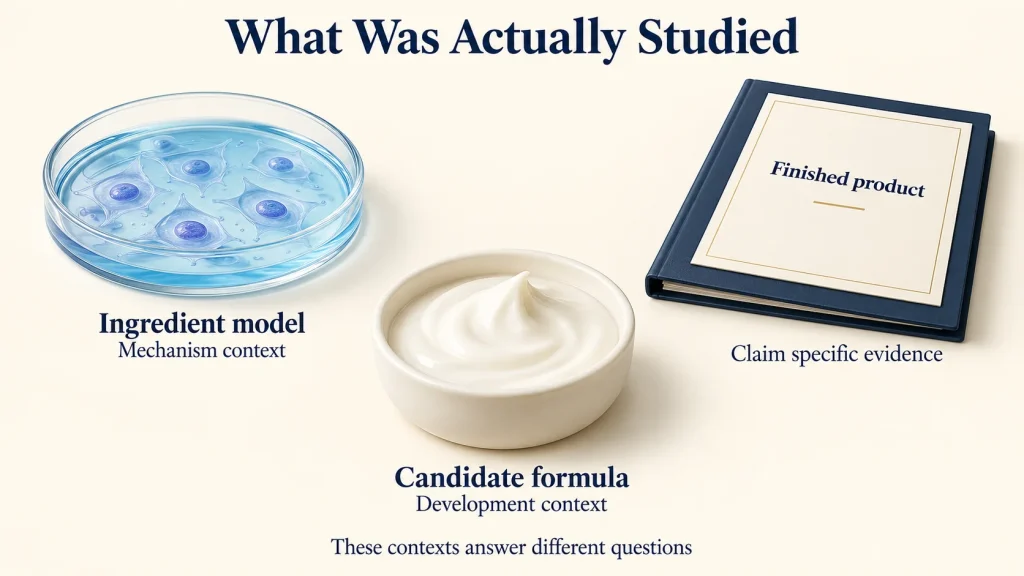
The study setting needs an equally explicit label. Cultured cells, an isolated tissue preparation and people using a product are different contexts. Avoid collapsing them into a generic science-backed badge. For internal review, we recommend a one-line study identity beside every selected finding: material, model or population, endpoint and conditions. That compact label makes an evidence jump visible before it reaches a designer’s layout, where the original context can be harder to recover.
Use a mechanism finding to ask a better development question
A mechanism discussion can help explain why a candidate deserves investigation. Its useful next sentence is often a question: under what formulation and use conditions could the proposed benefit be assessed? That keeps peptide efficacy data connected to development without converting a laboratory observation into a consumer guarantee. When circulating a literature summary, preserve the research setting in the same paragraph as the finding. Do not move the limitation to a slide that will disappear when the summary is reused.
Technical storytelling also needs a defined audience. A research discussion for a formulator may describe a pathway with its model limitations. The same passage beside a buy button may suggest an outcome for the advertised product. An editorial explanation should therefore make clear when it is discussing research rather than offering a product benefit. Having the word mechanism in a heading does not, by itself, settle how the whole presentation will be understood or classified.
Check how closely the tested material matches the proposed formula
Build a short comparison between the report’s test article and the product revision proposed for sale. Note material grade, supplied composition, incorporation level, base, application and relevant handling differences. Missing information is a question for the supplier or investigator, not permission to assume equivalence. The comparison should explain which evidence is relevant, which needs qualification and which does not answer the proposed claim. It can be concise; it still needs a technical owner who understands the differences.
Do not treat every change as automatically harmless or automatically invalidating all previous work. A documented review should consider the significance of the specific revision. Changing the carrier, regimen or another active may raise different questions from changing a label colour. Ask what the earlier finding depended on and what remains established. If the team cannot justify applicability, narrow or hold the claim while it resolves the gap instead of silently carrying the old conclusion forward.
Keep perception and observed appearance distinct
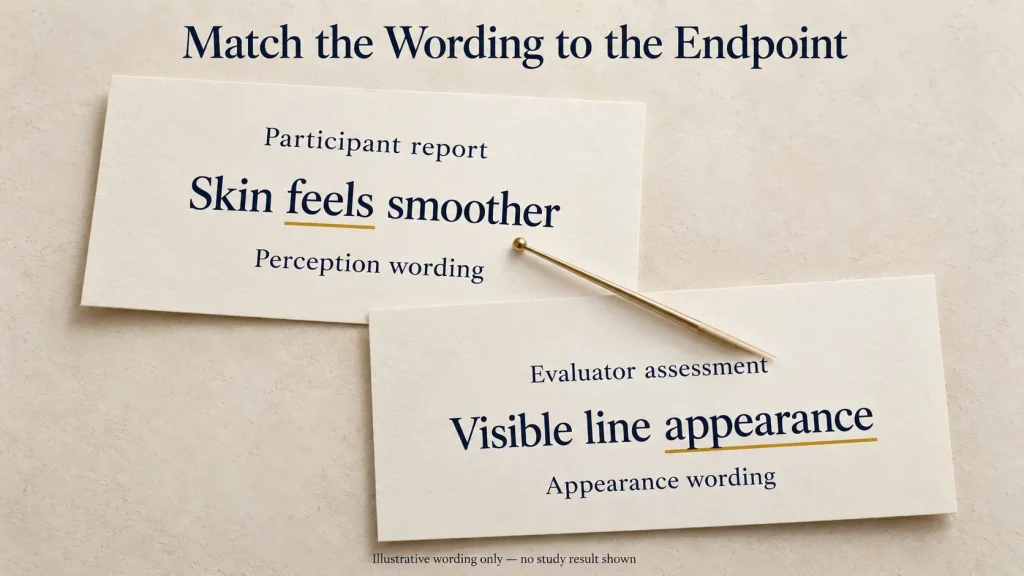
Consider two illustrative wording directions: skin feels smoother and improvement in visible line appearance. Neither is a claim about a real product in this article. The first directs attention to participant perception; the second requires evidence addressing visible appearance. The 2017 Technical Document on Cosmetic Claims discusses perception studies and the need for survey questions to support the corresponding wording. It is non-binding best practice agreed by a claims subgroup, not legislation or an official European Commission legal interpretation. [3]
Our practical recommendation is to put the exact question or assessment definition beside the draft sentence during review. Check who gave the answer and what they evaluated. A question about softness should not quietly become one about firmness; a reading from a hydration instrument should not be relabelled as a direct collagen measurement. Ask the investigator to explain the endpoint if its name is unfamiliar. Preserve that explanation in the claim brief so a later copy edit does not change its meaning.
Read the result behind the headline
Before selecting a number for the product page, locate its definition in the report. Is it a change in a measurement, a proportion of respondents, or an agreement score? What is the comparison and which participants were included in the analysis? Cosmetics Europe’s 2008 efficacy guidelines discuss report identification, methods, statistical interpretation and study limitations. They are an industry guideline, not a universal protocol that every peptide product can copy. Use the complete report and appropriate expertise to interpret its findings. [4]
For publication review, we recommend checking the figure, its denominator and its qualifying language together. A group average should not become a promise that every purchaser achieves that result. A result after a particular regimen should not acquire an earlier time point because the shorter headline looks stronger. If the result is difficult to explain accurately in the available space, choose a different presentation or defer it. A compact claim is useful only when the compression leaves its meaning intact.
A whole-formula finding does not isolate the peptide’s contribution
Keep the subject of a finished-formula finding intact. A product study evaluates the product under its design; it does not necessarily establish how much of the outcome belongs to one ingredient. If a brand wants to attribute a benefit specifically to the peptide combination, that becomes a separate question for the study designer. Ask whether the comparison can address the attribution, including relevant differences between the test and comparison formulas. Avoid treating an ingredient list as an explanation of causation.
This matters in a multi-active cream with moisturizers, emollients and other functional ingredients. Even when a proposed product claim is supported, a sentence assigning that result solely to the peptide may go further. In the claim brief, separate what the whole product did from the rationale for including each component. That distinction gives the formulation team room to explain its choices without forcing the efficacy report to answer a question it was not designed to resolve.
Review market boundaries separately from scientific plausibility
For EU cosmetic claim substantiation, Regulation 655/2013 requires adequate, verifiable support and addresses the unjustified transfer of ingredient properties to finished products. It also covers implicit claims, including images. Scientific plausibility alone does not settle whether a particular product statement is supported. Have the responsible claim reviewer assess the wording against the applicable dossier and target-market requirements. This is an educational overview, not a legal opinion or a declaration that any example is cleared for use. [2]
For the United States, FDA distinguishes appearance-oriented moisturizing from claims intended to affect body structure or function; its anti-aging page specifically discusses collagen-production claims. Intended use can also be established through advertising and online promotional material. Do not assume adding the word appearance makes an otherwise structural promise cosmetic. Review the complete presentation with qualified target-market expertise. The classification question and the evidence question both need attention, even when a laboratory mechanism is scientifically interesting. [5][6]
Audit the picture and the small print together
An image can make the promise broader than the sentence. A retouched face, a simulated before-and-after sequence or a chart without its study context may suggest results that the accompanying words do not establish. FTC advertising guidance explains that it considers express and implied claims and requires support before an advertisement runs. It also warns that a disclosure cannot contradict the main message. Keep the overall impression within what the supporting evidence can justify. [7]
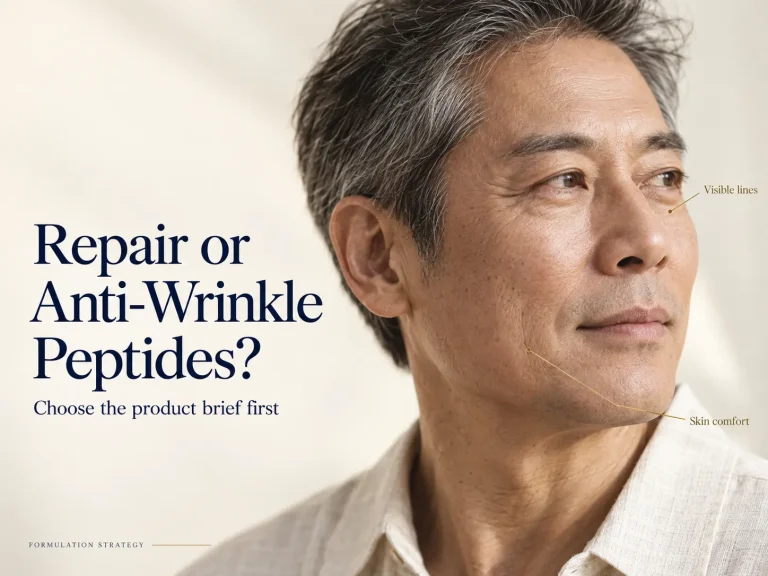
For this article, the portrait illustrates natural skin texture and the diagrams explain research contexts. None depicts a tested response. Apply the same discipline to commercial assets: label a conceptual model where needed, keep evidence qualifications close to the relevant claim, and do not use synthetic skin changes as a substitute for an authentic study record. A footer saying illustration may be insufficient if the dominant visual still communicates a product transformation. Review the rendered asset, not only the text file.
Keep a claim record that survives a handover
We recommend one review record for each approved wording version. Attach the report identifier, tested article, endpoint, applicable conditions, reviewer and decision. Add the approved translation and the visual that will accompany it. This is a practical project-control recommendation, not a claim that a single form meets every jurisdiction’s requirements. The record should let a new colleague find why the sentence was accepted without asking the person who happened to attend the original development meeting.
The following review map illustrates the questions to preserve. It does not approve any wording or establish a required test design. Use it to expose missing information when discussing ingredient data vs product claims with formulation, marketing and regulatory colleagues.
| Evidence context | Keep in the record | Do not silently add |
| Ingredient model | Material, model, endpoint | Finished-product benefit |
| Participant perception | Exact question and analysis | Objective structural change |
| Evaluator assessment | Assessed feature and conditions | An unmeasured benefit |
| Whole-formula study | Formula revision and comparison | Sole peptide attribution |
| Reused claim | Current formula, language, visual | Old approval for a new promise |
Recheck the wording when the product story changes
Marketing copy often changes after technical approval. A sentence may be shortened for a label, intensified for an advertisement or translated into a different promise. Ask whether the edited version preserves the original subject, endpoint and conditions. For example, translating feels firmer into a statement that skin structure has been strengthened changes the proposition. Include language review in the release process, and return substantive changes to the evidence reviewer rather than treating them as typography or localization alone.
A useful outcome of claim review can be a smaller, clearer promise, a request for missing information or a decision to postpone a sentence. None of those outcomes means the peptide concept has failed. They keep the project honest about what is known today and what remains a development question. The strongest public wording is the wording the team can trace to applicable evidence and explain accurately when someone asks what the study actually showed.
Frequently Asked Questions
1. Can ingredient research support a finished skincare claim?
It can contribute when relevance to the proposed product and statement is adequately justified. It is not an automatic transfer. Identify the tested material, context and endpoint, assess differences from the finished formula, and document why the evidence applies. Request additional support where the proposed benefit remains unanswered.
2. Does clinically tested mean clinically proven effective?
No. The phrase does not, by itself, identify the benefit, design or result. Ask what was assessed and whether the report supports the particular efficacy wording. A tolerability evaluation should not be presented as proof of an unmeasured appearance outcome. Any proposed use of the phrase still needs market-specific review.
3. Is supplier data less useful than independent data?
Funding or authorship is relevant context, but it does not replace examining the work. Request enough information to assess the material, method, results and limitations. A supplier study may be useful; a third-party logo alone does not make a poorly matched report applicable to your formula or claim.
4. Does using the same peptide concentration guarantee the same result?
No. First establish what concentration means in each document, including whether it refers to the supplied solution or the peptide itself. Then review the formulation and use differences relevant to the outcome. Matching one number is not a complete justification for reproducing another study’s result or advertising its benefit.
5. Can approved wording be reused after changing the formula?
Only after an appropriate applicability review. Record the change, consider what the supporting finding depended on, and obtain a documented decision on the revised product and wording. The required work depends on the change and claim; neither automatic reuse nor automatic repetition of every study is a sound default.
Bring the proposed benefit into the technical enquiry
If your team is evaluating a cosmetic peptide concept, review Pro Peptide Solutions and send a focused technical enquiry. Tell Genopep the product type, intended market, candidate grade, formulation stage and proposed cosmetic benefit. Ask which material-specific information Skinkind Cosmetics can provide and what remains to be established for your finished formula. This opens a useful evidence discussion without implying that purchasing an ingredient supplies validated product claims. [1][8]
References
1. Skinkind Cosmetics — Pro Peptide Solutions. Category context; not customer-product efficacy evidence.
2. European Union — Commission Regulation (EU) No 655/2013. Binding EU common criteria for cosmetic claims.
3. Sub-Working Group on Claims — Technical Document on Cosmetic Claims, 3 July 2017. Non-binding best practice hosted by the European Commission; not its official legal interpretation.
4. Cosmetics Europe — Guidelines for the Evaluation of the Efficacy of Cosmetic Products, revised May 2008. Industry guidance on study and report quality.
5. FDA — Wrinkle Treatments and Other Anti-Aging Products. U.S. appearance and structure/function claim boundary.
6. FDA — Is It a Cosmetic, a Drug, or Both?. Intended-use context, including promotional material.
7. FTC — Advertising FAQs: A Guide for Small Business. U.S. advertising support, implied claims and disclosures.
8. Skinkind Cosmetics — Contact Us. Technical enquiry route only.