Professional Cosmetics Peptide Supplier | GENOPEP



Peptide Formulation Testing Before a Skincare Product Launch
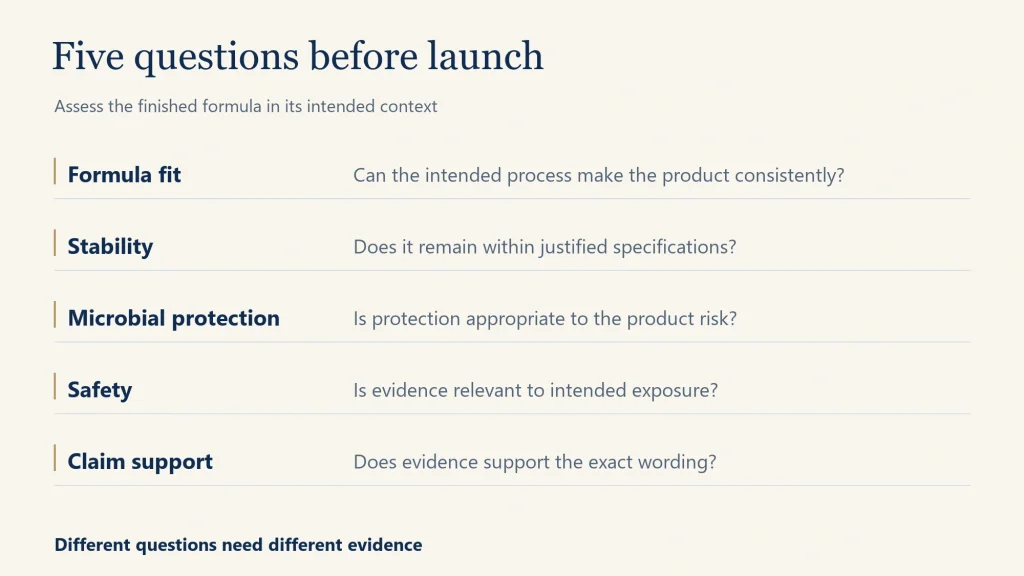
Peptide formulation testing should evaluate the finished product in its intended process, package and use context. Review formula suitability, physical and chemical stability, microbial protection, safety and the evidence for each proposed cosmetic claim. Supplier documents support that work but do not replace it. Define the product version, test questions, methods and acceptance criteria before sending samples, then review changes against the evidence used for the launch decision.
A good sample is the beginning of the assessment
A peptide solution arrives with its COA. The pilot serum looks smooth, dispenses well and feels pleasant during a preliminary trial. The launch team may now ask whether it is ready for production. Those observations are useful, but several questions remain open: what happens during storage, whether the chosen package changes the formula, how microbial protection is supported, and what the label can reasonably promise.
The sample being assessed is now a different object from the supplier’s raw material. It contains the base, other ingredients and the contribution from the supplied solution. It has passed through the manufacturer’s process and will be used from a particular pack. Finished cosmetic formula testing should keep that whole context visible, rather than reduce the decision to whether the peptide ingredient was supplied within specification.
The Pro Peptide Solutions category from Skinkind Cosmetics offers formulation starting points and customized combination development. Once a candidate is chosen, ask Genopep for the current information relevant to that grade and identify the finished-product work that the brand and manufacturer will own. A useful technical handover distinguishes supplied-material data from evidence for the product consumers will use. [1]
Name the product version before choosing the tests
Record the formula revision, peptide-solution product code and lot, addition level and content basis, manufacturing process, package specification and intended use. Retain the sample preparation record. A report that says only peptide serum is difficult to connect to a later production batch, particularly when a carrier, preservative or pack component changes between development and launch.
Before commissioning work, write the question each assessment must answer. State who reviews the result and what would require an investigation. Acceptance criteria should be agreed before the result is known. If an external laboratory proposes a standard package of tests, ask which product risks it addresses and where it leaves gaps. A convenient testing bundle may still omit a question central to the planned peptide claim.
| Commissioning field | Information to send | Purpose |
| Sample identity | Formula, lot, preparation and pack versions | Connect the report to the product |
| Test question | Attribute or concern to assess | Select a relevant method |
| Decision criteria | Justified specifications and investigation triggers | Interpret the result consistently |
| Review responsibility | Named technical reviewer and decision point | Resolve findings before release |
Follow formula performance through the intended process
Evaluate the candidate in a representative base using the proposed addition stage, mixing conditions and filling process. Record pH, appearance and other product attributes relevant to the brief. When an unexpected change appears, compare the preparation records before assigning the cause to the peptide. The supplied carrier, another ingredient, the process or the package may be part of the explanation.
If a comparison base is used, document what was removed and what was replaced. Omitting a peptide solution also removes its carrier contribution unless the comparison is adjusted. A difference in viscosity or skin feel cannot confidently be assigned to the peptide when the two samples have different solvent or humectant levels. Discuss the comparison design with the formulator and, for claim studies, the study team.
Build a stability protocol around the actual product
Plan which batches and filled units will represent the product. A small hand-prepared sample can help screen a candidate, yet it may not reproduce the mixing, holding or filling conditions used by the manufacturer. Before relying on it for a launch decision, review the differences and decide what representative production work is needed. Keep enough traceable material for planned assessments and relevant follow-up investigations, with storage and sampling instructions agreed by the responsible teams.
ISO/TR 18811:2018 provides a framework for selecting appropriate cosmetic stability methods. Its public abstract leaves the conditions, parameters and acceptance criteria to a justified manufacturer protocol; it does not define a single universal program. There is therefore no automatic temperature and duration that this article can prescribe for every peptide serum. [2]
Choose conditions and review points that address foreseeable storage, distribution and use. Separate routine storage information from deliberately stressful development conditions. When accelerated work is used, document its interpretation and limitations rather than turn a short study into an unsupported long shelf-life promise. Continue collecting relevant longer-term observations as the product program requires.
The 2004 Cosmetics Europe and CTFA guidance considers physical, chemical and microbiological stability together with container compatibility. As historical guidance, it helps frame the questions, rather than supplying a peptide-specific protocol. Select measurable attributes that matter to this product, define their specifications and record the basis for accepting a change. A stable-looking sample can still leave a chemical question unanswered. [3]
Decide what the peptide assay must establish
Peptide stability testing may require information about relevant peptide identities and content in the finished matrix. Ask the analytical laboratory exactly what its result measures. A method suitable for a neat supplied solution may need further work when used in an emulsion with other ingredients. Agree how the laboratory will assess matrix interference, sample preparation, recovery and the ability to distinguish the relevant analyte from other signals.
A total-content result may leave individual members of a multi-peptide blend unresolved. Conversely, a method that measures one marker peptide does not establish the stability of every peptide in the blend. Define the scope of the result in the report. If the intended statement is that a particular peptide remains present, use evidence capable of answering that specific identity and content question.
Keep the initial result and later samples on a comparable basis. Record whether content is reported per mass of finished product, per volume or against another defined denominator. Where a method cannot yet support the required conclusion, identify the analytical gap early. Marketing should not describe chemically verified peptide stability when the available study tracked only pH, color and viscosity.
When an assay result changes unexpectedly, investigate before explaining it as degradation. Review sample history, extraction, calibration and matrix behavior with the laboratory. A lower reported recovery could reflect a real content change, a preparation problem or another analytical issue. The investigation should distinguish these possibilities as far as the evidence allows. Record unresolved uncertainty in the technical decision; repeating the measurement until a favorable value appears does not resolve the underlying question.
Assess microbial protection in the finished formulation
Cosmetic preservation efficacy belongs to the formulation being evaluated. ISO 11930:2019 describes interpretation of preservation-efficacy data, microbiological risk assessment or both, and addresses products according to risk. Its public scope distinguishes low-risk products and notes the method’s applicability. Have the laboratory determine the applicable approach using the current standard and amendment rather than treating every product identically. [4]
A low microbial count at one sampling point answers a different question from performance after an introduced microbial challenge. Likewise, a preserved supplier solution does not establish protection after dilution into the brand’s formula. Review the full preservative system, the manufacturing context, the package and intended use with the microbiology team. Do not use an airless-pack description as a substitute for that review.
Evaluate the pack that will be sold
Peptide packaging compatibility should use the proposed product and pack specification. Review the contact materials, closure, dispensing system and exposure during normal handling. A glass development jar and a commercial pump are different contexts. Packaging observations can include leakage, visible interaction, dispensing changes or weight change, with investigation methods chosen for the actual concern. The goal is a useful assessment, not an impressive list of tests unrelated to the pack.
EU Decision 2013/674/EU gives guidance for the cosmetic product safety report, including stability information and packaging considerations. It discusses comparing inert containers with the marketed pack to investigate packaging-related stability issues. Use that distinction where it helps the assessment; a prototype pack should be traceable to the specification selected for sale. [5]
Review safety separately from the product claim
FDA explains that relevant existing safety information can be used and that gaps may require additional testing. Its guidance does not supply a fixed test list for every cosmetic. MoCRA requires the responsible person to maintain records supporting adequate safety substantiation. For the planned market, have qualified reviewers assess the relevance of available information to composition, exposure and intended use. [6,7]
A preliminary patch or use observation has a defined scope. Its population, conditions and endpoint determine what it can support. It does not automatically establish suitability for every user, a sensitive-skin claim or the complete safety of a changed formula. Ask the assessor to identify remaining questions rather than collect a favorable test name and assume the safety work is finished.
Match the claim to the evidence actually obtained
Cosmetic claim substantiation starts with the exact proposed wording. EU Regulation 655/2013 requires adequate, verifiable evidence and relevant, well-designed studies when studies are used. It also addresses extrapolating ingredient properties to the finished product. Define whether the label describes ingredient inclusion, perceived smoothness, an instrument-assessed outcome or a comparison; those statements require different supporting questions. [8]
For a peptide-related appearance claim, discuss the intended users, application conditions, endpoint, comparison and analysis with the study team. A moisturized appearance can be influenced by the whole base. If the brand wants to attribute a difference specifically to the peptide solution, its comparison design must address that question. Do not assume that adding more peptides establishes synergy or that a cellular mechanism predicts a visible consumer result.
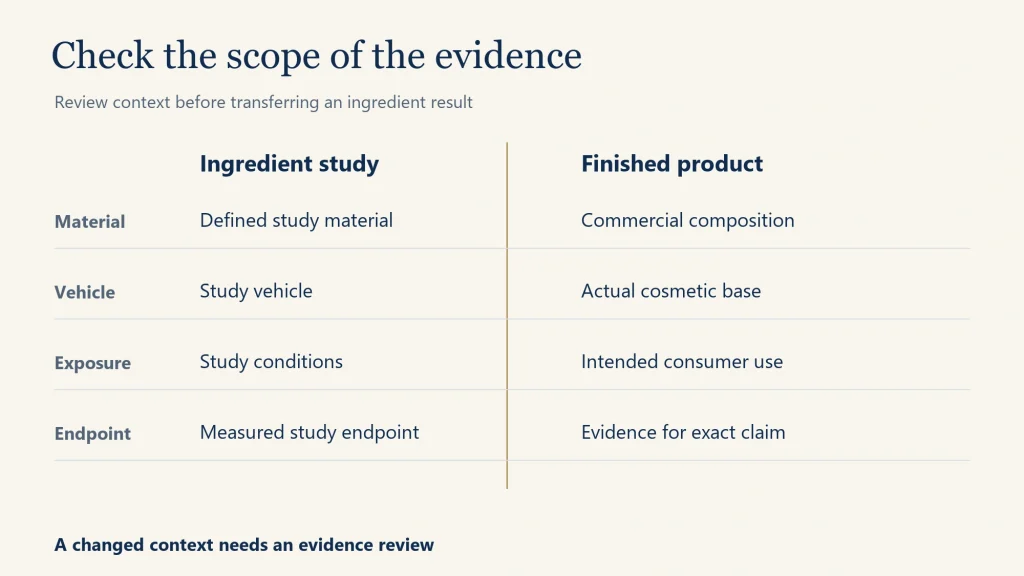
Keep the study formula and proposed commercial product connected by version records. If the formula or instructions change after a study, assess whether the report still supports the final statement. Images, headlines and implied benefits also need review; narrowing the words in a footnote does not necessarily correct a broader impression created by the main presentation.
Close the development record and control later changes
Before launch, assemble the formula and package versions, sample records, reports, justified specifications, relevant supplier documents and the claim review. Record unresolved findings and the technical decision made about them. Each workstream needs an identified reviewer. Avoid a release meeting in which the manufacturer assumes the supplier checked the finished product while the supplier assumes the brand arranged the necessary assessments.
Use a change review after the launch decision as well. The table below identifies questions to reopen, not a universal requirement to repeat every test. The technical team should document which existing evidence remains relevant, which gaps arise and what additional work is proportionate. Peptide formulation testing remains tied to the controlled product, not simply to its unchanged trade name.
| Change | Review focus | Record to update |
| Solution grade or level | Composition and relevant content | Formula and assessment rationale |
| Preservative or base | Microbial protection and matrix behavior | Relevant protocols and reports |
| Pack or process | Contact, dispensing and manufacturing effects | Package and process specifications |
| Claim or use instructions | Evidence scope and exposure | Claim review and safety assessment |
Frequently Asked Questions
1. Does a peptide solution COA replace finished-product testing?
No. It reports the supplied lot against the specified tests. It does not establish the stability, microbial protection, safety or cosmetic performance of the brand’s final formulation and package. Use it as part of the raw-material record and technical handover.
2. Can I prove peptide stability by checking pH and appearance?
Those observations support particular physical or formula assessments. They do not directly establish peptide identity or content. If the claim concerns chemical peptide stability, agree a suitable analytical approach for the relevant peptides in the finished matrix.
3. Does an airless pump remove the need to assess preservation?
An airless description does not settle microbial risk. Assess the actual formulation, package and intended use with the microbiology team. Choose the applicable preservation-efficacy or risk-assessment approach rather than relying on the packaging label.
4. What temperature and duration should I use for a peptide stability study?
There is no single program suitable for every cosmetic peptide product. Define conditions, methods, review points and acceptance criteria for the actual product and justify them. Discuss interpretation of accelerated work and longer-term observations with the responsible technical team.
5. Can an ingredient study support an anti-wrinkle claim for my serum?
Review its relevance to the exact serum, exposure, endpoint and wording. Ingredient evidence can contribute, but transferring its findings requires appropriate support. A supplier mechanism description alone does not establish the finished serum’s visible anti-wrinkle result.
Discuss the ingredient handover and finished formula with Genopep
Review Pro Peptide Solutions for a candidate, then send your formulation context to Genopep. Include the product code, intended addition, base, process, package, target market and proposed claim. Ask Skinkind Cosmetics which current supplied-material documents and relevant technical information are available, and agree with your manufacturer who owns the finished-product assessments. [1,9]
References
1. Skinkind Cosmetics — Pro Peptide Solutions. Candidate solutions and custom-combination development; no universal finished-product validation is implied.
2. ISO — ISO/TR 18811:2018 Cosmetics Guidelines on Stability Testing. Public scope and manufacturer justification of product-specific protocols.
3. Cosmetics Europe and CTFA — Guidelines on Stability Testing of Cosmetic Products, 2004. Historical stability and container-compatibility guidance, not a peptide-specific protocol.
4. ISO — ISO 11930:2019 Evaluation of Antimicrobial Protection. Public scope; current listing includes Amendment 1:2022. Full requirements require the applicable standard.
5. European Commission — Decision 2013/674/EU Guidelines on the Cosmetic Product Safety Report. Stability records and packaging considerations.
6. US FDA — Product Testing of Cosmetics. Existing safety information and appropriate additional assessment.
7. US FDA — Modernization of Cosmetics Regulation Act of 2022. Safety-substantiation record responsibilities.
8. European Commission — Regulation 655/2013. Adequate evidence, study relevance and ingredient-to-product extrapolation.
9. Skinkind Cosmetics — Contact Us. Technical enquiry route.