Professional Cosmetics Peptide Supplier | GENOPEP



Pre-Blended vs Custom Peptide Solutions When Customization Makes Sense
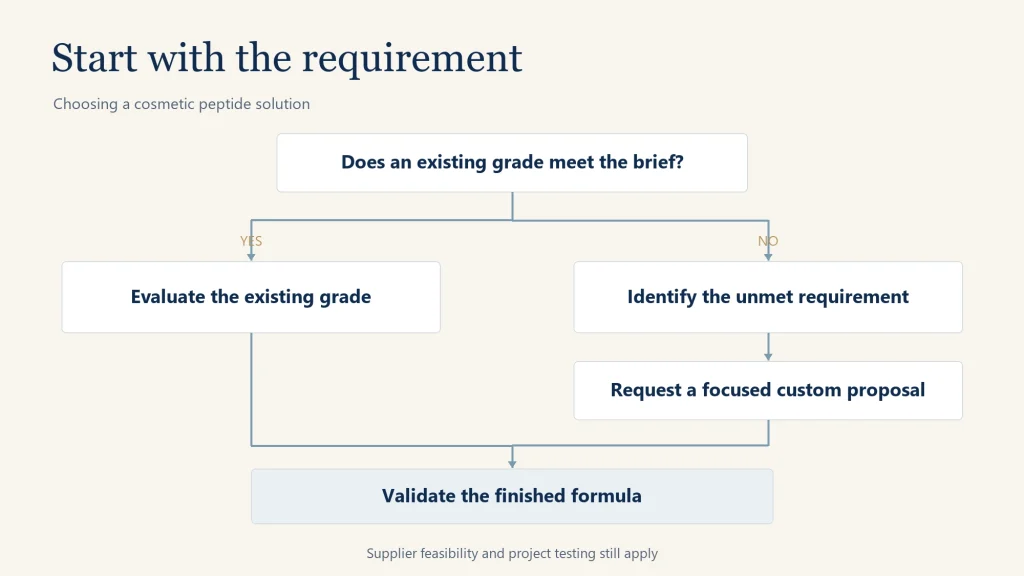
Custom peptide solutions make sense when a defined requirement cannot be met by an existing grade and the project can fund the additional development, testing and supply commitments. Start by evaluating a pre-blended candidate against the intended formula, ingredient exclusions, target market and evidence plan. Customize the smallest relevant part, such as the carrier, concentration basis or peptide combination, after the supplier confirms feasibility. Both routes still require assessment of the finished cosmetic product.
The first question is what the existing grade cannot do
A skincare team may want a peptide serum with a light finish, a particular ingredient list and a launch date that has already been agreed with its manufacturer. A supplier offers a pre-blended solution. The peptide concept seems suitable, yet its carrier conflicts with one exclusion in the brief. That is a useful reason to discuss customization. A request for something more exclusive, without a defined composition or performance question, gives the supplier much less to work with.
Before requesting custom peptide solutions, record the candidate grade and the exact requirement it misses. Is the difficulty in the supplied material, the finished base, the process or the proposed claim? A change to the base may solve a texture problem more directly than changing the peptide blend. A documentary gap may require clarification rather than a new material. This first diagnosis keeps the project from spending development resources on the wrong part of the formula.
Skinkind Cosmetics presents existing candidates and customized peptide combination development within its Pro Peptide Solutions category. Use that range as the starting point for a technical comparison, then ask Genopep to confirm what can be changed for the actual project. Availability, minimum quantity and development timing need a project-specific response. [1]
What the pre-blended route gives the development team
Pre-blended peptide solutions provide a defined starting composition and a supplied form for evaluation. The team can request the current technical documents, examine the carrier contribution and test one candidate in a representative base. This can reduce the work of selecting and preparing each peptide separately. The amount of work saved depends on how closely the grade fits the project and how much relevant information is available.
An existing blend may also be the most practical comparator for a custom proposal. Keep its product code, lot and trial conditions in the record. If the custom sample changes several things at once, the team needs a way to tell whether the observed difference follows from the new carrier, the peptide level or another formula change. A clear starting candidate makes that discussion more useful.
The development team still owns integration into the finished product. Appearance at receipt, convenient handling and a supplier use-level recommendation each answer a limited question. They do not tell the team how its emulsion, package and intended use will behave together. Evaluate the existing grade with the same seriousness that would be applied to a custom grade.
Define the scope of customization
Peptide solution customization can describe several different projects. A carrier adjustment changes the supplied medium. A concentration adjustment changes the specified content or dilution. A new combination changes which peptides are supplied together. A newly designed peptide introduces an additional identity and evidence question. Ask which of these the proposal actually covers before comparing cost or promising a launch date.
| Proposed change | Project question | What to confirm |
| Carrier or preservative | Can the grade meet a defined ingredient restriction? | Feasibility, full composition and revised handling |
| Peptide content | Does the supplied concentration fit the formula addition? | Content basis, method and specification |
| Peptide combination | Does the proposed combination answer the product brief? | Identity, proportions available for review and evidence |
| New peptide identity | Is a new molecule needed and supportable? | Separate feasibility, naming, safety and evidence assessment |
Changing a trade name alone does not establish a changed composition, ownership or exclusivity. PCPC explains that INCI names identify cosmetic ingredients and do not establish approval or interchangeability. When reviewing a custom cosmetic peptide blend, distinguish the trade name from the ingredient declaration and the controlled grade specification. [2]
When a focused custom request is worth pursuing
Customization is easiest to assess when the brief contains a concrete conflict. Examples include an excluded carrier in the existing grade, a supplied concentration that does not fit a constrained addition level, or a combination whose purpose differs from the planned product. These are development scenarios, not claims that a particular supplier can resolve every conflict. Send the reason and ask for technical feasibility before asking for a final quote.
For a concentration request, compare the amount of each relevant peptide delivered to the finished formula on a consistent basis. A higher percentage printed on the supplied solution does not automatically mean a higher finished-product level. The intended addition matters, as does whether the specification reports an individual peptide, total peptide content or the amount of a commercial blend. Ask the supplier to resolve that basis before evaluating a more concentrated grade. This avoids buying a change that does not address the original constraint.
Use an existing solution when its composition fits, the team can obtain the information needed for review, and the representative formula trial supports further development. An approaching launch date strengthens the case for limiting changes, provided the candidate meets the brief. If the final base and package are still undecided, start by narrowing those decisions before specifying a custom blend that may later need revision.
Write down the first sample’s acceptance criteria before ordering it. For a carrier exclusion, the revised composition and the relevant ingredient documentation are central. For a handling constraint, the team needs a representative trial in its actual process. For a proposed cosmetic benefit, define the evidence question separately; passing a handling trial does not substantiate the claim. Each criterion should have an owner and an agreed review point.
Keep a stopping option in the plan. If the supplier cannot meet the mandatory requirement, the candidate creates an unresolved assessment gap, or the remaining work exceeds the project’s resources, pause that route and compare alternatives. The next decision may be to adjust the base, revise the brief or evaluate another existing grade. A custom sample is useful only if it moves a defined decision forward.
Follow a carrier change into the finished formula
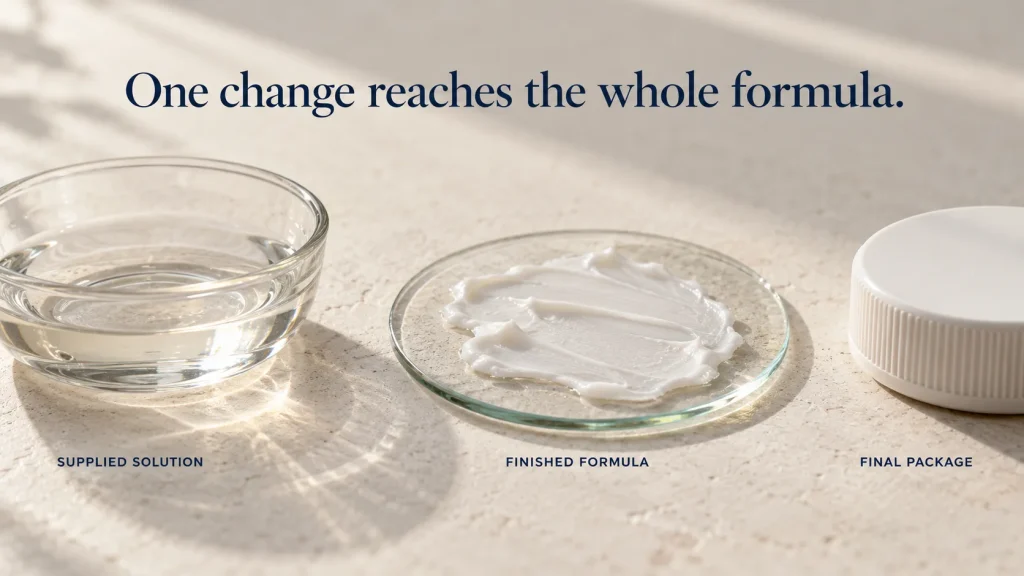
Suppose an existing grade is supplied in a water and humectant system, and the team requests a different carrier. Even if peptide identities remain unchanged, the new material contributes a different composition to the finished batch. The formulator should review the actual addition, the water balance, the ingredient declaration and any resulting process adjustment. Similar-looking sample liquids give no basis for assuming equivalence.
Cosmetics Europe and CTFA’s 2004 stability guidance treats physical, chemical and microbiological stability, along with container compatibility, as relevant concerns. It calls for programs suited to the product rather than one universal test. Accordingly, a material change should prompt a documented review of which parts of the existing stability assessment remain relevant. [3]
A preservative change also needs its own review. ISO 11930 provides a framework for evaluating a cosmetic product’s antimicrobial protection using preservation-efficacy testing and risk assessment as applicable. The supplier solution and the finished cosmetic are different assessment objects; a favorable result for one cannot simply be copied to the other. [4]
Budget for the decision and the testing it creates
Compare the routes on total project work. Ask for a quote that identifies material supply, development work, analytical work, sample iterations and any separate external testing. Clarify who pays when the brief changes or a further iteration is requested. A low sample charge can still lead to substantial work if the project keeps changing its carrier, base or claim after each trial.
At the planned use level, compare ingredient cost per finished batch with the one-time development and assessment costs alongside it. Keep ongoing purchasing and initial project expenditure separate so a larger order forecast does not hide the immediate funding need. Use written estimates from the relevant parties. This article gives no generic MOQ, development fee or lead time because those depend on scope and actual supply terms.
Schedule the decision points as well as the sample delivery. The project needs time to review documents, incorporate the candidate, investigate problems and decide whether to proceed. Assign an owner to the finished-formula work before committing to a custom grade. Cosmetic peptide development can stall when a supplier has delivered the requested sample but the brand and its manufacturer have not agreed who runs the next assessment.
Keep the evidence aligned with the proposed claim
A customized ingredient list does not establish a consumer benefit. Under EU Regulation 655/2013, cosmetic claims need adequate, verifiable support, and transferring ingredient properties to the finished product requires appropriate evidence. Decide whether the intended statement concerns ingredient inclusion, a visible cosmetic outcome or a comparison with another product, then plan substantiation for that statement. [5]
US FDA guidance allows relevant existing safety information to be considered and explains that additional work may be needed to fill gaps. MoCRA requires the responsible person to maintain adequate safety-substantiation records. Review the relevance of available information to the changed composition and intended use with qualified assessors; a new product name does not answer that question. [6,7]
For a multi-peptide formulation, ask whether evidence describes an individual peptide, the supplied combination or a finished product. Record the concentration basis, vehicle and endpoint used in relevant studies. If a custom combination differs from the studied material, define what can reasonably be retained and what needs further support. More ingredients alone provide no reliable basis for claiming greater efficacy or synergy.
Agree what can be supplied again
Before approving the custom sample, establish its product code, composition basis, specification and analytical method. Ask which documents will accompany routine supply and which changes require notice. Confirm packaging, storage instructions and commercial availability for that particular grade. The qualified sample should remain traceable to the material ordered for production.
Discuss exclusivity in writing if it matters commercially. Specify the composition or product code covered, territories, duration, purchase commitments and the rights to use data. Also establish what happens if the supplier changes a component or the buyer changes manufacturers. A private trade name and a development payment do not, by themselves, settle these questions.
Send a brief that makes the next sample useful
An effective brief lets the supplier propose a material the team can actually evaluate. State the product type, target market, intended base and package, ingredient restrictions, proposed claim, candidate addition level, launch constraints and expected purchasing scale. Attach the existing candidate code and explain what it misses. Distinguish mandatory requirements from preferences so the supplier can discuss feasible alternatives.
| Brief item | Useful input | Decision it supports |
| Existing candidate | Product code and unmet requirement | Whether a change is necessary |
| Formula context | Base, addition, process and package | Whether a proposal can be evaluated |
| Evidence and ownership | Claim, available information and assessment owner | Scope of further work |
| Commercial context | Quantity estimate, timing and exclusivity request | Feasibility of continuing supply |
The next useful response is a defined proposal with a feasibility statement, document list and sample-evaluation plan. That response may recommend keeping an existing grade, making a limited adjustment or developing a new combination. Each is a reasonable outcome when it answers the brief and leaves the team with manageable validation work.
Frequently Asked Questions
1. Are custom peptide solutions more effective than pre-blended solutions?
Customization alone does not establish greater effectiveness. The relevant comparison is the intended finished product, its composition and the evidence supporting its claim. A custom grade may solve a carrier or concentration problem while providing no basis for a superior-efficacy claim.
2. Can a supplier change only the carrier or preservative?
Ask whether a limited change is technically feasible for the exact grade. Removing or replacing a component can affect the supplied material and the finished formulation. Request revised composition and handling information, and agree which assessments need to be repeated before approving the sample.
3. Does a custom peptide blend belong exclusively to my brand?
Ownership and exclusivity depend on the written agreement. Define the material covered, markets, duration, purchasing commitments and rights to use evidence. A custom label or sample charge does not establish those terms automatically.
4. What MOQ and lead time should I expect for customization?
Request a project-specific estimate after the supplier has reviewed the scope. Distinguish sample development, assessment time and routine supply. Ask which stage the quoted lead time covers and what changes would require a revised quotation or schedule.
5. Do I need to repeat finished-formula testing after a custom change?
Review the change with the responsible technical team and assessors. Its composition, use level, process, package and intended claim determine which existing information remains relevant and where further work is needed. A similar appearance or unchanged trade name is insufficient to establish equivalence.
Discuss the existing candidate and the custom requirement with Genopep
Review Pro Peptide Solutions to identify a starting candidate, then send a development brief to Genopep. Include the candidate code, the requirement it cannot meet and the team’s assessment plan. Ask Skinkind Cosmetics for the current documents and project-specific feasibility, quantity and timing information before committing to a custom route. [1,8]
References
1. Skinkind Cosmetics — Pro Peptide Solutions. Existing candidates and customized combination development; project terms require confirmation.
2. Personal Care Products Council — INCI FAQs. Ingredient identity, naming and interchangeability boundaries.
3. Cosmetics Europe and CTFA — Guidelines on Stability Testing of Cosmetic Products, 2004. Product-specific stability programs and packaging compatibility context; historical guidance, not a peptide-specific protocol.
4. ISO — ISO 11930:2019 Cosmetics Microbiology Evaluation of the Antimicrobial Protection of a Cosmetic Product. Public scope; current listing includes Amendment 1:2022. Full method requirements require the applicable standard.
5. European Commission — Regulation EU 655/2013 on Cosmetic Claims. Adequate evidence and transfer of ingredient properties to finished-product claims.
6. US Food and Drug Administration — Product Testing of Cosmetics. Existing safety information and additional assessment where needed. / 已有安全信息及必要补充评估。
7. US Food and Drug Administration — Modernization of Cosmetics Regulation Act of 2022. Responsible-person safety-substantiation records.
8. Skinkind Cosmetics — Contact Us. Technical consultation and project enquiry route.