Professional Cosmetics Peptide Supplier | GENOPEP



Do Topical Peptides Really Work for Wrinkles? What Cosmetic Science Can—and Cannot—Claim
Some topical peptide formulations have improved wrinkle measurements in controlled studies, but the result cannot be generalized to every peptide serum. Peptide identity, concentration, vehicle, skin delivery, study design and finished-product testing determine what the evidence supports. For brands, the strongest conclusion is formula-specific improvement in wrinkle appearance—not a universal promise that all topical peptides work.
Introduction
Do topical peptides work for wrinkles? The honest answer is sometimes, in a specific formula, under specific test conditions. “Peptides” describes a broad group of short amino-acid chains rather than one standardized active. A positive study on one sequence in one vehicle cannot validate every cream or serum carrying a peptide label.
This distinction matters to formulators, product managers and buyers. Useful peptide skincare evidence connects ingredient identity to a stable vehicle, realistic skin exposure and a finished-product result. Weak evidence jumps directly from a laboratory mechanism to a broad promise such as “erases wrinkles.” This article separates those two levels and uses Acetyl Hexapeptide-8 as a practical case study.
Why “Peptides” Are Not One Single Ingredient Category
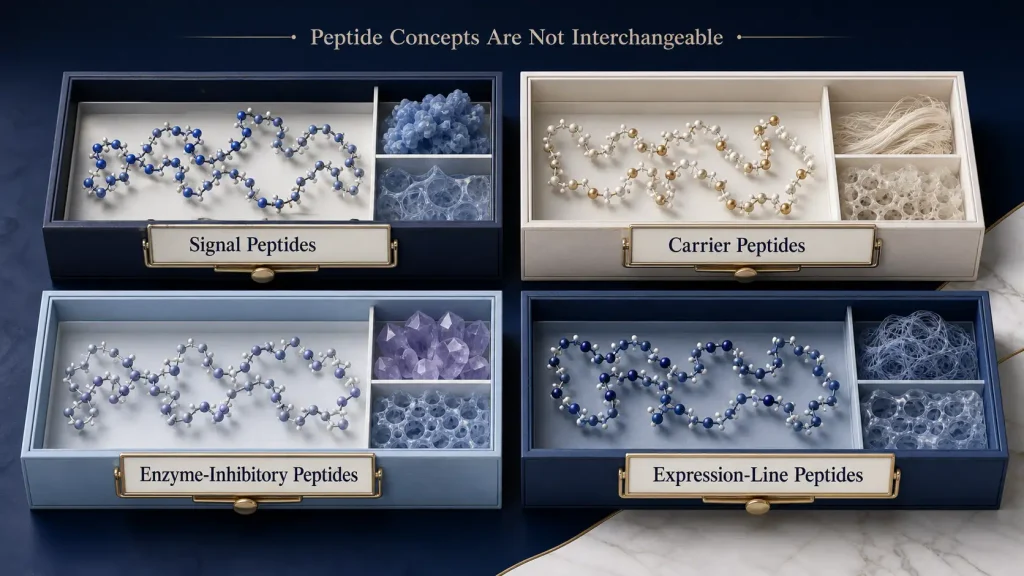
Cosmetic peptides are often grouped by the story used to explain their intended role. Signal peptides are associated with cell-signaling pathways; carrier peptides are designed to bind and deliver another component; enzyme-inhibitory peptides are discussed in relation to selected enzymes; and neurotransmitter-inspired peptides are positioned for expression-line concepts. These labels help organize formulation ideas, but they do not guarantee penetration, clinical performance or an approved claim.
Even peptides placed in the same conceptual group may differ in sequence, molecular properties, recommended use conditions and available human data. The INCI name, supplier documentation and quality specification must therefore be reviewed before an evidence story is built. “Contains anti-wrinkle peptides” is a starting description, not a completed substantiation file.
What Current Clinical Evidence Shows
The overall evidence base is promising but uneven. A 2026 systematic review and meta-analysis identified 19 randomized controlled trials involving 1,341 participants, yet only two evaluated topical peptides; most studied oral collagen peptides. The pooled wrinkle result was modest, with high heterogeneity, and the topical subgroup was smaller and not statistically significant.[1] This does not prove that topical peptides fail. It shows why the topical category still needs more standardized, independent trials.
Individual finished-formula studies can nevertheless produce useful evidence. A 12-week randomized, double-blind, placebo-controlled trial involving 55 women reported improvements from a line-targeting peptide serum versus its placebo vehicle.[2] A separate split-face trial in 93 women evaluated a moisturizer containing 3 ppm palmitoyl pentapeptide against a control moisturizer and reported improvements over 12 weeks.[3] Both examples are relevant, but both are evidence for the tested formulas—not automatic proof for every peptide serum.
Why One Positive Study Does Not Prove Every Peptide Serum Works
A clinical result is shaped by more than the featured ingredient. Concentration, base formula, pH, packaging, application amount, frequency, study duration, comparator and measurement method can all change the outcome. Participant age, baseline wrinkle severity, skin type and adherence matter as well. If a study tests a finished serum, the result belongs first to that serum as a system.
Funding and author affiliations also belong in the evidence review. The 55-subject serum study disclosed company funding and current or former employee authorship, while the palmitoyl pentapeptide study included industry authors.[2][3] Industry-funded research is not automatically invalid, but independent replication and transparent methods increase confidence. A brand should document both the positive result and its limitations.
Formulation, Stability and Skin Delivery Matter
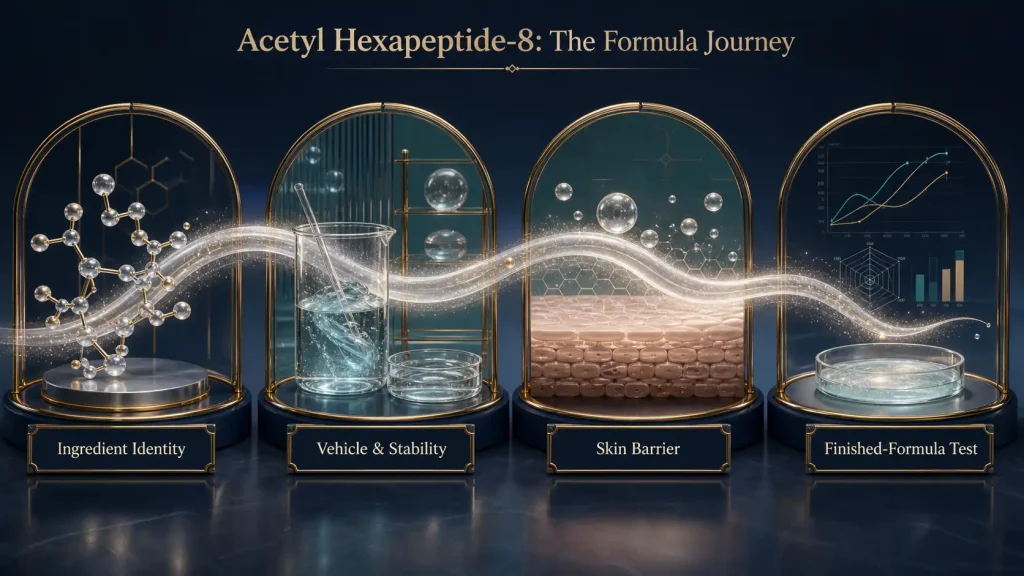
Peptides are generally hydrophilic and may face difficulty moving through the lipid-rich stratum corneum. A 2015 in-vitro study of Acetyl Hexapeptide-8 in an oil-in-water emulsion found that most of the applied material was removed during washing, most recovered peptide remained in the stratum corneum, and only a very small fraction reached human epidermis; none was detected in the dermis or receptor fluid under those test conditions.[5]
This was an in-vitro penetration experiment using excised skin, not a consumer efficacy trial. It should not be translated into “the ingredient cannot work,” because surface residence, vehicle effects and other cosmetic pathways may still influence appearance. It does show why delivery assumptions must be tested instead of inferred from an ingredient mechanism. Vehicle design, solubility, peptide stability, preservative compatibility and packaging are part of efficacy planning.
Acetyl Hexapeptide-8 as a Formula-Specific Case Study
Acetyl Hexapeptide-8, commonly associated with the trade name Argireline, is used in expression-line formulation concepts. A randomized placebo-controlled study of 60 subjects evaluated an Acetyl Hexapeptide-8 formulation around the eyes for four weeks and reported improvement in objective skin-roughness measurements compared with placebo.[4] The study also reported a higher subjective response rate in the active group, but that figure should remain attached to this specific protocol.
The responsible interpretation of Acetyl Hexapeptide-8 evidence is therefore neither “Botox in a bottle” nor “delivery is impossible.” It is that this peptide has a plausible expression-line rationale and some formula-specific human data, while skin delivery and finished-product performance remain formulation questions. It should not be presented as equivalent to an injectable neuromodulator.
For B2B development, Skinkind Cosmetics supplies Acetyl Hexapeptide-8 in powder and solution formats through the Genopep peptide portfolio. Format selection should follow the intended manufacturing process, target active content, stability plan and supplier technical documentation rather than a marketing headline alone.[8]
Peptides vs Retinol for Wrinkles
The question “retinol vs peptides for wrinkles” is not best answered by declaring one universal winner. Retinoids have a broader and more established dermatology evidence base for photoaging and mild fine lines, but they can cause dryness and irritation. Peptides are a diverse group whose tolerability and evidence vary by formula. They may support a differentiated concept, especially when a brand wants a routine that does not rely on retinol alone.
The comparison should consider evidence strength, target consumer, tolerance, format and testing plan. A product can contain both categories if the complete formula is compatible and stable, but the combination itself does not guarantee superior performance. Final claims still need finished-product support.
How Brands Should Evaluate Peptide Evidence
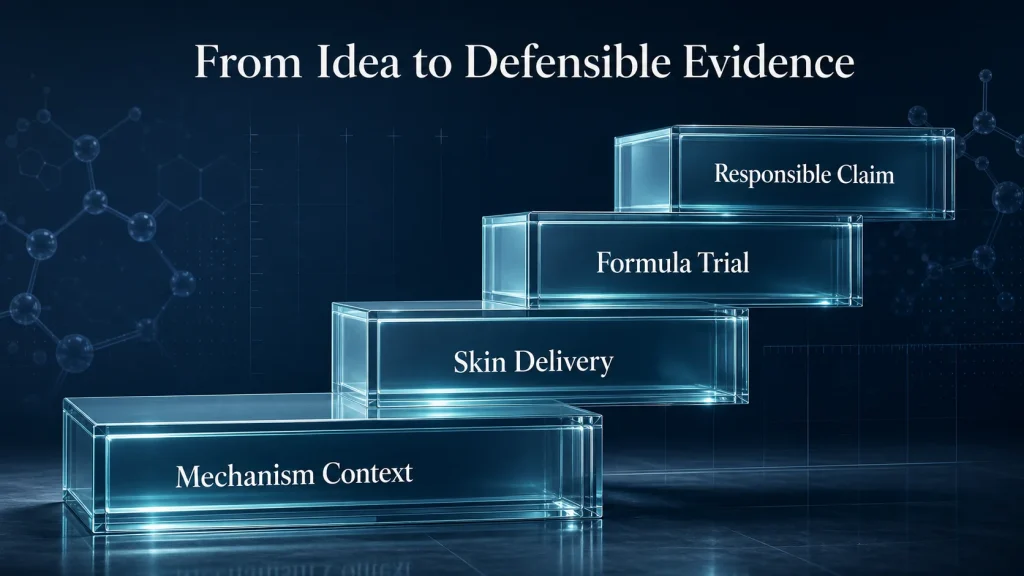
Before approving a peptide concept, a brand can use a simple evidence ladder:
1. Confirm identity: verify the INCI name, sequence or derivative, format and supplier specification.
2. Review mechanism: treat laboratory findings as biological context, not as a finished-product promise.
3. Assess delivery: examine solubility, stability, vehicle choice and any relevant penetration data.
4. Match human evidence: check whether the tested concentration, base, use pattern and target area resemble the planned product.
5. Test the finished formula: select instrumental, expert-grading or consumer methods that match the intended wording.
6. Audit the claim: state improvement in appearance without implying injection-like action or permanent wrinkle removal.
What Can Cosmetic Science Reasonably Claim?
In the United States, the FDA distinguishes cosmetic claims that affect appearance from claims to remove wrinkles or change body structure or function, which may place a product in drug or device territory.[7] Regulatory rules differ by market, but the evidence principle is consistent: the wording should not outrun the data.
More defensible language includes “helps reduce the appearance of fine lines,” “supports smoother-looking skin,” or “improves the look of expression lines,” when the finished product has suitable support. Riskier language includes “paralyzes facial muscles,” “works like Botox,” “rebuilds collagen” without direct substantiation, or “eliminates wrinkles.” A mechanism diagram should never be allowed to function as hidden clinical proof.
Product Development Implications
For a peptide serum for expression lines, start with the desired consumer-visible outcome, then work backward to ingredient identity, concentration, vehicle and test design. Request a current specification, COA, recommended processing conditions and stability guidance. If the product uses Genopep Acetyl Hexapeptide-8, the brand should still validate the final formula in its own package and intended use conditions.
Conclusion
So, do topical peptides work for wrinkles? Some do in specific, well-designed formulas, and several controlled studies justify continued development. The category does not support a blanket promise. The most credible peptide product connects verified raw material, thoughtful delivery, stable formulation, finished-product testing and carefully bounded cosmetic language.
Frequently Asked Questions
Do topical peptides work for wrinkles?
Some specific topical peptide formulas have improved wrinkle appearance or measurements in controlled studies. Results cannot be generalized to every peptide serum because the sequence, concentration, vehicle, stability and test design differ.
How do peptide serums help reduce expression lines?
Peptide serums may support smoother-looking skin through formula-specific biological and cosmetic pathways. For expression-line peptides such as Acetyl Hexapeptide-8, the proposed mechanism is useful context, but the final serum must demonstrate its own performance.
What peptides are good for wrinkles?
There is no single best peptide for every wrinkle product. Palmitoyl pentapeptide and Acetyl Hexapeptide-8 have published formula-specific human data, but selection should also consider target claim, compatibility, stability, supplier quality and the planned finished-product test.
Can peptides get rid of smile lines?
Cosmetic peptide products should not promise to eliminate smile lines. A supported formula may help make some lines look less noticeable, but deeper persistent folds involve multiple structural and movement-related factors beyond ordinary topical skincare.
Which is better for wrinkles, retinol or peptides?
Retinoids have a broader evidence base for photoaging and mild fine lines, while peptide evidence is more ingredient- and formula-specific. The better option depends on tolerance, product format, target consumer and the quality of the finished-product evidence.
CTA
Explore Acetyl Hexapeptide-8 for evidence-aware peptide skincare formulation concepts.
References
1. Al-Hamdani M, et al. Effects of Oral and Topical Collagen-Based Peptides on Skin Aging: A Systematic Review and Meta-Analysis. 2026. https://pmc.ncbi.nlm.nih.gov/articles/PMC13037056/
2. Garre A, et al. Efficacy and Tolerability of a Line-Targeting Peptide Serum: A Randomized, Double-Blind, Placebo-Controlled Study. Journal of Clinical and Aesthetic Dermatology. 2021. https://pubmed.ncbi.nlm.nih.gov/34188744/
3. Robinson LR, et al. Topical Palmitoyl Pentapeptide Provides Improvement in Photoaged Human Facial Skin. International Journal of Cosmetic Science. 2005/2008 PubMed record. https://pubmed.ncbi.nlm.nih.gov/18492182/
4. Wang Y, et al. The Anti-Wrinkle Efficacy of Argireline, a Synthetic Hexapeptide, in Chinese Subjects: A Randomized, Placebo-Controlled Study. American Journal of Clinical Dermatology. 2013. https://pubmed.ncbi.nlm.nih.gov/23417317/
5. Kraeling MEK, et al. In Vitro Skin Penetration of Acetyl Hexapeptide-8 from a Cosmetic Formulation. Cutaneous and Ocular Toxicology. 2015. https://pubmed.ncbi.nlm.nih.gov/24754410/
6. Acetyl Hexapeptide-8 in Cosmeceuticals—A Review of Skin Delivery and Evidence. 2025. https://pubmed.ncbi.nlm.nih.gov/40565185/
7. U.S. Food and Drug Administration. Wrinkle Treatments and Other Anti-Aging Products. https://www.fda.gov/cosmetics/cosmetic-products/wrinkle-treatments-and-other-anti-aging-products
8. Skinkind Cosmetics. Acetyl Hexapeptide-8 (CAS 616204-22-9) Anti-Wrinkle and Firming Peptides. https://www.skinkindcosmetics.com/products/product/cosmetic-peptide/facial-care/anti-wrinkle-firming/acetyl-hexapeptide-8-cas-616204-22-9-anti-wrinkle-and-firming-peptides/