Professional Cosmetics Peptide Supplier | GENOPEP



GHK vs GHK-Cu: What Changes When the Tripeptide Binds Copper?
GHK is the tripeptide Gly-His-Lys, while GHK-Cu is its copper complex, identified in cosmetics as Copper Tripeptide-1. When GHK binds copper, the peptide sequence remains GHK, but the material gains a different chemical identity, coordination structure, blue optical signature, solution behavior, and analytical requirements. Copper binding does not automatically prove better penetration or stronger finished-product efficacy.
Introduction
The distinction between GHK and GHK-Cu is often compressed into one sentence: “GHK-Cu is GHK with copper.” That is directionally correct, but too simple for ingredient selection, formulation, quality control, or claims. A metal–peptide complex is not merely a free peptide placed next to copper in a formula.
GHK can coordinate Cu(II) through several donor atoms in the peptide. The resulting complex has a defined coordination environment and its own spectral and solution behavior.[2,3] The exact species present can also depend on pH, ratios, competing ligands, and the test environment.[2,3]
For cosmetic product teams, the practical question is therefore not only whether the name contains “Cu.” Teams need to confirm which chemical form is supplied, how it is measured, whether it remains suitable in the intended formula, and what evidence supports the final product.
GHK and GHK-Cu Are Related but Distinct Ingredients
The Cosmetic Ingredient Review assessment defines Tripeptide-1 as the synthetic peptide Gly-His-Lys and Copper Tripeptide-1 as a complex formed by copper and Tripeptide-1.[1] This is the cleanest terminology for cosmetic work:
| Question | GHK / Tripeptide-1 | GHK-Cu / Copper Tripeptide-1 |
| Core peptide sequence | Gly-His-Lys | Gly-His-Lys coordinated to copper |
| Chemical form | Uncomplexed peptide ligand | Metal–peptide complex |
| Typical visual cue | Commonly pale or colorless in solution, depending on supplied form | Characteristic blue to deep-blue material or solution |
| Identity question | Is the intended GHK sequence present? | Are the intended peptide, copper, and complex-related specifications met? |
| Main formulation focus | Solubility, degradation, vehicle release, and delivery | Those issues plus metal binding, oxidation, color, pH, and competing ligands |
| Cosmetic evidence | Must match the tested GHK material and formula | Must match the tested GHK-Cu material and formula |
The terms should not be exchanged casually in specifications, INCI lists, purchase orders, or study summaries. A paper testing GHK is not automatically evidence for GHK-Cu, and a GHK-Cu study does not automatically substantiate an uncomplexed Tripeptide-1 formula.
What Changes When GHK Binds Copper?
1. The Coordination Structure Changes
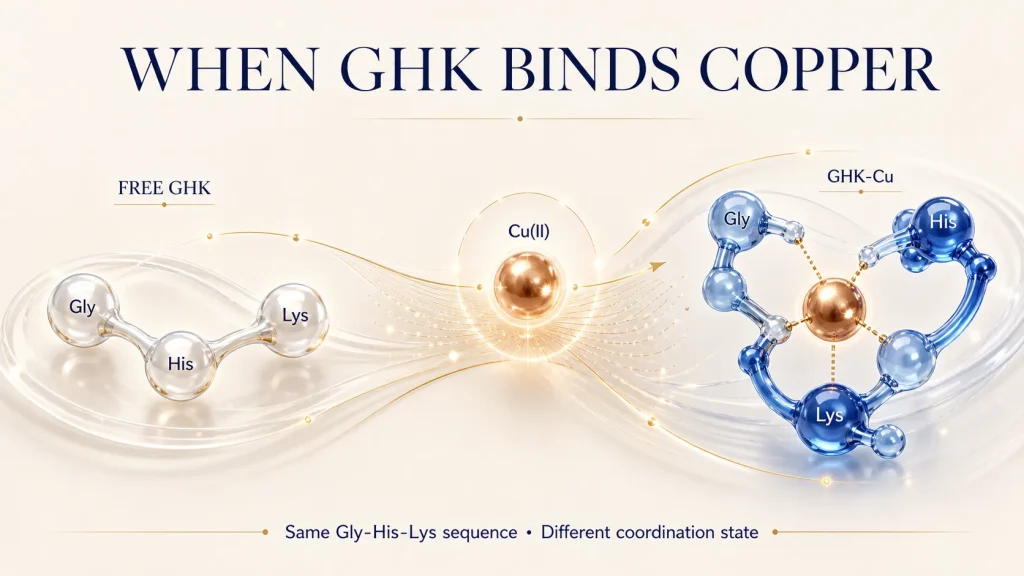
Structural studies show that GHK acts as a multidentate ligand for Cu(II). The metal is coordinated through peptide nitrogen donors, including the histidine imidazole environment, creating a geometry that differs from free GHK.[2,3] This changes how the material should be described and analyzed.
The intended ingredient is commonly discussed as a GHK-to-copper complex, and equimolar preparation is described in the CIR report.[1] Experimental work has also demonstrated 1:1 copper binding under defined conditions.[8] Solution chemistry can nevertheless include more than one species under some conditions. “GHK-Cu” identifies the ingredient concept; it does not eliminate the need to define the analytical and formulation context.
2. The Material Gains a Copper-Related Optical Signature
Copper Tripeptide-1 is associated with blue to deep-blue color because the coordinated copper complex absorbs visible light differently from free GHK. The CIR manufacturing description refers to a 600 nm absorbing fraction and dark blue-purple crystals.[1] Color is therefore a useful observation, but it is not a complete identity or potency test.
A blue sample can still vary in peptide assay, copper content, counterions, water, impurities, degradation products, or species distribution. A color shift may trigger investigation, while unchanged color cannot by itself prove that the complex remains fully intact and available.
3. Charge, Speciation, and Exchange Behavior Become Relevant
Binding copper changes the charge distribution and coordination state of the peptide. Studies of GHK-Cu have reported pH-dependent equilibria, different stoichiometries, and copper-exchange behavior.[2,3] Work involving serum albumin also demonstrates that copper-bound GHK can participate in more complex biological coordination environments.[7]
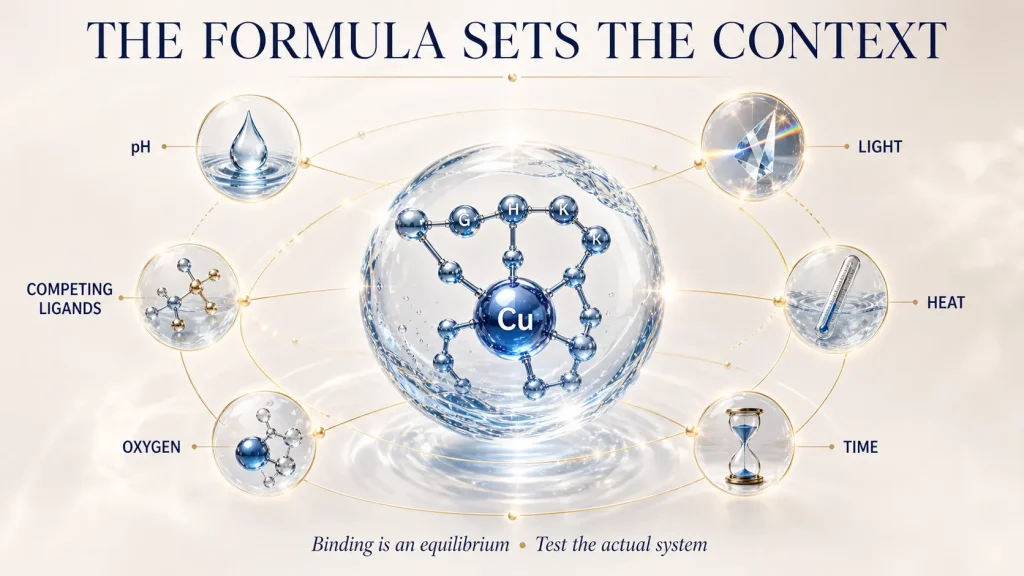
This does not mean the bond simply “breaks” whenever another active is present. It means that pH, ligand strength, ratios, order of addition, ionic environment, oxidation state, and time can matter. Compatibility must be tested in the actual formulation.
4. The Biological Interpretation Changes—but Not in One Direction
GHK and GHK-Cu are both discussed in biological research, and some models directly compare them. In one fibroblast study, GHK, GHK-Cu, and copper ions all altered IGF-2-dependent TGF-β1 secretion under the reported cell-culture conditions.[6] Earlier complex-formation work suggested that copper complexation was important for a specific growth-factor model.[2]
These findings show why chemical form matters. They do not establish a universal conclusion that GHK-Cu is stronger for every pathway, concentration, topical vehicle, or visible skin endpoint. Mechanistic differences should generate testable hypotheses, not automatic marketing rankings.
What Does Not Change?
The three-amino-acid sequence remains Gly-His-Lys. Copper coordination does not turn GHK into a different peptide sequence, a longer peptide, or a palmitoylated derivative. Copper Tripeptide-1 is also different from simply adding an unspecified copper salt to a Tripeptide-1 formula.
The evidence boundary also remains unchanged. Ingredient identity and cell research do not prove a visible benefit for every serum or cream. Both GHK and GHK-Cu require suitable formulation, stability, delivery, safety, and finished-product substantiation.
Does Copper Stay Bound to GHK in a Formula?
No universal yes-or-no answer applies to every formula. Metal–ligand binding is an equilibrium process. GHK has a strong affinity for Cu(II), but solution studies demonstrate that pH, competing ligands, and the wider molecular environment can influence species and exchange.[2,3,7]
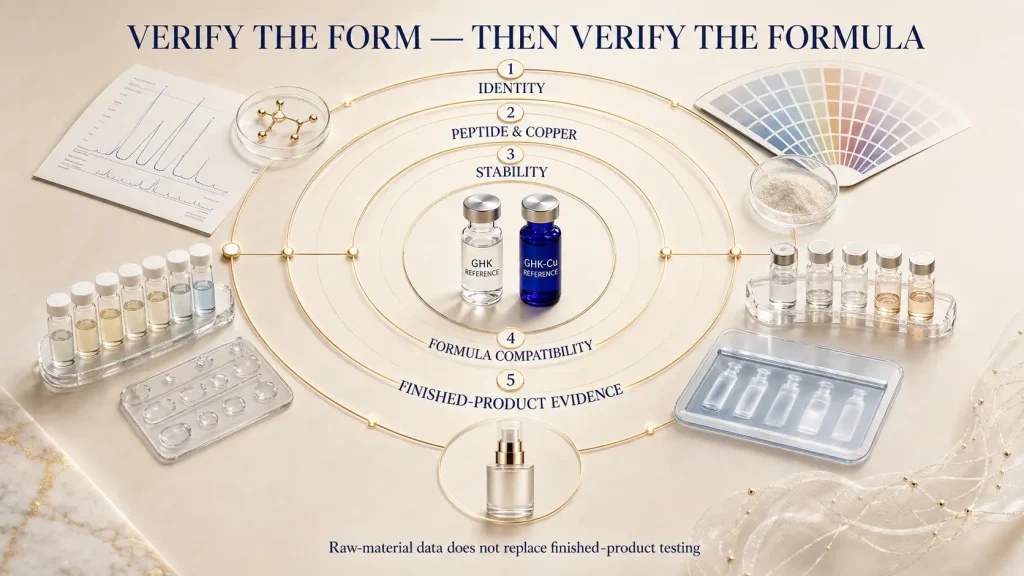
A development program should therefore test the intended formula rather than rely only on a raw-material certificate. Useful work can include stress stability, color and spectral monitoring, peptide assay, copper measurement, degradation profiling, packaging compatibility, and a method capable of distinguishing the question the team actually needs to answer.
Preformulation research found GHK-Cu to be highly hydrophilic and susceptible to degradation under basic and oxidative stress, while also reporting stability in water and pH 4.5–7.4 buffers under that study’s accelerated conditions.[4] Those results are useful development clues, not a universal shelf-life or compatibility guarantee.
Does Copper Binding Improve Skin Delivery?
Copper binding does not by itself prove superior topical penetration. GHK-Cu remains highly hydrophilic, and delivery depends on the vehicle, concentration basis, pH, skin model, exposure time, and analytical method.[4] An in-vitro human-skin study detected Copper Tripeptide-1 in different skin layers under its defined conditions, but that finding cannot be transferred to every formula.[5]
When comparing GHK vs GHK-Cu, teams should use the same vehicle, equivalent and clearly defined content basis, the same model, and the same endpoint. Comparing results from unrelated papers is not equivalent to a head-to-head formulation study.
How Should Product Teams Choose Between GHK and GHK-Cu?
| Development Question | Choose GHK for Evaluation When… | Choose GHK-Cu for Evaluation When… |
| Ingredient concept | The project specifically needs uncomplexed Tripeptide-1 | The project specifically needs Copper Tripeptide-1 identity and a copper-complex rationale |
| Formula appearance | A colorless or pale system is important | Blue color is acceptable or useful to the concept |
| Analytical capability | The team can verify peptide identity, content, and stability | The team can also evaluate copper-related specifications, complex behavior, and color change |
| Compatibility program | The base is being screened for peptide stability and delivery | The base is also being screened for metal-binding, oxidation, pH, and competing-ligand effects |
| Claim plan | Claims will be based on the tested GHK finished formula | Claims will be based on the tested GHK-Cu finished formula |
Skinkind Cosmetics currently lists Copper Tripeptide-1 powder as blue to deep blue with HPLC purity options of at least 95% or 98%, and a customizable blue solution with peptide content from 1,000 to 50,000 ppm.[12] HPLC purity, peptide content, copper content, solution concentration, and finished-formula use level are different measurements and should not be substituted for one another.
Cosmetic Claim Boundaries
In the United States, claims to treat disease or affect body structure or function can cause a cosmetic to be regulated as a drug.[10] European common criteria also require adequate, verifiable support and state that ingredient properties should not be transferred misleadingly to a finished product.[11]
| Overstated Message | More Defensible Cosmetic Direction |
| GHK-Cu is a stronger version of GHK | GHK-Cu is the copper-complexed form of the GHK tripeptide |
| Copper binding guarantees better penetration | Delivery depends on the material, vehicle, model, conditions, and method |
| GHK-Cu rebuilds collagen better than GHK | Compare exact formulas using matched, finished-product endpoints |
| Blue color proves full biological activity | Use color as an observation and verify identity, content, stability, and complex-related specifications |
| GHK-Cu heals damaged skin | Use a substantiated appearance or skin-conditioning endpoint appropriate for cosmetics |
Conclusion
GHK and GHK-Cu share the same Gly-His-Lys peptide sequence, but copper coordination creates a distinct ingredient identity with different color, charge distribution, solution behavior, formulation variables, and analytical control needs. The practical comparison is therefore not “which name sounds more advanced,” but which chemical form matches the intended formula, test method, evidence package, and cosmetic claim plan.
CTA
If your team is comparing GHK vs GHK-Cu, begin by fixing the intended chemical identity and the question the formula must answer. Genopep and Skinkind Cosmetics can provide current Copper Tripeptide-1 powder or customizable solution information and relevant technical documents. Request the applicable TDS, batch COA, SDS, sample, peptide-content basis, and copper-related data, then verify compatibility, stability, delivery, safety, cost-in-use, and finished-product performance before finalizing claims.
Review Skinkind Cosmetics Copper Tripeptide-1 Formats and Request Technical Documents
Frequently Asked Questions
1. Is GHK the same as GHK-Cu?
No. GHK is the uncomplexed Gly-His-Lys tripeptide. GHK-Cu is the copper complex of that peptide. They share the GHK sequence but have different chemical identities and formulation requirements.
2. Is Copper Tripeptide-1 the same as GHK-Cu?
In cosmetic ingredient terminology, Copper Tripeptide-1 is the complex formed by copper and Tripeptide-1, the GHK sequence.[1] Supplier specifications and batch documents should still confirm the supplied form, content basis, and applicable identity information.
3. What happens when GHK binds copper?
GHK coordinates Cu(II) to form a metal–peptide complex with a different coordination environment, blue optical signature, charge distribution, solution behavior, and analytical control needs. The Gly-His-Lys peptide sequence itself remains related across both forms.
4. Is GHK-Cu better than GHK?
There is no universal ranking. The answer depends on the target endpoint, chemical form, content basis, vehicle, delivery, stability, safety, comparator, and finished-product evidence. Copper complexation creates a different research and formulation profile, not an automatic performance advantage.
5. Can you get GHK-Cu naturally?
GHK occurs in human biological fluids and can bind copper in biological environments.[7,9] That biological occurrence should not be used to label every commercial Copper Tripeptide-1 material or finished formula “natural.” Cosmetic raw materials are manufactured and standardized, and their origin and claim status require supplier documentation and market-specific review.
References
1. Johnson W Jr, Bergfeld WF, Belsito DV, et al. Safety Assessment of Tripeptide-1, Hexapeptide-12, Their Metal Salts and Fatty Acyl Derivatives, and Palmitoyl Tetrapeptide-7 as Used in Cosmetics. International Journal of Toxicology. 2018;37(Suppl 3):90S-102S. CIR safety assessment
2. Conato C, Gavioli R, Guerrini R, et al. Copper Complexes of Glycyl-Histidyl-Lysine and Two of Its Synthetic Analogues: Chemical Behaviour and Biological Activity. Biochimica et Biophysica Acta. 2001;1526(2):199-210. PubMed record
3. Hureau C, Eury H, Guillot R, et al. X-ray and Solution Structures of Cu(II) GHK and Cu(II) DAHK Complexes: Influence on Their Redox Properties. Chemistry—A European Journal. 2011;17(36):10151-10160. PubMed record
4. Badenhorst T, Svirskis D, Wu Z. Physicochemical Characterization of Native Glycyl-L-Histidyl-L-Lysine Tripeptide for Wound Healing and Anti-Aging: A Preformulation Study for Dermal Delivery. Pharmaceutical Development and Technology. 2016;21(2):152-160. PubMed record
5. Mazurowska L, Mojski M. Human Skin Penetration of a Copper Tripeptide In Vitro as a Function of Skin Layer. Skin Pharmacology and Physiology. 2010;23(5):266-271. PubMed record
6. Gruchlik A, Chodurek E, Dzierzewicz Z. Effect of GLY-HIS-LYS and Its Copper Complex on TGF-β Secretion in Normal Human Dermal Fibroblasts. Acta Poloniae Pharmaceutica. 2014;71(6):954-958. PubMed record
7. Bossak-Ahmad K, Bal W, Frączyk T, Drew SC. Ternary Cu2+ Complexes of Human Serum Albumin and Glycyl-L-Histidyl-L-Lysine. Inorganic Chemistry. 2021;60(22):16927-16931. PubMed record
8. Hsiao CD, Wu HH, Malhotra N, et al. Expression and Purification of Recombinant GHK Tripeptides Are Able to Protect against Acute Cardiotoxicity from Exposure to Waterborne Copper in Zebrafish. Biomolecules. 2020;10(9):1202. PubMed record
9. Pickart L, Vasquez-Soltero JM, Margolina A. Regenerative and Protective Actions of the GHK-Cu Peptide in the Light of the New Gene Data. International Journal of Molecular Sciences. 2018;19(7):1987. PMC full text
10. U.S. Food and Drug Administration. Cosmetics Labeling Claims. FDA guidance
11. European Commission. Commission Regulation (EU) No 655/2013 Laying Down Common Criteria for the Justification of Claims Used in Relation to Cosmetic Products. EU regulation
12. Skinkind Cosmetics / GENOPEP. Copper Tripeptide-1 (CAS: 49557-75-7) Anti-Aging Peptides. Product page