Professional Cosmetics Peptide Supplier | GENOPEP



GHK-Cu vs Matrixyl: How Copper Peptides and Signal-Peptide Systems Differ
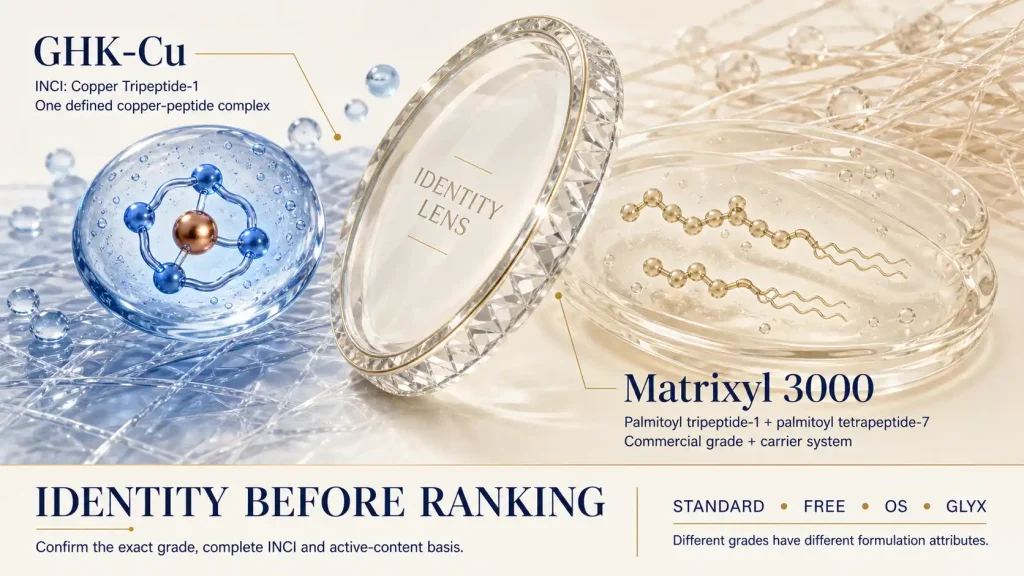
GHK-Cu vs Matrixyl is not a comparison between two equivalent single peptides. GHK-Cu is a defined copper complex of the tripeptide Gly-His-Lys and is listed in cosmetics as Copper Tripeptide-1. Matrixyl is a trademarked family of peptide technologies; Matrixyl 3000, the version most often meant in this comparison, contains palmitoyl tripeptide-1 and palmitoyl tetrapeptide-7 in a commercial carrier system. GHK-Cu brings copper-coordination chemistry and a broad tissue-remodeling research history. Matrixyl 3000 is positioned as a two-matrikine signal-peptide system focused on extracellular-matrix support and visible wrinkle care. Neither is universally “better.” The right choice depends on the product brief, target claims, supplier dossier, formula architecture, color and sensory limits, analytical capability, cost, and finished-product substantiation.
Introduction
Online answers to “Is Matrixyl or copper peptide better?” usually compress several decisions into one ranking. A formulator must first identify the exact material, then ask what biological story it supports, how it behaves in the target vehicle, and what evidence can legally and scientifically support the finished-product claim. A recognizable ingredient name does not remove those steps.
The naming issue is especially important here. Matrixyl, Matrixyl 3000, Matrixyl Synthe’6 and newer members of the Matrixyl range are not interchangeable names. Croda identifies Matrixyl 3000 as a liquid blend whose INCI list includes glycerin, water, butylene glycol, carbomer, polysorbate 20, palmitoyl tripeptide-1 and palmitoyl tetrapeptide-7; other grades and Matrixyl technologies have different compositions or delivery formats.[2] This article therefore uses “Matrixyl” as the family name and “Matrixyl 3000” when discussing that defined two-peptide system.
For GHK-Cu, the comparison refers to the cosmetic ingredient Copper Tripeptide-1. It is the copper complex of the GHK sequence, not uncomplexed GHK, palmitoyl tripeptide-1, or free copper.[1,4] Skinkind Cosmetics lists both powder and customizable solution formats, with the actual specification and content basis to be confirmed from the applicable TDS and batch COA.[3]
First Compare Identity, Not Marketing Labels
| Decision Point | GHK-Cu / Copper Tripeptide-1 | Matrixyl 3000 |
| What it is | A copper(II)-GHK coordination complex | A commercial system containing palmitoyl tripeptide-1 and palmitoyl tetrapeptide-7 plus a carrier base |
| Peptide logic | Copper-binding carrier/signaling peptide with tissue-remodeling biology | Two palmitoylated signal peptides presented as a matrikine association |
| INCI reading | Copper Tripeptide-1 | Read the complete grade-specific INCI; the standard grade includes both peptide INCI names and its carrier components |
| Visible formulation cue | Characteristic blue color can influence the finished-product appearance | Commercial liquid grades vary; they do not provide the same copper-blue identity |
| Core development question | Can the copper-peptide complex remain defined and stable in this formula? | Is this the correct Matrixyl grade and carrier system for the target vehicle and claim package? |
How Their Biological Stories Differ
GHK-Cu: Copper Coordination and Remodeling Biology
Structural studies show that GHK binds Cu(II) through a defined coordination environment, and that this metal-binding state affects redox behavior.[4,5] Reviews of the GHK-Cu literature describe effects across fibroblast activity, extracellular-matrix synthesis and turnover, inflammatory signaling, antioxidant defense and tissue remodeling.[6,8] That breadth is commercially attractive, but it also creates a discipline requirement: results from cell, wound, gene-expression or medical research cannot automatically become finished-cosmetic efficacy claims.
Skin delivery is another practical constraint. An in-vitro human-skin study detected copper tripeptide penetration across skin layers, while later reviews and delivery-system work still identify permeability and stability as formulation-dependent challenges.[6,7] The presence of a promising mechanism does not prove that every serum delivers the same amount to the same site.
Matrixyl 3000: Two Palmitoylated Signaling Peptides
Palmitoyl tripeptide-1 is the palmitoylated form of the GHK sequence, while palmitoyl tetrapeptide-7 contains the GQPR sequence. Palmitoylation adds a lipid chain intended to improve affinity for the lipid-rich skin barrier and support topical delivery.[1,9] The two peptides are discussed as signaling or matrikine-type peptides rather than as a copper-delivery complex. Their development story focuses on communicating extracellular-matrix repair signals, not on reproducing GHK-Cu’s metal-coordination chemistry.
The distinction also prevents a frequent naming error. Palmitoyl pentapeptide-4 is associated with the original Matrixyl technology and has published controlled topical data, but it is not one of the two peptide INCI ingredients in standard Matrixyl 3000.[2,10] Evidence for one Matrixyl-family member should not be silently transferred to another member or to an unrelated finished formula.
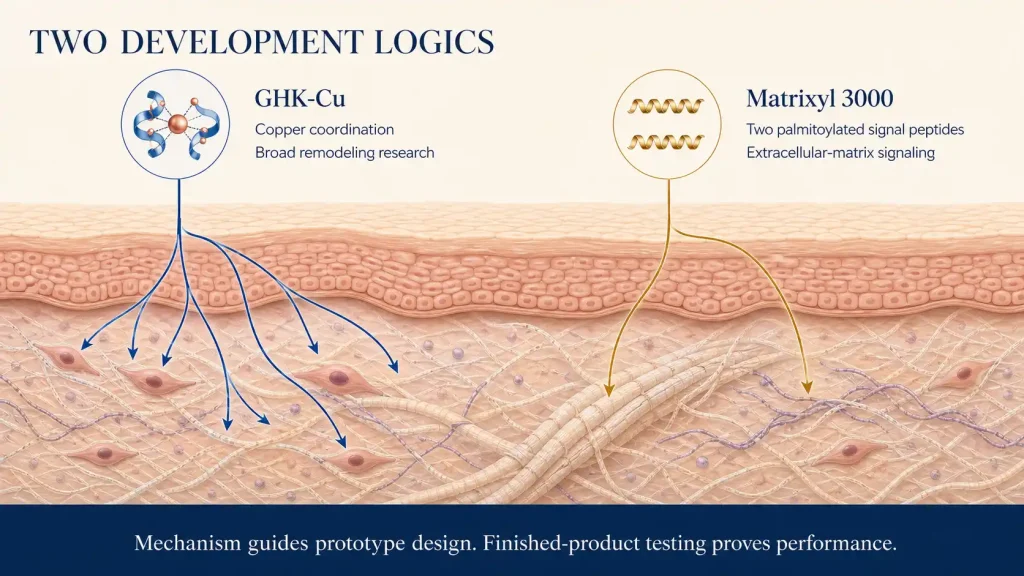
Figure 2. The two systems support different development stories: copper coordination and remodeling biology for GHK-Cu, versus palmitoylated extracellular-matrix signaling for Matrixyl 3000.
What the Evidence Can and Cannot Prove
GHK-Cu has a comparatively broad scientific literature, but much of it is mechanistic, preclinical, wound-related or based on reviews that combine different models and formulations.[6-8] Matrixyl 3000 has an identifiable supplier dossier and published discussion of its component peptides, yet reviews note that a significant share of cosmetic-peptide evidence remains in patents and supplier materials rather than independent randomized trials.[9,11] A commercial finished-product trial containing palmitoyl oligopeptide and palmitoyl tetrapeptide-7 reported dermal biomarker and longer-term appearance findings, but the tested product also contained several other actives; it does not isolate Matrixyl 3000 as the sole cause.[12]
The practical conclusion is not that one evidence package is “strong” and the other “weak.” They answer different questions. Ingredient-mechanism evidence supports concept selection and test design. Supplier studies can support a specific commercial ingredient when their formulation, dose, population, comparator and endpoint are understood. Only finished-product testing supports the performance wording of the formula that a brand will actually sell.
GHK-Cu vs Matrixyl: Which Fits the Product Brief?
| Product-Development Priority | More Natural Starting Point | Why | What Still Requires Validation |
| A recognizable blue copper-peptide concept | GHK-Cu | Defined Copper Tripeptide-1 identity and characteristic color | Complex integrity, color stability, compatibility, package and finished claims |
| A two-signal-peptide anti-wrinkle platform | Matrixyl 3000 | Palmitoyl tripeptide-1 plus palmitoyl tetrapeptide-7 with a supplier claim package | Correct grade, carrier fit, active basis, stability and finished-product performance |
| Broad repair/remodeling research narrative | GHK-Cu | Larger literature across copper binding and tissue-remodeling biology | Cosmetic relevance and claim substantiation for the actual product |
| Low-color or color-controlled formula | Often Matrixyl 3000, grade dependent | Avoids the inherent blue identity of GHK-Cu | Grade color, odor, carrier and formula appearance still need review |
| Combining several peptide signals | Either, or both after testing | Different mechanisms may support a multi-pathway concept | No assumed synergy; assay, stability, safety and consumer testing are required |
Formulation and Quality-Control Differences
GHK-Cu introduces metal-complex questions that ordinary signal-peptide blends do not share to the same degree. Teams should define peptide content, copper-related specification, complex identity, pH range, competing ligands or chelators, oxidative and reductive stress, light exposure, packaging and color acceptance. Published preformulation work shows that GHK-Cu stability changes with stress conditions and selected excipients, so the complete system matters.[4,13]
For Matrixyl 3000, purchasing and R&D should identify the exact commercial grade rather than approve the word “Matrixyl” alone. The standard grade, preservative-free grade, oil-soluble grade and other versions have different carrier and formulation attributes.[2] Incoming documentation should state the complete INCI, active basis, recommended processing and use conditions, storage, analytical controls and grade-specific claim support. A supplier addition rate for the commercial blend is not the same as the concentration of each peptide active.
| QC Question | GHK-Cu / Copper Tripeptide-1 | Matrixyl 3000 or Another Matrixyl Grade |
| Identity | Confirm the copper-peptide complex, not only a peptide peak or blue color | Confirm exact trademarked grade and complete INCI composition |
| Content basis | Separate HPLC purity, peptide content and solution concentration where applicable | Separate commercial blend use level from individual peptide-active content |
| Formula watchpoints | pH, redox environment, chelators, ionic excipients, color, light and packaging | Carrier compatibility, solubility grade, process temperature, preservation and supplier-defined conditions |
| Claim file | Link mechanism and raw-material data to the tested material without overextending | Keep supplier substantiation grade-specific and distinguish it from finished-product proof |
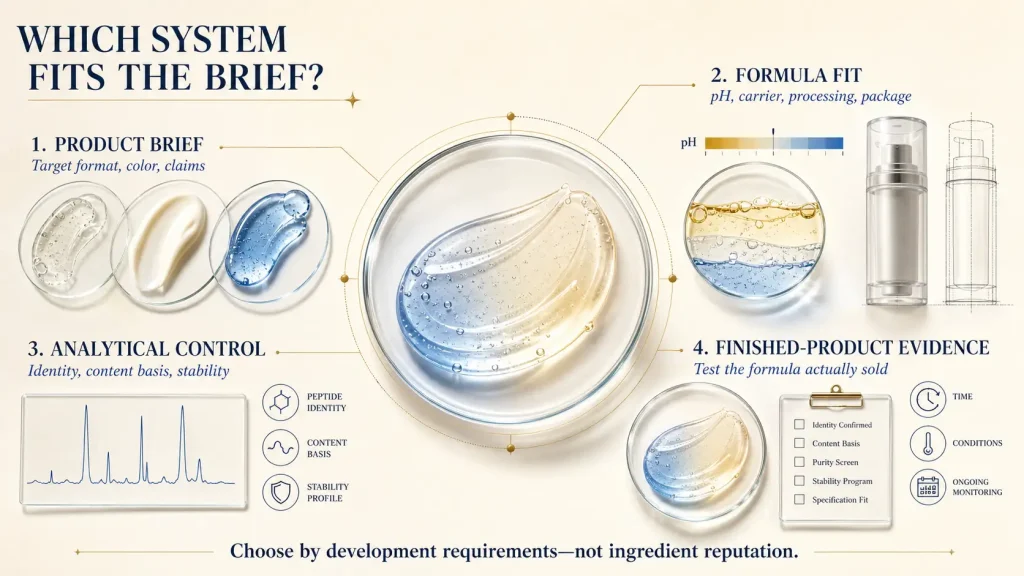
Can GHK-Cu and Matrixyl Be Used Together?
The chemistry does not justify a universal prohibition, and products containing multiple peptide types exist. However, a longer INCI list is not proof of better performance. A combined formula should define why both systems are needed, confirm that the Matrixyl grade and its carrier fit the GHK-Cu environment, and monitor both peptide systems with suitable analytical or surrogate endpoints. Stability controls should include appearance, pH, color, odor, viscosity, package compatibility, microbiology where relevant, and stability-indicating content or identity methods.
If the concept cannot articulate a distinct role for each ingredient, one well-characterized peptide system may produce a cleaner formula, clearer claim story and more interpretable test result. Combination should follow a hypothesis, not ingredient-list decoration.
Conclusion
GHK-Cu and Matrixyl 3000 are not interchangeable versions of the same peptide concept. GHK-Cu is a defined copper-peptide coordination complex whose development questions include complex identity, redox environment, color and stability. Matrixyl 3000 is a grade-specific commercial system built around palmitoyl tripeptide-1 and palmitoyl tetrapeptide-7, with carrier composition and supplier-defined processing conditions that must be read as part of the material. The useful comparison is therefore not “which name is stronger,” but which exact material fits the product brief and can be controlled in the intended formula.
Mechanism and raw-material data can justify a prototype and a test plan, but they cannot substitute for grade verification, formula compatibility, analytical control, stability work or finished-product substantiation. If both peptide systems are considered, each should have a defined role and the combination should be treated as a hypothesis to test rather than assumed synergy.
CTA
If your team is comparing GHK-Cu vs Matrixyl for a new serum, cream or eye-care concept, begin with the product brief rather than a winner-takes-all ingredient ranking. Genopep and Skinkind Cosmetics can provide current information on Copper Tripeptide-1 powder and customizable solution formats. Request the applicable TDS, batch COA, SDS, sample, peptide-content basis, copper-related specification and storage information, then benchmark the exact material against the selected Matrixyl grade in your target formula, package and claims program.
Review Skinkind Cosmetics Copper Tripeptide-1 Formats and Request Technical Documents
Frequently Asked Questions
1. Is Matrixyl or copper peptide better?
Neither is universally better. Choose GHK-Cu when a defined copper-peptide identity, blue visual cue and remodeling research story fit the brief. Choose a specific Matrixyl grade when its peptide composition, carrier and supplier substantiation better match the desired signal-peptide claim and formula. Compare finished prototypes, not ingredient reputations.
2. Can I use Matrixyl and copper peptides together?
Consumers should follow the directions of the finished products rather than mix raw materials. For product development, the combination is a testable formulation hypothesis, not an automatic incompatibility or guaranteed synergy. Validate the exact grades, concentrations, pH, vehicle, process, package and safety profile.
3. What is better than GHK-Cu?
“Better” needs an endpoint. Retinoids may have stronger evidence for some photoaging outcomes, while other peptides or delivery systems may fit a colorless, low-cost or highly targeted product better. None of those facts makes them a universal replacement for GHK-Cu. Define the target claim and comparator before ranking ingredients.
4. What should you not mix Matrixyl with?
There is no reliable universal blacklist for every Matrixyl product. The answer depends on the exact Matrixyl technology and grade, because carrier systems and processing requirements differ. Follow the current supplier TDS, then test pH, temperature, solvents, surfactants, preservatives, oxidation exposure and the complete finished formula.
5. Should I use Matrixyl day or night?
Signal peptides are not automatically restricted to one time of day. Use depends on the directions supplied for the finished product, its vehicle and accompanying actives. Daytime products still require an appropriate sunscreen step; neither Matrixyl nor GHK-Cu provides SPF.
References
1. Johnson W Jr, Bergfeld WF, Belsito DV, et al. Safety Assessment of Tripeptide-1, Hexapeptide-12, Their Metal Salts and Fatty Acyl Derivatives, and Palmitoyl Tetrapeptide-7 as Used in Cosmetics. International Journal of Toxicology. 2018;37(Suppl 3):90S-102S. Journal record
2. Croda Beauty. Matrixyl 3000: Product Composition, Grades and Formulation Attributes. Official product page
3. Skinkind Cosmetics / GENOPEP. Copper Tripeptide-1 (CAS: 49557-75-7) Anti-Aging Peptides. Product page
4. Hureau C, Eury H, Guillot R, et al. X-ray and Solution Structures of Cu(II) GHK and Cu(II) DAHK Complexes: Influence on Their Redox Properties. Chemistry – A European Journal. 2011;17(36):10151-10160. PubMed record
5. Conato C, Gavioli R, Guerrini R, et al. Copper Complexes of Glycyl-Histidyl-Lysine and Two of Its Synthetic Analogues: Chemical Behaviour and Biological Activity. Biochimica et Biophysica Acta. 2001;1526(2):199-210. PubMed record
6. Mortazavi SM, Mohammadi Vadoud SA, Moghimi HR. Topically Applied GHK as an Anti-Wrinkle Peptide: Advantages, Problems and Prospective. BioImpacts. 2025;15:30071. PMC full text
7. Mazurowska L, Mojski M. Human Skin Penetration of a Copper Tripeptide In Vitro as a Function of Skin Layer. Skin Pharmacology and Physiology. 2010;23(5):266-271. PubMed record
8. Pickart L, Vasquez-Soltero JM, Margolina A. Regenerative and Protective Actions of the GHK-Cu Peptide in the Light of the New Gene Data. International Journal of Molecular Sciences. 2018;19(7):1987. PMC full text
9. Resende DISP, Ferreira MS, Sousa-Lobo JM, Sousa E, Almeida IF. Usage of Synthetic Peptides in Cosmetics for Sensitive Skin. Pharmaceuticals. 2021;14(8):702. PubMed record
10. Robinson LR, Fitzgerald NC, Doughty DG, Dawes NC, Berge CA, Bissett DL. Topical Palmitoyl Pentapeptide Provides Improvement in Photoaged Human Facial Skin. International Journal of Cosmetic Science. 2005;27(3):155-160. PubMed record
11. Schagen SK. Topical Peptide Treatments with Effective Anti-Aging Results. Cosmetics. 2017;4(2):16. Journal article
12. Watson REB, Ogden S, Cotterell LF, et al. A Cosmetic Anti-Ageing Product Improves Photoaged Skin: A Double-Blind, Randomized Controlled Trial. British Journal of Dermatology. 2009;161(2):419-426. PMC full text
13. Badenhorst T, Svirskis D, Wu Z. Physicochemical Characterization of Native Glycyl-L-Histidyl-L-Lysine Tripeptide for Wound Healing and Anti-Aging: A Preformulation Study for Dermal Delivery. Pharmaceutical Development and Technology. 2016;21(2):152-160. PubMed record