Professional Cosmetics Peptide Supplier | GENOPEP



Copper Tripeptide-1 MOQ Explained: Matching Order Size to Your Development Stage
Copper Tripeptide-1 MOQ is not a universal property of the ingredient. It is a commercial condition attached to a defined form, specification, package, service scope and production route. The right order size changes from feasibility work to prototypes, pilot and stability studies, and commercial manufacturing. Buyers should compare the usable quantity, active-equivalent amount, lead time, storage window and inventory risk—not MOQ alone.
Introduction
“What is your Copper Tripeptide-1 MOQ?” looks like a simple purchasing question. In practice, it is incomplete until the supplier and buyer define what is being ordered. A powder sample, a standard powder pack, a 1% solution, a customized low-concentration solution and a commercial production batch can each have a different minimum, package increment and lead time.
The purchasing objective is not to obtain the smallest possible number. It is to secure enough suitable material for the current stage without creating avoidable reorders, expired inventory, storage pressure or cash tied up in a specification that may still change. This article discusses cosmetic-ingredient procurement only. It does not cover injectable products, medical reconstitution or consumer retail serum sizes.
MOQ Is an Operating Rule, Not a Universal Ingredient Property
An MOQ may be attached to a stock keeping unit, a standard package, a manufacturing batch, a custom-preparation service or a distributor’s order-processing rule. These are not interchangeable. One supplier may offer a small copper peptide sample but require a larger quantity for routine production. Another may sell a ready-made solution in several package sizes. A custom concentration may require a separate preparation minimum even when a standard item is available in a smaller pack.
| Supplier Offer | What the MOQ May Attach To | What the Buyer Must Confirm |
| Development sample | Sample policy, handling fee or limited stock allocation | Net quantity, specification, lot status, documents, shipping and whether the sample matches the later commercial item |
| Standard powder | Smallest standard vial or package, or the supplier’s routine order line | HPLC purity basis, net mass, package increment, batch COA, storage and lead time |
| Standard solution | Full solution mass in a listed package | Peptide content, complete carrier system, package size, preservation, storage and active-equivalent quantity |
| Custom preparation | Minimum practical preparation or filling batch | Target concentration, carrier, preservative, analytical scope, packaging, setup cost and lead time |
| Commercial supply | Production batch, case quantity, pallet configuration or supply agreement | Forecast, batch strategy, release timing, change control, delivery schedule and safety-stock responsibilities |
Public listings illustrate why no single number should be treated as the GHK-Cu MOQ for the whole market. One current marketplace listing for a specific 1.0% Copper Tripeptide-1 solution displays a sample size and larger 1 kg, 5 kg and 25 kg packs, with different per-kilogram prices.[2] Those package choices belong to that exact formulation and listing. They do not establish the Copper Tripeptide-1 minimum order quantity for powders, other solution concentrations or another supplier.
Four Development Stages Require Different Order Logic
1. Feasibility and Initial Screening
At the feasibility stage, the buyer needs enough material to confirm identity, handling, solubility or dispersion behavior, color impact and early formula compatibility. The quantity should also cover a justified repeat and a retained portion if the team intends to compare the same lot later. It should not be based on an uncertain annual sales forecast.
2. Prototype and Formula Optimization
Prototype work normally requires more than one beaker. The team may compare use levels, addition sequences, pH windows, preservative systems, packaging interactions or base-formula variants. Order planning should begin with the experimental matrix, batch mass and number of repeats, then add a controlled allowance for transfer and weighing loss.
3. Pilot, Stability, and Compatibility Work
Pilot-stage demand must cover the pilot batch plus the samples allocated to stability, microbiological assessment, packaging compatibility, analytical checks, retain samples and internal review. A small reorder during this stage can delay the program or introduce a second raw-material lot into a study that was intended to use one lot. The order should therefore reflect the full approved test plan, not only the pilot kettle charge.
4. Commercial Manufacturing
Commercial ordering starts from an approved formula and a credible production forecast. The buyer then considers manufacturing yield, campaign size, supply lead time, quality-release time, package increments, shelf-life or retest window, storage capacity, planned launches and a justified safety-stock policy. A peptide bulk order should be linked to an actual production schedule and change-control status, not only to the lowest price tier.

Why the Lowest MOQ Can Still Create Higher Total Cost
A very small order may reduce the first payment, but it can increase the cost of completing the current stage. Fixed charges for order processing, packaging, documentation, freight, customs work and incoming inspection are spread across less usable material. If the order is too small, a second purchase may repeat those costs and add another lead time.
The smallest package can also create a false comparison between powder and solution. The current Skinkind Cosmetics product page describes powder by HPLC purity options and solution by customizable peptide content from 1,000 ppm to 50,000 ppm; it lists 1 kg or 5 kg packages for solution and sample or customized packages for powder.[1] A kilogram of solution therefore cannot be compared with a kilogram of powder without converting to a stated active-equivalent basis.
Why Buying More for a Lower Unit Price Can Backfire
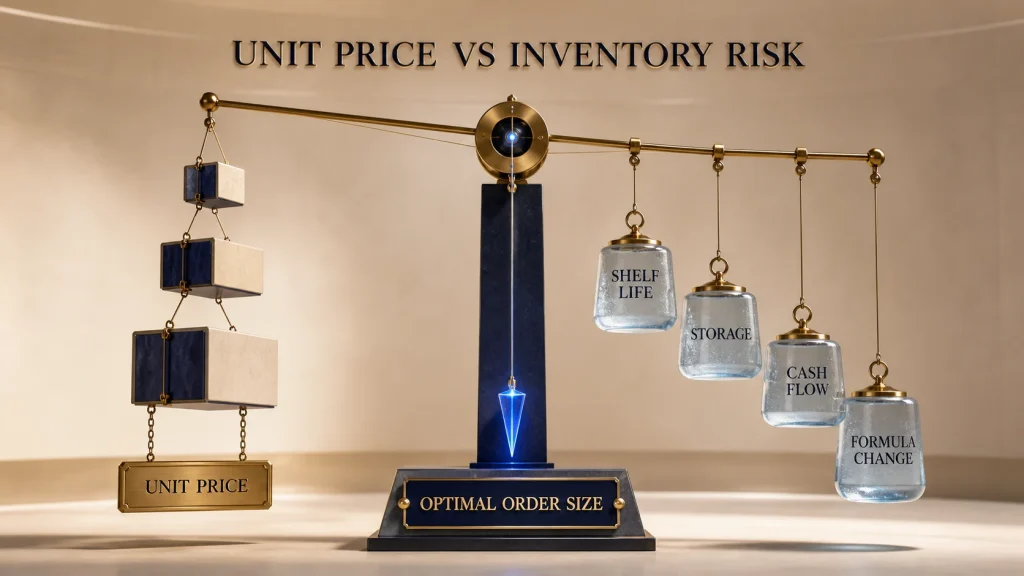
Larger packs may reduce the displayed unit price because some preparation, release, packing and order costs are distributed across more material. The saving is real only when the buyer can use the material under the required storage conditions and within its supported shelf-life or retest window. FDA notes that cosmetic shelf life varies with product type, use and storage, and that temperature, sunlight and air can change color, texture or odor.[5] Ingredient-specific storage and dating should follow the supplier dossier and the received batch documentation.
Excess inventory can create five avoidable risks: cash remains tied up, controlled storage space is consumed, a formula or claim direction may change, an approved supplier or specification may be revised, and multiple launches may need different raw-material lot strategies. A lower unit price does not compensate for material that cannot be used.
A Practical Order-Size Calculation
Start with the work the material must support. For a powder or other material whose planned addition is expressed as a mass fraction:
Planned ingredient need = total batch mass × intended use level × number of batches
Then adjust for realistic process loss and add only the quantities required by the approved plan for repeats, stability samples, retains, incoming checks or contingency. Do not add a large arbitrary safety factor merely because the ingredient is difficult to source.
For a solution, calculate both solution mass and nominal active-equivalent amount. If peptide content is stated in ppm by mass:
Nominal active-equivalent grams = solution mass in kilograms × peptide content in ppm ÷ 1,000
This arithmetic is a planning tool. It does not replace a batch COA, correct for method uncertainty or prove finished-formula performance. It helps the buyer determine whether the listed pack and the intended use level are commercially coherent.
Before rounding the calculated need up to a supplier pack size, check five boundaries: the smallest package increment, available lot quantity, order lead time, usable storage window and whether future work must remain on the same raw-material lot. The final order quantity should be documented as a project decision rather than remembered as a habit.
What Good Peptide Procurement Planning Protects
Good peptide procurement planning protects both development continuity and quality control. ISO 22716 addresses the production, control, storage and shipment quality aspects of cosmetics.[3] Health Canada likewise highlights controlled storage and handling of raw materials, examination or testing against defined standards, and records for raw materials, manufacturing, finished products and distribution.[4] These principles support a quantity decision that considers material control after delivery, not only the act of buying it.
For early projects, this may mean choosing a smaller pack that preserves flexibility. For a locked commercial formula, it may mean consolidating demand to reduce reorder and lot-change risk. The same cosmetic peptide MOQ can be sensible for one project and unsuitable for another because the surrounding development and supply conditions differ.
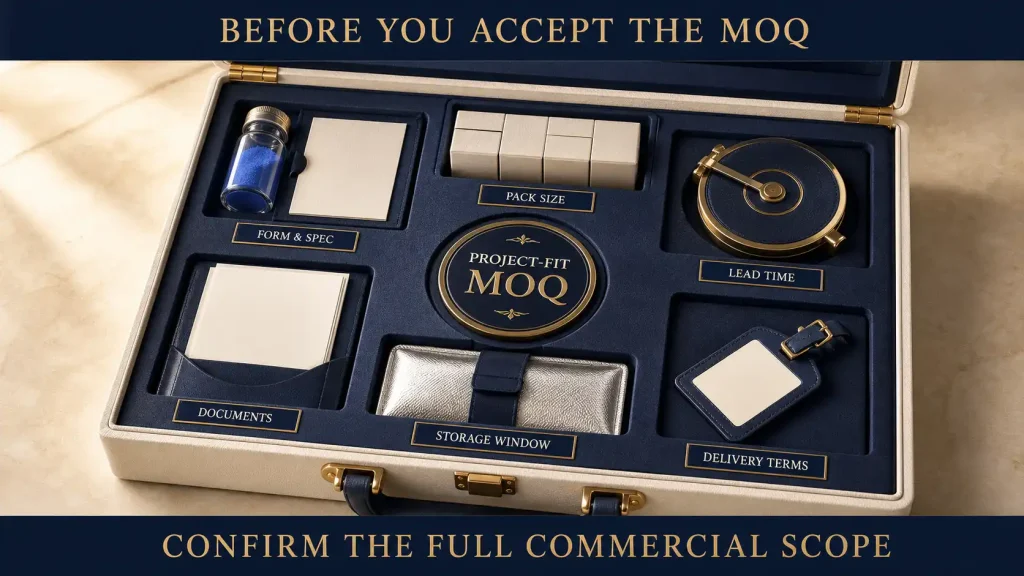
Questions to Send Before Accepting an MOQ
- Form and specification: Is the offer powder or solution? What identity, purity or peptide-content basis applies, and what batch acceptance items will appear on the COA?
- MOQ and package increment: Is the minimum tied to a sample, standard pack, custom preparation, filling batch, case quantity or production batch? Can the order be split into scheduled deliveries?
- Active-equivalent quantity: For a solution, what peptide content and full carrier composition apply? How much nominal peptide is present in one package on the declared basis?
- Lead time and lot status: Is the material in stock, allocated from an existing lot or made to order? Does lead time include production, testing, release and export preparation?
- Documents and change control: Which TDS, SDS, COA, traceability and market-specific statements are included? How are specification, method, site or composition changes communicated?
- Storage, dating and delivery: What unopened storage condition, shelf-life or retest window, packaging protection, shipping condition, destination term and quotation validity apply?
Frequently Asked Questions
1. What is the MOQ for Copper Tripeptide-1?
There is no universal Copper Tripeptide-1 MOQ. The minimum depends on the supplier, powder or solution form, specification, concentration, standard package, stock status, custom-preparation requirements and service scope. Ask for a project-specific quote that identifies exactly what the minimum applies to.
2. Can I request a copper peptide sample below the commercial MOQ?
Often a supplier has a separate sample policy, but availability, fee, specification, document package and shipping are supplier-specific. Confirm that the copper peptide sample represents the same material or commercial route you expect to purchase later; otherwise, successful testing may not transfer cleanly to the commercial item.
3. Is powder MOQ comparable with solution MOQ?
Not by package mass alone. Powder is commonly specified by an analytical purity basis, while solution is specified by peptide content plus a carrier system. Compare the nominal active-equivalent quantity, full composition, usable pack size, handling needs, storage and landed cost.
4. Should I buy commercial volume during early formulation?
Usually only when the formula, specification, supplier route and demand are sufficiently stable to justify the inventory. Early development benefits from flexibility because use level, carrier, color tolerance, preservation, target market or formula architecture may change. Use the approved experiment plan and near-term milestone—not a speculative launch forecast—to size the early order.
5. What should an MOQ quote include?
An MOQ quote should identify the exact product form and specification, package size and increment, minimum quantity, unit basis, quantity breaks, stock or make-to-order status, lead time, included documents, storage and dating, delivery term, payment terms, quotation validity, customization and exclusions. This makes competing offers commercially comparable.
CTA
If your team is planning a Copper Tripeptide-1 order, send Skinkind Cosmetics the required form, specification or concentration, application, development stage, calculated need, target market, document list, destination and desired timing. Genopep can then confirm available sample, powder or solution options and prepare a project-specific commercial scope. The resulting MOQ should be treated as the minimum for that defined offer—not as a universal rule for the ingredient.
Review Copper Tripeptide-1 formats and request a project-specific MOQ
References
1. Skinkind Cosmetics / GENOPEP. Copper Tripeptide-1 (CAS: 49557-75-7) Product Information: powder and solution specifications, peptide-content range, packaging and storage. Product page
2. CM Studio+. SpecPed GHK-Cu 1.0% Copper Peptide Solution marketplace listing: composition, sample size and pack-size example. Last updated April 27, 2026; accessed August 2026. Marketplace listing
3. International Organization for Standardization. ISO 22716:2007 Cosmetics – Good Manufacturing Practices (GMP) – Guidelines on Good Manufacturing Practices. Current version confirmed in 2022. ISO record
4. Health Canada. Good Manufacturing Practices (GMPs) for Cosmetic Products: raw-material storage, testing, records, handling and distribution considerations. Government guidance
5. U.S. Food and Drug Administration. Shelf Life and Expiration Dating of Cosmetics: factors affecting shelf life and manufacturer responsibility. FDA guidance