Professional Cosmetics Peptide Supplier | GENOPEP



How to Calculate Peptide Concentration from PPM and Use Level
For a mass-based peptide concentration calculation, multiply the verified peptide concentration of the supplied solution by the solution’s mass fraction in the finished formula. A 1,000 ppm peptide solution used at 5% contributes 50 ppm peptide to the formula: 1,000 × 0.05 = 50. This arithmetic is valid only when both values use the same basis and the 1,000 ppm figure describes the peptide content being calculated. It is not an efficacy recommendation or a specification for every commercial peptide solution.
Start by naming every number
A peptide quotation can place several percentages and ppm values on one page. The solution may have a recommended use level, a stated peptide concentration, an HPLC purity value for one component, and a batch result. These numbers answer different questions. Treating them as interchangeable can create a tenfold or hundredfold error before the first laboratory trial begins.
For buyers and formulators, the safest first step is to rewrite each number as a complete statement: what substance is being measured, in which material, on what basis, by which method, and whether the value is nominal, specified or measured for the batch. “1,000 ppm peptide” is incomplete if the document does not say whether it refers to one named peptide or the sum of several peptides.
In practical searches, ppm in skincare formulation usually points to a mass-fraction question, but the source document still needs to state the basis. A familiar unit cannot repair an incomplete definition.
Within the Pro Peptide Solutions category, a commercial preparation may contain peptides together with water, glycols, buffers, preservatives or other supporting ingredients. The percentage added to a serum or cream therefore describes the whole supplied preparation. It does not, by itself, disclose the active peptide concentration in the finished product. [7]
Keep four quantities separate
The following four quantities commonly appear in peptide discussions. A useful technical brief keeps their names and units visible rather than shortening all of them to “concentration.”
| Quantity | What it describes | What it does not prove |
| Supplied solution peptide content | Verified or specified peptide amount in the commercial preparation | Recommended formula use level or efficacy |
| Peptide solution use level | Fraction of the whole commercial preparation added to the formula | The same percentage of pure peptide |
| Final active peptide concentration | Calculated or measured peptide amount in the finished formula | Retention after processing or finished-product performance |
| HPLC purity | Target peptide peak relative to detected peptide-related material under the stated method | Total peptide mass in a solution, gross powder weight or biological activity |
NIST defines mass fraction as the mass of a substance divided by the mass of the mixture. It also cautions that ppm is a language-dependent expression and recommends explicit quantity forms where possible. In a cosmetic worksheet, writing 1,000 mg/kg instead of only 1,000 ppm makes the mass basis visible. On that basis, 1 ppm equals 1 mg/kg, and 10,000 ppm equals a mass fraction of 1%. [1,2]
Use one calculation chain
When the supplier’s peptide content and the formula addition are both expressed on a mass basis, the basic calculation is:
Final peptide ppm = supplied solution peptide ppm × solution mass fraction
The use level must be entered as a fraction. Five percent becomes 0.05; it is not entered as 5. If a solution contains 1,000 mg/kg of the peptide being calculated and it is used at a mass fraction of 5%, the nominal finished concentration is 50 mg/kg, or 50 ppm.
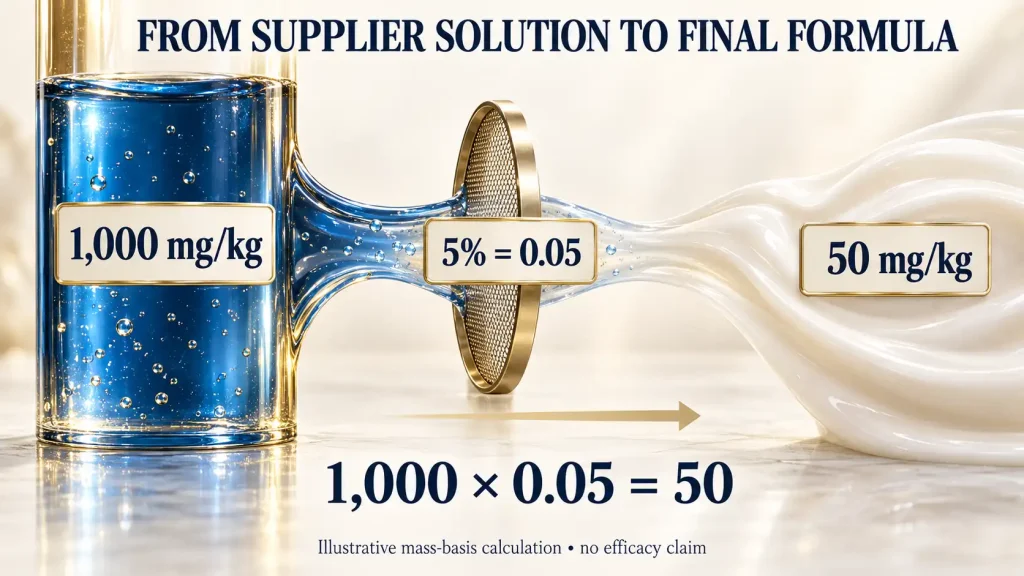
The same result can be checked through batch mass. In a 100 kg batch, a 5% use level means 5 kg of the supplied solution. At 1,000 mg/kg peptide content, those 5 kg contribute 5,000 mg, or 5 g, of peptide. Five grams distributed across 100 kg equals 50 mg/kg. Performing both checks is useful when a worksheet mixes percentages, kilograms and grams.
If the target finished concentration is known, the arithmetic can be reversed:
Required solution mass fraction = target final peptide ppm ÷ supplied solution peptide ppm
For example, reaching a nominal 20 ppm from a solution specified at 800 ppm would require a solution mass fraction of 0.025, or 2.5%. This only calculates a proposed addition. It does not show that 20 ppm is effective, safe, stable or compatible, and it should not override the current supplier guidance for the exact grade.
Do not mix mass and volume bases
The simple multiplication above assumes that both the supplied concentration and the formula use level are expressed as mass fractions. Cosmetic production formulas are commonly controlled by mass, but supplier brochures, laboratory notes and dispensing equipment may introduce volume-based values. A statement such as mg/mL cannot be inserted directly into an mg/kg worksheet unless the relevant density and measurement conditions are available.
For example, adding 2 L of a solution to a 100 kg batch is not automatically a 2% mass fraction. The solution mass depends on density, and the batch total must include the added material. If density is required for the conversion, use a controlled, temperature-relevant value for the exact grade rather than assuming that every aqueous peptide concentrate has a density of exactly 1 kg/L.
The same discipline applies to small laboratory trials. Record whether the peptide solution was weighed or dispensed by volume, the balance or pipette resolution, the target and actual batch mass, and any correction made for density. These details can explain why a pilot calculation appears correct while the executed addition differs from the worksheet.
Keep precision proportionate to the source data
A calculator can display many decimal places even when the input specification is broad. Do not report a final peptide concentration with greater apparent precision than the source values support. Record the unrounded calculation internally, then choose a reporting precision that reflects the specification, weighing capability and purpose of the document. A development worksheet may show a nominal value, while a claim or safety dossier may require measured content and method uncertainty.
If a supplier specification is expressed as a range, calculate the corresponding range in the finished formula rather than selecting the highest value without explanation. If the value is a minimum limit, a typical result or a target, label it accordingly. The arithmetic should preserve the meaning of the source document, not manufacture certainty that the source does not contain.
Total peptide ppm is not a formula disclosure
A multi-peptide solution may report one total peptide value. That number can support a total-mass calculation, but it does not reveal the content of each peptide. An 800 ppm total distributed across four components is not automatically 200 ppm each. The proportions may be unequal, and a supplier may control them as a proprietary composition.
This distinction also affects comparisons. Two solutions can both state 1,000 ppm total peptide while containing different sequences, ratios and carrier systems. Equal totals do not establish equal activity, stability, evidence or value. If a brand needs per-peptide disclosure for safety assessment, formula review or claim substantiation, define that need during qualification and discuss an appropriate confidentiality route where necessary.
| Supplier statement | What can be calculated | What is still needed |
| 800 ppm total peptide | Total peptide contributed at a stated use level | Per-peptide identity and ratio |
| 800 ppm Peptide A | Nominal Peptide A contribution at a stated use level | Basis, method and specification status |
| 1%-5% recommended use | Amount of the whole solution added | Peptide content and project-specific rationale |
| 98% HPLC purity | Chromatographic purity under the stated method | Peptide content, solution concentration and identity evidence |
HPLC purity vs peptide content answers two different questions
Bachem describes analytical HPLC purity as the proportion of the requested peptide relative to material detected at 220 nm under the method. It separately defines net peptide content as peptidic material relative to non-peptidic mass such as counterions and residual water. A lyophilized sample can therefore show high HPLC purity while its gross mass still includes water and counterions. [3-5]
For a powder calculation, a supplier may use a lot-specific relationship involving gross weight, net peptide content or assay, and HPLC purity. For illustration, if a defined method reports 98% HPLC purity and 80% assay for a 10 g gross powder mass, multiplying the documented factors gives 7.84 g of target peptide equivalent. This example follows a stated analytical convention; it should not be imposed on a different supplier’s terminology without checking the method and certificate.
For a commercial cosmetic solution, do not automatically multiply every percentage on the dossier. First find the value that actually quantifies the peptide in that solution. A powder COA may characterize the peptide used to make the concentrate, while the solution specification may use a separate manufacturing target or assay. The traceability between those documents matters more than a large purity number displayed without context.
Separate nominal, specified and measured values
A nominal value is the intended formulation or manufacturing value. A specification sets an acceptance range or limit. A batch result reports what was obtained using the stated method for a particular lot. These categories should not be blended in a purchasing comparison. If one supplier quotes a nominal total and another provides a batch assay for one peptide, the numbers are not yet comparable.
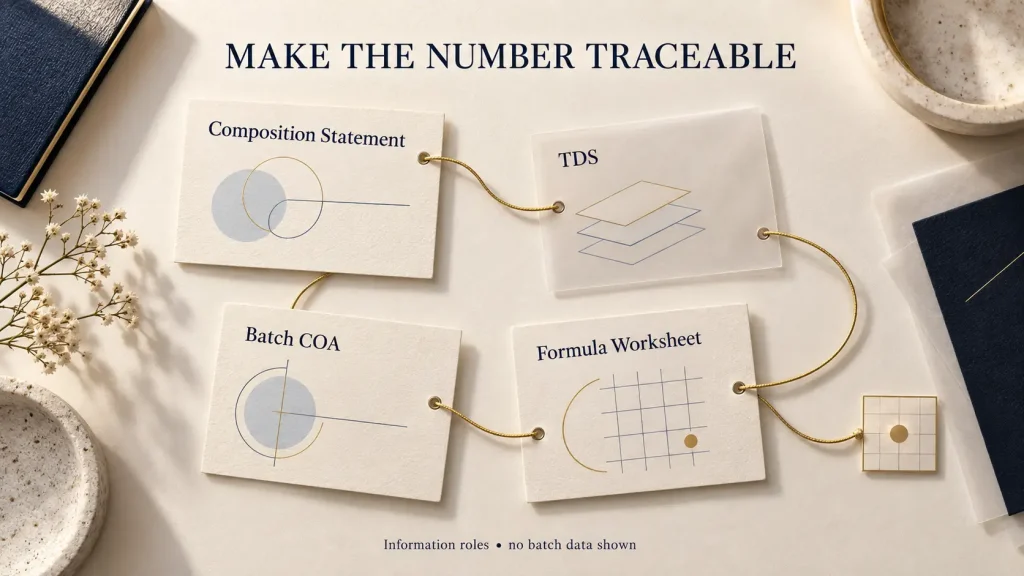
Build the calculation record from four connected sources. The composition statement identifies what the preparation contains. The TDS defines recommended handling and use guidance. The COA reports the tests and results released for the batch, within the supplier’s system. The internal formula worksheet shows which concentration and use-level values were used, their basis, the equation and the responsible reviewer.
The Skinkind Cosmetics pages for Geno-Soothe Pro and Geno-Wrinkle Pro currently publish solution use guidance, but the displayed use-level percentage is not a substitute for the current grade-specific composition, peptide-content basis or batch documentation. Request the latest controlled documents before using a web-page value in development or purchasing work. [8,9]
Do not convert arithmetic into an efficacy claim
The finished-formula concentration is an exposure descriptor, not a performance conclusion. A recent framework on cosmetic-peptide safety notes that reviewed synthetic peptides can appear at ppm-level concentrations, while also emphasizing ingredient purpose, mechanism work, clinical confirmation and finished-product tolerance assessment. The reported range is background for the materials reviewed, not a universal target for every peptide. [10]
A calculated 50 ppm does not establish that 50 ppm remains after heating, storage or packaging contact. It also does not establish skin availability, wrinkle reduction, soothing performance or safety for the target users. Those questions require appropriate analytical, stability, compatibility, safety and efficacy work on the actual material and finished formula.
Compare quotations on a common worksheet
Before comparing price, place every candidate on the same calculation sheet. Record the exact grade, solution price per kilogram, proposed use level, peptide-content statement, basis, source document and date. Then calculate ingredient cost per kilogram of finished product and, only when the content data are genuinely comparable, the nominal peptide contribution.
Cost per kilogram of finished product equals the solution price per kilogram multiplied by its formula mass fraction. This calculation can compare the cost contribution of commercial preparations. Cost per nominal peptide milligram is more demanding: it requires reliable peptide-content definitions and does not make two different peptide blends equivalent. A lower number may simply reflect a different composition or evidence package.
For a Genopep project, provide the intended product format, batch basis, candidate use level and the concentration statement being used. If your target is expressed as final active peptide concentration, identify whether it applies to one peptide or a total. This gives Skinkind Cosmetics a clear question to answer and reduces the risk that commercial, formulation and quality teams are using the same number to mean different things.
Frequently Asked Questions
1. What does a 1,000 ppm peptide solution mean?
It means one part in one million only after the measured substance and basis are defined. On a mass-fraction basis, 1,000 ppm can be written as 1,000 mg/kg, equal to a mass fraction of 0.1%. Confirm whether the value applies to one named peptide, total peptide or another component, and whether it is nominal, specified or batch-tested.
2. How do I calculate final peptide ppm from a solution use level?
Multiply the verified solution peptide ppm by the solution’s formula mass fraction. For example, 800 ppm × 0.025 equals a nominal 20 ppm in the formula. Keep the calculation on one mass basis and verify that the concentration refers to the peptide you intend to track.
3. Is using a peptide solution at 5% the same as adding 5% peptide?
No. Five percent is the amount of the whole supplied preparation in the formula. The active peptide contribution depends on the verified peptide content of that preparation. Carrier ingredients enter the formula with it and may also affect compatibility, preservation and sensory properties.
4. Does 99% HPLC purity mean a solution contains 99% peptide?
Not necessarily. HPLC purity commonly describes the target peak relative to detected peptide-related material under a stated method. It does not by itself state the peptide mass fraction of a commercial solution, and it does not account for every carrier, water or counterion question. Use the concentration specification and batch documentation for the supplied solution.
5. Can I compare two multi-peptide solutions by total ppm alone?
Only their reported totals can be compared, and only when the definitions and methods match. Total ppm does not disclose individual peptide ratios or establish equivalent performance. Compare identity, per-peptide or total content basis, carrier, evidence, processing fit, documents and cost at the proposed use level.
Request a concentration-ready dossier from Genopep
When requesting a sample or quotation, send Genopep the target formula type, batch size, proposed peptide solution use level, target market and the exact concentration question you need answered. Ask Skinkind Cosmetics for the current composition statement, TDS, SDS, representative or batch COA, peptide-content definition, test basis and storage or processing guidance available for the selected grade.
Explore Pro Peptide Solutions and use the worksheet logic in this guide to compare candidates. The most useful answer is a traceable concentration statement tied to the exact supplied material, not the largest percentage on a sales page.
References
1. NIST — Guide to the SI, Chapter 7: Rules and Style Conventions. Percentage and ppm notation context.
2. NIST — Guide to the SI, Chapter 8. Definition of mass fraction.
3. Bachem — Frequently Asked Questions. HPLC purity, assay, gross weight and net peptide content definitions.
4. Bachem — Peptide Content and Concentration Calculator. Lot-specific purity and assay calculation framework.
5. Bachem — Peptide Guide. Net peptide content and analytical context.
6. Skinkind Cosmetics — Acetyl Hexapeptide-8 Safety and Concentration. Existing worked example and document checklist.
7. Skinkind Cosmetics — Pro Peptide Solutions. Commercial category context.
8. Skinkind Cosmetics — Geno-Soothe Pro. Published product positioning and use guidance; current controlled documents remain decisive.
9. Skinkind Cosmetics — Geno-Wrinkle Pro. Published product positioning and use guidance; not used as efficacy proof.
10. Fiume MZ et al. — A framework for the safety evaluation of peptides in cosmetics. Ingredient- and finished-product assessment context; reported concentrations are peptide-specific.