Professional Cosmetics Peptide Supplier | GENOPEP



How Does GHK-Cu Work in Skincare? Understanding Copper-Peptide Signaling
How does GHK-Cu work in skincare? GHK-Cu is a copper-complexed tripeptide studied for copper binding and signals associated with extracellular-matrix turnover, oxidative stress and inflammatory responses. These mechanisms provide a formulation rationale, but visible results still depend on ingredient identity, copper complexation, use level, stability, skin delivery and finished-product testing.
Introduction
GHK-Cu is often introduced with a simple story: a small peptide carries copper to skin cells and switches repair processes on. That description is memorable, but it compresses several different scientific questions into one sentence. Copper binding is a chemical event. Changes in cultured cells or tissue models are mechanistic observations. Improvements in the appearance of human skin are finished-product outcomes. Each layer needs its own evidence.
For skincare brands and formulators, understanding those layers is more useful than memorizing one pathway diagram. It helps teams decide what the ingredient is, which mechanism statements are supportable, what the formula must preserve and which claims require human testing. It also prevents laboratory language such as gene modulation, wound healing or matrix remodeling from becoming an unsupported cosmetic promise.
This article focuses on topical cosmetics. Injectable, therapeutic and post-procedure medical uses are outside its scope, even when they appear in the broader GHK-Cu literature.
Start With Identity: GHK, Copper, and Copper Tripeptide-1
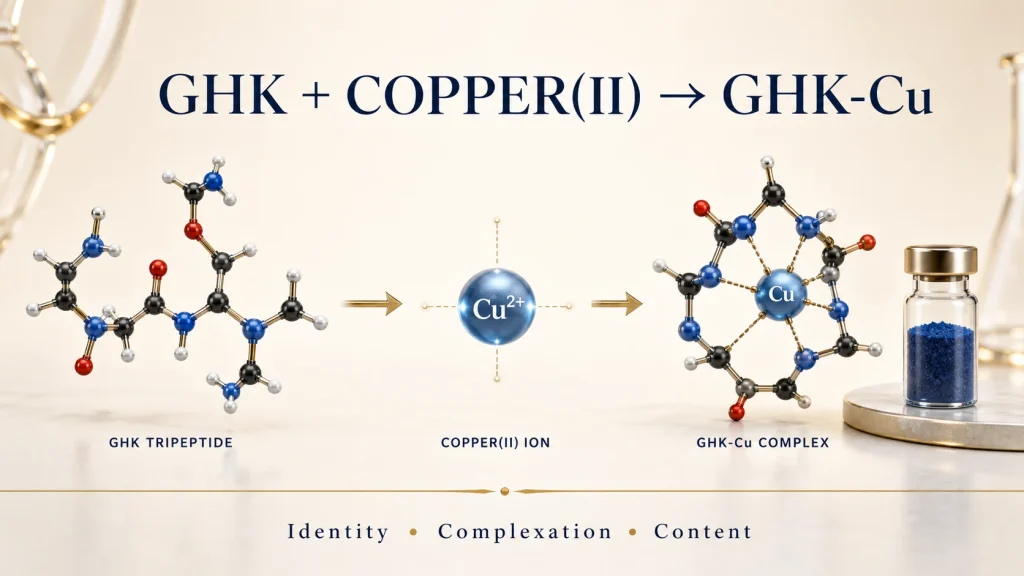
GHK is the three-amino-acid sequence glycyl-L-histidyl-L-lysine. When it coordinates a copper(II) ion, the resulting complex is commonly called GHK-Cu. In cosmetic ingredient terminology, Copper Tripeptide-1 is defined as a complex formed by copper and Tripeptide-1.[1] The copper complex therefore has a related but distinct chemical identity from the uncomplexed tripeptide.
Histidine is important to the coordination environment, while other donor groups in the peptide also contribute to binding. Spectroscopic and equilibrium studies show that GHK forms defined copper complexes under controlled chemical conditions.[4] In a cosmetic formula, however, the relevant question is not merely whether GHK can bind copper in principle. Teams must know the supplied material’s identity, complexation state, peptide and copper content, counterions, impurities and behavior in the intended vehicle.
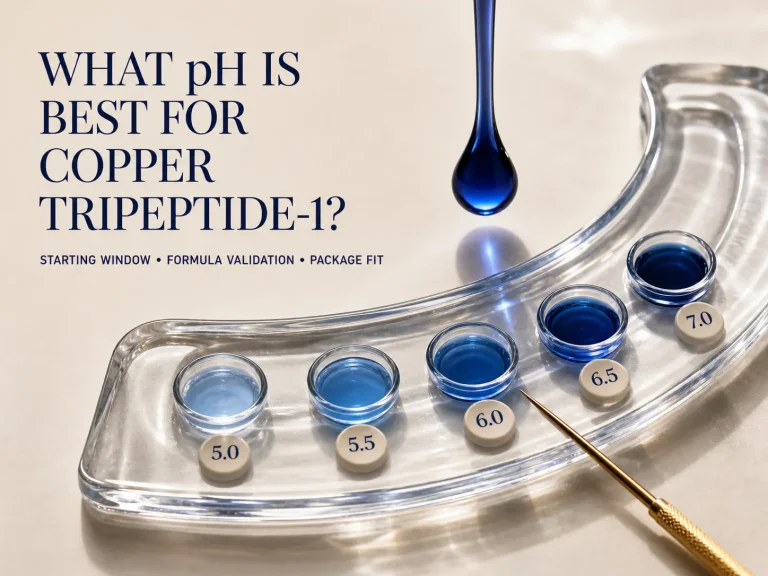
The characteristic blue to deep-blue appearance can be consistent with a copper complex, but color alone is not an identity or efficacy test. Other ingredients, concentration, optical path and pH can change what a raw material or formula looks like. Analytical documentation is more meaningful than judging authenticity or performance by shade.
What Does “Copper-Peptide Signaling” Mean?
The phrase “signaling peptide” is useful shorthand, but it should not imply a single receptor, one guaranteed pathway or an immediate visible response. In experimental systems, GHK or GHK-Cu has been associated with changes in gene expression, extracellular-matrix synthesis and degradation, antioxidant defenses and inflammatory mediators.[2,3] The studies vary in model, concentration, exposure route and endpoint, so the observations do not form one universal switch.
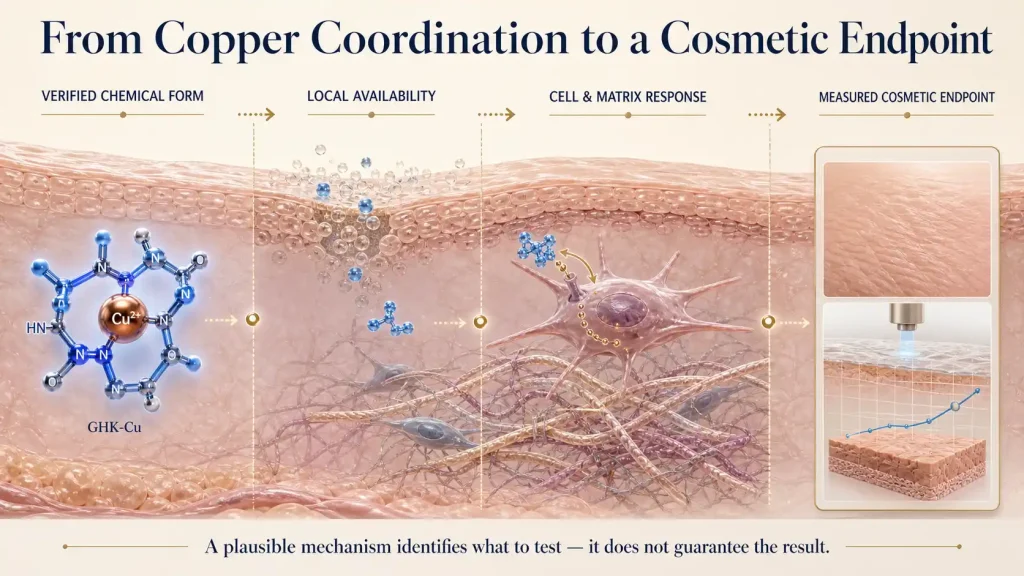
One proposed model begins with copper coordination and exchange. Copper is a cofactor for multiple biological enzymes, and GHK has a strong capacity to coordinate copper under appropriate conditions. The complex may influence local copper availability or interactions with cells and matrix components. Calling GHK-Cu a universal “copper delivery system,” however, requires evidence that the specific topical formula reaches a relevant compartment and retains the appropriate chemical form.
A second part of the model concerns cell and tissue responses. Reviews describe observations involving fibroblast activity, collagen and glycosaminoglycan synthesis, and regulation of matrix metalloproteinases and their inhibitors.[2,3] These findings support an extracellular-matrix rationale. They do not establish that every commercial serum increases dermal collagen, because dose, delivery, study model and finished-formula equivalence still have to be demonstrated.
The third part concerns downstream cosmetic endpoints. If a finished formula is stable, tolerated and able to make the ingredient available where it is needed, matrix-related or soothing mechanisms may support research into wrinkle appearance, texture, firmness or visible redness. The mechanism identifies a plausible route to test; it does not supply the result in advance.
| Evidence Layer | What It Can Support | What It Cannot Prove Alone |
| Coordination chemistry | GHK can form a defined complex with copper under stated conditions | Stability or bioavailability in every cosmetic formula |
| Cell or biochemical model | A pathway, molecular interaction or measurable response is biologically plausible | A visible consumer result or commercial-product claim |
| Ex vivo or penetration study | Distribution, retention or transformation in a specific model | Performance across all skin types and use conditions |
| Controlled human study | Outcome for the tested formula, population, duration and method | Universal efficacy for another concentration, vehicle or product |
Extracellular-Matrix Remodeling Is About Balance
“More collagen” is an incomplete description of extracellular-matrix biology. Healthy matrix maintenance involves synthesis, organization, breakdown and replacement. GHK-Cu literature discusses collagen, elastin, glycosaminoglycans, proteoglycans, matrix metalloproteinases and tissue inhibitors of metalloproteinases.[2,3] The proposed value is therefore closer to regulated turnover than to indiscriminate production of one protein.
This distinction matters for marketing. “Supports the appearance of firmer, smoother skin” can be evaluated with suitable instrumental, expert or consumer methods. “Rebuilds the dermis,” “replaces damaged collagen” or “reverses skin aging” makes a much broader structural or biological promise. In the United States, claims that imply treatment of disease or effects on body structure or function can change a product’s regulatory status.[10]
Wound and post-procedure studies require especially careful interpretation. A molecule can participate in repair-related biology without a daily cosmetic serum being a wound-healing product. Procedures also alter the barrier and create a setting that differs substantially from intact skin. Data from that context should not be transferred to routine cosmetic use without qualification.
Oxidative-Stress and Inflammatory Pathways
Laboratory literature also describes GHK-Cu in relation to reactive oxygen species, antioxidant enzymes and inflammatory signaling.[2,3] These observations may justify research into formulas intended to improve the appearance of environmentally stressed or visibly uncomfortable skin. They do not support an unrestricted statement that the ingredient “neutralizes all free radicals,” prevents UV injury or treats inflammation.
For a cosmetic claim, the relevant evidence could include a validated oxidative-stress marker in an appropriate test model, a controlled visible-redness assessment or consumer-perception data for the final formula. The endpoint should be named precisely. A mechanistic marker and a visible outcome may be related, but they are not interchangeable.
What Does Human Evidence Show?
Human evidence for topical GHK-Cu is less uniform than broad mechanism summaries may suggest. In a randomized study of 13 patients after carbon-dioxide laser resurfacing, objective assessments found no significant between-group improvement in erythema, wrinkles or overall skin quality with the GHK-Cu regimen, although patient satisfaction was higher.[8] The sample was small and the post-procedure setting limits generalization to intact skin.
Reviews describe additional promising observations, but many reports are small, use different formulations or provide limited methodological detail.[3,5,7] A 2026 systematic review of peptide interventions for skin aging included 19 randomized trials, yet 17 assessed oral peptides and only two assessed topical formulas.[9] Its pooled results should therefore not be presented as direct proof of a GHK-Cu serum.
The practical conclusion is measured: GHK-Cu has a substantial mechanistic literature and a plausible cosmetic rationale, while outcome claims should be tied to the exact ingredient and finished formula. Evidence quality is better represented as a chain than as a yes-or-no verdict.
Formula Design Determines Whether the Mechanism Is Testable
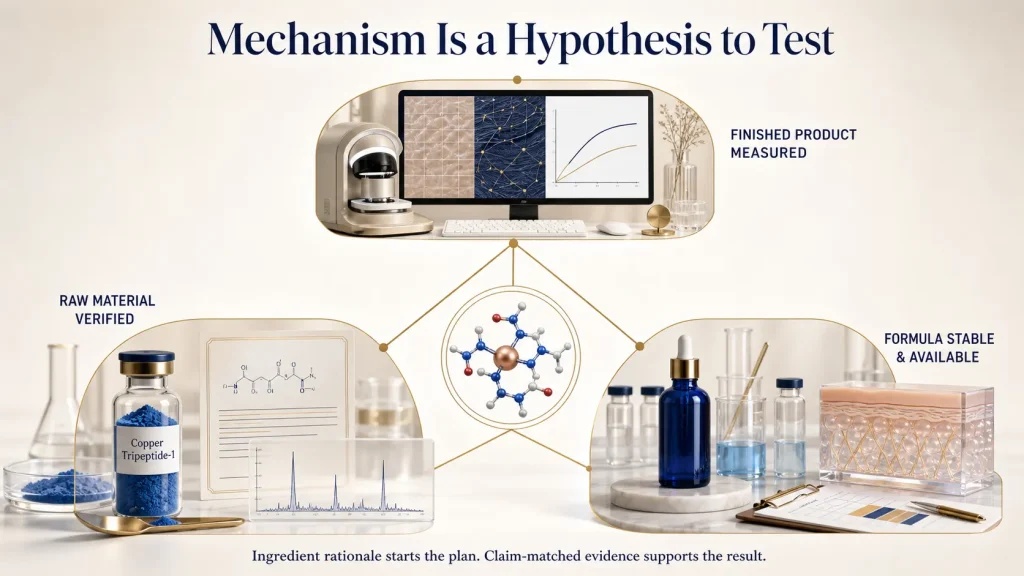
Peptides can be affected by hydrolysis, oxidation, pH, metal-binding competitors, enzymes, heat and light. Copper complexes add further questions about speciation and interactions with chelators or other reducing and oxidizing ingredients. Current cosmetic-peptide guidance consequently treats characterization, exposure, local tolerability, delivery and formulation stability as connected parts of development.[6]
Skin delivery should also be demonstrated rather than assumed. The stratum corneum is a major barrier, and peptide behavior depends on molecular properties, concentration, vehicle, contact time and skin model.[5,6] A result obtained with one peptide cannot be borrowed automatically for GHK-Cu, and a result obtained in a solvent system cannot be assumed for a serum or cream.
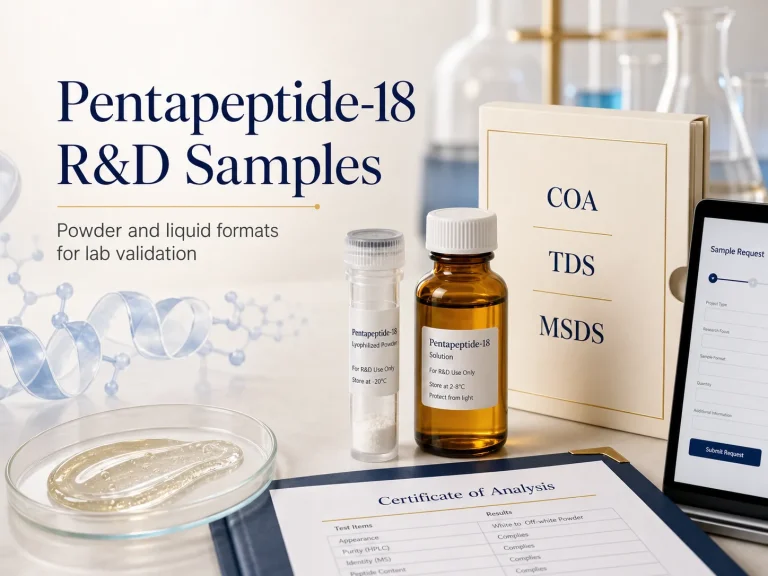
Skinkind Cosmetics currently presents Copper Tripeptide-1 as a blue to deep-blue powder with HPLC options of at least 95% or 98%, and as a customizable blue solution containing 1,000 to 50,000 ppm peptide content.[12] These are supplier-format specifications, not universal efficacy thresholds. Product teams should work from the applicable TDS and batch COA, then confirm compatibility and stability in their own finished formula.
A Practical Claim Ladder for Product Teams
Mechanism communication becomes more defensible when each sentence stays within its evidence layer. Ingredient identity can be stated from verified nomenclature and analytical documentation. Mechanistic rationale can be described with qualified language such as “studied for” or “associated with” in specified models. A finished-product benefit should name the measured cosmetic endpoint and cite testing of the actual formula.
| Claim Level | More Defensible Wording | Additional Evidence Needed |
| Ingredient identity | Copper Tripeptide-1 is a complex formed by copper and Tripeptide-1 | Identity, content and batch documentation |
| Mechanistic rationale | GHK-Cu has been studied in models involving extracellular-matrix turnover and oxidative-stress signaling | Relevant model, concentration and method |
| Formula performance | The tested formula improved the measured appearance of fine lines or perceived firmness | Controlled finished-product study and statistics |
| Comparative superiority | The product performs better than a retinoid, vitamin C or another peptide formula | Direct head-to-head testing of matched finished products |
| Medical or structural promise | Repairs DNA, heals wounds, rebuilds the dermis or reverses aging | Usually outside ordinary cosmetic positioning; market-specific regulatory review required |
Conclusion
How does GHK-Cu work in skincare? The most defensible answer is a connected but conditional sequence: verified GHK-Cu identity and copper complexation provide the chemical starting point; relevant formula conditions determine whether that form remains available; experimental models describe plausible cell and extracellular-matrix responses; and a finished-product study determines whether a defined cosmetic endpoint is actually observed.
For product teams, this separation prevents a mechanistic diagram from being treated as a guaranteed claim. Copper Tripeptide-1 can supply a defined ingredient identity and a scientifically plausible cosmetic rationale, while stability, delivery, tolerability and claim-matched finished-product evidence still belong to the formula being developed.
Frequently Asked Questions
1. What is the mechanism of action of Copper Tripeptide-1 on the skin?
Copper Tripeptide-1 is studied as a copper-complexed signaling peptide. Research models associate GHK-Cu with copper coordination, extracellular-matrix turnover, antioxidant responses and inflammatory signaling. For a topical cosmetic, these mechanisms remain conditional on the ingredient’s identity, concentration, stability and delivery, and they do not independently prove a visible result.
2. What does Copper Tripeptide-1 do for the skin?
At ingredient level, it provides a research rationale for formulas targeting the appearance of fine lines, texture, firmness or visible signs of stress. What a particular product actually does must be established with testing of that finished formula. The ingredient’s mechanism should not be presented as a guaranteed product outcome.
3. Does GHK-Cu actually help your skin?
GHK-Cu has credible chemical and mechanistic research, while the topical human evidence is smaller and more variable. Some finished products may produce useful cosmetic outcomes, but the answer depends on the exact formula, study population, duration and endpoint. A broad ingredient story is not a substitute for product-specific evidence.
4. How long does it take GHK-Cu to tighten skin?
There is no universal timeline. A formula may create faster hydration or sensory changes through its complete vehicle, while measured wrinkle or firmness endpoints usually require repeated use over a defined study period. Brands should report the timeline demonstrated by their own finished-product test rather than borrowing one from another GHK-Cu product.
5. Is GHK-Cu the same as copper tripeptide?
GHK-Cu is the commonly used scientific abbreviation for the copper complex of the GHK sequence. Copper Tripeptide-1 is the cosmetic ingredient name used for a complex formed by copper and Tripeptide-1.[1] The broad phrase “copper peptide” can refer to more than one copper-complexed peptide, so technical documents should use the exact INCI name and identity.
CTA
For teams investigating how does GHK-Cu work in skincare, the next step is to turn the mechanism into a testable development plan. Genopep supplies Copper Tripeptide-1 in powder and customizable solution formats, while Skinkind Cosmetics can provide current format information and relevant technical documents. Request the applicable TDS, batch COA and sample data, then confirm identity, content basis, compatibility, stability and the finished-product endpoint before finalizing claims.
Review Skinkind Cosmetics Copper Tripeptide-1 Formats and Request Technical Documents
References
1. Johnson W Jr, Bergfeld WF, Belsito DV, et al. Safety Assessment of Tripeptide-1, Hexapeptide-12, Their Metal Salts and Fatty Acyl Derivatives, and Palmitoyl Tetrapeptide-7 as Used in Cosmetics. International Journal of Toxicology. 2018;37(3 Suppl):155-295. CIR safety assessment
2. Pickart L, Vasquez-Soltero JM, Margolina A. Regenerative and Protective Actions of the GHK-Cu Peptide in the Light of the New Gene Data. International Journal of Molecular Sciences. 2018;19(7):1987. PMC full text
3. Pickart L, Margolina A. GHK Peptide as a Natural Modulator of Multiple Cellular Pathways in Skin Regeneration. BioMed Research International. 2015;2015:648108. PMC full text
4. Conato C, Gavioli R, Guerrini R, et al. Copper Complexes of Glycyl-Histidyl-Lysine and Two of Its Synthetic Analogues: Chemical Behaviour and Biological Activity. Biochimica et Biophysica Acta. 2001;1526(2):199-210. PubMed record
5. Pintea A, Manea A, Pintea C, et al. Peptides: Emerging Candidates for the Prevention and Treatment of Skin Senescence: A Review. Biomolecules. 2025;15(1):88. PMC full text
6. Bjerke DL, Li J, Gao Y, Hu P, Lintner K, Hakozaki T. A Framework for the Safety Evaluation of Peptides in Cosmetics. Current Research in Toxicology. 2026;10:100291. PMC full text
7. Ash M, Zibitt M, Shauly O, Menon A, Losken A, Gould D. The Innovative and Evolving Landscape of Topical Exosome and Peptide Therapies: A Systematic Review of the Available Literature. Aesthetic Surgery Journal Open Forum. 2024;6:ojae017. PMC full text
8. Miller TA, Wagner JD, Baack BR, Eisbach KJ. Effects of Topical Copper Tripeptide Complex on CO2 Laser-Resurfaced Skin. Archives of Facial Plastic Surgery. 2006;8(4):252-259. PubMed record
9. Nukaly HY, Halawani IR, Irtaza HM, et al. Oral and Topical Peptides for Skin Aging: Systematic Review and Meta-Analysis of Randomized Controlled Trials. Frontiers in Medicine. 2026;13:1618306. PMC full text
10. U.S. Food and Drug Administration. Cosmetics Labeling Claims. FDA guidance
11. European Commission. Commission Regulation (EU) No 655/2013 Laying Down Common Criteria for the Justification of Claims Used in Relation to Cosmetic Products. EU regulation
12. Skinkind Cosmetics / GENOPEP. Copper Tripeptide-1 (CAS: 49557-75-7) Anti-Aging Peptides. Product page