Professional Cosmetics Peptide Supplier | GENOPEP



Copper Peptides vs Regular Peptides: What Does Copper Complexation Change?
Copper peptides differ from “regular peptides” because a peptide ligand is coordinated to copper, creating a chemically distinct metal–peptide complex. In Copper Tripeptide-1, copper is complexed with the Gly-His-Lys sequence. Complexation can change coordination chemistry, color, speciation, analytical controls, and formulation behavior, but it does not automatically make the ingredient stronger, more penetrating, or more effective than every non-copper peptide.
Introduction
The search phrase “copper peptides vs regular peptides” sounds like a comparison between two fixed ingredient classes. In formulation science, only one side is reasonably specific. “Copper peptide” describes a peptide associated with copper, while “regular peptide” is consumer shorthand that can include many unrelated sequences and modifications.
Cosmetic peptides are often grouped by proposed function, including signal peptides, carrier peptides, neurotransmitter-pathway peptides, and enzyme-inhibitory peptides.[2,3] They may also be chemically modified—for example by palmitoylation—or delivered in different vehicles. Sequence, modification, metal binding, purity, concentration, stability, and vehicle can all change the development question.
The useful comparison is therefore not “Which family wins?” It is: what is the exact ingredient, what does its chemistry change, which endpoint is relevant, and what evidence is required for the finished formula?
First Clarify the Names
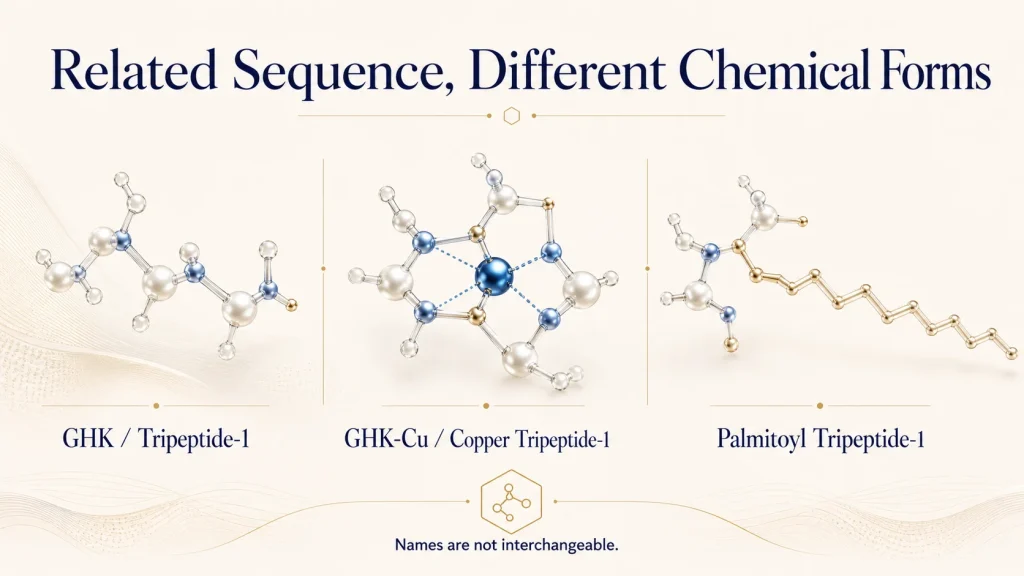
Tripeptide-1 is the synthetic tripeptide Gly-His-Lys, commonly abbreviated GHK. Copper Tripeptide-1 is defined as a complex formed by copper and Tripeptide-1. Palmitoyl Tripeptide-1 is the reaction product of palmitic acid and Tripeptide-1.[1] These ingredients share a related peptide sequence, but they are not interchangeable names.
| Name Used in Discussion | Chemical Meaning | What It Does Not Mean |
| GHK / Tripeptide-1 | Uncomplexed Gly-His-Lys peptide | Not automatically GHK-Cu |
| GHK-Cu / Copper Tripeptide-1 | Copper complex of Tripeptide-1 | Not every peptide that contains copper; not an injectable protocol |
| Palmitoyl Tripeptide-1 | Tripeptide-1 modified with a palmitoyl group | Not a copper peptide |
| Copper peptide | Broad descriptive term | Does not identify the sequence, ratio, counterion, purity, or supplied form by itself |
| “Regular peptide” | Informal umbrella term | Not a recognized single chemical or functional class |
What Copper Complexation Changes
1. It Creates a Different Chemical Identity
Copper complexation is not simply adding a marketing descriptor to the same free peptide. GHK coordinates Cu(II) through donor atoms in the peptide, producing a metal–ligand complex with its own structure and solution behavior.[4,5] Studies of GHK-Cu also report metal exchange and multiple species under particular solution conditions, which is why pH, ligand ratios, competing binders, and analytical method matter.[4,5]
For R&D teams, this changes the identity question. A sequence confirmation for GHK does not alone establish the amount or state of the copper complex. Likewise, total copper does not establish that all copper is present as the intended GHK-Cu species.
2. It Adds Copper-Related Biological Rationale
Reviews commonly place GHK-Cu among carrier peptides because the peptide binds copper, while GHK is also discussed as a signal peptide.[2,3,6] This provides a distinct research rationale involving copper-dependent biology and extracellular-matrix signaling. It does not establish that GHK-Cu is universally superior to a palmitoylated signal peptide, a neurotransmitter-pathway peptide, or another sequence designed for a different endpoint.
Mechanistic literature can guide candidate selection. It cannot replace dose selection, compatibility testing, delivery work, safety assessment, or a controlled study of the finished cosmetic.
3. It Changes Visual and Analytical Controls
The blue to deep-blue appearance associated with Copper Tripeptide-1 can be a useful incoming-material and stability observation. Color, however, is only one signal. A blue solution can still differ in peptide content, copper ratio, impurities, counterions, degradation products, or complex distribution. A clear non-copper peptide is not inferior because it lacks color.
The analytical plan should match the specification. HPLC purity, peptide assay, total copper, water, counterions, microbiological limits, and solution concentration answer different questions. One number cannot stand in for all of them.
4. It Changes the Formulation Risk Map
Metal coordination introduces additional formulation questions: can another ingredient bind copper, change the local pH, alter the oxidation state, or shift complex distribution? Light, heat, oxygen, processing time, water quality, chelators, reductants, and container interaction may also matter. These are hypotheses to test in the actual formula, not universal internet rules about ingredients that must never be combined.
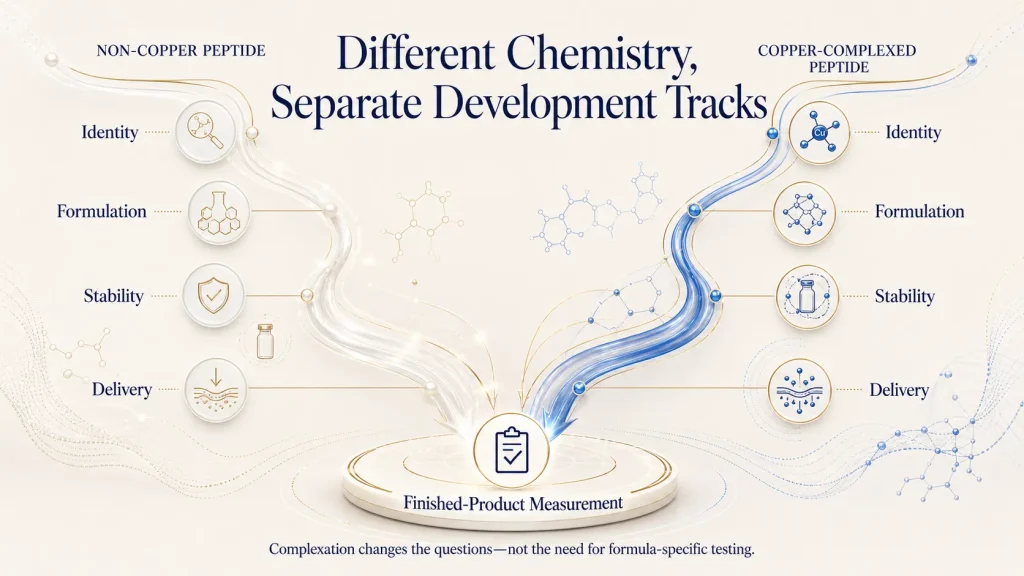
What Copper Complexation Does Not Automatically Change
Complexation does not prove better skin penetration. Peptides face familiar topical-delivery constraints related to molecular size, charge, hydrophilicity, proteolysis, vehicle release, and the stratum corneum.[2,6] An in-vitro study detected GHK-Cu distribution across skin layers under its own experimental conditions, but that result does not guarantee equivalent delivery from every commercial serum.[7]
Complexation also does not create a universal efficacy ranking. Copper Tripeptide-1, Palmitoyl Tripeptide-1, Acetyl Hexapeptide-8, and other cosmetic peptides have different identities and research rationales. “More active” is incomplete unless it specifies the formula, concentration basis, endpoint, comparator, method, population, and duration.
Finally, complexation does not transfer ingredient observations directly to a finished-product claim. Systematic reviews continue to describe limited and heterogeneous topical peptide clinical evidence.[9] Product benefits must be demonstrated for the formula that will actually be marketed.
Copper Peptides vs Common Non-Copper Peptide Types
| Peptide Approach | Primary Selection Logic | Main Formulation Question | Appropriate Comparison Endpoint |
| Copper-complexed GHK-Cu | Metal–peptide identity and copper-related carrier/signaling rationale | Complex integrity, copper interactions, color, oxidation, pH, and delivery | Formula-specific appearance, tolerance, stability, and delivery data |
| Uncomplexed signal peptide | Sequence-dependent cellular signaling rationale | Sequence stability, proteolysis, solubility, and delivery | Endpoint linked to the exact sequence and formula |
| Palmitoylated peptide | Fatty-acyl modification changes physicochemical behavior | Dispersion, solubility, vehicle location, stability, and bioavailability | Finished-formula performance versus a defined control |
| Neurotransmitter-pathway peptide | Designed around a different pathway associated with expression-line appearance | Sequence integrity, dose basis, delivery, and claim wording | Dynamic-line or appearance endpoint—not copper biology |
| Enzyme-inhibitory peptide | Selected for a specific enzyme-related rationale | Specificity, stability, effective exposure, and off-target assessment | A defined biochemical or cosmetic endpoint matched to the peptide |
Are Copper Peptides Better Than Regular Peptides?
There is no scientifically useful yes-or-no answer across all products. Copper Tripeptide-1 may be the better candidate when the project specifically needs a GHK-Cu identity, a blue copper-complex story, and an R&D program designed around that chemistry. A different peptide may be more suitable when the target endpoint, delivery system, sensory profile, color requirement, regulatory position, or cost-in-use points elsewhere.
The same principle applies to “copper peptides vs Matrixyl.” Matrixyl is used for more than one commercial peptide system, so teams must first inspect the exact INCI composition and supplier documents. A formula containing Palmitoyl Tripeptide-1 is chemically different from GHK-Cu. The two may be evaluated in the same development program, but neither should be declared the universal winner before matched formula testing.
Can they be used together? Possibly, if the exact raw materials, solvent systems, pH, processing sequence, packaging, stability, safety, and finished-product performance are compatible. The answer belongs to a documented formulation study, not a general ingredient-pairing chart.
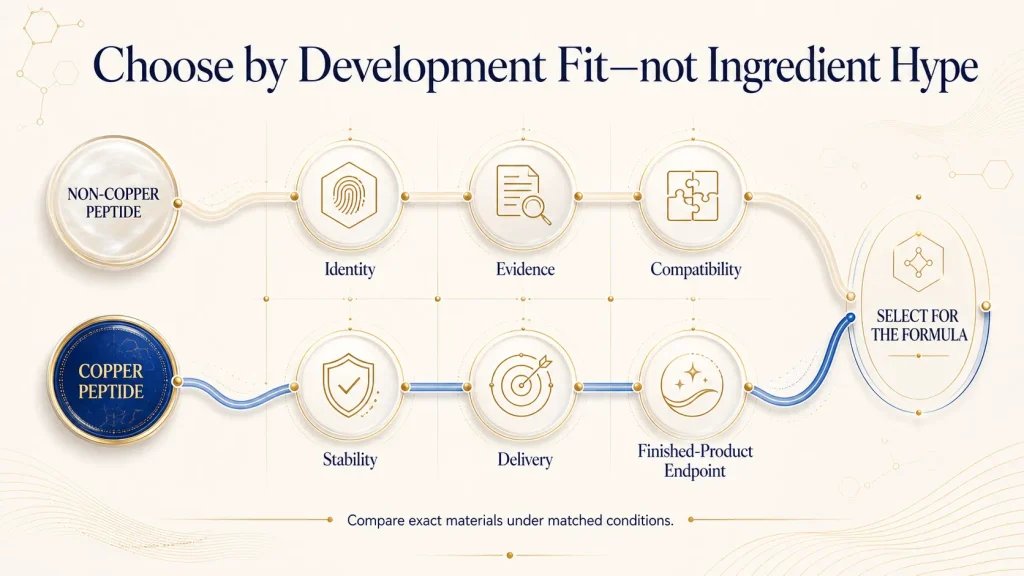
How Product Teams Should Compare Supplier Materials
Start with identity. Request the INCI name, sequence or complex description, CAS information where applicable, supplied form, counterion or solvent system, and analytical method. A vague label such as “blue copper peptide” or “peptide complex” is not enough for technical comparison.
Next, separate purity from content. HPLC purity describes the relative chromatographic purity of the peptide-related material under the stated method. Peptide assay, total copper, water, salts, solvent, and the concentration of a supplied solution describe other parts of the material. A 98% HPLC purity powder and a 5,000 ppm peptide solution cannot be compared as though the percentages measure the same thing.
Then compare usable evidence: batch COA, TDS, SDS, analytical validation, accelerated and real-time stability, compatibility data, microbial controls for solutions, packaging, transport conditions, and sample performance in the intended base. Cost should be calculated from verified active-content basis and usable formula level, not quotation per kilogram alone.
Skinkind Cosmetics currently lists Copper Tripeptide-1 as a blue to deep-blue powder with HPLC purity options of at least 95% or 98%, and as a customizable blue solution with peptide content from 1,000 to 50,000 ppm.[12] These are supplier-format specifications, not evidence that one format is more effective than another or that either will outperform a non-copper peptide in a finished cosmetic.
A Matched Comparison Protocol for R&D
A useful comparison should hold the base formula, packaging concept, application area, test conditions, and decision endpoint as constant as practical. It should not compare a high-concentration supplier solution in one finished base with a low-dose powder in an unrelated base and then attribute every difference to copper complexation. Before making prototypes, normalize each candidate to a verified peptide-content basis and document the assumptions used when supplier assays are expressed differently.
Build a small prototype matrix rather than one sample per ingredient. A practical screen may include the base control, one or more feasible levels of the copper-peptide candidate, and matched levels of the defined non-copper candidate. Record addition phase, temperature, mixing time, order of addition, pH before and after addition, immediate appearance, viscosity, odor, and packaging observations. Then place the samples into a stability plan appropriate to the formula, including controls for light, temperature, and container exposure where relevant.
Predefine what would make a candidate advance. One project may prioritize a clear formula and minimal color shift; another may accept blue color but require stronger documentation for complex identity and long-term stability. Sensory performance, cost-in-use, supplier continuity, regulatory documentation, and the feasibility of a finished-product efficacy study may change the decision even when both candidates pass basic compatibility. The result is a documented development choice, not a universal ranking of peptide families.
Claim Boundaries for Comparison Content
Comparison claims need the same discipline as efficacy claims. In the United States, language about treating disease or affecting body structure or function can move a product into drug territory.[10] European common criteria require cosmetic claims to be supported by adequate, verifiable evidence and not to transfer an ingredient property misleadingly to the finished product.[11]
| Weak Comparison | More Defensible Direction |
| Copper peptides are stronger than regular peptides | Copper complexation creates a different ingredient identity and formulation profile |
| GHK-Cu penetrates better than all other peptides | Delivery depends on the peptide, vehicle, method, and tested conditions |
| Copper peptides rebuild collagen better than Matrixyl | Compare the exact formulas using the same endpoint, population, and duration |
| Blue color proves active copper peptide | Use color as an observation; verify identity, content, stability, and complex state analytically |
| Copper peptides repair skin damage | Define an appearance or conditioning endpoint appropriate for cosmetics and substantiate the finished formula |
Conclusion
Copper complexation changes the ingredient identity, analytical questions, color profile, and formulation risk map. It does not turn every copper peptide into a universal upgrade over every non-copper peptide. Product teams should compare exact INCI materials through matched specifications, stability plans, delivery assumptions, and finished-product endpoints.
CTA
If your team is comparing copper peptides vs regular peptides, begin with identity and the intended finished-product endpoint. Genopep can support candidate selection and formulation-oriented technical discussion, while Skinkind Cosmetics can provide current Copper Tripeptide-1 powder or customizable solution information and relevant technical documents. Request the applicable TDS, batch COA, SDS, sample, and content basis, then evaluate compatibility, stability, safety, delivery, cost-in-use, and finished-product performance against the exact non-copper peptide candidate.
Review Skinkind Cosmetics Copper Tripeptide-1 Formats and Request Technical Documents
Frequently Asked Questions
1. What is the difference between copper peptides and regular peptides?
Copper peptides are metal–peptide complexes in which a peptide coordinates copper. “Regular peptides” is not one scientific class; it can refer to uncomplexed, palmitoylated, acetylated, signal, carrier, neurotransmitter-pathway, or enzyme-inhibitory peptides. Compare exact INCI identities and supplied forms rather than the umbrella terms.
2. Are copper peptides better than regular peptides?
Not universally. Suitability depends on the target endpoint, exact formula, delivery, stability, color and sensory constraints, safety, evidence, and cost-in-use. Copper complexation provides different chemistry and a different research rationale, not an automatic performance ranking.
3. Is GHK-Cu just copper peptide?
GHK-Cu is a specific copper peptide: the copper complex of the Gly-His-Lys tripeptide, identified in cosmetics as Copper Tripeptide-1. “Copper peptide” can be used more broadly, so the sequence and INCI name should still be confirmed.
4. Can I use Matrixyl and copper peptides together?
Potentially, but “Matrixyl” can refer to different commercial peptide systems. Check the exact INCI composition, solvent system, pH, processing sequence, compatibility, stability, safety, and finished-product data. A general pairing rule cannot replace testing of the intended formula.
5. What are the downsides of copper peptides?
Development limitations can include blue color, metal-binding interactions, oxidation or pH sensitivity, uncertain delivery, analytical complexity, and overstatement of limited finished-product evidence. These are formulation and substantiation challenges, not proof that Copper Tripeptide-1 is unsuitable for cosmetic use.
References
1. Johnson W Jr, Bergfeld WF, Belsito DV, et al. Safety Assessment of Tripeptide-1, Hexapeptide-12, Their Metal Salts and Fatty Acyl Derivatives, and Palmitoyl Tetrapeptide-7 as Used in Cosmetics. International Journal of Toxicology. 2018;37(Suppl 3):90S-102S. CIR safety assessment
2. Pintea A, Manea A, Pintea C, et al. Peptides: Emerging Candidates for the Prevention and Treatment of Skin Senescence: A Review. Biomolecules. 2025;15(1):88. PMC full text
3. Bjerke DL, Li J, Gao Y, Hu P, Lintner K, Hakozaki T. A Framework for the Safety Evaluation of Peptides in Cosmetics. Current Research in Toxicology. 2026;10:100291. PMC full text
4. Hureau C, Eury H, Guillot R, et al. X-ray and Solution Structures of Cu(II) GHK and Cu(II) DAHK Complexes: Influence on Their Redox Properties. Chemistry—A European Journal. 2011;17(36):10151-10160. PubMed record
5. Conato C, Gavioli R, Guerrini R, et al. Copper Complexes of Glycyl-Histidyl-Lysine and Two of Its Synthetic Analogues: Chemical Behaviour and Biological Activity. Biochimica et Biophysica Acta. 2001;1526(2):199-210. PubMed record
6. Mortazavi SM, Mohammadi Vadoud SA, Moghimi HR. Topically Applied GHK as an Anti-Wrinkle Peptide: Advantages, Problems and Prospective. BioImpacts. 2025;15:30071. PMC full text
7. Mazurowska L, Mojski M. Human Skin Penetration of a Copper Tripeptide In Vitro as a Function of Skin Layer. Skin Pharmacology and Physiology. 2010;23(5):266-271. PubMed record
8. Pickart L, Vasquez-Soltero JM, Margolina A. Regenerative and Protective Actions of the GHK-Cu Peptide in the Light of the New Gene Data. International Journal of Molecular Sciences. 2018;19(7):1987. PMC full text
9. Ash M, Zibitt M, Shauly O, et al. The Innovative and Evolving Landscape of Topical Exosome and Peptide Therapies: A Systematic Review of the Available Literature. Aesthetic Surgery Journal Open Forum. 2024;6:ojae017. PMC full text
10. U.S. Food and Drug Administration. Cosmetics Labeling Claims. FDA guidance
11. European Commission. Commission Regulation (EU) No 655/2013 Laying Down Common Criteria for the Justification of Claims Used in Relation to Cosmetic Products. EU regulation
12. Skinkind Cosmetics / GENOPEP. Copper Tripeptide-1 (CAS: 49557-75-7) Anti-Aging Peptides. Product page