Professional Cosmetics Peptide Supplier | GENOPEP



Buying Copper Tripeptide-1 Solution in Bulk: Concentration, Packaging, and Storage Questions
When buying Copper Tripeptide-1 solution in bulk, do not compare offers by kilograms alone. Confirm the declared peptide content and its basis, complete carrier and preservation system, nominal active-equivalent quantity, batch acceptance tests, product-contact packaging, unopened and in-use storage conditions, transport controls, shelf life, and documents. A lower-concentration solution can be practical, but it is not equivalent to the same mass of a higher-concentration solution or powder.
Introduction
A bulk GHK-Cu solution can simplify weighing and dispersion at the formula stage, especially when a development team wants a ready-to-dose liquid rather than handling a small mass of blue peptide powder. That convenience does not make every liquid offer interchangeable. The commercial item includes the peptide, water or another carrier, humectants or solvents, preservation strategy, pH range, package and supported storage conditions.
The current Skinkind Cosmetics product page distinguishes powder from liquid and describes the solution as a blue transparent liquid with customizable peptide content from 1,000 ppm to 50,000 ppm, standard 1 kg or 5 kg packaging, room-temperature transport capability and long-term storage at 2–8°C in a dry, dark place.[1] Those are product-page parameters for a defined supply option. A purchase order and batch documents should still identify the exact concentration, composition, package and storage statement being supplied.
This article addresses cosmetic raw-material procurement and formula development. It does not cover injections, medical reconstitution, self-administration or finished consumer serum dosing.
First Define What “Solution” Means
The INCI name Copper Tripeptide-1 identifies the peptide complex, not the full commercial liquid. A supplier’s solution may contain water, glycerin, glycols, a preservative system or other carriers. The declared concentration may refer to Copper Tripeptide-1, peptide solids, an upstream concentrate or a branded active blend. Unless the basis is written down, two offers both described as “1% copper peptide solution” may not represent the same composition or active-equivalent quantity.
A public 1.0% Copper Tripeptide-1 solution listing demonstrates this distinction: the full INCI includes Copper Tripeptide-1, ethylhexylglycerin, water, caprylyl glycol and glycerin, while the composition table separately describes the Copper Tripeptide-1 fraction.[2] The example is useful because it shows why the full carrier deck matters; its formulation and storage statements remain specific to that supplier item.
Before requesting a quote, ask for five definitions:
- The exact INCI and complete composition range of the commercial solution.
- The peptide-content value, units and calculation basis.
- Whether the value is a specification limit, typical value or batch result.
- The preservation approach and any relevant microbiological specification.
- The pH specification or typical range and the method used to measure it.
Read Concentration on an Active-Equivalent Basis
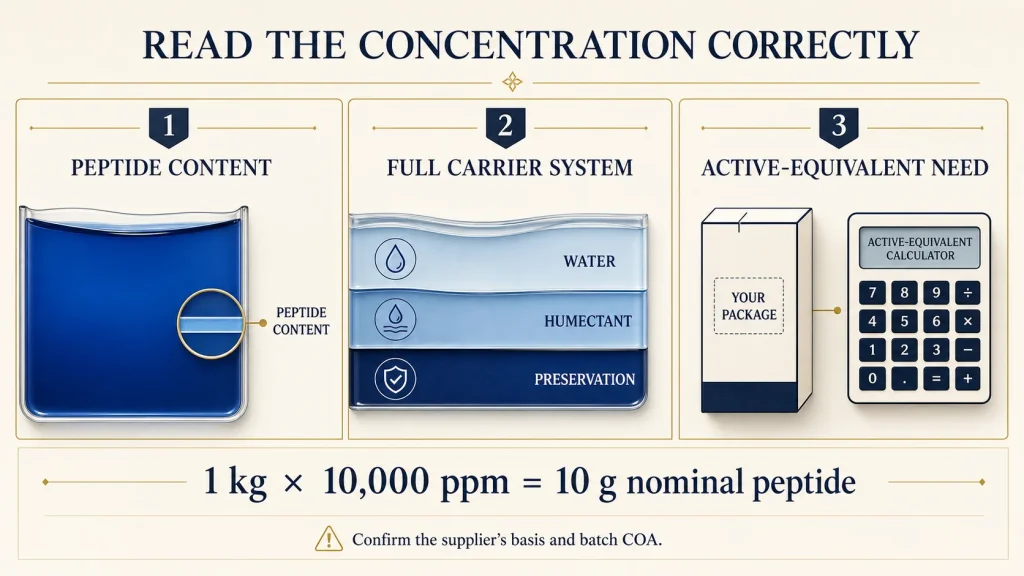
Ppm and percent are only meaningful when the basis is clear. For mass-based values, 10,000 ppm corresponds mathematically to 1% by mass. A 1 kg package at 10,000 ppm therefore contains a nominal 10 g of peptide on the declared basis. A 1 kg package at 1,000 ppm contains a nominal 1 g. This arithmetic supports planning; it does not replace the batch COA or correct for test-method uncertainty.
Nominal active-equivalent grams = solution mass in kilograms × peptide content in ppm ÷ 1,000
The buyer should then calculate how much commercial solution is required at the intended formula use level. If a formulation target is expressed as a final amount of the commercial solution, use that solution percentage directly. If the target is expressed as active peptide, first convert the target to the supplier solution amount. Do not switch between these two conventions midway through development.
The Carrier System Can Change Formula Fit
Carrier ingredients contribute to the finished formula. Water affects the aqueous phase; glycerin or glycols affect humectancy, sensory profile and process mass balance; preservation components can overlap with the finished product’s preservation strategy; and the solution pH may influence the adjustment required after addition. A copper peptide solution supplier should therefore disclose enough composition information for the formulator to perform a complete formula review.
The published review of topical GHK notes that preformulation evidence for GHK derivatives remains limited and describes GHK-Cu as hydrophilic. It also reports forced-stress findings in which oxidative conditions were more damaging than the tested acidic condition, while emphasizing the limited evidence base.[3] This supports a disciplined compatibility and stability program; it does not create a universal rule that every finished formula behaves the same way.
Review the liquid against the actual formula architecture: target pH, redox-active ingredients, chelators, electrolytes, surfactants, emulsion system, preservative system, process temperature and addition sequence. Supplier guidance can define a starting window, but finished-formula stability, color, odor, viscosity, assay and microbiological control remain formula-validation-dependent.
Packaging Is Part of the Purchased Specification
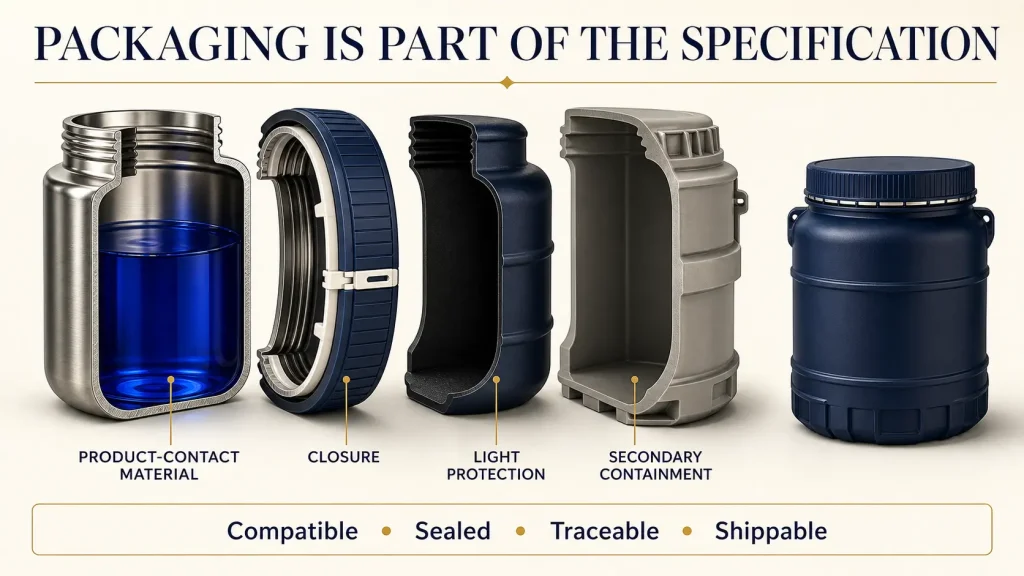
Packaging is not merely a shipping accessory for a blue aqueous raw material. The product-contact material, closure, headspace, light protection, tamper evidence, label durability and secondary containment all affect handling and traceability. A bulk package should be compatible with the supplied liquid and practical for the buyer’s dispensing process.
Ask the supplier to identify the primary container material, nominal fill, closure type, induction seal or other tamper-evident feature, light barrier, secondary bag or overpack, and package dimensions or gross weight needed for storage and handling. If the buyer intends to dispense the package repeatedly, confirm whether the proposed closure supports that use or whether controlled subdivision on receipt is more suitable.
ISO 22716 covers cosmetic GMP guidance across production, control, storage and shipment.[4] It does not prescribe one universal container for Copper Tripeptide-1. Its quality-system logic supports defining, receiving, labeling, storing and using raw-material packages under controlled procedures.
Separate Transport Conditions from Long-Term Storage
“Can transport at room temperature” and “store at 2–8°C for long-term storage” answer different questions. The first describes an allowed transport condition within a supplier-defined route and duration. The second describes the intended storage environment after receipt. Neither statement should be expanded beyond the supplier’s supporting data, shipment design or batch documentation.
Before ordering, confirm whether shipment requires insulated packaging, temperature indicators, protection from freezing, light shielding or maximum transit time. Define what happens if delivery is delayed or the package arrives warm, frozen, wet, unsealed or damaged. An excursion assessment should use documented time and condition information plus supplier guidance; appearance alone cannot establish chemical or microbiological acceptability.
Stability principles used in regulated development emphasize that storage conditions, container-closure systems and environmental factors must be linked to supporting stability evidence.[5] ICH Q1A(R2) applies to pharmaceutical substances and products, not cosmetic ingredients, so it should not be presented as a cosmetic legal requirement. Its general evidence logic is nevertheless useful: a shelf-life or storage statement should belong to the tested material in its defined package.
Plan the Opening and Dispensing Strategy
A five-kilogram container that remains closed until a single production campaign is different from one opened weekly for small laboratory batches. Each opening may introduce air, light, moisture, handling contact and opportunities for contamination. The supplier’s unopened shelf life should not automatically be treated as an in-use period after repeated opening.
Before bulk purchasing, estimate the dispensing frequency and working quantity. Options may include selecting smaller standard packs, requesting customized pack sizes, using a validated transfer procedure, or subdividing the material into controlled working portions after receipt. The buyer should define clean tools, exposure time, relabeling, lot traceability, closure checks, return-to-storage timing and discard criteria. These controls must fit the site’s own quality system.

What to Inspect at Receipt
Receipt inspection should compare the delivery with the purchase order and approved supplier documents before the material is released for use. At minimum, check product name and form, supplier and manufacturer identity where applicable, batch or lot number, manufacture and expiry or retest information, package count and net quantity, seal integrity, external damage, label legibility, required transport evidence and storage transfer time.
For the liquid itself, the specification may include appearance, color, odor, pH, peptide content or identification, relative density and microbiological limits, depending on the supplier item and agreed test plan. A clear blue appearance can be a useful observation, but it is not a standalone identity, assay, purity or microbiological test. Acceptance criteria and methods should be documented rather than inferred from the color photograph on a product page.
Documents to Request Before the Purchase Order
Request the current TDS, SDS, representative specification, complete INCI or composition declaration, and a representative or batch-specific COA as appropriate. Depending on target market and brand requirements, the dossier may also include allergen, animal-origin, GMO, residual solvent, heavy metal, microbiological, regulatory, traceability or manufacturing-quality statements. The document list is project-specific; more pages do not automatically mean better control.
Check that product name, concentration, composition, package and storage information agree across the quote, purchase order, TDS, SDS, specification, label and COA. If the solution is customized, define how formula, concentration, preservative, analytical method, packaging or manufacturing-site changes will be communicated. A bulk purchase creates more inventory exposure, so change-control expectations matter before the first commercial shipment.
A Practical Bulk-Solution Inquiry Template
Send the supplier a defined commercial brief rather than asking only for “your best price.” Include:
| Inquiry Field | Information to Provide or Confirm |
| Product identity | Copper Tripeptide-1 / GHK-Cu cosmetic raw-material solution; required INCI and target market |
| Concentration | Required peptide content, units and basis; acceptable standard or custom range |
| Quantity | Sample, pilot or commercial need; preferred package size and expected annual demand if credible |
| Formula context | Product type, target use level, pH window, relevant compatibility concerns and process limits |
| Packaging | Product-contact material, closure, light protection, tamper evidence, secondary containment and dispensing frequency |
| Storage and shipping | Destination, acceptable transit plan, long-term storage, excursion handling and desired delivery date |
| Quality documents | TDS, SDS, specification, COA, composition, traceability and project-specific declarations |
| Commercial terms | MOQ, pack increment, lead time, quotation validity, payment, Incoterm and customization scope |
Frequently Asked Questions
1. Is 1% Copper Tripeptide-1 solution the same from every supplier?
No. The “1%” value must be linked to a defined peptide-content basis, analytical specification and full carrier composition. Water, glycerin, glycols, preservatives, pH and acceptance limits can differ. Compare the TDS, composition declaration and batch COA—not the front-page percentage alone.
2. How do I compare Copper Tripeptide-1 solution with powder?
Convert both options to a nominal active-equivalent basis, then compare handling, carrier contribution, process fit, packaging, storage, waste, testing and landed cost. Powder may offer more concentration flexibility; solution may simplify low-level dosing. The better option depends on the validated formula and production workflow.
3. Can Copper Tripeptide-1 solution ship at room temperature?
Only when the supplier’s defined product, package, route and allowed duration support it. The Skinkind Cosmetics product page states room-temperature transport for its solution option and recommends dry, dark 2–8°C long-term storage.[1] Confirm the same statement in the quotation or shipment documents for the exact item and destination.
4. What package size is best for bulk GHK-Cu solution?
Choose a size that matches batch demand, dispensing frequency, storage capacity and the supported in-use handling plan. A larger pack can lower ordering frequency but may increase repeated-opening and inventory risk. Ask whether standard 1 kg or 5 kg packs, customized fills or scheduled deliveries better fit the project.
5. What should be on a batch COA for Copper Tripeptide-1 solution?
The COA should identify the product and lot and report the agreed batch tests against their specifications. Depending on the item, these may include appearance, identification or peptide content, pH and microbiological limits. Exact items and methods are supplier- and specification-specific; the COA should match the approved specification and purchase order.
CTA
If you are evaluating Copper Tripeptide-1 solution in bulk, send Skinkind Cosmetics your target concentration and basis, product type, expected use level, package preference, dispensing pattern, quantity, destination, storage capability, target market, required documents and desired delivery date. Genopep can then confirm a standard or customized solution scope, packaging options, storage statement, available documentation and project-specific quotation.
Review Copper Tripeptide-1 solution specifications and request a bulk quotation
References
1. Skinkind Cosmetics / GENOPEP. Copper Tripeptide-1 product information: liquid appearance, customizable peptide-content range, packaging, transport and storage. Product page
2. CM Studio+. SpecPed GHK-Cu 1.0% Copper Peptide Solution: example full INCI, composition, package sizes and product-specific storage statement. Last updated April 27, 2026; accessed August 2026. Marketplace listing
3. Pickart L, Vasquez-Soltero JM, Margolina A. Topically applied GHK as an anti-wrinkle peptide: advantages, problems and prospective. Review of physicochemical and formulation evidence, including the limited GHK-Cu preformulation data. PubMed Central
4. International Organization for Standardization. ISO 22716:2007 Cosmetics—Good Manufacturing Practices (GMP)—Guidelines on Good Manufacturing Practices. Current version confirmed in 2022. ISO record
5. European Medicines Agency. ICH Q1A(R2): Stability Testing of New Drug Substances and Products. Referenced for general stability-evidence principles; not presented as a cosmetic legal requirement. EMA guideline