Professional Cosmetics Peptide Supplier | GENOPEP



Choosing Repair or Anti-Wrinkle Peptide Solutions
The useful comparison in repair vs anti-wrinkle peptides starts with the finished product’s main goal. A repair-focused brief may prioritize dryness, comfort or a defined barrier-related outcome; an anti-wrinkle brief prioritizes visible lines and texture. These directions can overlap. Choose the exact peptide solution by relevant evidence, formula compatibility and the tests needed to support the intended claim.
Decide which result the product must deliver first
A brief that asks for “repair, firmness, fewer wrinkles and sensitive-skin suitability” can describe a plausible product. It still leaves the formulation team without a priority. If development produces good hydration but no convincing change in wrinkle appearance, would the brand launch it? Answering that question early is more useful than starting with the longest peptide list.
Define the intended user, application area and primary observable result before selecting an active blend. “Skin feels less tight after cleansing” and “crow’s feet look less pronounced after repeated use” lead to different development questions. A product can pursue both, but the secondary objective needs its own supporting evidence. Do not let one favorable measurement silently stand in for every benefit on the pack.
Within Genopep’s Pro Peptide Solutions category, repair-focused and anti-wrinkle concepts provide different starting points for a formulation discussion. They are commercial development directions, not mutually exclusive scientific classes. The practical choice depends on what the selected material can contribute to your particular product. [1]
Give repair a precise meaning
For a cosmetic brief, separate a more comfortable skin feel, improved surface hydration and a defined barrier-related measurement. A user reporting less tightness has described an experience. That report alone does not show which skin process changed. Similarly, a moisturizing result cannot establish recovery from every form of damage. Write the intended cosmetic outcome plainly before deciding whether “repair” is an appropriate description in the target market.
When evaluating peptides for skin barrier support, ask which endpoint was actually measured and in what setting. A cell-model result, an ingredient supplier’s study and a finished-cream human study answer different questions. Check whether the participants resemble the intended users and whether the tested formula resembles the proposed one. A study on a different material should remain background context rather than becoming your product’s proof.
A repair-led formula still needs a suitable base. Decide what the moisturizing system, emollients and sensory profile are meant to do, then identify the additional job assigned to the peptide solution. If the base already meets the primary brief, the peptide should earn its place through a relevant contribution or a clearly identified development hypothesis. Its presence alone does not justify an expanded claim.
Define which visible lines the anti-wrinkle brief concerns
Anti-wrinkle peptide solutions are also too broad a category to rank without context. Specify whether the project concerns the eye area, forehead or a broader facial texture assessment. State whether the planned evaluation uses a resting face or a standardized expression. Photographs taken under different lighting or with different facial movement can make a comparison difficult to interpret, regardless of the ingredient story.
Choose the intended appearance claim and discuss a suitable method with the testing laboratory. Expert grading, standardized photography and surface-imaging measurements can play different roles. Specify the area and assessment conditions before the study begins. Consumer perception can add useful context, but “my skin feels smoother” should not be rewritten as a measured reduction in wrinkle depth.
Also distinguish a near-term moisturizing or film-related appearance effect from a claim about sustained change with repeated use. Either may be commercially relevant if accurately described and supported. The protocol needs to reflect the intended claim, including the timing of the last application. A photograph taken immediately after application does not answer how the skin will look later under a different use schedule.
Keep hydration water loss and line appearance separate
Corneometry assesses hydration of the outer skin through capacitance-related measurement. Transepidermal water loss, or TEWL, concerns water vapor leaving the skin and is used to evaluate the water-barrier aspect of skin function. Neither measurement is a wrinkle-depth measurement. Instrument manufacturers describe these as different measurement principles, so the results should remain distinct in the development report. [2,3]
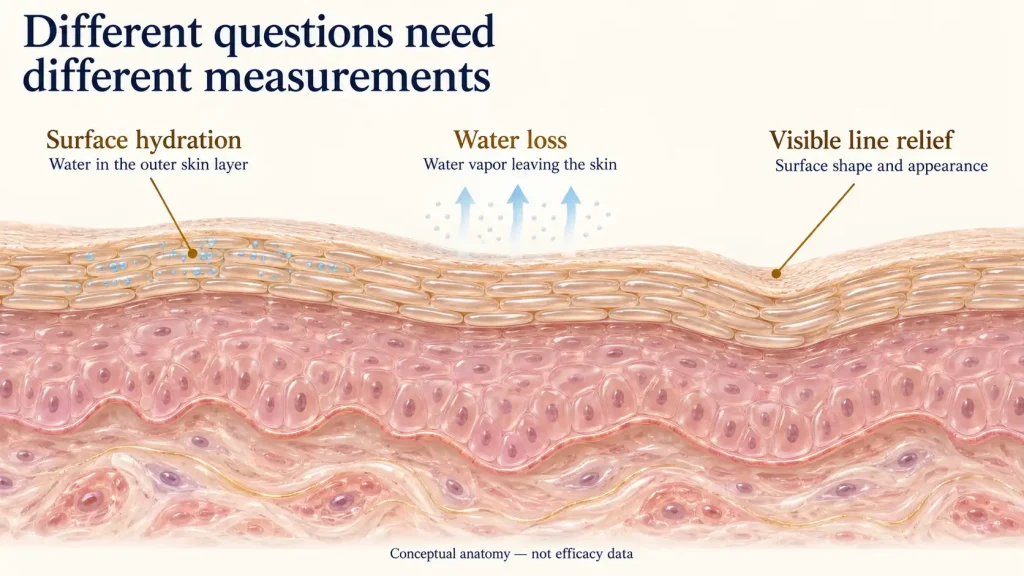
The following matrix is a planning aid. A laboratory should refine the methods, controls and interpretation for the actual claim; it is not a universal test checklist. In particular, a barrier-support study needs more context than a single reading, and a comfort questionnaire needs wording that matches what the participant can genuinely observe.
| Intended result | Relevant evidence | Do not infer |
| Better hydration | Suitable hydration measurement | Complete barrier recovery |
| Defined water-barrier benefit | TEWL under a suitable protocol | Wrinkle reduction |
| Less visible lines | Standardized grading or imaging | Confirmed collagen rebuilding |
| Improved comfort | Specific user-reported outcomes | Disease treatment |
Use mechanism as a reason to test
A mechanism can help select a candidate. It can also help decide which evidence to request next. It does not remove the need to establish exposure, compatibility and performance in a topical formula. If a dossier reports a response in cultured cells, retain that setting when discussing it. Do not translate the same sentence into a promise that a finished serum will rebuild skin or switch off expression lines.
For multi-peptide solutions, examine the evidence for the supplied blend as well as for individual components. Several plausible mechanisms do not establish synergy. Ask whether the blend was compared with meaningful controls and what outcome improved. Where that comparison has not been performed, describe a complementary formulation rationale rather than a demonstrated combined advantage. More ingredients can also create additional formulation and documentation work.
Read human studies at the level they support
Robinson and colleagues reported a 12-week, randomized, double-blind, split-face study in 93 women comparing a moisturizer with the same base containing pal-KTTKS. Image-based assessments favored the peptide formula for fine lines and wrinkles. The authors were affiliated with Procter & Gamble. This supports that studied formulation and comparison, not every solution containing a related peptide. [4]
Zonari and colleagues’ 2024 study compared an OS-01 formula with its vehicle in 22 participants over 12 weeks. It reported a TEWL advantage and assessed wrinkle appearance, illustrating that barrier-related and appearance outcomes can coexist in one investigation. The study was funded by OneSkin and disclosed inventor and founder interests. It does not validate either Genopep solution discussed here. [5]
These examples should change how a buyer reads a dossier. Look for the material actually tested, the comparator, participant population and endpoint. An ingredient name appearing in a published paper is the beginning of that review. The key question is how far the proposed commercial product differs from the tested system, and which additional work is needed to bridge that difference.
Ask what the peptide adds to the base
For peptide efficacy testing intended to identify an incremental contribution, discuss a matched vehicle control. The test formula and control should differ in a way that allows the intended question to be answered. Simply removing a water-and-glycerin peptide concentrate without accounting for its carrier can change the base. Document how the laboratory or formulator handles that difference rather than calling two visibly similar creams identical.
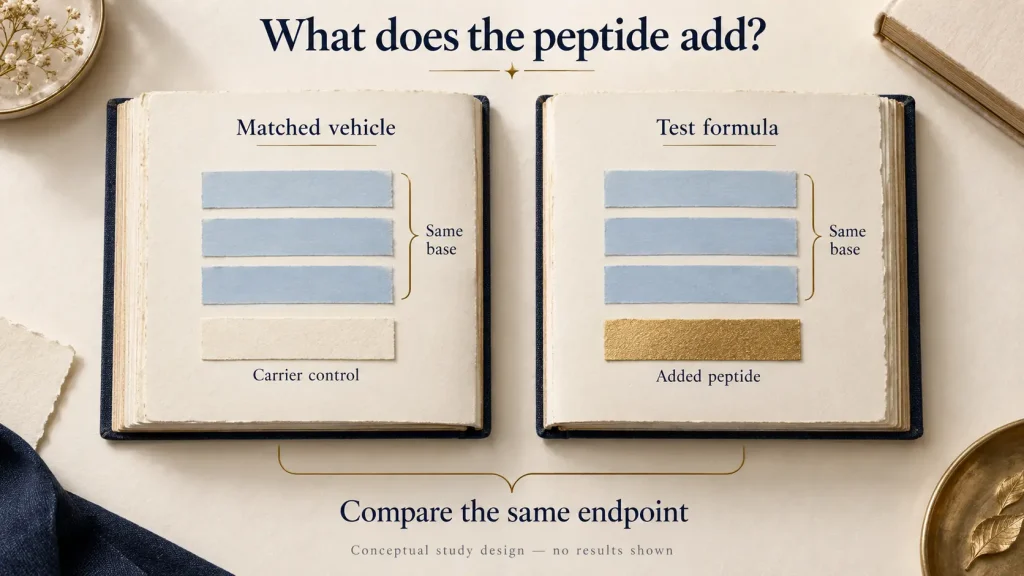
A finished-product study without a matched vehicle can still answer useful questions about that product under its test conditions. Its limits should remain visible. It may support overall product performance without isolating the peptide’s contribution. Conversely, a small controlled exploratory study may help select a candidate without being sufficient for the full launch claim. Decide what the study must establish before choosing its design.
Compare the two Genopep directions without forcing a false divide
PxGHK-7® is presented as a repair-focused anti-aging solution. Its published component list includes Copper Tripeptide-1 alongside peptides also used in wrinkle-care concepts. This makes it a broader candidate discussion than a simple hydration-only ingredient. It does not, by itself, establish a finished-product barrier claim. [8]
Geno-Wrinkle Pro™ is positioned around multi-peptide wrinkle-care formulation development. Its published list includes Acetyl Hexapeptide-8 and palmitoylated peptides, with some overlap with the repair-focused solution. Request the current composition and evidence dossier for the exact grade before comparison. Neither product name supplies a head-to-head efficacy ranking. [9]
Turn the choice into a practical development brief
For a comfort-led daily moisturizer, put the intended comfort and dryness outcomes first, then ask whether the candidate solution adds relevant evidence beyond the base. For a line-focused serum, prioritize the specified wrinkle area and a credible appearance-assessment plan. If one formula must carry both messages, budget for both evidence streams. Combining two claims does not reduce the testing burden to one convenient measurement.
The technical comparison should use the same reporting basis. Confirm whether the proposed addition level refers to the commercial solution or its peptide content. Review carrier composition, color, preservation, processing guidance and stability information. A solution that supports an attractive concept but cannot fit the chosen base without major redesign may be a poor first candidate for that project. This is a project-fit decision, not a verdict on the ingredient’s general value.
Set an initial go-or-no-go question that the first development round can answer. For example, can the candidate be incorporated into the intended base while meeting the project’s appearance and physical-stability criteria? Later work can address the primary human-use endpoint. Record unresolved questions separately from failures so a missing study is not mistaken for proof that the ingredient cannot work.
Keep the market claim within the evidence
EU Regulation 655/2013 requires adequate, verifiable support for cosmetic claims and addresses extrapolation from ingredient properties to finished products. A mechanism summary therefore cannot serve as an automatic claim approval. In the United States, FDA distinguishes cosmetic appearance or moisturizing claims from claims about treating disease or affecting body structure or function. Review the final wording for the intended market. [6,7]
Keep internal research language and consumer language aligned without making them identical. The technical dossier may discuss a cellular marker; the consumer claim should state the supported product outcome. Terms such as “repair” deserve particular care when surrounding text implies wound treatment or reversal of damage. A short qualification in a footnote cannot reliably correct an exaggerated main message.
Frequently Asked Questions
1. Are repair peptides different from anti-wrinkle peptides?
The labels describe development priorities more reliably than separate scientific classes. A blend may contain components relevant to both stories. Compare the exact composition and the endpoints supported by its evidence rather than assigning all peptides to one of two boxes.
2. Can one peptide formula support both barrier and wrinkle claims?
It can be developed with both objectives, but each claim needs relevant support. A favorable water-loss result does not establish reduced wrinkles, and improved wrinkle appearance does not establish a barrier benefit. Plan the assessments separately within a coherent study program.
3. Which peptide solution is better for sensitive-skin products?
Neither a repair label nor a peptide count establishes sensitive-skin suitability. Review the complete formula, intended users, use conditions and tolerability evidence. Ask what the supplier has actually evaluated, then determine what finished-product assessment the project requires.
4. Does a formula with more peptides work better?
Peptide count is not a performance ranking. Concentration, supplied form, the base and the evidence all matter. A longer list can support a development rationale, but superiority or synergy requires a comparison capable of demonstrating that specific advantage.
5. How should a brand compare repair vs anti-wrinkle peptides?
Write one primary product outcome, identify a relevant assessment, and request comparable technical and efficacy information for each candidate. Then evaluate fit in the intended formula. Choose the solution that best supports the project brief, not the most expansive marketing description.
Discuss a specific brief with Genopep
When approaching Genopep, share the intended product format, main consumer concern, application area, target market and proposed claim. Add the draft base, processing constraints and available testing budget. This makes it possible to discuss whether the first candidate should emphasize repair-related care, visible line improvement or a carefully supported combination.
Explore Pro Peptide Solutions on Skinkind Cosmetics, then request the current technical documents and relevant study details for the shortlisted material. The next useful step is a candidate formula with a clear validation question, not a broader list of promises.
References
1. Skinkind Cosmetics — Peptides Solution. Commercial category context.
2. Courage + Khazaka — Corneometer CM 825 brochure. Hydration measurement principle.
3. Courage + Khazaka — Tewameter TM Hex. TEWL measurement principle, not a claim-validation protocol.
4. Robinson LR et al. — Topical palmitoyl pentapeptide provides improvement in photoaged human facial skin. International Journal of Cosmetic Science. 2005;27(3):155–160. Abstract and study design reviewed.
5. Zonari A et al. — Double-blind, vehicle-controlled clinical investigation of peptide OS-01 for skin rejuvenation. Journal of Cosmetic Dermatology. 2024. Product-specific study with disclosed commercial interests.
6. European Commission — Regulation EU No 655/2013. Common criteria for cosmetic claims.
7. FDA — Wrinkle Treatments and Other Anti-aging Products. US cosmetic and drug claim distinction.
8. Skinkind Cosmetics — PxGHK-7 Multi-Peptide Repair Solution. Product positioning and published component context only.
9. Skinkind Cosmetics — Geno-Wrinkle Pro Multi-Peptide Anti-Wrinkle Serum Solution. Product positioning and published component context only.